
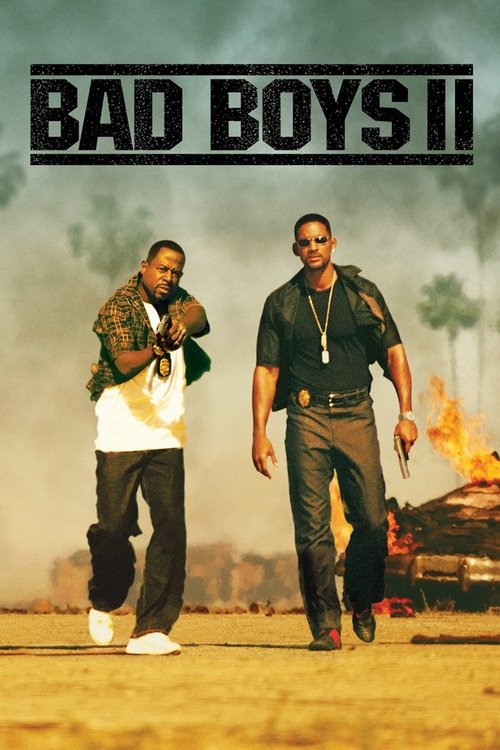













































































Popular
What is the relationship between Mike Lowrey and Marcus Burnett throughout the film?
How does the subplot involving Marcus's sister, Syd, impact the main storyline?
What role does the drug lord, Hector Juan Carlos Reyes, play in the film?
How do Mike and Marcus's methods of handling crime differ throughout the film?
What is the significance of the car chase scenes in 'Bad Boys II'?
Should I watch it?
Ask Your Own Question

What is the plot?
Eight years after the events of Bad Boys, Miami Police Department detectives Mike Lowrey and Marcus Burnett are still working narcotics, but the city's drug war has changed shape around them: instead of heroin, they are chasing a flood of ecstasy/MDMA pouring into Miami from Cuba through the brutal network controlled by Johnny Tapia. From the start, the film frames their hunt as a high-volume, high-speed war over territory and supply, with Tapia's operation moving massive quantities of drugs into the city and igniting a wider underground conflict involving other criminal groups.
The story opens with Mike and Marcus on surveillance duty, tracking boats coming in from Cuba and following the trail into a bizarre undercover operation in a Ku Klux Klan meeting in a marshland outside Miami. The scene is grotesque and tense at once: the detectives, disguised and moving carefully through the swampy darkness, expect to catch distributors, but the meeting turns out to be a buyer pickup, not a seller exchange. That revelation instantly shifts the danger. The operation collapses into chaos, and the bust goes badly wrong in a violent shootout that tears through the marshland and establishes the film's full-throttle tone. The sources confirm the scene ends in operational failure, though they do not identify any named casualties from the opening gunfight.
As the wreckage of the failed bust settles, the film begins layering in the characters' personal tensions. Marcus Burnett is no longer just Mike's ride-or-die partner; he is increasingly uneasy with the violence, the damage, and the way the job is swallowing his family life. He is thinking about a transfer, worn down by the stress and by Mike's reckless style, which repeatedly leaves smashed cars, burned-out scenes, and furious supervisors in its wake. Mike, by contrast, remains pure bravado: fast, cocky, and completely committed to the mission, charging into danger with the same swagger that makes him effective and infuriating.
At the same time, the film introduces a second, hidden thread that will poison the partnership from the inside. Marcus's younger sister, Sydney "Syd" Burnett, is working as a DEA agent on her own undercover assignment that overlaps with the Miami narcotics investigation. She has not told Marcus what she is doing, keeping her work secret even from her brother, and she is also secretly involved in a romance with Mike. That relationship becomes one of the film's biggest personal twists: Marcus believes he is simply dealing with a volatile partner and a dangerous case, while in reality his sister and his partner are hiding a relationship from him. The tension between professional duty and family loyalty gives the action scenes extra heat, because every success in the drug case threatens to expose another secret.
The investigation pushes Mike and Marcus deeper into Miami's drug world. The ecstasy trail leads them from surveillance of incoming shipments to distribution networks that run through the city's criminal infrastructure, including nightclubs and other venues where Tapia's product is being moved and sold. The films of this kind often keep the drug pipeline abstract, but here the story emphasizes the scale: Tapia is not just dealing in street-level sales, he is trying to dominate the entire market and bring in enormous profits, with one account describing him as moving $150 million worth of ecstasy into the United States. The drugs are shipped from Cuba, dropped in the ocean in coffins, and retrieved by speedboats before the Coast Guard can stop the transfer, a logistics chain that makes the operation feel coldly theatrical and very difficult to crack.
A major midpoint sequence follows as the detectives chase a lead to a nightclub distribution point, where Tapia's product is moving through Miami's nightlife and criminal channels. The atmosphere changes from murky swamp surveillance to flashing lights, deafening music, and the sense that everyone in the room might be connected to the same hidden pipeline. The scene escalates into a violent confrontation and then into a manic car chase through Miami, the kind of destruction-laced pursuit that defines the franchise's style. The police work is no longer just about evidence; it becomes a series of collisions, reactions, and near misses, with Mike pressing forward and Marcus increasingly aware that each new step is pulling them closer to a larger and more dangerous war.
That war expands when the detectives finally identify the man behind the flow of ecstasy: Johnny Tapia, a Cuban drug lord with a volatile personality and a violent grasp on power. Tapia is not operating in isolation. He is entangled in a bloody conflict with Russian and Haitian mobsters, turning Miami into the center of a broader criminal struggle over territory, shipments, and control. The revelation reframes the case: Mike and Marcus are no longer just chasing a trafficking ring, they are moving through a live gang war in which every faction is armed, aggressive, and prepared to retaliate. The city feels smaller and more dangerous with every new discovery.
Tapia's personal interest in the detectives' world sharpens when his operation collides with Syd's undercover work. Because she is investigating the same network from the DEA side and has not revealed her identity to Marcus, she is vulnerable in ways neither of them initially understands. Mike knows enough to keep the romance hidden, but the secrecy only deepens the coming disaster. The relationship between Mike and Syd, and the fact that Marcus does not know about it, becomes a source of emotional suspense layered over the physical action. Marcus remains focused on the job and his family, while Mike is balancing his own swagger with a private loyalty to Syd that he cannot easily explain.
The film's tension spikes when Tapia retaliates by kidnapping Syd. This is the point at which the case turns from a professional investigation into a rescue mission. Syd's abduction personalizes everything: for Mike, it is now about saving the woman he loves; for Marcus, it becomes about saving his sister and confronting the fact that the people closest to him have been living inside a secret he never saw coming. The kidnapping also underlines Tapia's ruthlessness. He is no longer content to move drugs and fight rival gangs; he is willing to seize and hold a federal agent to protect his operation and pressure his enemies.
With Syd taken, the film accelerates toward its climax. Mike and Marcus assemble a cross-border rescue effort with the unofficial help of various operatives, including people from the CIA, the DEA, the Miami PD, and anti-Castro forces in Cuba. The choice to go to Cuba matters because Tapia's power base lies beyond U.S. jurisdiction, forcing the story out of Miami and into enemy territory. The mission now has the urgency of a deadline and the danger of a war zone. The camaraderie that defined the opening film is still present, but now it is strained by secrets, guilt, and the pressure of a rescue that could fail catastrophically.
The final assault lands at Tapia's compound in Cuba, where the film erupts into a large-scale battle of guns, explosions, and impossible vehicle maneuvers. The location is important not just because it is Tapia's base, but because it is the physical manifestation of his reach: a private fortress beyond American law, built to protect his money, his drugs, and his captives. Mike and Marcus storm the compound in a barrage of noise and firepower, and the action pushes into full spectacle mode as allied forces surge through the grounds and Tapia's guards scramble to hold their line. The assault is both a rescue and a reckoning, with every prior deception now collapsing under gunfire.
Inside the compound, the story drives directly toward the final showdown between Mike Lowrey and Johnny Tapia. Syd is found and pulled from Tapia's control during the assault, completing the rescue mission that has driven the second half of the film. Tapia himself is finally cornered, and the confrontation resolves the central conflict in a violent climax: Johnny Tapia dies during the final showdown, killed in the compound assault as Mike and the raid bring him down. The sources do not identify any other named character deaths with certainty, so the only named fatality that can be stated confidently is Tapia's.
After Tapia's death, the film eases out of the chaos and back into the emotional core of the buddy-cop story. Syd is alive and rescued, the drug operation is broken, and the Cuban base of power collapses with its leader. What matters most in the ending is the restoration of the partnership that the whole story has threatened to fracture. Marcus, who has been contemplating a transfer throughout the film because of the danger and the strain on his family, does not leave. He stays with Mike, and their relationship reasserts itself after the confrontation with Tapia and the revelation surrounding Syd. Mike and Marcus drive off together at the end, their bond intact, the immediate crisis over, and the familiar rhythm of the franchise restored.
The ending also closes the emotional triangle without lingering on punishment or confession. Marcus now knows enough to understand that Syd was involved in the case and that Mike's life is far messier than he had believed, but the resolution favors survival and partnership over fallout. Syd's rescue removes the immediate threat, Tapia's death ends the drug empire driving the plot, and the city is left without its Cuban pipeline leader. The final scenes return the focus to Mike and Marcus as working partners in Miami, having survived a conflict that nearly shattered both the case and their personal lives.






What is the ending?
In the ending of "Bad Boys II," Mike Lowrey and Marcus Burnett confront the drug lord, Johnny Tapia, in a climactic showdown. After a series of intense confrontations, they manage to defeat Tapia and his men. The film concludes with a sense of resolution as Mike and Marcus reaffirm their partnership, and Marcus comes to terms with his daughter's relationship with Mike.
As the film approaches its climax, the tension escalates dramatically. Mike Lowrey and Marcus Burnett, having uncovered the full extent of Johnny Tapia's drug operation, prepare for a final confrontation. The scene shifts to a lavish mansion where Tapia is hosting a party, unaware that the two detectives are closing in on him.
The atmosphere is thick with anticipation as Mike and Marcus, clad in tactical gear, stealthily infiltrate the mansion. The camera captures their synchronized movements, showcasing their deep bond and teamwork. As they navigate through the opulent halls, they exchange quick, knowing glances, underscoring their reliance on each other. The stakes are high, and both men are acutely aware that this could be their last stand.
Suddenly, the tranquility is shattered when they are discovered. A fierce gunfight erupts, with bullets flying and chaos reigning. The cinematography captures the frenetic energy of the scene, with close-ups of the characters' faces reflecting their determination and fear. Mike, ever the sharpshooter, takes out several of Tapia's henchmen with precision, while Marcus, fueled by adrenaline, fights with a mix of bravado and desperation.
As the battle rages on, they finally corner Tapia in a lavishly decorated room. The confrontation is intense, with Tapia taunting them, revealing his ruthless nature. Mike and Marcus, however, are undeterred. In a tense standoff, they manage to outsmart Tapia, leading to a dramatic showdown. The scene is filled with high stakes as they fight not just for their lives but for justice.
In a final act of bravery, Marcus takes a risk that pays off, allowing Mike to deliver the decisive blow to Tapia. The drug lord falls, defeated, and the camera lingers on Mike and Marcus, their expressions a mix of relief and triumph. They have not only survived but have also dismantled a significant threat to their city.
As the dust settles, the film shifts to a quieter moment. Mike and Marcus stand outside the mansion, catching their breath. The weight of their experiences hangs heavy in the air, but there is a sense of camaraderie and renewed purpose. They share a heartfelt conversation, reaffirming their friendship and partnership. Marcus expresses his gratitude for Mike's presence in his life, and they both acknowledge the risks they take as law enforcement officers.
The final scenes transition to Marcus's home, where the emotional stakes rise once more. His daughter, who has been secretly dating Mike, confronts her father about their relationship. Marcus, initially resistant, comes to terms with the situation, realizing that Mike genuinely cares for her. This moment signifies Marcus's growth as a character, as he learns to trust Mike not just as a partner but as a family member.
The film concludes with a light-hearted tone, as Mike and Marcus drive off together, bantering and laughing, embodying the essence of their partnership. The camera pulls back, capturing the city skyline, a symbol of the challenges they face but also the victories they achieve together. The ending encapsulates the themes of friendship, loyalty, and the complexities of family, leaving the audience with a sense of closure and hope for the future of these two iconic characters.
Is there a post-credit scene?
In "Bad Boys II," there is no post-credit scene. The film concludes with a climactic showdown and a resolution to the main plot, focusing on the relationship between the two main characters, Mike Lowrey and Marcus Burnett. After the intense action and emotional moments throughout the film, the credits roll without any additional scenes or content following them. The film wraps up with a sense of closure for the characters, particularly highlighting their friendship and the bond they have developed over their adventures.
What is the relationship between Mike Lowrey and Marcus Burnett throughout the film?
Mike Lowrey and Marcus Burnett share a deep, brotherly bond that is tested throughout 'Bad Boys II.' Their relationship is characterized by playful banter and contrasting personalities--Mike is the suave, reckless one, while Marcus is more grounded and family-oriented. As the film progresses, their friendship is strained by Marcus's protective instincts over his sister, who becomes involved with Mike, leading to tension and comedic moments.
How does the subplot involving Marcus's sister, Syd, impact the main storyline?
Syd, played by Gabrielle Union, is introduced as Marcus's sister and becomes a key player in the drug investigation. Her involvement with Mike complicates the dynamics between the two men, as Marcus is initially unaware of their romantic relationship. This subplot adds emotional stakes to the narrative, as Marcus struggles with his protective instincts while also trying to support his sister's independence and career.
What role does the drug lord, Hector Juan Carlos Reyes, play in the film?
Hector Juan Carlos Reyes, portrayed by Jordi Mollà, serves as the primary antagonist in 'Bad Boys II.' He is a ruthless drug lord whose operations in Miami lead to a series of violent confrontations with Mike and Marcus. His character embodies the film's high-stakes action, as he is involved in a massive drug trafficking scheme that the protagonists aim to dismantle. Reyes's cunning and brutality escalate the tension, culminating in explosive confrontations.
How do Mike and Marcus's methods of handling crime differ throughout the film?
Mike and Marcus exhibit contrasting approaches to law enforcement. Mike is impulsive and often resorts to flashy, high-octane tactics, while Marcus prefers a more cautious and strategic approach. This difference leads to comedic clashes and highlights their unique personalities. Their methods are put to the test as they face increasingly dangerous situations, forcing them to find a balance between their styles to effectively combat the drug trade.
What is the significance of the car chase scenes in 'Bad Boys II'?
The car chase scenes in 'Bad Boys II' are not only visually spectacular but also serve to heighten the film's adrenaline-fueled narrative. These sequences showcase the chemistry between Mike and Marcus as they navigate through Miami's streets, often leading to humorous exchanges and showcasing their contrasting driving styles. The chases symbolize their relentless pursuit of justice and the chaos that ensues in their lives, reinforcing the film's action-comedy tone.
Is this family friendly?
"Bad Boys II," produced in 2003, is not considered family-friendly due to its mature content. Here are some potentially objectionable or upsetting aspects that may occur for children or sensitive viewers:
-
Strong Language: The film features frequent use of profanity and vulgar language throughout, which may not be suitable for younger audiences.
-
Violence: There are numerous intense action sequences, including shootouts, car chases, and physical confrontations that depict graphic violence and may be distressing.
-
Drug Themes: The plot revolves around drug trafficking, with scenes that depict drug use, drug dealers, and the consequences of drug-related crime.
-
Sexual Content: There are suggestive scenes and innuendos, as well as instances of nudity that may be inappropriate for children.
-
Gore: Some scenes include graphic depictions of injuries and death, which could be unsettling for sensitive viewers.
-
Mature Themes: The film explores themes of loyalty, betrayal, and the moral complexities of law enforcement, which may be difficult for younger audiences to fully understand.
Overall, the film's combination of violence, strong language, and adult themes makes it more suitable for mature audiences.








