
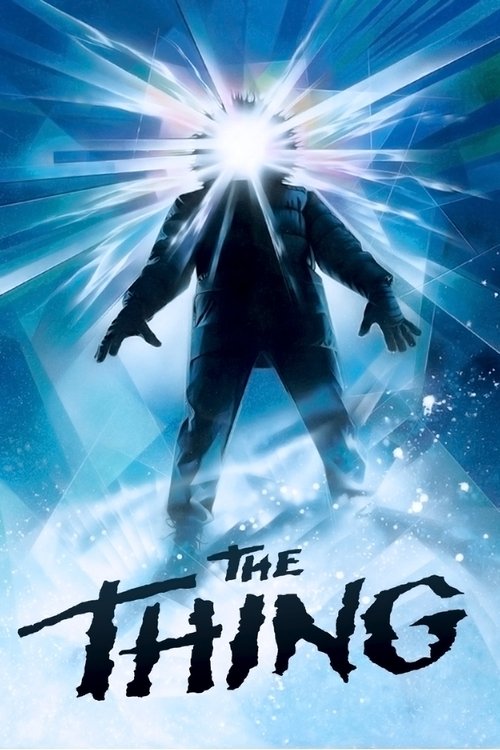


















Popular
What is the significance of the blood test scene in The Thing?
How does the character of MacReady evolve throughout the film?
What role does the setting of the Antarctic research station play in the story?
What are the characteristics of the alien creature in The Thing?
How does the character of Blair contribute to the film's tension and paranoia?
Should I watch it?
Ask Your Own Question

What is the plot?
In the bleak, frozen expanse of Antarctica during the winter of 1982, a Norwegian helicopter tears across the endless white, chasing a lone sled dog with desperate gunfire echoing against the ice. The dog, frantic and panting, races toward the nearby American research station, its only hope of escape. The Norwegians' pursuit ends abruptly when their helicopter crashes and explodes in a fiery ball, killing the entire crew. The dog, unscathed but wild-eyed, reaches the American base, setting in motion a nightmare no one could have foreseen.
At the American Antarctic research station, the atmosphere is tense but routine. The men here are isolated from the rest of the world, their lives measured in shifts and scientific work. Among them is R.J. MacReady, the station's helicopter pilot, a rugged man with a wary edge. Dr. Blair, the station's biologist, is a thoughtful but increasingly troubled presence. Childs, the mechanic, is practical and no-nonsense, while Windows, the radio operator, keeps the lines of communication open. The medical doctor Copper tends to the men's health, and Garry commands the station with a steady hand. The cook, Nauls, keeps the men fed, while Palmer and Clark handle the sled dogs. Norris, a geologist, and Fuchs, a scientist, round out the crew.
When the dog arrives, the men are initially relieved to have a new companion in the desolation. But unease quickly spreads. The dog's behavior is strange -- it growls and snaps at its handlers, and soon, horrifyingly, it begins to transform. In the kennel, the dog's flesh melts and twists grotesquely, revealing the alien horror beneath. The Thing, a parasitic extraterrestrial capable of assimilating and perfectly imitating any living organism, has infiltrated their base.
The American team soon discovers the nearby Norwegian base in ruins, burned and abandoned. Outside, the charred remains of a malformed humanoid creature smolder, a grotesque testament to the Thing's destructive power. The scientists bring the remains back to their own station, hoping to understand what happened. But the alien is far from dead. It begins to assimilate the sled dogs, then the men themselves, spreading like a virus among them.
Paranoia takes hold. No one knows who is still human and who has been taken over by the Thing. Dr. Blair, horrified by the alien's threat, sabotages the station -- destroying the vehicles, killing the remaining sled dogs, and smashing the radio to prevent any chance of escape or outside contact. His actions are desperate but clear: the alien must not be allowed to spread beyond this frozen wasteland. The crew imprisons Blair in the tool shed, fearing his madness but understanding the necessity.
Tensions rise as Bennings, a crew member, is isolated and assimilated by the Thing. Windows interrupts the process, and MacReady burns the Bennings-Thing to death in a fiery purge. The men realize the alien's terrifying ability: it not only kills but perfectly imitates its victims, making it impossible to tell friend from foe.
The crew's trust fractures completely. MacReady takes command, his leadership firm but burdened by the impossible task of rooting out the alien among them. He devises a chilling test: using heated wire to burn blood samples, he can detect the Thing's unnatural reaction. The blood of the infected recoils from the heat, betraying the alien's presence.
One by one, the test reveals the infected. Palmer's blood writhes and recoils, exposing him as the Thing. Bound and helpless, Palmer transforms violently, breaking free and infecting Windows. MacReady is forced to incinerate both to prevent further spread.
The horror escalates when Norris appears to suffer a heart attack. As Copper attempts to revive him with a defibrillator, Norris's chest splits open into a monstrous mouth, biting off Copper's arms and killing him. MacReady incinerates the Norris-Thing, but its severed head tries to escape before being burned as well. This grotesque scene reveals the Thing's horrifying nature: every part of it is an independent life form, each fighting for survival.
Suspicion and fear consume the crew. Clark, one of the dog handlers, lunges at MacReady with a scalpel during the blood test confrontation, forcing MacReady to kill him in self-defense. Nauls, suspecting MacReady of being infected, abandons him in a snowstorm, leaving him isolated and vulnerable.
MacReady survives the storm and returns to the station, only to find the situation worse than ever. The alien has infiltrated deeper, and the men's paranoia has turned deadly. The survivors debate their next move, realizing that the Thing's ability to imitate means no one can be trusted.
In the final, desperate confrontation, MacReady and Childs remain. They rig the base's underground generator room with explosives, planning to destroy the station and the Thing in a fiery blast. As the tension reaches its peak, the Thing attacks, but MacReady fights back fiercely.
The film's climax is a chaotic battle of survival and suspicion. The base burns around them, the cold Antarctic night illuminated by flames and explosions. MacReady and Childs, both exhausted and wary, sit amid the ruins, sharing a bottle of whiskey. Their faces are grim, their eyes searching for signs of humanity in each other. Neither knows if the other is still human or if the Thing has survived.
The film ends on this ambiguous note, the fate of the survivors--and the alien--left uncertain in the frozen wasteland. The chilling question lingers: who, if anyone, can be trusted when the Thing can be anyone?








What is the ending?
At the end of "The Thing," MacReady and Childs are left in the frozen wasteland, unsure if either of them is human or if one of them is the alien creature. They share a tense moment, contemplating their fate as the camp burns around them, and the film ends ambiguously.
As the film reaches its climax, the atmosphere in the Antarctic research station is thick with paranoia and dread. The remaining survivors, MacReady and Childs, are among the last of the crew, having witnessed the horrific transformations and deaths of their colleagues at the hands of the alien entity. The station is now a smoldering ruin, a testament to the chaos that has unfolded.
In the final scenes, MacReady, having taken decisive action against the creature, sets explosives to destroy the station. He is weary, his face lined with exhaustion and determination, as he prepares to confront the last remnants of the Thing. The cold winds howl outside, a stark reminder of their isolation and the relentless environment they are trapped in.
As the explosives count down, MacReady encounters Childs, who has been missing for a time. Their reunion is fraught with tension; both men are on edge, aware that the Thing could be lurking within either of them. They exchange wary glances, each man assessing the other for signs of the alien influence. The atmosphere is charged with uncertainty, and the viewer can feel the weight of their shared trauma.
MacReady, with a mix of defiance and resignation, offers Childs a drink from a bottle of whiskey. The gesture is both a moment of camaraderie and a test of trust. Childs hesitates, his eyes darting, reflecting his own internal conflict. The two men sit in the freezing cold, surrounded by the remnants of their once-thriving research station, now reduced to ash and ruin.
As the countdown reaches its final moments, MacReady and Childs share a tense silence, contemplating their fate. The flames from the burning station illuminate their faces, casting flickering shadows that dance across the snow. The fire symbolizes both destruction and a potential end to the horror they have endured.
In this moment, the film leaves the audience with an ambiguous conclusion. The fate of MacReady and Childs hangs in the balance. Are they both human, or has the Thing infiltrated one of them? The film ends without resolution, leaving viewers to ponder the implications of trust, survival, and the nature of humanity in the face of an insidious threat.
As the screen fades to black, the last image is of the two men, isolated in the vast, frozen landscape, their future uncertain. The haunting question lingers: who will survive, and what will become of them in this desolate world?
Is there a post-credit scene?
The 1982 film "The Thing" does not have a post-credit scene. The movie concludes with a tense and ambiguous ending, leaving viewers with a sense of uncertainty about the fate of the characters and the creature.
In the final moments, MacReady and Childs are left in the snow, both exhausted and wary of each other, after the destruction of the research station. The atmosphere is thick with distrust as they share a drink, knowing that one of them could potentially be the alien creature. The film ends with the two men sitting in the cold, surrounded by the desolate landscape, as the flames from the destroyed station flicker in the background. The screen fades to black, leaving the audience to ponder the implications of their situation and the possibility of the Thing surviving. This unresolved tension is a hallmark of the film, contributing to its lasting impact and legacy in the horror genre.
What is the significance of the blood test scene in The Thing?
The blood test scene is a pivotal moment in The Thing, showcasing the paranoia and distrust among the characters. Dr. Blair, played by Wilford Brimley, devises a test to determine who is human and who has been assimilated by the alien creature. The tension escalates as each character's fear and suspicion grow, culminating in a shocking revelation when the blood of the infected reacts violently to the heat. This scene not only serves as a turning point in the narrative but also highlights the themes of isolation and the struggle for survival.
How does the character of MacReady evolve throughout the film?
MacReady, portrayed by Kurt Russell, begins as a helicopter pilot who is somewhat detached from the group dynamics. As the threat of the alien creature escalates, he transforms into a decisive leader. His emotional state shifts from skepticism to determination as he grapples with the horror of the situation. MacReady's internal conflict is evident as he balances his survival instincts with the need to protect his fellow team members, ultimately leading him to make morally ambiguous decisions in the face of overwhelming fear.
What role does the setting of the Antarctic research station play in the story?
The Antarctic research station serves as a claustrophobic and isolating backdrop for the events of The Thing. The harsh, frozen landscape outside contrasts sharply with the growing tension inside the station. The confined quarters amplify the characters' paranoia and fear, as they are cut off from the outside world. The setting becomes a character in itself, reflecting the characters' emotional states and heightening the sense of dread as they confront the unknown threat lurking among them.
What are the characteristics of the alien creature in The Thing?
The alien creature in The Thing is a shape-shifting entity capable of assimilating and imitating any living organism. Its grotesque transformations are marked by a disturbing blend of organic and mechanical features, often resulting in horrific and surreal forms. The creature's ability to mimic voices and appearances adds to the tension, as it can infiltrate the group without detection. This unpredictability makes it a formidable antagonist, embodying the themes of identity and trust as the characters struggle to discern friend from foe.
How does the character of Blair contribute to the film's tension and paranoia?
Blair, played by Wilford Brimley, becomes increasingly paranoid as the film progresses, reflecting the psychological toll of the alien threat. His initial scientific curiosity turns into fear and desperation as he realizes the implications of the creature's ability to assimilate. Blair's isolation from the group, as he locks himself in the lab, heightens the tension, as he becomes a wild card in the unfolding chaos. His descent into madness serves as a catalyst for the group's fear, illustrating how the threat of the alien can fracture human relationships and lead to irrational behavior.
Is this family friendly?
"The Thing" (1982) is not a family-friendly film and contains several potentially objectionable or upsetting scenes that may be distressing for children or sensitive viewers. Here are some aspects to consider:
-
Graphic Violence: The film features intense scenes of body horror, including grotesque transformations and violent deaths. The special effects are particularly graphic and realistic, showcasing dismemberment and other forms of bodily harm.
-
Tension and Paranoia: The atmosphere is filled with suspense and dread, as characters struggle with trust issues and the fear of the unknown. This psychological tension can be unsettling.
-
Creature Effects: The alien entity exhibits disturbing and nightmarish forms, including scenes of horrific mutations and transformations that can be frightening.
-
Isolation and Despair: The characters experience extreme isolation and emotional turmoil, leading to moments of despair and hopelessness that may be upsetting.
-
Strong Language: The dialogue includes profanity and harsh language, which may not be suitable for younger audiences.
-
Themes of Betrayal: The film explores themes of mistrust and betrayal among the characters, which can be emotionally intense and distressing.
Overall, "The Thing" is best suited for mature audiences due to its graphic content and psychological themes.









