


















Popular
What motivates Mr. Keating to teach in such an unconventional manner?
How does Neil Perry's relationship with his father influence his actions?
What role does the Dead Poets Society play in the students' lives?
How does Todd Anderson's character evolve throughout the film?
What impact does Mr. Keating have on the students' perspectives on life and education?
Should I watch it?
Ask Your Own Question

What is the plot?
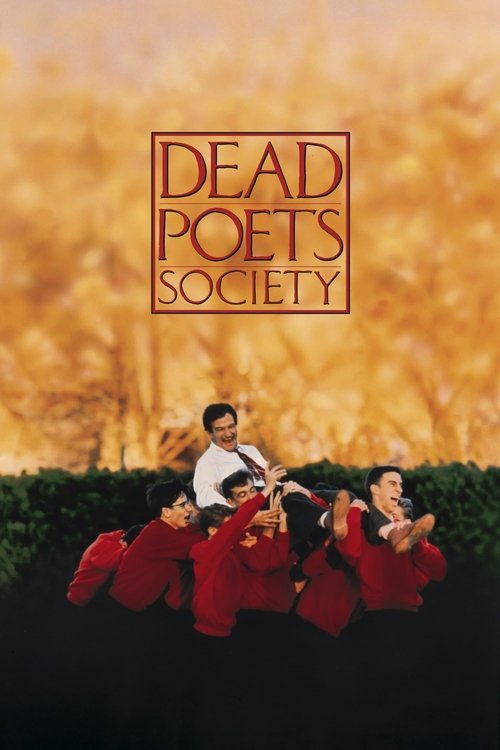
Autumn 1959. The leaves are turning gold and crimson across the rolling hills of Vermont, and the air is crisp with the promise of change. Welton Academy, an elite Episcopalian all-male preparatory boarding school, stands as a fortress of tradition, discipline, and unyielding expectations. Its stone halls echo with the footsteps of generations of boys who have walked the same path: excel, obey, and conform. The school's motto, "Tradition, Honor, Discipline, Excellence," is etched into the very walls, a constant reminder of the rigid order that governs every aspect of life here.
Todd Anderson, a shy and anxious new transfer student, arrives at Welton to begin his junior year. He is assigned as roommate to Neil Perry, one of the school's brightest and most popular students. Through Neil, Todd meets his circle of friends: Knox Overstreet, Richard Cameron, Steven Meeks, Gerard Pitts, and Charlie Dalton. Each boy carries his own burdens--Knox is infatuated with a girl named Chris Noel, whose family is friends with his; Richard is cautious and rule-abiding; Steven and Gerard are intellectual and curious; Charlie is rebellious and impulsive; and Neil, though outwardly confident, is haunted by the weight of his father's expectations.
The school year begins with the arrival of a new English teacher, John Keating. Keating, a Welton alumnus himself, is unlike any teacher the boys have ever encountered. On the first day of class, he surprises them by leading them out into the hallway, where he points to the black-and-white photographs of past Welton graduates lining the walls. "They're not that different from you, are they?" he asks, his voice soft but intense. "Same haircuts. Full of hormones, just like you. Invincible, just like you feel. The world is their oyster. They believe they're destined for great things, just like many of you. But their hopes, their dreams… dead and decaying." He pauses, then whispers, "Carpe Diem. Seize the day, boys. Make your lives extraordinary."
Keating's lessons are unorthodox. He encourages the boys to rip out the introduction to their poetry textbook, which argues that poetry can be measured by a mathematical formula. "We don't read and write poetry because it's cute," he says. "We read and write poetry because we are members of the human race. And the human race is filled with passion. Medicine, law, business, engineering--these are noble pursuits and necessary to sustain life. But poetry, beauty, romance, love--these are what we stay alive for." His words ignite something in the boys, a spark of curiosity, of rebellion, of longing.
Inspired by Keating's teachings, Neil Perry discovers that Keating himself had once been a member of an unofficial club called the Dead Poets Society, a secret group of students who would meet in a cave off-campus to read poetry and discuss ideas. Neil convinces his friends--Todd, Knox, Charlie, Richard, Steven, and Gerard--to revive the society. Under the cover of night, they sneak off campus to the cave, where they read poetry aloud, smoke, and talk about their dreams. For the first time, they feel free, unburdened by the expectations of their parents and the school.
But as the boys begin to apply Keating's philosophy in their lives, tensions rise. Knox Overstreet, emboldened by the spirit of the Dead Poets, pursues Chris Noel with relentless passion, despite the fact that she is dating Chet Danburry, a football player from a local public school. Knox's pursuit is reckless--he writes her poems, visits her school, and even begs her to see him at a performance of A Midsummer Night's Dream. Chris warns him that Chet will hurt him if he continues, but Knox is undeterred. "I am not afraid," he says, his voice trembling with conviction. "I am not afraid."
Meanwhile, Neil Perry discovers his true passion: acting. He auditions for and lands the lead role of Puck in a local production of A Midsummer Night's Dream. He keeps his involvement a secret from his father, Mr. Perry, who is a stern and authoritarian man determined that Neil will become a doctor. When Mr. Perry discovers Neil's deception, he is furious. "You will not embarrass me," he says, his voice cold and final. "You will not throw away your future for some childish fantasy." He forbids Neil to continue with the play and threatens to withdraw him from Welton and enroll him in Braden Military School to prepare him for Harvard and a career in medicine.
Neil is devastated. He confides in Keating, who encourages him to stand up for himself, to follow his dreams. "You must trust yourself," Keating says. "Even though others may doubt you, even though you may doubt yourself, you must trust yourself." But Neil is torn between his love for acting and his fear of disappointing his father. He continues with the play, delivering a performance that is met with a standing ovation. Chris, Knox's love interest, is in the audience, and she begins to see Knox in a new light. After the show, she kisses him, a moment of pure, unguarded joy.
But the joy is short-lived. Mr. Perry confronts Neil after the performance, his face dark with anger. "You have no idea what you've done," he says. "You have no idea what you've thrown away." He takes Neil home and tells him that he will be leaving Welton immediately, that his future is set, and that there will be no more talk of acting. Neil is crushed. That night, alone in his room, he takes his father's revolver and shoots himself. The news of Neil's death sends shockwaves through Welton. The school is plunged into grief and confusion.
In the aftermath, Mr. Perry demands a thorough investigation into the circumstances surrounding his son's death. Headmaster Gale Nolan, eager to protect the school's reputation, launches an inquiry. Richard Cameron, fearing for his own future, betrays the Dead Poets Society. He goes to Nolan and names all the members, shifting the blame onto Keating. "It was Keating," Cameron says. "He corrupted us. He filled our heads with dangerous ideas. He made us believe we could be anything we wanted, that we didn't have to follow the rules."
Nolan uses Cameron's testimony to cast Keating as a scapegoat. He calls each member of the Dead Poets Society into his office, where they are pressured to sign a confession letter stating that Keating abused his authority and incited them to restart the Dead Poets Society. Charlie Dalton, enraged by Cameron's betrayal, punches him in the face. "You coward!" Charlie shouts. "You sold us out!" For this act, Charlie is expelled from Welton.
One by one, the boys are forced to sign the confession. Knox, Steven, Gerard, and Richard all sign, their hands trembling with fear and guilt. Todd Anderson is the last to be called. His parents are waiting in Nolan's office, their faces stern and unyielding. Nolan forces Todd to admit to being a member of the Dead Poets Society and tries to make him sign the confession. Todd sees the signatures of his friends already on the document. "You will sign," Nolan says, his voice cold. "Or you will be expelled." Under his parents' pressure, Todd reluctantly signs.
Keating is fired from Welton. The school's administration makes it clear that he will never teach again. The boys are devastated. They gather in Keating's English classroom, where Nolan has taken over as their new teacher. The atmosphere is heavy with grief and regret.
One day, as the class is in session, Keating appears at the door. He has come to collect his belongings. The boys watch in silence as he packs his things. Nolan warns them not to speak, not to cause any trouble. But Todd, who has been silent and withdrawn since Neil's death, can no longer hold back. He stands up, his voice trembling but clear. "O Captain! My Captain!" he cries, echoing the words of Walt Whitman's poem that Keating had taught them.
Nolan is furious. "Sit down, Mr. Anderson," he says. "Sit down or you will be expelled." But Todd does not sit. Instead, he climbs onto his desk, standing tall and facing Keating. One by one, Knox, Steven, Gerard, and the other members of the Dead Poets Society follow suit. They stand on their desks, facing Keating, saluting their former teacher. Only Cameron and one or two others remain seated.
Nolan is powerless. He slumps against the teacher's desk, angry and defeated. Keating looks at his students, his eyes filled with emotion. "Thank you, boys," he says softly. "Thank you." He gathers his belongings and leaves the classroom, the door closing softly behind him.
The boys remain standing on their desks, a silent tribute to the teacher who changed their lives. Todd, who once had no identity, has finally found his voice. The camera lingers on their faces, each one a mix of sorrow, defiance, and hope. The final shot is of Keating's hat, left behind on the desk, a symbol of the legacy he leaves behind.
The story ends with the boys standing tall, their heads held high, ready to face the world on their own terms. The legacy of the Dead Poets Society lives on, not in the cave or in the classroom, but in the hearts of those who dared to seize the day.



What is the ending?
In the ending of "Dead Poets Society," Neil Perry takes his own life after a confrontation with his father about his passion for acting. The school administration blames Mr. Keating for Neil's death, leading to his dismissal. In a final act of defiance, the students stand on their desks to honor Mr. Keating.
As the film approaches its climax, the atmosphere at Welton Academy becomes increasingly tense. Neil Perry, having defied his father's wishes and pursued his passion for acting, is cast in a leading role in a school production of "A Midsummer Night's Dream." The excitement of the performance is palpable, and Neil feels a sense of freedom and joy as he embraces his true self on stage. However, this joy is short-lived, as his father, Mr. Perry, arrives unexpectedly after the performance and confronts Neil with anger and disappointment.
In a heated exchange, Mr. Perry insists that Neil must abandon his dreams of acting and instead focus on a more traditional career path, such as medicine. Neil, feeling trapped and desperate, pleads for his father to understand his passion, but Mr. Perry remains resolute, leaving Neil feeling utterly defeated. The emotional weight of this confrontation hangs heavily over Neil, who is torn between his love for acting and his father's oppressive expectations.
The following day, Neil's internal turmoil culminates in a tragic decision. In a heart-wrenching scene, he takes his own life, leaving a note that expresses his love for his friends and his sorrow for the pain he has caused. The news of Neil's death sends shockwaves through the school, and the students are left grappling with their grief and guilt.
In the aftermath, the school administration, led by the stern Headmaster Nolan, seeks to place blame for Neil's death. They target Mr. Keating, the beloved English teacher who inspired Neil and his classmates to think for themselves and embrace their passions. In a meeting with the students, the administration pressures them to denounce Mr. Keating's influence, attempting to shift the narrative away from the oppressive environment that contributed to Neil's tragic fate.
As Mr. Keating is called into the office to face the consequences of the school's investigation, he is met with hostility and accusations. The students, however, are conflicted. They have been profoundly affected by Mr. Keating's teachings, which encouraged them to seize the day and pursue their dreams. In a powerful moment of solidarity, the students decide to stand up for their teacher.
In the final scene, as Mr. Keating prepares to leave Welton, the students, led by Todd Anderson, rise one by one and stand on their desks in a poignant tribute to their teacher. They call out "O Captain! My Captain!" in a show of respect and defiance against the oppressive forces that seek to silence their voices. This act symbolizes their commitment to individuality and the impact Mr. Keating has had on their lives.
The film concludes with Mr. Keating looking back at his students, a mixture of pride and sorrow on his face, as he realizes the profound effect he has had on them, even in the face of tragedy. The fate of each main character is sealed in this moment: Neil's life is tragically cut short, Mr. Keating is forced out of the school, and the students are left to navigate their futures with the lessons they have learned about courage, passion, and the importance of living authentically.
Is there a post-credit scene?
The movie "Dead Poets Society," produced in 1989, does not have a post-credit scene. The film concludes with a powerful and emotional climax, focusing on the aftermath of Neil Perry's tragic decision and the impact it has on his friends and their teacher, John Keating. The final moments of the film are poignant, showcasing the students' defiance against authority and their tribute to Keating, but there are no additional scenes or content after the credits roll. The film ends on a note that emphasizes the themes of individuality, the struggle against conformity, and the lasting influence of a passionate teacher.
What motivates Mr. Keating to teach in such an unconventional manner?
Mr. Keating, played by Robin Williams, is motivated by his own experiences as a student at Welton Academy, where he was inspired by the teachings of his own English teacher. He believes in the importance of individuality, creativity, and the pursuit of passion in life. His unconventional teaching methods, such as encouraging students to stand on desks and think for themselves, stem from his desire to awaken the same passion in his students that he felt during his youth.
How does Neil Perry's relationship with his father influence his actions?
Neil Perry, portrayed by Robert Sean Leonard, has a strained relationship with his father, Mr. Perry, who imposes strict expectations on him regarding his future. Mr. Perry wants Neil to pursue a career in medicine, disregarding Neil's passion for acting. This conflict drives Neil to seek independence and ultimately leads him to audition for a role in a play, which he feels is his true calling. The pressure from his father culminates in a tragic decision when Neil feels he has no other way to assert his identity.
What role does the Dead Poets Society play in the students' lives?
The Dead Poets Society, a secret club formed by Mr. Keating's students, serves as a sanctuary for them to explore their love for poetry and express their innermost thoughts and feelings. It becomes a pivotal element in their lives, allowing them to break free from the constraints of Welton Academy's rigid structure. Through their meetings, the boys bond over shared experiences and the pursuit of their dreams, which ultimately influences their choices and personal growth throughout the film.
How does Todd Anderson's character evolve throughout the film?
Todd Anderson, played by Ethan Hawke, begins as a shy and insecure student who struggles with self-expression and the weight of his family's expectations. Under Mr. Keating's guidance and the influence of his peers, particularly Neil, Todd gradually gains confidence. His transformation is highlighted during the climactic scene where he stands up to recite poetry in front of the class, ultimately embracing his individuality and finding his voice, which symbolizes his growth and newfound courage.
What impact does Mr. Keating have on the students' perspectives on life and education?
Mr. Keating profoundly impacts his students by challenging their preconceived notions about education and success. He encourages them to seize the day ('carpe diem') and to pursue their passions rather than conform to societal expectations. His teachings inspire the boys to think critically and embrace their individuality, leading them to make bold choices that reflect their true selves. However, this influence also sets the stage for the tragic consequences that arise from their struggles against authority and the pressures of their environment.
Is this family friendly?
"Dead Poets Society" is a film that explores themes of individuality, conformity, and the pressures of academic life, which may not be suitable for all children or sensitive viewers. Here are some potentially objectionable or upsetting aspects:
-
Suicide: The film addresses the serious topic of suicide, which is central to the emotional climax and can be distressing for viewers, particularly younger audiences.
-
Parental Pressure: There are scenes depicting intense parental expectations and pressure on students, which may resonate negatively with children who experience similar dynamics in their own lives.
-
Conflict with Authority: The film portrays conflicts between students and teachers, including moments of rebellion that may be unsettling for some viewers.
-
Emotional Turmoil: Characters experience significant emotional struggles, including feelings of despair, isolation, and the weight of societal expectations, which could be heavy for sensitive viewers.
-
Depictions of Failure: The film includes scenes where characters face failure and disappointment, which may be upsetting for children who are sensitive to themes of inadequacy.
These elements contribute to the film's overall serious tone and may require parental discretion for younger audiences.









