









































Popular
What motivates the Evil Queen Ravenna to seek Snow White's heart?
How does Snow White escape from the castle?
What is the significance of the Huntsman's backstory?
What role do the dwarfs play in Snow White's journey?
How does the relationship between Snow White and the Huntsman develop throughout the film?
Should I watch it?
Ask Your Own Question

What is the plot?
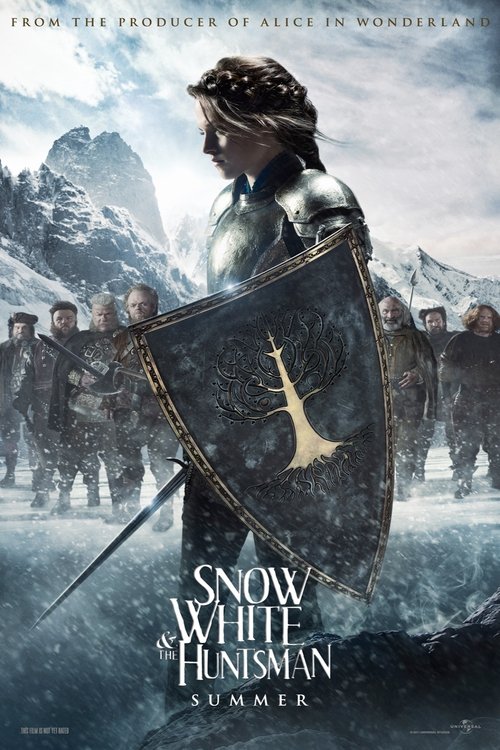
The story opens in the kingdom of Tabor, where a winter fairy tale already feels haunted by grief and prophecy. In the deep past, Queen Eleanor has a daughter, Snow White, in the middle of a landscape that is literally painted in white and blood red: a rose blooms in the snow, Eleanor cuts her finger, and the image becomes the kingdom's first omen of Snow White's destiny. After Eleanor dies, King Magnus raises his daughter alone, and Snow White grows up in the castle with her childhood friend William, the son of Duke Hammond. For a time, the royal court seems stable, but Magnus's loneliness and vulnerability leave the kingdom exposed, and when a dark invading force assaults the castle, he discovers a beautiful captive woman named Ravenna among the prisoners and brings her back with him.
Ravenna is radiant in the way a blade is polished: dazzling, fragile-looking, and deadly. Magnus is bewitched by her beauty and power, and he marries her almost at once, believing that he is saving a victim from the invading army. The next day, the horror of his mistake becomes clear. Ravenna reveals that she is no helpless prisoner but a powerful sorceress, and on her wedding night she murders King Magnus so she can seize the throne of Tabor. The coup is swift and brutal. Duke Hammond escapes with his son William, but Snow White is not so lucky. She is captured by Ravenna's brother, Finn, and locked away in a tower room, cut off from the world while Ravenna consolidates power by fear and magic.
Years pass. Snow White remains imprisoned, and Ravenna rules from the castle as a tyrant, sustaining her beauty by stealing life and youth from others. The film's central supernatural mechanism is introduced through the Magic Mirror, which functions like an oracle and an executioner at once. Ravenna repeatedly consults it to confirm her supremacy, because her power depends on being the "fairest" and on feeding on vitality to preserve her youth. The mirror eventually delivers the verdict that changes everything: Snow White, now grown into a young woman, is more beautiful than Ravenna and is destined to surpass her. More importantly, Ravenna learns that Snow White's heart is the key to becoming truly immortal. That revelation turns Snow White from a prisoner into a threat that Ravenna cannot ignore.
Ravenna immediately orders Finn and her men to find Snow White and bring her to her. But Snow White escapes before they can reach her, and the chase spills into the Dark Forest, a place the film treats as a living nightmare. It is not just a forest but a corrupt, shifting wilderness filled with hallucinations, hostile creatures, and fear made visible. Trees distort, shadows move unnaturally, and the landscape itself seems intent on breaking anyone who enters it. Snow White runs through this terrifying terrain with Ravenna's forces close behind, and when Ravenna loses her trail, she turns to a man she can exploit: Eric the Huntsman.
Eric is introduced as a drunken, broken widower whose life was already damaged by the Dark Forest long before he meets Snow White. Ravenna promises him wealth and a chance to bring his dead wife back from the grave if he will track Snow White down and deliver her alive. He agrees, but only because he is trapped by grief and intoxication, and his assignment is meant to be fatal for Snow White. He and Finn lead the pursuit into the woods, and Eric eventually corners Snow White. This is the movie's first major turning point, because the expected fairy-tale role reversal begins here: instead of killing her, Eric recognizes the betrayal in Ravenna's scheme and refuses to hand her over.
The confrontation in the forest changes both of them. Snow White is frightened, filthy, and exhausted, but she is not passive. Eric, despite his bitterness, begins to see that Ravenna lied to him and used him as disposable muscle. He becomes her protector rather than her executioner. What follows is a hard, uneasy alliance built on survival rather than trust. Eric teaches Snow White how to endure, how to stand, how to fight, and how to think like someone who can survive a battlefield instead of a cell. The film makes this transformation clear: Snow White is no longer only a hunted princess; she begins learning "the art of war" under Eric's brutal, practical instruction.
As they move deeper through the Dark Forest, Ravenna's reach continues to threaten them. Finn remains one of her chief enforcers, and he repeatedly acts as the physical arm of her will while Ravenna herself maneuvers from the castle. In the forest, Snow White and Eric encounter the first of the film's allies and refuges, including magical sanctuary spaces and eventually the dwarves, who are not comic relief so much as hardened survivors living on the edge of a collapsing kingdom. Their presence widens the rebellion around Snow White and gives the story momentum beyond simple flight. Snow White is also forced to confront the truth of who she is meant to become: not merely a girl preserved by innocence, but a ruler who can end Ravenna's reign.
The journey eventually leads to Duke Hammond's side of the struggle. William, who has grown from Snow White's boyhood companion into a man, has remained emotionally bound to her all these years. The story uses his loyalty to sharpen the romantic and political stakes at once. He is not just a lost friend; he is the surviving heir of a noble resistance to Ravenna's rule. The rebellion begins to assemble around Snow White, Eric, William, and the dwarves, and the film shifts from chase to insurrection. This is the point at which Snow White's role changes decisively: she is no longer running away from the kingdom's violence but moving back toward the castle that was taken from her.
Ravenna responds with escalating cruelty. She cannot allow Snow White to live because Snow White's existence threatens both her beauty and her power. The Queen's obsession becomes increasingly personal and grotesque. Her youth is sustained through predation, and Snow White's growing power exposes the artificiality of Ravenna's hold on the throne. One of Ravenna's most significant deceptions comes through impersonation and manipulation. At a crucial moment, she disguises herself as William and tricks Snow White into eating a poisoned apple. This is one of the film's largest twists because it appears, for a moment, as though the fairy tale has ended in the classic tragic way: Snow White collapses into a deathlike sleep, and Ravenna seems to have won.
The apple does not kill Snow White outright; it puts her into a state that resembles death, freezing the momentum of the rebellion and creating a desperate emotional void. She is taken to Duke Hammond's castle, where the resistance gathers around her body and tries to understand whether there is any hope left. Eric's role becomes especially important here because the story has already established that his affection is no longer rooted in the reward Ravenna promised him. He has become a genuine ally, and in the castle he provides the awakening the fairy tale demands. He kisses Snow White, and this kiss breaks the poison's hold, reviving her from the deathlike sleep. The film uses this not as a simple romantic device but as a reaffirmation that Snow White's return is tied to trust, memory, and the refusal to let Ravenna define the story.
Once Snow White awakens, the pace tightens toward the final assault. She now stands at the center of a coalition that includes Eric, William, the dwarves, and Duke Hammond's forces. The kingdom's struggle becomes open war, and the final confrontation is staged at Ravenna's castle. This last movement is one of the film's most visually intense sequences: black glass, towering stone, and supernatural weaponry all converge as the castle itself seems to defend Ravenna's rule. William and Eric fight Ravenna's army outside while Snow White climbs the castle tower alone to confront the Queen directly. Ravenna does not wait passively. She hurls shards of black glass that burst into monstrous creatures, turning the battlements into a nightmare battlefield where the dead and the living seem equally at risk.
Inside the chaos, Snow White reaches Ravenna at last. The Queen is still beautiful, still terrifying, still confident in her superiority. She overpowers Snow White in the close confrontation and nearly completes her plan by killing her and consuming her heart, which would secure her immortality. This is the movie's true climax: not a generalized battle, but a direct contest between predator and heir, with every earlier revelation folding into one final struggle. Ravenna's power has always depended on fear, illusion, and the belief that she cannot be beaten. Snow White's victory depends on learning to stop reacting like a captive and start acting like a warrior.
At the last possible moment, Snow White uses the counterattack Eric taught her. She drives a blade into Ravenna's heart. The act is simple, physical, and decisive, the opposite of Ravenna's manipulative magic. Ravenna falls, and as she dies, her glamour collapses. The queen withers and ages rapidly, revealing the rot beneath the beauty she stole from others. Her death breaks the spell of her rule, ends her dark reign, and restores balance to the kingdom. It is also the final answer to the film's central mystery: Ravenna's power was never natural or permanent, only sustained by constant theft. Once Snow White pierces that illusion, Ravenna is destroyed.
With Ravenna dead, the kingdom can finally breathe again. The final scene moves into restoration rather than devastation. Snow White is crowned Queen of Tabor, now no longer the hidden child or imprisoned heir but the rightful ruler at the center of her land's rebirth. William remains by her side, and the surviving allies who fought for her are present as the story resolves into triumph. The film closes on the visual and emotional contrast that has shaped it from the beginning: where the opening gave the audience a world of mourning, seduction, and violent usurpation, the ending returns to light, legitimacy, and a restored throne. Snow White's victory is complete, Ravenna is dead, Magnus remains avenged, and the kingdom that was stolen through murder is finally returned to the daughter who outlived the darkness.
More Movies Like This
Browse All Movies →




What is the ending?
In the ending of "Snow White and the Huntsman," Snow White confronts the Evil Queen, Ravenna, in a final battle. With the help of the Huntsman, she defeats Ravenna, who is ultimately killed by her own magic. Snow White then takes her rightful place as queen, bringing peace to the kingdom.
As the climax approaches, the scene shifts to the dark castle where Ravenna resides. The atmosphere is thick with tension as Snow White, now emboldened by her journey and the support of the Huntsman and the dwarves, prepares to face the Evil Queen. The castle is shrouded in shadows, reflecting Ravenna's malevolence. Snow White, dressed in armor, stands resolute, her face a mixture of determination and fear. She knows that this confrontation is not just for her own life but for the future of her kingdom.
The battle begins as Snow White and the Huntsman storm the castle. They are met with fierce resistance from Ravenna's guards, but the duo fights valiantly, showcasing their growth and partnership. The Huntsman, once a reluctant ally, now fights with a fierce loyalty to Snow White, driven by his desire to see her reclaim her throne. The dwarves, loyal to Snow White, also join the fray, adding to the chaos of the battle.
As they reach the heart of the castle, Snow White confronts Ravenna. The Evil Queen, cloaked in dark magic, taunts Snow White, reminding her of her past failures and the power she once held. Snow White, however, stands firm, her resolve strengthened by the love and support she has received throughout her journey. The two engage in a fierce duel, with Ravenna using her dark powers to create illusions and manipulate the environment around them.
In a pivotal moment, Snow White remembers the power of love and light, which she has learned to harness. She draws upon the strength of her late father and the memories of her mother, channeling this energy into a powerful arrow. With a swift motion, she releases the arrow, striking Ravenna directly in the heart. The Evil Queen screams in agony as her own dark magic turns against her, consuming her. In her final moments, Ravenna's face twists in rage and despair, and she crumbles into a cascade of black feathers, symbolizing her defeat and the end of her reign of terror.
With Ravenna defeated, the atmosphere in the castle shifts. The dark clouds that once loomed overhead begin to dissipate, revealing a bright sky. Snow White, now free from the shadows of her past, stands tall, embodying the hope and strength of her lineage. The Huntsman, who has fought valiantly by her side, looks at her with admiration and respect, acknowledging her transformation from a frightened girl into a powerful leader.
The final scenes depict Snow White returning to her kingdom, where she is greeted by the people with joy and celebration. She takes her place as queen, her heart filled with compassion and a desire to restore peace and prosperity to her realm. The dwarves, who have become her loyal friends, stand by her side, ready to help her lead the kingdom into a new era.
As the camera pans out, we see Snow White standing on a balcony, looking out over her kingdom, a symbol of hope and renewal. The Huntsman, having found his purpose alongside her, watches from a distance, a sense of fulfillment in his heart. The film closes with the message that true strength comes from love, unity, and the courage to face one's fears, leaving the audience with a sense of closure and hope for the future.
Is there a post-credit scene?
In the movie "Snow White and the Huntsman," there is no post-credit scene. The film concludes with a final scene that wraps up the story, showing Snow White, played by Kristen Stewart, taking her rightful place as queen after defeating the Evil Queen Ravenna, portrayed by Charlize Theron. The ending emphasizes themes of rebirth and hope, as Snow White is seen leading her people and restoring peace to the kingdom. The absence of a post-credit scene leaves the audience with a sense of closure regarding the characters' journeys and the resolution of the conflict.
What motivates the Evil Queen Ravenna to seek Snow White's heart?
The Evil Queen Ravenna, portrayed by Charlize Theron, is driven by her insatiable desire for power and beauty. She believes that by consuming Snow White's heart, she can regain her youth and maintain her dominance over the kingdom. Ravenna's jealousy of Snow White's purity and beauty fuels her obsession, as she feels threatened by the young princess's potential to overthrow her.
How does Snow White escape from the castle?
Snow White, played by Kristen Stewart, escapes from the castle after being imprisoned by the Evil Queen. With the help of a sympathetic guard, she manages to flee into the dark forest. This escape is marked by her desperation and fear, as she runs through the castle's cold, stone corridors, ultimately finding herself in the treacherous woods where she must confront her fears and the dangers that lie ahead.
What is the significance of the Huntsman's backstory?
The Huntsman, portrayed by Chris Hemsworth, has a tragic backstory that shapes his character. He is a widower who lost his wife to the Evil Queen's tyranny. This personal loss instills in him a deep sense of grief and anger, which initially makes him reluctant to help Snow White. However, as he spends time with her, he begins to see her as a symbol of hope and redemption, ultimately motivating him to fight against Ravenna's oppressive rule.
What role do the dwarfs play in Snow White's journey?
The dwarfs, led by the character Beith, play a crucial role in Snow White's journey. They initially capture her but soon become her allies. Each dwarf has a distinct personality and backstory, adding depth to the narrative. They provide guidance, protection, and camaraderie, helping Snow White to grow into a leader. Their loyalty and bravery inspire her to embrace her destiny and fight against the Evil Queen.
How does the relationship between Snow White and the Huntsman develop throughout the film?
The relationship between Snow White and the Huntsman evolves significantly throughout the film. Initially, the Huntsman is reluctant to assist her, viewing her as a mere pawn in a larger game. However, as they face various challenges together, a bond forms based on mutual respect and shared loss. Snow White's determination and courage inspire the Huntsman, leading him to become her protector and ally, ultimately culminating in a deep emotional connection that transcends their initial circumstances.
Is this family friendly?
"Snow White and the Huntsman" contains several elements that may not be suitable for younger audiences or sensitive viewers. Here are some potentially objectionable or upsetting aspects:
-
Violence and Dark Themes: The film features intense battle scenes, including sword fights and the deaths of characters, which may be distressing for children.
-
Death and Mourning: The story includes themes of loss, particularly surrounding the death of Snow White's father, which is depicted in a somber manner.
-
Dark Imagery: The film has a dark and gothic aesthetic, with scenes involving the Evil Queen's magic that can be frightening, including transformations and the use of dark creatures.
-
Emotional Turmoil: Characters experience significant emotional pain, betrayal, and fear, which may be heavy for younger viewers to process.
-
Implied Threats and Manipulation: The Evil Queen uses psychological manipulation and threats, creating a tense atmosphere that may be unsettling.
-
Mature Themes: The film explores themes of power, jealousy, and revenge, which may be complex for younger audiences to understand fully.
These elements contribute to a darker tone that may not be appropriate for all children or sensitive viewers.





