










































































Popular
What challenges do Ralph and Vanellope face when they enter the internet?
How does Vanellope's character evolve throughout the film?
What role does the character Yesss play in the story?
What is the significance of the 'Slaughter Race' game in Vanellope's journey?
How does Ralph's insecurity affect his actions throughout the film?
Should I watch it?
Ask Your Own Question

What is the plot?
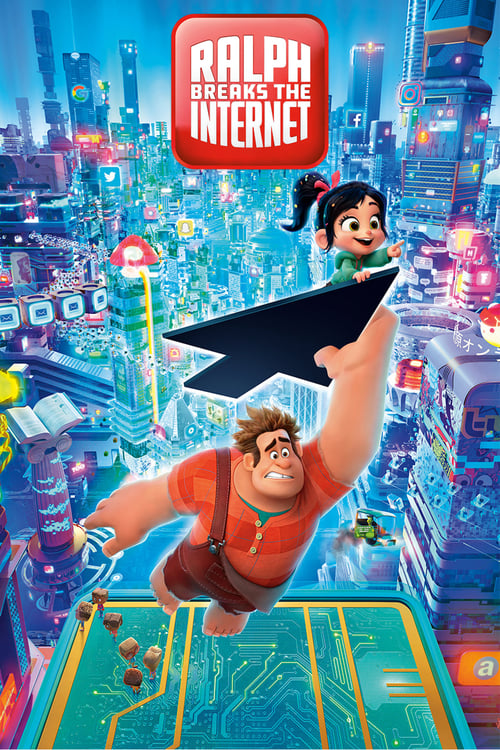
Six years after the events of Wreck-It Ralph, Litwak's Arcade falls into its familiar nighttime rhythm: the humans go home, the cabinets sleep, and Ralph and Vanellope von Schweetz finally get to be themselves together in the glow of the arcade floor. Ralph is content with the small, predictable world he knows, but Vanellope is not. She has grown bored with Sugar Rush because she already knows every track by heart, and the sameness of her life starts to feel less comforting than confining.
Ralph takes her frustration personally. He wants to be the friend who fixes things, the one who keeps her happy and close, so he secretly sneaks into Sugar Rush and builds her a brand-new track. It is a sweet gesture in his mind, a way to surprise her with excitement and prove that he understands her. But the moment the track is tested by a player the next day, the whole plan collapses. Vanellope resists the steering input, the cabinet jerks, and the game's steering wheel snaps apart.
The break is not just a mechanical accident; it becomes the spark that sends the story spiraling out of the arcade and into the Internet. As the game's condition worsens, the threat to Sugar Rush becomes real. The replacement wheel is found online, but the listing on eBay is outrageously expensive, and the auction quickly becomes a desperate race against time. Ralph and Vanellope watch the price climb to $27,001, and they learn they have only 24 hours to pay before they lose the wheel entirely.
The urgency around the wheel is tied to the fate of the game itself. In the pressure of the moment, Sugar Rush is unplugged, and its characters are forced into temporary refuge while the adults of the arcade figure out what to do. The home base of the story remains Litwak's Arcade, but the problem now reaches beyond the cabinets and into the strange infrastructure behind them. Mr. Litwak has installed a new Wi‑Fi router, and that router becomes the literal gateway to the Internet, the impossible place that Ralph and Vanellope decide to enter in order to save the game.
When they leave the arcade, the film opens outward into a dazzling digital city. The Internet is presented as a vast, living metropolis where websites are buildings, programs are people, and avatars stand in for users. Ralph and Vanellope stumble through it like visitors from another world, confused by its speed, commerce, and noise. Their first major obstacle is simple and brutal: they need money fast. To get it, they rely on a search engine and the self-serving advice of spammy online guides, eventually being steered by Spamley, a pop-up advertiser whose whole personality is manipulation.
Spamley directs them toward a plan that seems reckless even by Internet standards: they need to steal a rare car from Slaughter Race, the chaotic and dangerous racing game where the hottest traffic in the story begins to gather. The game is vivid and violent compared with Sugar Rush, a place of wrecks, neon, and constant peril. There they meet Shank, the game's fastest racer, a cool and intimidating figure whose confidence is undeniable. Shank and her crew are not villains in the traditional sense, but they are powerful, self-possessed, and used to surviving in a harsher world than Ralph and Vanellope have ever known.
For Vanellope, Slaughter Race is a revelation. What begins as curiosity becomes enchantment, and then something deeper: recognition. She feels alive there in a way she has not felt in Sugar Rush. The danger, the unpredictability, and the freedom all speak to her at once, and she starts to understand that boredom was never her whole problem. She wants change. She wants more than repetition. She wants a place that matches the restless part of herself she has been trying to ignore.
That realization becomes one of the film's most important turns. Vanellope eventually says that Slaughter Race feels like home, and the line lands like a blow because it reveals how much she is drifting away from the life Ralph assumed they would always share. Ralph hears the statement as a threat to their friendship, but for Vanellope it is a confession of identity. She is not rejecting him; she is discovering herself.
Ralph, however, cannot bear that distance. His fear hardens into jealousy, then into panic. He hears only that she wants something he cannot give her, and instead of trusting her, he tries to control the situation. The film makes the emotional damage clear: Ralph's devotion has turned possessive, and what he thinks is love begins to look like fear of abandonment.
That fear pushes him into the film's darkest turn. Ralph learns about the dark web, a hidden and dangerous corner of the Internet, and goes there to buy a virus from a seller named Double Dan. The virus is meant to slow down or sabotage Slaughter Race so Vanellope will no longer want to stay there. Ralph tells himself he is protecting their friendship, but the act is deeply selfish. He is trying to force Vanellope back into the role he wants for her, not the life she has chosen for herself.
The virus is the story's central monster, but it is not a monster in the usual sense. Once it enters Slaughter Race, it scans Ralph's insecurities and reproduces them, creating countless Ralph clones that multiply across the Internet. The clones are funny at first, but the humor quickly gives way to dread as they spread like a digital plague, overwhelming sites, causing chaos, and behaving like a denial-of-service attack made flesh. The catastrophe is not random destruction; it is Ralph's emotional instability made visible and contagious.
This is the film's major revelation: the real danger has never been the Internet itself. The danger is Ralph's refusal to accept that Vanellope is a separate person with her own desires. The clones are not independent villains. They are the physical manifestation of his fear of losing her, each one carrying the same insecurity until it becomes a literal army.
As the Ralphs multiply, the Internet descends into chaos. Ralph, Vanellope, and Yesss scramble to contain the outbreak, and the effort leads them toward an anti-virus trap and firewall-style containment zone where the clones can be lured and eliminated. The sequence is frantic and surreal, with the fake Ralphs behaving as both threat and comic exaggeration of the original. The situation becomes more dangerous when Vanellope is caught in the disaster, forcing Ralph to confront the possibility that his attempt to preserve their friendship has nearly destroyed it.
At the height of the crisis, Ralph finally says the thing he has been unable to admit: Vanellope's happiness does not belong to him. He sees that her wanting to stay in Slaughter Race does not mean she has stopped loving him, and it does not mean the bond they share has been erased. That realization is the emotional key to the ending. Ralph's insecurity is the source of the virus's power, so the cure is not physical destruction but acceptance. Once he understands that friendship is not possession, the clones begin to vanish, and the giant Ralph collapses away.
Before that resolution fully lands, the climax gives the film one last burst of danger. The giant Ralph-form threatens the whole system, looming over the Internet like a grotesque embodiment of self-doubt. Ralph tries to hold the damage back long enough to speak honestly to Vanellope. His admission is simple but crucial: she can choose her own path, and that choice does not make their friendship less real. The moment the insecurity breaks, the digital monster disintegrates, and the Internet is restored.
Ralph falls after the collapse, but even in the middle of the chaos, the film makes room for a surprisingly affectionate rescue. The Disney Princesses step in and save him from the drop, turning the sequence into one of the movie's most playful payoffs. Their intervention is both comic and thematically neat: the story that began with a boy trying too hard to protect a girl ends with a group of iconic heroines showing Ralph that rescue can come from unexpected places.
There are no permanent deaths in the film. No major character dies, and the destruction remains digital, reversible, and symbolic rather than fatal. The real casualties are emotional assumptions: Ralph loses the fantasy that Vanellope will always stay exactly where he wants her, and Vanellope loses the pressure to pretend that their lives must remain identical forever.
Once the virus crisis ends, the film settles into its true resolution. Vanellope chooses to stay in Slaughter Race rather than return permanently to Sugar Rush. She has found a place that fits her sense of self, and the story treats that choice as both bittersweet and healthy. Ralph does not win her back by force or guilt. He lets her go because he loves her enough to stop defining her life for her.
The final emotional gesture between them is small but powerful. Ralph gives Vanellope half of his broken medal, preserving a physical token of their bond even as their lives separate. It is an intimate reminder that their friendship remains, just in a new form. They do not become strangers. They become friends who understand that closeness can survive distance.
Back in the arcade, Sugar Rush is repaired, and Litwak's world returns to normal around Ralph. The game is not the same as it was at the beginning, because neither Ralph nor Vanellope is the same. Ralph no longer clings to the idea that happiness must look a single way. He joins in with the other arcade characters' activities and learns to be comfortable on his own, while staying in touch with Vanellope through video chat. The final image is not one of loss, but of mature affection: two friends separated by choice, connected by trust, and finally secure enough to let each other grow.



What is the ending?
In the ending of Ralph Breaks the Internet, Ralph sacrifices himself to save Vanellope and their friendship. He realizes that he must let her go to pursue her own dreams. Vanellope becomes a part of a new racing game, and Ralph learns to embrace change and the importance of friendship. The film concludes with Ralph and Vanellope maintaining their bond, even as they embark on separate paths.
As the climax of Ralph Breaks the Internet unfolds, Ralph and Vanellope find themselves in a tense confrontation. After a series of misadventures in the vast expanse of the internet, Ralph's insecurities about losing Vanellope to her newfound passion for the racing game "Slaughter Race" come to a head. In a moment of desperation, Ralph inadvertently creates a viral video that threatens to destroy Vanellope's new home and the friendships she has formed there.
In the ensuing chaos, Ralph realizes that his actions have put Vanellope in danger. He watches as she struggles to navigate the consequences of his mistake, feeling the weight of guilt pressing down on him. The emotional turmoil is palpable; Ralph's fear of losing Vanellope clashes with his desire to protect her. This internal conflict drives him to make a pivotal decision.
In a heart-wrenching moment, Ralph chooses to confront his fears. He understands that true friendship means allowing Vanellope to pursue her dreams, even if it means they will be apart. With a heavy heart, he steps into the path of danger, sacrificing himself to save her from the viral chaos he created. As he faces the consequences of his actions, Ralph's character arc culminates in a profound realization about selflessness and the nature of love.
Vanellope, witnessing Ralph's sacrifice, is filled with a mix of fear and determination. She races against time to save him, but ultimately, she must confront the reality that their paths are diverging. In a poignant scene, she embraces Ralph, assuring him that their friendship will endure despite the changes ahead. The emotional weight of their bond is evident as they share a heartfelt goodbye, solidifying their connection even as they prepare to embark on separate journeys.
As the dust settles, Vanellope finds her place in "Slaughter Race," where she thrives in her new environment, surrounded by friends who appreciate her unique spirit. Ralph, on the other hand, returns to his original game, but he is forever changed by the experience. He learns to embrace the idea that friendships can evolve and that letting go can be an act of love.
The film concludes with a montage that highlights the enduring nature of their friendship. Ralph and Vanellope may be apart, but they remain connected through their shared experiences and the lessons they have learned. The final scenes depict Ralph happily engaging with his game, while Vanellope races in her new world, both characters enriched by their journey and the sacrifices they made for one another. The screen fades to black, leaving the audience with a sense of hope and the understanding that true friendship can withstand any challenge.
Is there a post-credit scene?
Yes, "Ralph Breaks the Internet" features a post-credit scene. In this scene, Ralph is seen in a digital space, where he is trying to get the attention of Vanellope. He is playfully calling out to her, but she is busy playing a game on her phone. As he continues to call her name, he becomes increasingly frustrated and starts to make silly faces and noises to get her attention.
Eventually, Vanellope looks up and sees Ralph, and they share a moment of laughter. This light-hearted interaction emphasizes their strong friendship and the playful dynamic between them. The scene serves as a reminder of their bond and the fun they have together, even after the main events of the film have concluded. It leaves the audience with a sense of warmth and joy, highlighting the importance of friendship and connection in their digital world.
What challenges do Ralph and Vanellope face when they enter the internet?
Ralph and Vanellope face several challenges when they enter the internet, including navigating the vast and chaotic landscape of websites, dealing with the overwhelming amount of information, and encountering various internet denizens. They must also confront the dangers of the internet, such as the threat of being deleted or lost in the digital world. Their journey leads them to the dark web, where they face off against a menacing pop-up ad and the consequences of their actions.
How does Vanellope's character evolve throughout the film?
Vanellope's character evolves significantly throughout the film as she discovers her desire for independence and a sense of belonging. Initially, she is content with her life in the arcade, but as she explores the internet, she becomes enamored with the idea of being a part of a racing game that offers her a new identity. This desire creates tension between her and Ralph, as she begins to prioritize her own dreams over their friendship, leading to a poignant exploration of growth and self-discovery.
What role does the character Yesss play in the story?
Yesss is a key character in 'Ralph Breaks the Internet,' serving as the algorithm for the website BuzzTube. She is a savvy and stylish influencer who helps Ralph and Vanellope navigate the complexities of the internet. Yesss embodies the culture of viral content and social media, providing guidance and insight into how to gain views and popularity. Her character also highlights the themes of friendship and the impact of social media on personal relationships.
What is the significance of the 'Slaughter Race' game in Vanellope's journey?
The 'Slaughter Race' game is significant in Vanellope's journey as it represents her longing for adventure and a place where she truly belongs. Unlike her previous racing game, 'Sugar Rush,' which feels limiting, 'Slaughter Race' offers her the thrill and excitement she craves. It becomes a symbol of her growth and desire to break free from the constraints of her old life. The game also serves as a catalyst for the conflict between her and Ralph, as she becomes increasingly drawn to it, leading to pivotal moments in their friendship.
How does Ralph's insecurity affect his actions throughout the film?
Ralph's insecurity profoundly affects his actions throughout the film, driving him to seek validation and fear losing his friendship with Vanellope. His desire to keep her happy leads him to make impulsive decisions, such as trying to create a viral video to impress her. However, his insecurities also manifest in jealousy and fear of abandonment, particularly when he realizes that Vanellope is finding her own path in the internet world. This internal struggle culminates in a moment of reckoning where Ralph must confront the consequences of his actions and learn to support Vanellope's independence.
Is this family friendly?
"Ralph Breaks the Internet" is generally considered family-friendly, but there are a few scenes and aspects that might be potentially objectionable or upsetting for children or sensitive viewers:
-
Internet Trolls: The film features characters that represent internet trolls, which can be depicted as mean-spirited and hurtful. This may be unsettling for younger viewers who might not fully understand the concept of online bullying.
-
Emotional Conflict: There are moments of emotional tension between Ralph and Vanellope, including misunderstandings and feelings of jealousy. These scenes may evoke feelings of sadness or discomfort as they navigate their friendship.
-
Mild Language: There are instances of mild language and some jokes that may not be suitable for very young children, though they are not overly explicit.
-
Scary Imagery: Certain scenes, particularly those involving the "Dark Web" or the depiction of pop-up ads, may be visually intense or confusing for younger audiences.
-
Themes of Loss and Change: The film explores themes of change in friendships and the fear of losing someone close, which could resonate deeply with sensitive viewers.
Overall, while the film contains these elements, it also delivers positive messages about friendship, loyalty, and personal growth, making it suitable for family viewing with some caution regarding the aforementioned aspects.








