

Popular
What motivates the character of Cole Thornton to help the sheriff in El Dorado?
How does the relationship between Cole Thornton and Mississippi evolve throughout the film?
What role does the character of Sheriff J.P. Hara play in the conflict with Bart Jason?
What is the significance of the final showdown between Cole Thornton and Bart Jason?
How does the character of Bart Jason embody the antagonist role in El Dorado?
Should I watch it?
Ask Your Own Question

What is the plot?
Sorry, we aren't able to watch and write up a full detailed plot yet. Check back in a few days.
What is the ending?
In the ending of "El Dorado," the film culminates in a showdown between the protagonists and the antagonists. After a series of intense confrontations, the main characters, including Cole Thornton, J.P. Hara, and the young gunfighter Mississippi, manage to defeat the corrupt rancher Bart Jason and his men. The film concludes with a sense of resolution as the characters reflect on their journey, with Cole Thornton deciding to leave the town, while Mississippi finds a new path ahead.
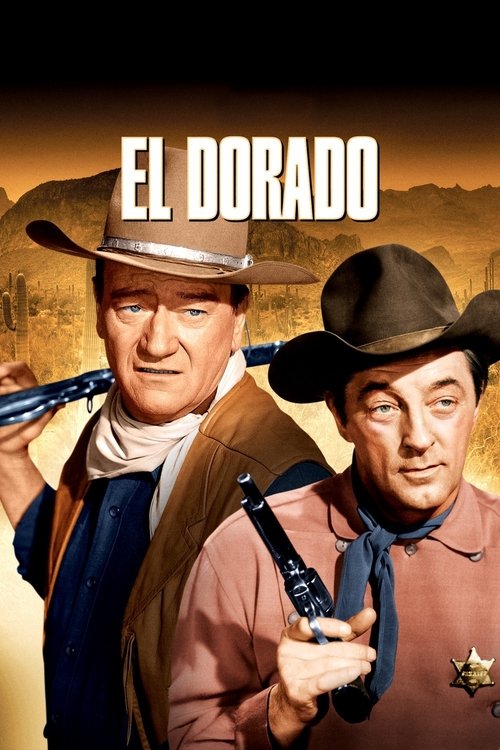
As the sun begins to set over the dusty town of El Dorado, the tension in the air is palpable. The final confrontation is set to unfold, and the stakes have never been higher. Cole Thornton, played by John Wayne, stands resolute, his face etched with determination and weariness. He has fought hard for what is right, and now he prepares for the ultimate showdown against Bart Jason, the ruthless rancher who has terrorized the town.
The scene opens with Thornton and his loyal friend, the aging sheriff J.P. Hara, portrayed by Robert Mitchum, strategizing in the dim light of the sheriff's office. Hara, despite his injuries and age, is steadfast, his loyalty to Thornton unwavering. They know that the odds are against them, but their bond and shared history fuel their resolve. Mississippi, the young and brash gunfighter played by James Caan, is eager to prove himself, his youthful bravado shining through as he readies himself for the fight ahead.
As they step out into the street, the atmosphere is thick with anticipation. The townsfolk, who have suffered under Jason's tyranny, watch with a mix of hope and fear. The camera captures the worried faces of the townspeople, emphasizing the stakes of this confrontation. The trio approaches the saloon where Jason and his men are holed up, the tension building with each step.
The showdown erupts in a flurry of gunfire. Thornton, Hara, and Mississippi engage in a fierce battle against Jason's men. The choreography of the gunfight is intense, with bullets flying and dust swirling around them. Thornton's experience shines through as he takes down several of Jason's henchmen with precision, while Mississippi's youthful energy adds a dynamic flair to the fight. Hara, despite his injuries, proves his worth, covering his friends and taking out a few adversaries himself.
As the dust settles, the remaining members of Jason's gang are either dead or fleeing. Bart Jason, cornered and desperate, faces Thornton in a final confrontation. The tension is thick as they exchange words, revealing Jason's arrogance and Thornton's unwavering sense of justice. In a climactic moment, Thornton draws his gun and shoots Jason, bringing an end to his reign of terror.
With the battle won, the aftermath reveals the toll it has taken on the characters. Hara, though victorious, is visibly aged and weary, his body bearing the scars of the fight. He reflects on the cost of their victory, knowing that the peace they fought for comes with sacrifices. Mississippi, exhilarated by the fight, realizes that he has found his place among these seasoned gunslingers, a sense of belonging washing over him.
As the sun sets, casting a warm glow over the town, Thornton makes the difficult decision to leave El Dorado. He understands that his journey is not over, and he must continue to seek his own path. Hara, now the sheriff of a town that can finally breathe easy, watches Thornton ride away, a mix of pride and sadness in his eyes. Mississippi, having proven himself, is left with a newfound sense of purpose, ready to forge his own destiny.
The film closes with a poignant sense of resolution. The characters have faced their demons, fought for justice, and emerged changed. Each of them has found a new direction, symbolizing the enduring spirit of friendship and the quest for a better life in the face of adversity. The final shot lingers on the horizon, hinting at the adventures that lie ahead for Thornton and the others, leaving the audience with a sense of hope and possibility.
Is there a post-credit scene?
The movie "El Dorado," produced in 1966, does not have a post-credit scene. The film concludes with the resolution of the main plot, focusing on the characters of Cole Thornton, played by John Wayne, and his friend, the sheriff J.P. Hara, portrayed by Robert Mitchum. The story wraps up as they confront the challenges posed by the villainous Bart Jason and his gang, leading to a climactic showdown. After the final confrontation, the film ends without any additional scenes or epilogues during or after the credits.
What motivates the character of Cole Thornton to help the sheriff in El Dorado?
Cole Thornton, played by John Wayne, is a former gunfighter who is drawn back into action by his sense of loyalty and friendship. When he learns that his old friend, Sheriff J.P. Hara (played by Robert Mitchum), is in trouble with a powerful rancher named Bart Jason, Thornton feels a moral obligation to assist him. His motivations are further complicated by his own past and the desire to prove himself once more, showcasing his internal struggle between a peaceful life and the call of his old ways.
How does the relationship between Cole Thornton and Mississippi evolve throughout the film?
Mississippi, portrayed by James Caan, is a young, brash gunfighter who idolizes Cole Thornton. Initially, Mississippi is eager to prove himself and gain Thornton's respect. As the story progresses, their relationship deepens; Mississippi learns from Thornton's experience and wisdom, while Thornton begins to see Mississippi as a younger version of himself. Their bond is tested during confrontations with Bart Jason's men, and ultimately, Thornton becomes a mentor figure, guiding Mississippi through the complexities of honor and friendship.
What role does the character of Sheriff J.P. Hara play in the conflict with Bart Jason?
Sheriff J.P. Hara, played by Robert Mitchum, is a central figure in the conflict against Bart Jason, a ruthless rancher who seeks to control the town. Hara represents law and order, but he is also portrayed as a man struggling with his own limitations and the weight of his responsibilities. His determination to protect the town and its people drives the narrative, as he faces overwhelming odds. Hara's character embodies the theme of resilience, as he stands firm against Jason's intimidation tactics, ultimately relying on Thornton's help to confront the escalating violence.
What is the significance of the final showdown between Cole Thornton and Bart Jason?
The final showdown between Cole Thornton and Bart Jason is a climactic moment that encapsulates the film's themes of honor, loyalty, and the consequences of violence. As tensions reach their peak, Thornton confronts Jason in a dramatic duel that not only tests his skills as a gunfighter but also serves as a resolution to the conflict that has been brewing throughout the film. This confrontation is significant as it represents Thornton's return to his roots as a gunslinger, while also highlighting the personal stakes involved--protecting his friends and the town from Jason's tyranny.
How does the character of Bart Jason embody the antagonist role in El Dorado?
Bart Jason, played by Edward Asner, embodies the antagonist role through his ruthless ambition and willingness to use violence to achieve his goals. He is depicted as a powerful rancher who seeks to dominate the town and eliminate any opposition, particularly Sheriff Hara and Cole Thornton. Jason's character is marked by a cold, calculating demeanor, and his interactions with other characters reveal his manipulative nature. His presence creates a palpable tension throughout the film, as he represents the lawlessness and corruption that Thornton and Hara must confront, making him a formidable foe.
Is this family friendly?
"El Dorado," produced in 1966, is generally considered a Western film that may not be entirely family-friendly due to some mature themes and content. Here are some potentially objectionable or upsetting aspects that could affect children or sensitive viewers:
-
Violence: The film contains several scenes of gunfights and brawls, which may be intense for younger audiences. The portrayal of violence is typical of Westerns, with characters facing life-threatening situations.
-
Alcohol Use: The character of J.P. Hara, played by Robert Mitchum, is depicted as a heavy drinker, and there are scenes in saloons that showcase drinking and its consequences.
-
Death: The film includes themes of mortality, with characters facing death and the emotional weight that comes with it. This may be distressing for younger viewers.
-
Mature Themes: The story involves complex relationships, including loyalty, betrayal, and the struggles of friendship, which may be difficult for children to fully understand.
-
Language: There are instances of mild profanity and rough language that may not be suitable for all audiences.
While the film has comedic elements and strong character dynamics, these aspects may warrant caution for families considering it for younger viewers.









