
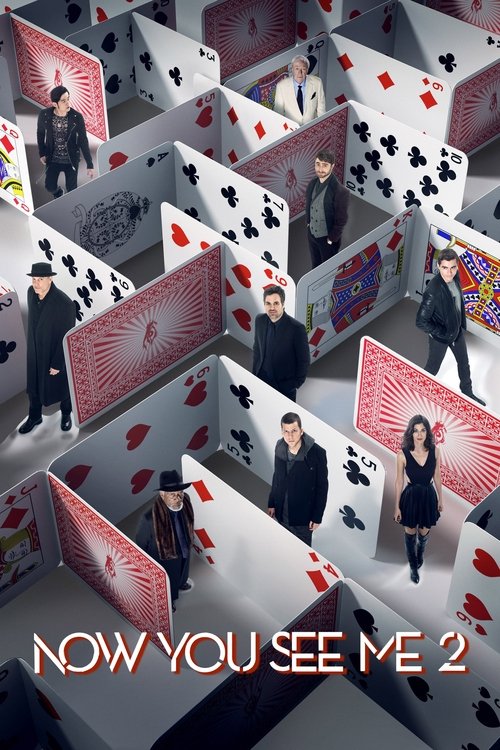























Popular
What is the significance of the Eye of Horus in Now You See Me 2?
How does the character of Daniel Atlas evolve throughout the film?
What role does Lula play in the dynamics of the Four Horsemen?
What is the relationship between Walter Mabry and the Four Horsemen?
How does the heist involving the data chip unfold in the film?
Should I watch it?
Ask Your Own Question

What is the plot?
Eighteen months after their daring escape from the FBI, the Four Horsemen--J. Daniel Atlas, Merritt McKinney, Jack Wilder, and their newest member, Lula May--are living as fugitives, their lives shadowed by secrecy and constant evasion. They await instructions from their mysterious overseers, the secret society known only as The Eye. Their handler, FBI Special Agent Dylan Rhodes, who walks a fine line between law enforcement and clandestine allegiance, contacts them with a new mission: expose the corrupt tech mogul Owen Case, whose latest smartphone launch hides a sinister secret. This device covertly harvests users' personal data to sell on the black market, threatening global privacy.
The film opens in New York City, where the Horsemen infiltrate the high-profile launch event of Owen Case's new phone. The atmosphere is electric, a blend of glamour and cutting-edge technology, but the Horsemen's intentions are far from celebratory. As they execute their signature spectacle--an intricate illusion designed to reveal Case's duplicity--the event is abruptly interrupted. A mysterious figure broadcasts to the public that Jack Wilder, presumed dead, is very much alive, and that Dylan Rhodes is covertly working with the Horsemen. This revelation fractures their fragile anonymity and escalates the FBI's pursuit. Dylan narrowly evades capture, while the Horsemen escape through a construction chute, disappearing into the urban maze.
Their flight leads them unexpectedly to Macau, a city of neon lights and towering casinos, where their world shifts from public spectacle to a perilous game of survival. Here, they are captured not by the FBI, but by a new adversary: Chase, Merritt McKinney's vindictive twin brother, and Walter Mabry, a ruthless tech prodigy and Owen Case's former business partner. Mabry, whose face is sharp and calculating, reveals a bitter vendetta--Case stole his company and the revolutionary chip he designed, the Octa chip, capable of accessing any computer system worldwide. Mabry coerces the Horsemen into stealing this chip from Case before it can be sold, using only tools from a local magic shop run by Li, a master magician, and his grandmother Bu Bu. Despite their mistrust, Daniel agrees, hoping to outwit Mabry and protect the chip from falling into the wrong hands.
The tension escalates as the Horsemen infiltrate the high-security tech facility in Macau. In a dazzling display of sleight of hand and teamwork, they execute a breathtaking card toss sequence, passing a tiny flash drive unnoticed among dozens of cards, evading intense scrutiny. The scene is a masterclass in visual storytelling, the camera tracking the cards with razor-sharp focus, the audience holding their breath as the chip changes hands without detection. Yet, as Daniel secures the chip, Mabry confronts him with a chilling revelation: he had deceived Daniel into believing Mabry was connected to The Eye, the secret society guiding their missions. A brutal fight ensues, Daniel narrowly escaping with the chip.
Meanwhile, Dylan is captured and taken to a yacht where Mabry and Arthur Tressler--Dylan's former employer and Mabry's father--hold him prisoner. Tressler, a powerful businessman with a cold demeanor, reveals the dark truth behind Dylan's past. Dylan's father, Lionel Shrike, was a magician who drowned during a trick gone wrong, a tragedy Dylan has long blamed on Thaddeus Bradley, the famed magic debunker. Now, Tressler and Mabry echo this cruelty by locking Dylan in a safe and drowning him, mirroring Lionel's death. The water closes in, tension mounting as Dylan struggles for air, his face a mask of desperation and determination. Against all odds, he escapes, rescued by the Horsemen who arrive just in time.
However, the chip they possess turns out to be a fake, a cruel bait set by Mabry. Realizing the true Octa chip remains in Mabry's hands, the Horsemen regroup with renewed resolve. Joined by Li and Bu Bu from the magic shop, they plan a final, audacious spectacle in London on New Year's Eve. Their performance is not just entertainment--it is a trap designed to expose Mabry's crimes to the world.
As midnight approaches, the Horsemen take to the streets of London, performing a series of illusions that captivate the city. The tension is palpable, the air thick with anticipation. Mabry, Arthur Tressler, and Chase arrive on a private jet, intent on seizing the chip and ending the Horsemen's interference. The confrontation aboard the jet is intense; Mabry demands the chip, and the Horsemen reluctantly surrender the fake. Then, in a shocking moment, Mabry's henchmen throw Dylan and the Horsemen out of the plane, expecting them to plummet to their deaths.
But the fall is an illusion. The jet is a set floating on the Thames, a masterstroke of deception orchestrated by the Horsemen and Dylan. As they reveal how Jack hypnotized Chase to facilitate their escape, the villains' shock turns to fury. The Horsemen broadcast Mabry, Tressler, and Chase's crimes live worldwide, their faces displayed for all to see as FBI agents move in to arrest them. The Horsemen vanish into the crowd, their freedom intact.
The story culminates beneath the Greenwich Observatory, where the Horsemen enter a hidden chamber to meet other members of The Eye. Here, the true mastermind is unveiled: Thaddeus Bradley, the magic debunker Dylan once blamed for his father's death. Bradley reveals that he was Lionel Shrike's partner and that much of what Dylan believed was a carefully constructed illusion. The Eye has been guiding the Horsemen all along, preparing them for greater challenges ahead.
As the camera pulls back, the Horsemen stand united, no longer fugitives but initiates of a secret world of magic and mystery. The screen fades with the promise that the game is far from over, and the greatest illusions are yet to come.

What is the ending?
In the ending of "Now You See Me 2," the Four Horsemen confront their nemesis, Walter Mabry, who has manipulated them into performing a heist. They manage to outsmart him, revealing that they have been working with the FBI agent, Dylan Rhodes, who is also revealed to be the son of the original mastermind, Lionel Shrike. The film concludes with the Horsemen escaping Mabry's clutches, and they decide to continue their journey as a team, embracing their roles as illusionists and champions of justice.
Now, let's delve into the ending in a more detailed, chronological narrative.
As the climax unfolds, the Four Horsemen--J. Daniel Atlas, Merritt McKinney, Jack Wilder, and Lula--find themselves in a precarious situation. They are trapped in a high-stakes game orchestrated by Walter Mabry, a tech-savvy villain who has taken control of their actions. Mabry forces them to steal a powerful chip that can control any digital device, threatening their lives and the lives of their loved ones.
In a tense confrontation, the Horsemen realize they must rely on their skills and teamwork to escape Mabry's clutches. They devise a plan to turn the tables on him. As they execute their elaborate ruse, the audience is treated to a series of breathtaking illusions and clever misdirections that showcase their mastery of magic and deception.
Dylan Rhodes, the FBI agent who has been a constant presence throughout their journey, plays a crucial role in the climax. He reveals his true allegiance, having been working with the Horsemen all along. This revelation adds a layer of complexity to his character, as he is not just an agent but also the son of Lionel Shrike, the original mastermind behind the Horsemen's creation. This connection to his father's legacy drives Dylan to help the Horsemen succeed.
In a dramatic showdown, the Horsemen manage to outsmart Mabry, using their skills to turn his own technology against him. They expose his plans to the authorities, ensuring that he will face justice for his crimes. The tension peaks as they narrowly escape his grasp, showcasing their resilience and ingenuity.
As the dust settles, the Horsemen regroup, reflecting on their journey and the bonds they have formed. They decide to continue their mission as a team, embracing their roles as illusionists who fight for justice. The film closes with a sense of camaraderie and purpose, as they prepare for their next adventure.
In terms of character fates, J. Daniel Atlas emerges as a confident leader, having solidified his place within the group. Merritt McKinney, with his wit and charm, remains a vital part of the team, while Jack Wilder showcases his resourcefulness and bravery. Lula, the newest member, proves her worth and finds her place among the Horsemen. Dylan Rhodes, now fully embracing his identity, stands alongside them, ready to face whatever challenges lie ahead.
The film concludes with a sense of hope and excitement for the future, as the Four Horsemen ride off into the unknown, united in their quest for justice and magic.
Is there a post-credit scene?
Yes, "Now You See Me 2" features a post-credit scene.
In this scene, we see a dimly lit room where a mysterious figure is seated at a table, shrouded in shadows. The camera slowly zooms in, revealing that it is none other than the character of Thaddeus Bradley, played by Morgan Freeman. He is seen in a contemplative mood, reflecting on the events that have transpired.
As the scene unfolds, Thaddeus is approached by a new character, who is revealed to be a member of the Eye, the secret society of magicians. This character presents Thaddeus with a proposition, hinting at a larger conspiracy and the potential for further involvement with the Eye. The atmosphere is tense, filled with intrigue and the promise of more magic and deception to come.
The scene leaves viewers with a sense of anticipation, suggesting that the story of the Four Horsemen and their battles against powerful adversaries is far from over. The post-credit moment serves as a tantalizing tease for potential future developments in the franchise, emphasizing themes of loyalty, betrayal, and the ever-present allure of magic.
What is the significance of the Eye of Horus in Now You See Me 2?
The Eye of Horus is a central symbol in Now You See Me 2, representing knowledge, protection, and royal power. It is tied to the character of Walter Mabry, who uses it as a motif for his control over the Four Horsemen. The Eye also symbolizes the overarching theme of surveillance and manipulation, as Mabry watches the Horsemen closely, using the symbol to assert his dominance and to manipulate events to his advantage.
How does the character of Daniel Atlas evolve throughout the film?
Daniel Atlas, played by Jesse Eisenberg, begins the film feeling disillusioned and frustrated after the events of the first movie. He grapples with his role as a leader and the pressure of living up to the expectations of the public and his fellow Horsemen. As the story progresses, he learns to trust his team more and embraces the idea of collaboration over individualism. His emotional journey culminates in a moment of self-realization when he understands that true magic lies in teamwork and friendship.
What role does Lula play in the dynamics of the Four Horsemen?
Lula, portrayed by Lizzy Caplan, is introduced as a new member of the Four Horsemen, replacing the character of Henley. Her character brings a fresh perspective and a unique set of skills, particularly in the realm of illusion and misdirection. Initially, she struggles to fit in with the established group, but as the plot unfolds, she proves her worth and becomes an integral part of the team. Lula's emotional journey involves overcoming her insecurities and finding her place among the Horsemen, ultimately showcasing her strength and creativity.
What is the relationship between Walter Mabry and the Four Horsemen?
Walter Mabry, played by Daniel Radcliffe, is the film's antagonist and has a complex relationship with the Four Horsemen. He is a tech mogul who seeks to control the Horsemen and exploit their talents for his own gain. Mabry's motivations are rooted in a desire for power and revenge against the Horsemen for their previous actions. His relationship with them is marked by manipulation and deceit, as he uses threats and coercion to force them into performing a heist for him, showcasing his cunning and ruthless nature.
How does the heist involving the data chip unfold in the film?
The heist involving the data chip is a pivotal plot point in Now You See Me 2. The Four Horsemen are coerced into stealing a powerful data chip that can control a vast amount of information. The heist unfolds with intricate planning and elaborate illusions, showcasing the Horsemen's skills in misdirection and magic. As they execute the plan, they face numerous challenges, including Mabry's surveillance and unexpected twists. The tension builds as they navigate through high-tech security measures, ultimately leading to a thrilling climax where their teamwork and ingenuity are put to the test.
Is this family friendly?
"Now You See Me 2" is rated PG-13, which suggests that some material may be inappropriate for children under 13. Here are some potentially objectionable or upsetting aspects that might occur in the film:
-
<li>
Violence and Threats: There are scenes that involve physical confrontations, threats, and moments of tension that could be intense for younger viewers.
li> <li>Mild Language: The film contains some instances of mild profanity, which may not be suitable for all children.
li> <li>Deception and Manipulation: The central theme revolves around magic and deception, which may be unsettling for sensitive viewers, especially regarding trust and betrayal among characters.
li> <li>Intense Situations: Characters find themselves in high-stakes scenarios that involve danger, which could be anxiety-inducing for some audiences.
li> <li>Emotional Conflict: There are moments of emotional distress and conflict among characters that may resonate deeply, potentially upsetting younger or more sensitive viewers.
li>Overall, while the film is entertaining and visually engaging, parents may want to consider these elements when deciding if it is appropriate for their children.








