
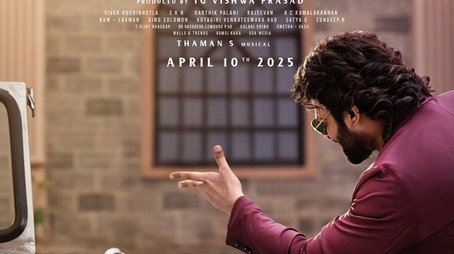


Loading additional questions...
Ask Your Own Question

What is the ending?
In the ending of The Raja Saab, RajaSaab finally breaks free of his grandfather Kanakaraju's control inside the haunted mansion by awakening a hidden, immense power within himself. Using this strength, he pulls everyone into a warped, parallel reality where he is finally able to overpower and defeat Kanakaraju. After RajaSaab rescues Bessy and Bhairavi and the group prepares to leave, a sinister, joker-like figure who looks exactly like RajaSaab appears in the shadows, hinting that the dark legacy of the family is not over and setting up their story for a sequel.
Now, the ending in a longer, step‑by‑step narrative:
Inside the haunted mansion, night has settled heavily over the estate. The halls are dim, lit only by scattered lamps and the pale wash of moonlight that slips through cracked windows. RajaSaab, Bessy, and Bhairavi are trapped deep within the building, confined by Kanakaraju's presence and the inexplicable, shifting architecture of the house itself. Every time they try a door, it loops them back to the same corridor. The air feels thick, and the three move cautiously, tired and tense.
RajaSaab's face shows the strain of the journey and the shock of what he has learned: the grandfather he has been searching for is not a victim, not a lost old man to be rescued, but the very architect of their suffering. Earlier, Kanakaraju revealed that his disappearance was deliberate, a planned vanishing meant to pull RajaSaab to this place and into his trap. That knowledge sits like a weight in RajaSaab's chest as he leads Bessy and Bhairavi through the mansion, knowing that the man he once imagined as a memory in his grandmother's dreams is now their direct enemy.
Bessy, the devout nun whom RajaSaab loves, walks close to him, clutching a small cross in her hand. Her fear shows in the way her eyes dart to every sound, but she stays beside him, trusting him to find a way out. Bhairavi, the thief's granddaughter who has thrown in with RajaSaab, moves more briskly, trying to mask her own unease with a show of stubborn courage. She scans for exits, windows, any weak point in the house's strange design.
At one point they reach what appears to be the main hall, only to find that the doors out are sealed by an invisible force. The mansion itself feels like an extension of Kanakaraju's will. No matter what they try--pushing, pulling, even attempting to break through--nothing yields. The sound of their effort echoes through the house.
In this desperation, they reach out to the one person they believe can counter the force gripping the mansion: Specialist Padmabhushan, an expert in dealing with supernatural and dangerous entities. Somewhere off-screen in the story's timeline, Padmabhushan is contacted and brought to the mansion. The film's focus returns as he arrives at the estate, stepping through the creaking main door with a sense of wary confidence. He brings tools, knowledge, and the assurance of experience, and for a brief stretch, RajaSaab, Bessy, and Bhairavi allow themselves to hope.
Padmabhushan surveys the mansion, senses the weight of Kanakaraju's influence over the place, and begins his work. He attempts to confront the presence, employing whatever rituals, methods, or psychological tactics he has mastered. RajaSaab, Bessy, and Bhairavi watch him with mixed anxiety and expectation, waiting for the atmosphere to change, for the invisible barrier to weaken.
Instead, what follows is a swift demonstration of Kanakaraju's superiority. The grandfather's powers--whether supernatural, psychological, or some blend of both--completely overwhelm Padmabhushan. The specialist's confidence breaks as the house responds violently to his efforts: lights flicker, sounds rise from nowhere, and the oppressive force in the mansion tightens. Whatever he attempts, Kanakaraju counters with ease. The confrontation ends quickly and decisively, with Padmabhushan defeated and effectively removed from the fight, leaving RajaSaab and his companions more isolated than before.
In the aftermath of Padmabhushan's failure, the atmosphere becomes heavier. RajaSaab feels cornered. He has discovered his grandfather's cruelty and manipulation; he has seen an expert fail; he is enclosed within a mansion that moves and breathes with Kanakaraju's will. Bessy and Bhairavi look to him--Bessy with quiet, pleading faith, Bhairavi with tense, impatient urgency. There is no one else left to rely on.
Pushed to his absolute limit, something changes inside RajaSaab. The story draws the focus tightly onto him as he confronts Kanakaraju more directly. Whether this confrontation is face to face in a single looming room of the mansion or across the shifting spaces of the house, the tension centers around their blood tie: grandson against grandfather. Kanakaraju stands as the orchestrator of everything, still confident, still controlling.
At that breaking point, RajaSaab reaches deep and taps into a hidden reservoir of strength the film has hinted at but not fully shown until now. This "mighty strength" is not merely physical. As it awakens, it begins to affect the environment itself. The mansion, already unreal, starts to distort even further. Walls stretch or ripple, shadows shift, and the world around them appears to bend.
RajaSaab's power grows so intense that it warps reality and creates a parallel world--a shifted dimension layered over or beside the original. The characters, willingly or not, are pulled into this altered space. The mansion is still present, but its details twist: angles are wrong, light moves strangely, and the sense of time feels loosened. Inside this new dimension, RajaSaab is no longer merely a victim; his awakened strength gives him a measure of control he did not possess before.
Within this parallel reality, the final confrontation plays out. Kanakaraju still wields formidable power, but for the first time, he is not completely dominant. RajaSaab's newfound abilities let him counter moves that previously felt unstoppable. The clash unfolds with RajaSaab and Kanakaraju facing off, their conflict now not just a family dispute, but a battle that shapes the very space they occupy. The fate of RajaSaab, Bessy, and Bhairavi hangs on this struggle.
Scene by scene, the momentum turns. The distorted mansion bears the marks of their battle as RajaSaab pushes harder, using the altered reality itself as a tool. Kanakaraju's long-prepared plan--his disappearance, the trap, the manipulation of the mansion--begins to falter under his grandson's resistance. Finally, within this warped dimension, RajaSaab succeeds in overpowering and defeating Kanakaraju. The grandfather's threat--his control over the house and over RajaSaab's fate--is broken.
With Kanakaraju's defeat, the parallel world begins to settle. The mansion's extreme distortions ease. The invisible grip that kept them imprisoned loosens. RajaSaab, Bessy, and Bhairavi are freed from the estate's hold. Step by step, they move away from the heart of the mansion, emerging from the twisted corridors to spaces that feel more stable, more grounded. The doors that once refused to open now yield.
As they come out, the film allows a moment of relief. RajaSaab stands with the weight of victory and exhaustion on his shoulders. He has uncovered the truth about his grandfather, survived the manipulation of the haunted mansion, and found within himself a power that allowed him to protect those with him. Bessy, alive and safe, remains by his side, her devotion intact after sharing the ordeal. Bhairavi, also surviving the nightmare, stands with them, a partner who has gone from an opportunistic ally to a true companion in the struggle.
From a purely factual standpoint at this stage: - RajaSaab is alive, having awakened and used a mighty, reality‑warping power to defeat Kanakaraju in a parallel world. - Bessy is alive and free of the mansion, remaining one of the close figures at RajaSaab's side as they leave. - Bhairavi is alive as well, having helped through the quest and now sharing in their escape. - Kanakaraju has been defeated by RajaSaab within the altered dimension and no longer holds power over the mansion or the group.
As the dust seems to settle and the group prepares to move on from the estate, the film introduces its final, unsettling image. Somewhere near the mansion--just beyond the immediate awareness of RajaSaab and his companions--a mysterious figure is present. He is dressed in joker-like attire, and his face, his bearing, his overall appearance closely resemble RajaSaab himself. He lingers in the shadows, not stepping fully into the light, watching.
This joker-like double does not announce himself to RajaSaab, Bessy, or Bhairavi. The scene is presented as something the audience sees but the central trio does not react to. His presence suggests a continuing thread tied to RajaSaab's bloodline and to the power that was awakened within him. The film closes on this image of the lookalike figure, leaving the ultimate future of RajaSaab's family and the true extent or consequences of his newfound strength open to future exploration.
In concrete terms, by the end of the story's last scenes: - RajaSaab survives the events of the haunted mansion and defeats his grandfather in a parallel reality. - Bessy survives and departs the mansion alongside RajaSaab. - Bhairavi survives and leaves the mansion with them. - Kanakaraju is defeated and stripped of his controlling role in the mansion and over RajaSaab's fate. - A joker-like figure, who looks like RajaSaab, appears separately in the shadows near the end, hinting at an unresolved or emerging threat connected to RajaSaab's lineage and teasing the continuation of their story in the announced sequel.








Who dies?
Based on available plot summaries and reviews of The Raja Saab (2026), no major reviews or synopses describe any character's explicit on‑screen death, and none list a body count or name specific characters who die.
Key points, tied to what is known of the story:
- Kanakaraju (the missing grandfather) is revealed as the architect of the trap in the haunted mansion and is ultimately "overpowered and defeated" by RajaSaab after the hero taps into a parallel‑world‑creating power, but the sources do not describe Kanakaraju as being killed or shown dying; his exact fate is left ambiguous, framed more as a supernatural/psychological defeat than a confirmed death.
- Ganga Devi (the grandmother) is central to the emotional core of the film and has advanced Alzheimer's, but again, no synopsis or review mentions her dying during the narrative; the drama revolves around her vulnerability and past, not her death.
- Supporting characters, including Bessy, Bhairavi, and Specialist Padmabhushan, are placed in danger and, in Padmabhushan's case, "swiftly defeated" by Kanakaraju's powers, yet there is no explicit statement that any of them are killed.
Because none of the detailed reviews or the full-story synopsis catalogue any concrete deaths, and because the climax emphasizes supernatural defeat, reality‑warping, and an ominous joker‑like figure rather than funerals or sacrifices, the safest accurate answer is:
As far as current public information goes, The Raja Saab does not have any clearly documented character deaths, and there is no reliable, detailed account of a named character's death (who, why, when, how) in the released plot descriptions.
Is there a post-credit scene?
There is no traditional mid- or post‑credits scene in The Raja Saab, but the end credits do contain a clear on‑screen sequel announcement confirming The Raja Saab Part 2 rather than any additional narrative footage.
Once the climax ends, the film cuts directly into the rolling credits and does not return to any new story beat, cameo, or action gag after the credits finish. Some early fan chatter and review thumbnails referred to a "post‑credit scene," but these are describing the way the film teases a continuation--specifically a title‑card style confirmation that "The Raja Saab Part 2" is coming--rather than an actual filmed stinger with characters and dialogue.