





Popular
What is the significance of the witch's mark in the story?
How does the protagonist, a young woman named Sarah, discover her family's history with witchcraft?
What role does the character of the mentor play in Sarah's journey?
How does Sarah's relationship with her friends change as the story progresses?
What are the consequences of Sarah's actions as she embraces her witch heritage?
Should I watch it?
Ask Your Own Question

What is the plot?
Jordyn's eighteenth birthday begins as a small, uneasy family gathering and ends as the first rupture in a life she has never really understood. She has grown up as an orphan, raised by her guardian Aunt Ruth, and she has spent year after year wanting only one thing: to know where she comes from and who her mother was. On this night, the question feels especially sharp because she is no longer a child, and the film frames her birthday as the exact point where hidden bloodlines start to surface. The house is crowded only by a few familiar faces: Aunt Ruth, Jordyn's boyfriend Donny, and her friend Kym, all gathered around a cake and candles in what should be an ordinary celebration. Jordyn blows out the candles with a wish that is not selfish or extravagant, just desperate and human, a wish to know her mother and the truth of her birth. That wish hangs in the air like a prayer, and Aunt Ruth's reaction immediately turns the scene sour, as if she already knows what the night is about to unleash.
Before anyone can settle back into the party, Aunt Ruth suddenly grabs a butcher knife and plunges it into her own stomach or chest, spraying blood and horrifying everyone in the room. She does not die, but the act is so shocking and violent that it transforms the birthday gathering into a nightmare in seconds. In some accounts, Ruth's outburst is accompanied by cryptic words and a cry that amounts to "It's time!" The moment is not just a breakdown; it is a signal that something long buried has reached its breaking point. Jordyn is left stunned, her face stripped of the comfort of childhood and the illusion that Aunt Ruth's guardianship has been simple or loving without complication. Ruth is taken away in an ambulance and likely into psychiatric care, leaving Jordyn alone with the blood-soaked wreckage of her birthday and the first real crack in the story she has always been told about herself.
Once Ruth is gone, Jordyn's world begins to fray almost immediately. The film shifts into a dreamlike, unstable rhythm where ordinary spaces start to feel contaminated by a larger, invisible force. Jordyn begins having vivid nightmares, disorienting visions, and a rising sense that her own thoughts and body are no longer fully hers. The streets, her workplace, and other public places stop feeling safe, because the threat follows her everywhere rather than remaining anchored to the house where the birthday disaster began. The visual language becomes increasingly surreal: distorted imagery, black-robed figures, flashes of ritual, and a sense that reality is sliding just out of reach. Jordyn starts waking up in places she does not remember going, and her friends begin noticing behavior she cannot explain or recall. The film makes clear that her confusion is not ordinary stress after trauma; something external is actively invading her life.
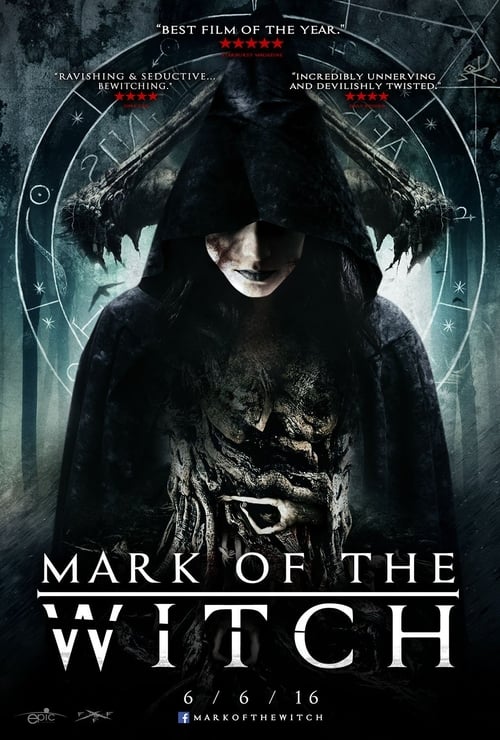
That something takes shape as a mysterious woman in black, played by Maria Olsen, who begins appearing wherever Jordyn goes. At first she seems like a stalking presence, a grotesque stranger lurking at the edge of sight, but the film gradually reveals her as a malevolent witch rather than a random menace. One of the clearest confrontations happens when the woman appears at Jordyn's workplace during a late-night shift, closes the distance, and scratches Jordyn's forearm hard enough to draw blood, leaving claw-like marks that function as the film's title image, the "mark of the witch." The act is intimate and invasive, not simply an attack but a ritualistic claim. Jordyn's body is no longer just her own; it has been touched, marked, and singled out. The scratch is more than a wound. It is the point where the haunting becomes physical proof that the stalking woman has power over her.
From that moment on, Jordyn's descent accelerates. She wanders through town in a state of dread, her surroundings becoming warped by hallucinations and intrusive sensations that make it impossible for her to tell what is memory, dream, or manipulation. The film repeatedly suggests that her body is being steered toward desires, behaviors, and experiences she does not consciously choose, and that the witch is in some way pulling the strings from behind the scenes. Her sense of self starts to unravel. She is not just afraid that someone is following her; she is terrified by the possibility that she herself may be changing into someone else. The title's implication becomes clearer: the "mark" is both a curse and a sign of ownership, a supernatural branding that binds her to a fate she has not consented to.
As Jordyn searches for an explanation, the film begins revealing the buried family mystery that has haunted her since infancy. She has been raised to believe she is simply an orphan whose mother died long ago, but that identity is false in its simplicity. The truth is tied to a coven and to a dark occult lineage concealed from her for years. One opening version of the story suggests that the film begins even earlier, with a black-robed ritual involving a baby, visually implying that Jordyn's life has been entwined with witchcraft since the beginning. Whether the ritual is remembered as a prologue, a symbolic memory, or a buried origin, its function is the same: it establishes that Jordyn's birth is not accidental or ordinary. She is not merely a young woman haunted by a stranger. She is the child around whom a larger supernatural conspiracy has formed.
The most important revelation is that Jordyn's mother did not simply disappear from the story; her death and Jordyn's birth are part of the same sinister secret. Jordyn has long wanted to know her mother, but the answer is tied to death, ritual, and a lineage she was never meant to understand. The witch stalking her is not acting out of random malice. She is connected to the coven and to Jordyn's hidden inheritance, and the film frames her as a doppelganger-like force determined to destroy Jordyn's life and insert herself into Jordyn's place. The threat is not only that Jordyn will be killed. It is that her identity can be overwritten, her body commandeered, and her life continued by something ancient and evil inhabiting her skin. The horror of the film lies in that replacement fantasy, where possession becomes a form of theft more intimate than murder.
Jordyn's encounters with the witch are never clean or conventional. They unfold as fragments, shocks, and distortions. The woman appears, vanishes, and reappears, as if she is slipping through the seams of the world rather than moving through it normally. Jordyn's social relationships begin to collapse under the strain. Donny and Kym cannot fully bridge the gap between what Jordyn is experiencing and what they can see, and the more isolated she becomes, the more the witch's influence seems to narrow in on her. The film's tension builds not through elaborate action scenes but through accumulation: repeated visions, repeated sightings, repeated reminders that Jordyn is trapped inside a story that has already been written for her.
The birthday aftermath also changes Aunt Ruth's role in the narrative. She stops being simply a protective guardian and becomes part of the mystery itself, because her outburst clearly comes from a place deeper than ordinary mental collapse. She has raised Jordyn since birth, and her knowledge of the truth seems to have been hidden for years under the guise of caretaking. By stabbing herself, she breaks the silence in the most violent way possible, but the film does not give Jordyn a neat explanation through Ruth afterward. Instead, Ruth's action functions as a gate opening onto the occult truth. She is not the final villain, but she is one of the keepers of the secret that Jordyn has been denied.
As the visions intensify, the film begins to blur the line between temptation and possession. Jordyn experiences heightened desire, strange impulses, and a growing sense that she is being seduced into surrendering herself to the witch's will. The horror is not just about fear; it is about contamination of the body, the mind, and even appetite itself. The witch is not content merely to stalk Jordyn from the shadows. She wants to occupy her, to live on forever by taking over Jordyn's body. That goal gives each of their encounters a terrible direction. Every appearance, every scratch, every nightmare is part of a campaign of invasion.
The closer Jordyn gets to the truth, the more the film presents her reality as a battleground between inheritance and resistance. She is "the baby in the ritual" in one reading, a child marked from the start, and she is "the devil's kin" in another, someone born into a curse rather than a normal family history. The exact metaphysical details are hazy by design, but the narrative logic is unmistakable: Jordyn belongs to an occult bloodline, and the witch wants to use that bloodline to complete a larger purpose. The film's imagery of black robes, ravens, and ritual spaces reinforces the sense that Jordyn is being watched by an older, impersonal evil that has been waiting for her adulthood to arrive. On her eighteenth birthday, the hidden machinery of that evil begins to move in earnest.
The climax of the story is less a single explosion than a final tightening of the trap around Jordyn. After all the stalking, the scratching, the visions, and the fragmented revelations, Jordyn is forced to confront the witch as the source of everything that has been happening to her. This is the central confrontation the film has been building toward, the face-to-face meeting between the girl who wants to know her origins and the supernatural figure who has stolen the meaning of those origins for herself. The witch's presence confirms the worst possibility: Jordyn is not simply being haunted by a dead relative or a random demon, but by a deliberate force tied to a coven and to the inheritance of her birth. The witch has not merely been watching. She has been preparing to take what is hers by occult right, and Jordyn's body is the prize.
The available source material does not preserve a scene-by-scene breakdown of the final battle, so the exact mechanics of the last confrontation are not fully recoverable from the record. What is clear is that the film closes with Jordyn having been driven deep into a surreal underworld of possession, identity crisis, and ancestral horror. The stalking woman's campaign leaves Jordyn shaken, marked, and transformed, and the narrative resolves around the revelation that her life has been shaped by a curse bound to her family and birth. There is no evidence in the available descriptions of a clean triumph over the witch, no confirmed series of additional deaths, and no reliable report of any character other than Aunt Ruth attempting self-destruction during the opening upheaval. The witch's objective is to insinuate herself into Jordyn's world and use Jordyn's body to live forever, and the film's ending leaves that threat at the center of the story's meaning.
In the final stretch, the emotional force of the film comes from Jordyn's realization that the truth she has wanted all her life is not liberating in any simple sense. Her mother's absence, her orphanhood, and Aunt Ruth's long silence have all been part of a concealed occult structure that has defined her from the beginning. The more she learns, the less stable her own identity becomes. She is no longer just a girl seeking her roots; she is the target of a predatory inheritance that treats her body as a vessel and her life as a site of replacement. That is why the film's horror lands so heavily. It turns the innocent longing to know where one comes from into a doorway for possession, corruption, and the collapse of self.
By the end, Jordyn remains alive, but she is deeply marked by everything that has happened to her. Aunt Ruth survives her stabbing, though she is removed from the center of the story and no longer functions as a safe guardian in any meaningful sense. Donny and Kym are left behind in a story that has moved beyond ordinary social life into occult destiny. The witch, meanwhile, has successfully transformed Jordyn's search for identity into a nightmare of inherited evil, and the film's resolution is defined less by victory than by revelation: Jordyn's life has been tied to the coven since birth, the woman in black is the embodiment of that curse, and the mark on Jordyn's arm is the visible sign that her body has become the battlefield. The last emotional note is one of contamination and dread, as if the truth Jordyn has uncovered may have condemned her as much as it has explained her.




What is the ending?
In the ending of "Mark of the Witch," the protagonist, a young woman named Sarah, confronts the dark forces that have been manipulating her life. After a series of harrowing events, she ultimately succumbs to the witch's influence, leading to a tragic conclusion where she becomes part of the very darkness she sought to escape.
As the film approaches its climax, Sarah finds herself in a desolate cabin, the atmosphere thick with tension and dread. The flickering candlelight casts eerie shadows on the walls, and the air is heavy with the scent of damp wood and decay. Sarah, visibly shaken and desperate, clutches a small, tattered book filled with spells and incantations, remnants of her family's dark past. Her heart races as she realizes the true nature of the witch's power and the sacrifices that have been made to maintain it.
In a pivotal scene, Sarah is confronted by her mother, who has been revealed to be a key figure in the witch's coven. The emotional weight of their reunion is palpable; Sarah's eyes brim with tears as she grapples with feelings of betrayal and confusion. Her mother, with a haunting calmness, explains the necessity of their lineage's connection to the witch, revealing that Sarah is destined to fulfill a dark prophecy. The tension escalates as Sarah's internal struggle becomes evident--she yearns for freedom but is drawn to the power that the witch offers.
As the confrontation intensifies, Sarah's resolve begins to waver. The witch's voice echoes in her mind, promising strength and control over her life. In a moment of vulnerability, Sarah succumbs to the temptation, chanting an incantation from the book. The atmosphere shifts dramatically; the cabin is engulfed in a swirling darkness, and the walls seem to pulse with a life of their own. Shadows dance around her, whispering secrets of power and revenge.
In the final moments, Sarah's transformation is complete. She stands at the center of the chaos, her eyes glowing with an otherworldly light. The witch's laughter fills the air, a chilling sound that reverberates through the cabin. Sarah's mother watches with a mix of pride and sorrow, knowing that her daughter has embraced the darkness. The camera lingers on Sarah's face, capturing the conflict within her--she is both terrified and exhilarated by her newfound power.
As the film concludes, the cabin is left in silence, the darkness slowly receding. Sarah, now fully aligned with the witch's legacy, steps out into the night, her silhouette framed against the moonlight. The fate of her mother remains uncertain, but it is clear that Sarah has chosen her path, one that intertwines her fate with the witch's curse. The screen fades to black, leaving the audience with a haunting sense of inevitability and the weight of the choices made.
In summary, Sarah's journey culminates in her acceptance of the witch's power, marking a tragic end for her character as she becomes a vessel for the darkness she once feared. The film closes on a note of ambiguity, leaving the audience to ponder the consequences of her decision and the legacy of the witch that will continue to haunt future generations.
Is there a post-credit scene?
In the movie "Mark of the Witch," there is no post-credit scene. The film concludes without any additional scenes or content after the credits roll. The story wraps up with the main narrative, focusing on the themes of witchcraft, family secrets, and the consequences of dark rituals, leaving the audience with a sense of closure regarding the characters' fates.
What is the significance of the witch's mark in the story?
The witch's mark in 'Mark of the Witch' serves as a symbol of the protagonist's connection to dark forces and her potential for witchcraft. It is a physical manifestation of her lineage and the curse that haunts her family, representing both a source of power and a burden that she must confront throughout the film.
How does the protagonist, a young woman named Sarah, discover her family's history with witchcraft?
Sarah uncovers her family's dark history when she finds an old journal belonging to her ancestor, which details rituals and the legacy of witchcraft that has plagued her lineage. This discovery is pivotal as it leads her to question her identity and the strange occurrences happening around her.
What role does the character of the mentor play in Sarah's journey?
The mentor, an enigmatic figure who appears to guide Sarah, plays a crucial role in her understanding of her powers and the dangers they pose. He provides her with knowledge about the rituals and the history of witchcraft, but his true intentions remain ambiguous, creating tension as Sarah navigates her newfound abilities.
How does Sarah's relationship with her friends change as the story progresses?
As Sarah becomes more entwined with her family's witchcraft legacy, her relationships with her friends begin to deteriorate. They grow increasingly concerned about her behavior and the strange events surrounding her, leading to feelings of isolation for Sarah as she grapples with her identity and the supernatural forces at play.
What are the consequences of Sarah's actions as she embraces her witch heritage?
As Sarah embraces her witch heritage, she experiences a surge of power that comes with dire consequences. Her actions lead to unintended harm to those around her, creating a moral conflict within her. This struggle highlights her internal battle between the allure of power and the responsibility that comes with it, ultimately shaping her character arc.
Is this family friendly?
"Mark of the Witch," produced in 2014, is not considered family-friendly due to its themes and content. Here are some potentially objectionable or upsetting aspects that may affect children or sensitive viewers:
-
Occult Themes: The film delves into witchcraft and dark magic, which may be unsettling for younger audiences or those sensitive to such topics.
-
Violence: There are scenes that depict violence, including physical confrontations and the aftermath of violent acts, which can be disturbing.
-
Supernatural Elements: The presence of supernatural occurrences and entities may evoke fear or anxiety in viewers, particularly children.
-
Psychological Tension: The film builds a sense of dread and psychological horror, which can be intense and unsettling.
-
Mature Themes: The narrative explores themes of possession, manipulation, and the impact of dark forces on individuals, which may be too complex or distressing for younger viewers.
Overall, the film's atmosphere and content are geared towards a mature audience, making it unsuitable for children or those who are sensitive to horror and dark themes.







