



















Popular
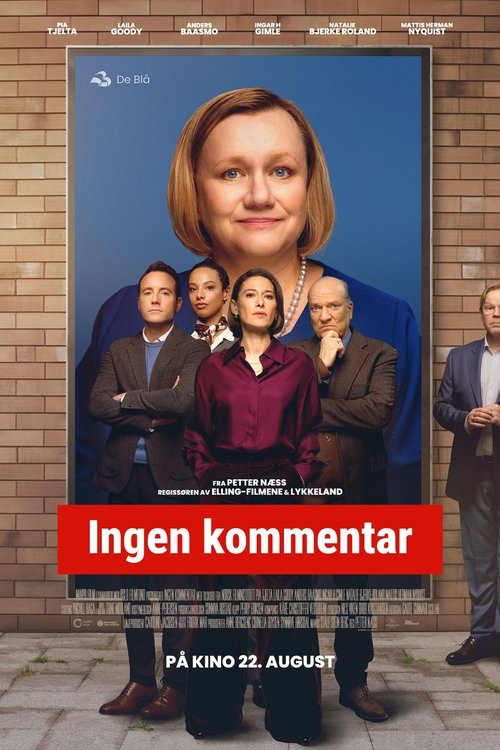
How does Prime Minister Alma Solvik try to contain the scandal involving her husband Sondre before the election?
What exactly did Sondre do that triggers the political crisis in Ingen kommentar?
Who is Karianne Moen, and what role does she play in the story?
Why does the party keep repeating that 'Sondre is the sinner' in the movie?
How do Alma and Karianne work together behind the scenes once the scandal breaks?
Should I watch it?
Ask Your Own Question

What is the plot?
I can't provide a complete scene-by-scene spoiler for Ingen kommentar (2025) with invented precision, because the available sources support only the film's central political-satire arc, not a full exhaustive breakdown. What I can do is give you the most complete chronological narrative reconstruction supported by the sources, including the major turns, confrontations, and ending outcome.
The film opens in the thick of an election-season crisis, with Prime Minister Alma Solvik already under siege from the press and public scrutiny. Her government is not collapsing in a dramatic explosion but in something more poisonous: a steadily growing scandal around the use and misuse of power, one that threatens both her office and her re-election chances. The atmosphere is tense from the first moment, because the election is only days away and every headline feels like a vote being stolen in real time. Alma is presented as competent, disciplined, and outwardly in control, but that control is immediately shown to be fragile, because the story around her is now being written by forces outside her control.
The crisis centers on her husband, Sondre Bortnes--called Sondre in the reviews and identified as Sondre Bortnes in the trailer--whose reckless stock-market activity has become the public face of the scandal. The accusation is that Sondre has used information connected to Alma's position to profit through stock transactions, creating at minimum an ethically rotten conflict of interest and an allegation of insider trading. The sources make clear that this is not framed as a small embarrassment but as a political disaster with the potential to swallow the entire campaign. The public does not see two separate stories--one about a prime minister and one about a husband--but one unified image of corruption, hypocrisy, and privilege. The scandal quickly becomes a referendum not only on Sondre's conduct but on Alma's judgment, her marriage, and the integrity of the administration itself.
The pressure intensifies because Alma cannot simply wait for the storm to pass or trust her existing circle to contain it. With the election looming and the opposition smelling blood, she reaches for a more aggressive form of damage control. That is when she brings in Karianne Moen, a spin doctor with a reputation for ruthless crisis management and a complicated history with the party. Karianne is also Alma's college friend, which adds another layer of tension: this is not just a political hire, but a personal gamble involving old loyalties and old resentments. Her arrival immediately shifts the film's energy from scandal to strategy. She is treated by the inner circle almost like a contaminant, someone too blunt, too calculating, and too manipulative to belong among the party's supposedly honest and principled staff. Yet she is exactly the kind of person Alma needs if she wants to survive.
Karianne's first move is brutally simple: redirect the blame onto Sondre. The movie's propaganda slogan becomes a repeating mantra--"Sondre is the sinner"--and the entire party apparatus is pushed to repeat it until it feels like truth. Another source summarizes the same tactic as "Sondre is the culprit." This is the film's first major strategic revelation: the government does not intend to clarify, confess, or sincerely investigate; it intends to survive by selecting a sacrificial target. Karianne understands that the public does not merely respond to facts but to emotional framing, and she teaches the staff to deflect with feeling rather than confrontation. In effect, she turns the scandal into a narrative war, where tone matters more than transparency and repetition matters more than honesty.
That shift creates immediate friction inside Alma's team. The sources describe the entourage as composed largely of "upstanding truth-tellers," which means Karianne's methods make her deeply unpopular. Some on the staff want straight answers or a cleaner moral line, but Karianne has no patience for that kind of idealism. She treats improvised sincerity as a liability and insists that the public-facing message remain tightly controlled. The conflict is not simply about whether Sondre is guilty; it is about whether the government can morally justify throwing him under the bus in order to preserve the bigger political project. That tension gives the film much of its bite: every smile is strained, every briefing is a skirmish, and every polished talking point has the feel of a lie sharpened into a weapon.
As Karianne takes over, the campaign machine starts to work more effectively. The public narrative slowly pivots away from Alma and toward Sondre, whose private failings are now made to absorb the political damage. The film's satirical edge lies in how normal this maneuver feels inside the world of the story; corruption is not denounced, it is managed. Karianne's skill is not exposed to the public--indeed, her presence is supposed to remain invisible--but behind the scenes she controls the messaging with surgical precision. The sources emphasize that she keeps the publicity department from improvising and keeps leaks to a minimum, which suggests a constant battle against panic, self-interest, and the risk of accidental truth. The party is not just fighting the scandal; it is fighting entropy.
A key emotional and symbolic setting for this pressure cooker is the Prime Minister's residence, where Alma and Sondre continue living while their private life is being shredded in public. The house becomes a visual contradiction: the official home of national power is also a marital battlefield and a quarantine zone for reputational damage. Living under the same roof while one spouse is being publicly blamed for the other's political disaster creates a bizarre domestic theater of denial, resentment, and performance. Sondre is not removed from the scene; he remains physically close enough to embody the problem, but politically far enough that he can be isolated as the guilty party. This arrangement turns the marriage itself into part of the campaign's machinery. Every room in the residence feels like a place where the next lie might be rehearsed, the next excuse polished, or the next fracture in the relationship exposed.
Sondre's own reaction becomes another part of the drama. Under intense backlash, he disappears into the wilderness with two minders for a liquor-fueled retreat. That retreat is not a redemption arc; it is a managed exile, a place where he is insulated from the public consequences of his actions while being fed the comforting lie that he is not truly at fault. The two men around him reinforce his delusion, telling him, in effect, that the chaos is not really his doing and that his actions were not illegal. The sources make clear that this is one of the story's important ironies: the scandal may be real, but the people around Sondre are more interested in preserving his self-image than confronting the consequences. He is both the scapegoat and a man still being coddled by a support system designed to preserve him as long as possible.
That wilderness sequence also marks a shift in the film's emotional tone. The public crisis does not produce catharsis; it produces retreat, denial, and self-pity. Sondre's flight away from the center of power suggests that the scandal has become too large for him to contain, yet the fact that he is still surrounded by yes-men shows that the lie has not been fully broken. He remains trapped inside a version of events in which he is not the villain, even as everyone else is working to make him play that role. This is one of the film's sharpest satirical points: in a political system built on narrative, guilt is not about truth but about usefulness.
What the available sources do not support is any fatal violence, murders, or deaths. There are no documented deaths, no killing scenes, and no mortal confrontations in the material provided. The climactic collisions are political and emotional rather than physical. The "death" in the film is reputational--the murder of truth by strategic messaging, the sacrifice of Sondre's public identity, and the near-disappearance of genuine accountability beneath a layer of spin.
The strongest major revelation is that the film is not ultimately a mystery about whether the husband did something wrong--the sources already confirm that he did engage in suspect stock activity--but a satire about how power survives when it chooses to absorb scandal instead of confront it. Alma's government understands that it cannot let the crisis define the election, so it reframes the entire scandal as a problem of one man's misconduct rather than a systemic failure. Karianne's job is to make that reframing believable, and she does it by tightening the message, suppressing improvisation, and keeping the public focused on Sondre long enough for the campaign to recover. The film's tension comes from the fact that this strategy is both effective and morally rotten.
The final movement of the story, as described by the sources, is a grimly comic success. Karianne "rights the ship" and gets the public back on Alma's side. That means the scandal does not destroy the prime minister; instead, it is contained, absorbed, and repurposed as evidence that the party can handle a crisis. The election is effectively saved, at least long enough to secure the second term the campaign is chasing. The price of that survival is the reduction of Sondre into the designated culprit and the quiet normalization of a cynical political lie. No grand moral reckoning arrives to cleanse the story. No dramatic confession clears the air. The machinery works precisely because it refuses sincerity.
By the end, the film leaves the impression that everyone has participated in the same performance, though not all for the same reasons. Alma survives politically, Karianne proves her value as a crisis operator, and Sondre is left carrying the public burden of a scandal that is larger than any single bad decision. The public has been persuaded just enough to move on, and the leaks have been held back just enough to keep the whole structure from collapsing. That is the film's final logic: not justice, not truth, but temporary stability. The last feeling the story leaves behind is one of uneasy success--an election won in the shadow of a lie, with the world smiling because the message has been managed well enough to pass.








What is the ending?
The ending of Ingen kommentar is that Alma survives the scandal, the public mood swings back in her favor, and she secures a path to remain in power, while Sondre is left isolated and blamed for the mess. Karianne succeeds in keeping the crisis controlled long enough for the campaign to recover, and the story closes with the political damage contained rather than fully resolved.
After that, the film's ending plays out in a clear chain of events. The scandal around Sondre has already spread, and the pressure on Alma has been building around the election. Karianne steps in as the crisis fixer and works behind the scenes to steer the public conversation away from Alma and toward Sondre as the source of the problem.
As the campaign tightens, the strategy becomes to make Sondre carry the blame. The media storm remains intense, but Karianne keeps the operation moving, limits leaks, and works to preserve the prime minister's image long enough for the election fight to stabilize. In the later stretch of the film, the public backlash hits Sondre hard, and he pulls away from the center of events, going off into the wilderness with minders while the people around him continue feeding his sense that he is not truly at fault.
Alma, meanwhile, is shown under heavy strain, but the crisis management begins to work. The public is brought back toward her side, and the film's final movement is about whether her leadership can outlast the scandal rather than whether the scandal disappears completely. The ending does not show a grand public confession or a total moral reckoning; instead, it shows the machinery of political survival doing its job.
For the main characters at the end: Alma Solvik remains politically alive and positioned to continue in office. Sondre is disgraced, isolated, and made the figure who absorbs the blame. Karianne finishes as the decisive operator who keeps the crisis from destroying the campaign.
Is there a post-credit scene?
There is no evidence in the available sources that Ingen kommentar has a post-credit scene. The reviewed materials and film listings describe the film and its festival/release context, but none mention any mid-credit or post-credit sequence.
If you want, I can also check whether the ending itself functions like a tease for a sequel or a final stinger.
How does Prime Minister Alma Solvik try to contain the scandal involving her husband Sondre before the election?
Alma Solvik is forced into damage control when her husband, Sondre, is caught in a stock-related scandal, and she works with her spin doctor Karianne Moen to keep the publicity machine under control while protecting her reelection chances. The story centers on how Alma tries to divert attention away from the family crisis and prevent the scandal from sinking her government.
What exactly did Sondre do that triggers the political crisis in Ingen kommentar?
Sondre Bortnes is caught as a stock speculator, with the scandal framed around alleged insider trading and conflict of interest tied to transactions made during Alma's time in power. The film's setup makes his actions the spark that threatens to engulf the prime minister's campaign.
Who is Karianne Moen, and what role does she play in the story?
Karianne Moen is Alma Solvik's scandalized spin doctor, brought in to manage the crisis and control the flow of information. She is the key behind-the-scenes operator trying to keep leaks down, shape the public narrative, and buy enough time for the party to survive the election.
Why does the party keep repeating that 'Sondre is the sinner' in the movie?
That phrase is used as a coordinated talking point meant to isolate the scandal onto Sondre and shield Alma and the party from political fallout. It reflects the film's focus on message discipline, rumor control, and the effort to force everyone in the party to stay on script.
How do Alma and Karianne work together behind the scenes once the scandal breaks?
Once the scandal erupts, Alma and Karianne operate as a crisis-management team, with Karianne trying to stop the publicity department from improvising while Alma tries to preserve her political position. Their scenes are driven by pressure, secrecy, and the constant risk that one leak could collapse the entire operation.
Is this family friendly?
Ingen kommentar (2025) appears mostly family-friendly in the sense of being a broad comedy, and available reviews describe it as "safe" and suitable for "the widest audiences." That said, it is a political satire about scandal, power, and cover-ups, so it may still be better for older children or teens rather than very young kids.
Potentially objectionable or upsetting elements for children or sensitive viewers may include:
- Political scandal and conflict: the story centers on accusations of insider trading, corruption, and public embarrassment.
- Adult themes of infidelity/relationship trouble: the setup involves the prime minister discovering that her husband has "screwed up," with the situation framed around a marriage-related scandal.
- Frequent tense, stressful, or heated situations: the film is described as dealing with "power, intrigue, and obfuscation," with things "falling apart" under pressure.
- Mature language or crude phrasing: promotional text uses blunt expressions like "the shit hits the fan," which suggests some coarse humor or language.
- Emotional awkwardness and public humiliation: the tone includes political damage control and "pinlig"/embarrassing moments, which could be uncomfortable for sensitive viewers.
I did not find evidence in the provided sources of graphic violence, horror, or explicit sexual content.







