
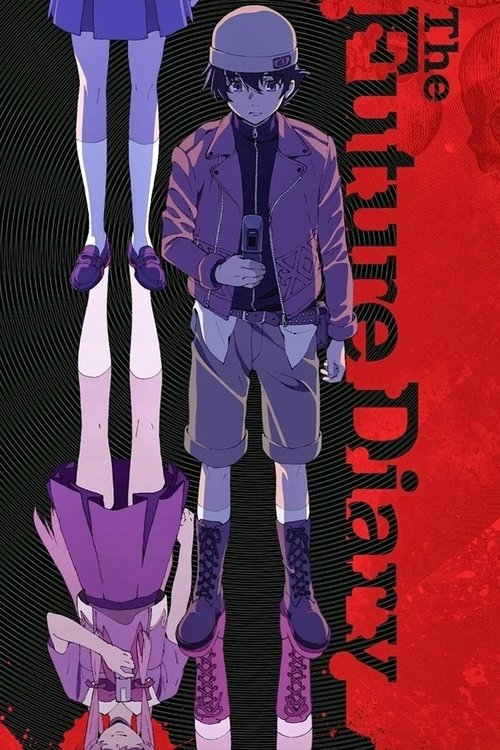






















Popular
What is the significance of Yuki's Future Diary and how does it affect his actions throughout the series?
How does Yuno's obsession with Yuki manifest throughout the series?
What role does the character of Minene Uryuu play in the overall conflict of the Future Diary game?
What are the consequences of the time travel element introduced in the series?
How does the relationship between Yuki and Yuno evolve throughout the series?
Should I watch it?
Ask Your Own Question

What is the plot?
Yukiteru Amano, a lonely high school student, spends most of his time writing in a diary on his phone. One day, he encounters a mysterious boy named Deus Ex Machina, who reveals himself to be a god. Deus grants Yukiteru a special diary that can predict the future, detailing events that will happen in the next 90 days. Yukiteru learns that he is one of twelve participants in a deadly survival game, where each participant possesses a unique future diary. The last one standing will become the new god.
Yukiteru is initially overwhelmed and frightened by the implications of the game. He meets Yuno Gasai, a classmate who is obsessed with him and possesses a diary that can predict Yukiteru's future. Yuno reveals her deep feelings for Yukiteru and vows to protect him at all costs. As they navigate the dangers of the game, Yukiteru struggles with his feelings for Yuno, torn between her affection and the threat she poses.
The first major confrontation occurs when Yukiteru and Yuno face off against the first diary holder, a sadistic boy named Minene Uryuu, who has a bomb in her possession. Minene attacks Yukiteru and Yuno, but they manage to escape using Yuno's foresight. They learn that Minene is a terrorist and that she has her own agenda in the game. Yukiteru's diary reveals that Minene will attempt to kill them, prompting them to prepare for a counterattack.
In a tense showdown, Yukiteru and Yuno confront Minene in an abandoned building. Minene uses her bomb to create chaos, but Yuno's predictions allow them to dodge her attacks. Yukiteru, feeling empowered by Yuno's support, decides to fight back. He uses his diary to predict Minene's movements, ultimately leading to her defeat. However, instead of killing her, Yukiteru shows mercy, which surprises Yuno.
As the game progresses, Yukiteru and Yuno form alliances with other diary holders, including the enigmatic Akise Aru, who becomes a key ally. Akise is determined to uncover the truth behind the game and the identities of the other participants. Tensions rise as Yukiteru's trust in Yuno is tested when he learns about her dark past and her willingness to kill to protect him.
The next major twist occurs when Yukiteru's diary reveals that Yuno will betray him. Struggling with this revelation, Yukiteru confronts Yuno, who admits her obsessive love for him and her willingness to eliminate anyone who stands in their way. This confrontation deepens Yukiteru's internal conflict, as he grapples with his feelings for Yuno and the danger she represents.
As the game continues, Yukiteru and Yuno face off against other diary holders, including the ruthless gas mask-wearing killer, Tsubaki Kasugano, and the manipulative and cunning, Reisuke Houjou. Each encounter tests their resolve and forces Yukiteru to confront the moral implications of the game. He begins to question whether he can trust Yuno completely, even as she continues to protect him fiercely.
In a climactic battle, Yukiteru and Yuno confront Tsubaki, who has been using mind games to manipulate them. The fight is intense, with Tsubaki using his diary to predict their moves. However, Yuno's foresight allows them to outmaneuver him, leading to Tsubaki's defeat. Yukiteru's mercy once again shines through as he chooses not to kill Tsubaki, which angers Yuno.
As the game nears its conclusion, Yukiteru learns that Akise has been investigating the true nature of the game and the identity of Deus. Akise reveals that the game is a test of survival and that the last remaining participant will inherit the powers of a god. Yukiteru's internal struggle intensifies as he realizes that he may have to betray Yuno to survive.
In a shocking turn of events, Yukiteru's diary reveals that Yuno will die if he does not act. Faced with the choice of saving her or ensuring his own survival, Yukiteru is torn. He ultimately decides to save Yuno, leading to a dramatic confrontation with the remaining diary holders. The stakes are higher than ever as Yukiteru and Yuno fight for their lives against the remaining participants.
The final battle takes place in a surreal landscape created by Deus, where the remaining diary holders face off against each other. Yukiteru and Yuno work together, using their combined knowledge of their diaries to outsmart their opponents. However, as the battle rages on, Yukiteru is forced to confront the reality of Yuno's obsession and the lengths she will go to for him.
In the climax, Yukiteru learns that Yuno has been manipulating events from the beginning, including the deaths of other participants. Heartbroken and betrayed, Yukiteru confronts Yuno, who reveals her true intentions: to create a world where they can be together forever, even if it means eliminating anyone who threatens their happiness. Yukiteru is faced with a choice: accept Yuno's twisted love or fight against her.
In the final moments, Yukiteru makes a desperate decision. He uses his diary to predict Yuno's actions and ultimately sacrifices himself to save her. This act of selflessness leads to a tragic conclusion, as Yukiteru's death allows Yuno to become the new god, reshaping reality to create a world where they can be together. However, this new world is a twisted reflection of Yukiteru's original desires, leaving Yuno alone with the consequences of her actions.
The series concludes with Yuno standing in a world of her own making, haunted by the memories of Yukiteru and the choices she made. The cycle of love, betrayal, and survival comes full circle, leaving a lasting impact on the characters and the world they inhabit.








What is the ending?
In the ending of The Future Diary, Yukiteru Amano and Yuno Gasai face the final confrontation in the survival game. Yuno reveals her true intentions and the depth of her obsession with Yukiteru. In a climactic moment, Yukiteru makes a choice that leads to a tragic conclusion, resulting in Yuno's death. Yukiteru, heartbroken, ultimately finds himself in a new timeline where he is alone, having lost Yuno but retaining the memories of their time together.
As the final episodes unfold, the tension escalates in the survival game, where the remaining participants are dwindling. Yukiteru Amano, a timid and introverted boy, finds himself at the center of a deadly competition orchestrated by the enigmatic deity, Deus Ex Machina. The stakes are high, and the emotional weight of the game bears down on him, especially as he grapples with his feelings for Yuno Gasai, a fiercely devoted girl who has been both his protector and his tormentor.
In the penultimate episode, the atmosphere is thick with dread as Yukiteru and Yuno confront the last remaining opponents. The setting shifts to a desolate landscape, a stark contrast to the vibrant world they once knew. The air is charged with tension as they face off against the final adversary, who is determined to eliminate Yukiteru. Yuno, driven by her obsessive love for Yukiteru, displays her ruthless side, showcasing her willingness to do anything to protect him.
As the battle rages on, Yukiteru's internal conflict becomes palpable. He is torn between his desire to survive and his growing realization of Yuno's dangerous obsession. The scene is fraught with emotional turmoil as he witnesses Yuno's violent actions, which both frighten and fascinate him. The camera captures the intensity of their relationship, highlighting the duality of love and fear.
In a pivotal moment, Yukiteru is faced with a choice that will determine the fate of everyone involved. Yuno, in a moment of vulnerability, reveals her true feelings, confessing her unwavering love for him. This confession is layered with desperation, as she believes that their bond is the only thing that can save them. Yukiteru, overwhelmed by the weight of her words, hesitates, caught between his affection for her and the horror of her actions.
The climax reaches its peak when Yukiteru, in a moment of clarity, decides to confront Yuno about her methods. He expresses his desire for a future where they can be together without the bloodshed and manipulation. However, Yuno, unable to let go of her possessive nature, reacts violently. In a heart-wrenching scene, she sacrifices herself to ensure Yukiteru's survival, believing that her death will free him from the cycle of violence.
As Yuno falls, the world around them begins to unravel. The emotional weight of her sacrifice hits Yukiteru hard, and he is left to grapple with the loss of the girl who had been both his savior and his captor. The scene is poignant, filled with the echoes of their shared memories, as Yukiteru cradles Yuno's lifeless body, tears streaming down his face. The camera lingers on their intertwined hands, symbolizing the bond that can never be severed, even in death.
In the aftermath, Yukiteru finds himself in a new timeline, one where the survival game has ended, but the memories of Yuno linger painfully in his heart. He walks through a familiar yet altered landscape, a reflection of his internal struggle. The world is quiet, devoid of the chaos that once surrounded him, but the silence is deafening. He is alone, haunted by the choices he made and the love he lost.
The series concludes with Yukiteru standing at a crossroads, contemplating the nature of love, sacrifice, and the consequences of their actions. The final shot captures his somber expression, a mix of longing and acceptance, as he gazes into the distance, forever marked by the events that transpired. The fate of each character is sealed: Yuno, in her tragic devotion, finds peace in her sacrifice, while Yukiteru is left to navigate a future shaped by their tumultuous past, forever carrying the weight of their intertwined destinies.
Is there a post-credit scene?
In the 2011 anime series "The Future Diary," there is indeed a post-credit scene that adds a poignant layer to the story's conclusion.
As the final episode wraps up, the scene shifts to a serene, idyllic setting. It features Yukiteru Amano, the protagonist, who is seen sitting on a bench in a peaceful park. The atmosphere is calm, with gentle sunlight filtering through the leaves of the trees, creating a warm and inviting ambiance.
Yukiteru appears contemplative, reflecting on the tumultuous events that have transpired throughout the survival game. His expression is a mix of relief and lingering sadness, as he grapples with the loss of friends and the weight of the choices he had to make.
Suddenly, the scene transitions to a vision of Yuno Gasai, his obsessive and devoted love interest. She appears in a dreamlike state, smiling at him with a sense of warmth and affection. This moment is bittersweet, as it encapsulates their complex relationship--filled with love, obsession, and tragedy.
Yukiteru reaches out as if to touch her, but she fades away, leaving him with a sense of longing. The scene closes with Yukiteru looking up at the sky, a mixture of hope and sorrow in his eyes, suggesting that while he has survived, the memories of Yuno and the game will forever linger in his heart.
This post-credit scene serves as a reflective moment, emphasizing themes of love, loss, and the consequences of their actions throughout the series, leaving viewers with a lasting emotional impact.
What is the significance of Yuki's Future Diary and how does it affect his actions throughout the series?
Yuki's Future Diary, which is a digital diary that predicts the future, plays a crucial role in shaping his character and decisions. Initially, Yuki is portrayed as a timid and indecisive boy, but as he learns to trust his diary, it becomes a source of empowerment. The diary's predictions force him to confront dangerous situations and make life-altering choices, particularly in his interactions with other diary holders. His reliance on the diary reflects his internal struggle between fear and the desire to protect those he cares about, especially Yuno.
How does Yuno's obsession with Yuki manifest throughout the series?
Yuno's obsession with Yuki is a central theme in the series, characterized by her intense devotion and willingness to go to extreme lengths to ensure his safety and affection. From the beginning, her actions are driven by a deep-seated need to be with Yuki, which leads her to manipulate events and eliminate threats. Her emotional state fluctuates between fierce protectiveness and violent jealousy, showcasing her complex personality. This obsession culminates in several pivotal moments where she reveals her true nature, including her willingness to kill for Yuki's love.
What role does the character of Minene Uryuu play in the overall conflict of the Future Diary game?
Minene Uryuu, the 9th diary holder, is a pivotal character who introduces a layer of complexity to the Future Diary game. As a terrorist with a strong sense of independence, she initially appears as an antagonist but gradually reveals her motivations and backstory. Her cunning and resourcefulness make her a formidable opponent, and her interactions with Yuki and Yuno highlight the moral ambiguities of the game. Minene's character arc explores themes of survival and betrayal, ultimately influencing the dynamics between the diary holders and the unfolding conflict.
What are the consequences of the time travel element introduced in the series?
The time travel element, particularly through the character of Yuki's Future Diary, introduces significant consequences that alter the course of events in the series. This ability allows characters to manipulate outcomes and create alternate realities, leading to unexpected twists and emotional turmoil. For instance, Yuki's attempts to change the future often result in unintended consequences, affecting his relationships and the fates of other diary holders. The exploration of time travel raises questions about fate versus free will, as characters grapple with the implications of their choices and the cyclical nature of their struggles.
How does the relationship between Yuki and Yuno evolve throughout the series?
The relationship between Yuki and Yuno evolves dramatically throughout the series, marked by a tumultuous blend of love, manipulation, and conflict. Initially, Yuki is wary of Yuno's obsessive behavior, but as they face various challenges together, he begins to see her as a protector. Yuno's unwavering devotion often leads her to act violently, creating a push-pull dynamic that keeps Yuki both drawn to and repulsed by her. As the series progresses, Yuki's understanding of Yuno deepens, leading to moments of vulnerability and connection, ultimately culminating in a complex bond that blurs the lines between love and fear.
Is this family friendly?
"The Future Diary" (2011) is not considered family-friendly due to several potentially objectionable or upsetting scenes and themes. Here are some aspects that may be concerning for children or sensitive viewers:
-
Violence and Gore: The series contains graphic violence, including murder and bloodshed, which can be disturbing. Characters often engage in life-or-death situations that result in intense confrontations.
-
Psychological Manipulation: The show explores themes of betrayal, manipulation, and psychological games, which may be unsettling for younger audiences.
-
Death and Suicide: Several characters face death, and there are instances of suicide or suicidal ideation, which can be triggering for some viewers.
-
Mature Themes: The narrative delves into complex themes such as obsession, survival, and the moral implications of killing, which may not be suitable for children.
-
Emotional Turmoil: Characters experience significant emotional distress, including fear, despair, and trauma, which can be heavy and difficult to process.
-
Romantic Relationships: There are elements of romantic tension that may include unhealthy dynamics, which could be inappropriate for younger viewers.
Overall, the series is best suited for a mature audience due to its intense and often dark subject matter.