









Popular
What is the significance of Satsuki Kiryuin's Goku Uniform, Junketsu?
How does Ryuko Matoi's relationship with Senketsu evolve throughout the series?
What role does Mako Mankanshoku play in Ryuko's journey?
What is the truth behind the Life Fibers and their connection to the characters?
How does the dynamic between Ryuko and Satsuki change throughout the series?
Should I watch it?
Ask Your Own Question

What is the plot?
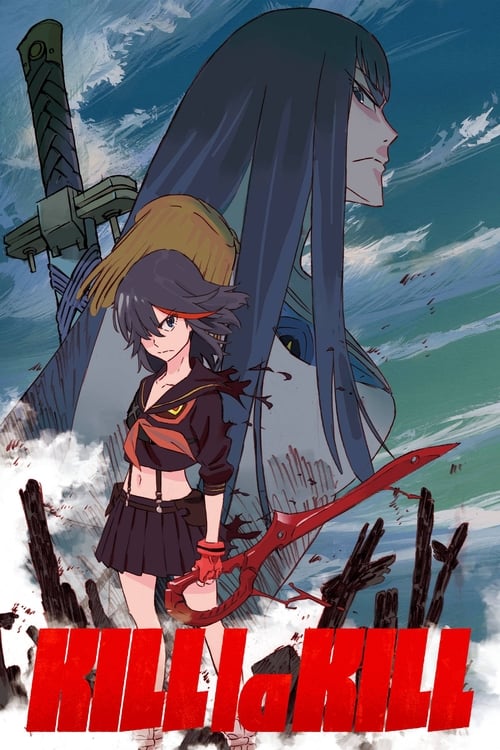
Ryuko Matoi arrives at Honnouji Academy, a school ruled by the powerful student council led by Satsuki Kiryuin. Ryuko is searching for her father's killer, and she believes that Satsuki holds the key to finding the truth. She wields a scissor blade, a weapon that was once part of a pair, and is determined to confront Satsuki. Upon her arrival, she is immediately challenged by the school's elite, the Elite Four, who are fiercely loyal to Satsuki.
In her first confrontation, Ryuko faces off against the Elite Four member, Gamagori, who uses his Goku Uniform to enhance his strength. The battle is intense, with Ryuko struggling against Gamagori's overwhelming power. However, she is saved by the appearance of Senketsu, a sentient uniform made from a special material called Life Fibers. Senketsu bonds with Ryuko, granting her enhanced abilities and transforming her into a powerful fighter. With Senketsu's help, Ryuko defeats Gamagori, but she is still far from uncovering the truth about her father's death.
After her victory, Ryuko learns more about the Goku Uniforms and the oppressive system at Honnouji Academy. Satsuki's ambition to control the school and its students becomes clear, as she uses the uniforms to enforce her rule. Ryuko's quest for revenge intensifies, and she decides to challenge Satsuki directly. In a dramatic showdown, Ryuko confronts Satsuki, but the fight is interrupted when Satsuki reveals her own connection to Ryuko's past. She claims that Ryuko's father, Isshin Matoi, was involved in the creation of the Life Fibers and that he was killed because of his research.
As Ryuko grapples with this revelation, she continues to battle the Elite Four, each member representing a different aspect of Satsuki's power. She faces off against Inumuta, who uses technology to manipulate the battlefield, and later against Nonon, who employs sound-based attacks. Each fight pushes Ryuko to her limits, but she grows stronger with each victory, learning to harness the power of Senketsu more effectively.
Ryuko's journey leads her to discover the truth about the Life Fibers and their connection to her father's death. She learns that Satsuki's mother, Lady Satsuki Kiryuin, is the true antagonist, having orchestrated the events that led to Isshin's demise. This revelation deepens Ryuko's resolve to confront Satsuki, as she believes that defeating her will ultimately lead to confronting Lady Kiryuin.
In a climactic battle, Ryuko faces Satsuki once more, this time in a more personal and emotionally charged confrontation. The fight is fierce, with both characters showcasing their growth and determination. Ryuko's motivations shift from revenge to understanding, as she begins to see Satsuki not just as an enemy, but as someone who has also suffered under the oppressive system of the Life Fibers.
As the story progresses, Ryuko and Satsuki form an uneasy alliance when they discover that the true threat lies in the form of a powerful entity known as the Devas, who seek to use the Life Fibers for their own gain. Together, they confront this new enemy, leading to a series of battles that test their newfound partnership. Ryuko learns to trust Satsuki, and they work together to defeat the Devas, showcasing their combined strength.
The final confrontation occurs when they face off against their ultimate foe, the entity known as Nui Harime, who is revealed to be a puppet of the Life Fibers. Nui's sadistic nature and her connection to Ryuko's past create a tense and emotional battle. Ryuko's determination to avenge her father and protect her friends fuels her strength, and with Satsuki's support, they manage to defeat Nui.
In the aftermath of the battle, Ryuko and Satsuki confront the reality of their world, which is still under the influence of the Life Fibers. They realize that their fight is not over, and they must continue to challenge the oppressive system that has caused so much suffering. Ryuko's journey of self-discovery culminates in her acceptance of her past and her determination to forge a new future alongside Satsuki.
The series concludes with Ryuko and Satsuki standing together, ready to face whatever challenges lie ahead, united in their quest to dismantle the remnants of the Life Fiber control and to seek justice for those who have suffered. Their bond, forged through battle and understanding, symbolizes hope for a new beginning.









What is the ending?
In the ending of "Kill la Kill," Ryuko Matoi confronts Satsuki Kiryuin in a climactic battle. After a fierce fight, they unite against a common enemy, the Life Fibers, and their creator, the entity known as the "Kiryuuin Family." Ryuko learns the truth about her father's death and the connection between the Life Fibers and her own existence. In the end, Ryuko and Satsuki work together to defeat the Life Fibers, leading to a new beginning for humanity. The series concludes with Ryuko and Satsuki parting ways, each embarking on their own journey, having forged a bond through their struggles.
As the final episodes of "Kill la Kill" unfold, the tension escalates dramatically. The scene opens with Ryuko Matoi standing resolute, her determination palpable as she prepares to confront Satsuki Kiryuin. The air is thick with anticipation, the remnants of their past conflicts swirling around them like ghosts. Ryuko, clad in her Kamui Senketsu, feels the weight of her journey pressing down on her shoulders. She is not just fighting for herself but for the truth behind her father's death and the fate of humanity.
The two engage in a fierce battle, their movements a blur of speed and power. Each strike is fueled by their conflicting emotions--Ryuko's anger and sorrow clash with Satsuki's stoic resolve. The environment around them shatters under the force of their blows, a visual representation of their tumultuous relationship. As they fight, flashes of their past encounters flicker in their minds, reminding them of the pain and misunderstandings that have defined their rivalry.
In a pivotal moment, Ryuko's resolve wavers as she recalls her father's last words and the truth about the Life Fibers. The realization hits her like a tidal wave: the Life Fibers are not just a threat; they are intertwined with her very existence. This revelation shifts the battle's dynamic, and Ryuko's anger transforms into a fierce determination to protect those she loves.
Satsuki, too, experiences a moment of clarity. She understands that her ambition to control the world through fear and power has led her down a dark path. The two girls, once enemies, find common ground in their shared pain and the desire to end the cycle of suffering caused by the Life Fibers. Their fight becomes less about defeating each other and more about uniting against a greater evil.
As they combine their powers, the atmosphere shifts. The Life Fibers, represented by the monstrous entity known as the "Kiryuuin Family," loom over them, a grotesque manifestation of their fears and struggles. Ryuko and Satsuki, now allies, unleash a combined attack that resonates with the strength of their newfound bond. The scene is visually stunning, with vibrant colors and dynamic animation capturing the intensity of their struggle.
In the climactic moment, they confront the core of the Life Fibers, a pulsating mass of energy that threatens to consume everything. Ryuko, channeling her father's spirit, and Satsuki, embracing her role as a leader, strike together. The explosion of light and energy signifies not just their victory but the breaking of chains that have bound them to their past.
As the dust settles, the aftermath reveals a transformed world. The Life Fibers are defeated, and humanity is freed from their control. Ryuko and Satsuki stand amidst the ruins, their expressions a mix of relief and uncertainty. They have forged a bond through their struggles, but the future remains uncertain.
In the final scenes, Ryuko decides to leave Honnouji Academy, embarking on a journey to discover her own identity and purpose. Satsuki, now free from the burden of her family's legacy, takes on the responsibility of rebuilding society. Their parting is bittersweet, filled with unspoken words and a promise to meet again. The camera lingers on their faces, capturing the complexity of their emotions--hope, sadness, and the weight of their shared experiences.
As the series concludes, the fate of each main character is revealed. Ryuko, having found a sense of closure regarding her father's death, steps into the unknown with newfound strength. Satsuki, having shed the oppressive expectations of her family, embraces her role as a leader with a vision for a better future. The supporting characters, too, find their paths, each reflecting the themes of growth and redemption that permeate the series.
The final shot of the series is a poignant reminder of their journey--a symbol of resilience and the enduring power of friendship forged through adversity. The screen fades to black, leaving viewers with a sense of hope and the promise of new beginnings.
Is there a post-credit scene?
Yes, "Kill la Kill" features a post-credit scene in its final episode, Episode 24, titled "No More."
As the episode concludes, the screen fades to black after the climactic battle between Ryuko Matoi and Satsuki Kiryuin. The post-credit scene begins with a serene view of the sun shining brightly over a peaceful landscape. The scene shifts to a beach where Ryuko and Mako Mankanshoku are seen enjoying a day off, relaxing and playing in the sand.
Mako, with her usual exuberance, is building a sandcastle, while Ryuko, sporting a more relaxed demeanor, watches her friend with a small smile. The atmosphere is light-hearted, contrasting sharply with the intense battles and emotional turmoil that preceded it.
As they play, Mako excitedly calls out to Ryuko, urging her to join in the fun. Ryuko, initially hesitant, eventually gives in to Mako's infectious enthusiasm, and they both start to engage in playful antics. This moment highlights their deep friendship and the bond they have formed throughout their tumultuous journey.
The scene encapsulates a sense of closure and hope, suggesting that despite the chaos and struggles they faced, they can find moments of joy and peace together. It serves as a reminder of the importance of friendship and the possibility of a brighter future after the trials they endured. The post-credit scene ends with laughter and a sense of camaraderie, leaving viewers with a warm feeling as the series concludes.
What is the significance of Satsuki Kiryuin's Goku Uniform, Junketsu?
Junketsu, the Goku Uniform worn by Satsuki Kiryuin, symbolizes her unwavering commitment to the ideals of the Kiryuin family and the power structure of Honnouji Academy. It is a sentient uniform that enhances her abilities but also represents the oppressive nature of the system she upholds. Satsuki's internal struggle with her identity and the burden of leadership is reflected in her relationship with Junketsu, as she grapples with the consequences of wielding such power.
How does Ryuko Matoi's relationship with Senketsu evolve throughout the series?
Ryuko Matoi's relationship with Senketsu, her Goku Uniform, evolves from one of distrust to a deep bond of friendship and mutual reliance. Initially, Ryuko views Senketsu as a tool for revenge against her father's killer, but as they face various challenges together, she learns to appreciate his sentience and personality. Their connection becomes a source of strength, highlighting themes of companionship and the importance of understanding one's own identity.
What role does Mako Mankanshoku play in Ryuko's journey?
Mako Mankanshoku serves as Ryuko's best friend and comic relief, but her role is crucial in grounding Ryuko's emotional journey. Mako's unwavering support and loyalty provide Ryuko with a sense of normalcy and friendship amidst the chaos of Honnouji Academy. Mako's own struggles with her family's financial issues and her determination to stand by Ryuko showcase the importance of camaraderie and the impact of friendship on personal growth.
What is the truth behind the Life Fibers and their connection to the characters?
The Life Fibers are a central element of the series, serving as the source of power for the Goku Uniforms and the antagonistic force behind the events at Honnouji Academy. They are sentient beings that seek to consume humanity, and their connection to characters like Satsuki and Ryuko reveals deeper themes of control and autonomy. The revelation that Ryuko is part Life Fiber herself complicates her identity and her fight against the oppressive system, as she must confront her own origins and the implications of her powers.
How does the dynamic between Ryuko and Satsuki change throughout the series?
The dynamic between Ryuko and Satsuki Kiryuin shifts dramatically from adversaries to allies. Initially, Ryuko sees Satsuki as a formidable enemy, representing the oppressive regime she seeks to dismantle. However, as the series progresses, they uncover shared goals and a deeper connection tied to their pasts. This transformation is marked by intense battles, emotional confrontations, and ultimately, a mutual understanding that leads to a temporary alliance against a greater threat, showcasing themes of redemption and the complexity of familial bonds.
Is this family friendly?
"Kill la Kill" is known for its vibrant animation and dynamic storytelling, but it contains several elements that may not be suitable for children or sensitive viewers. Here are some potentially objectionable aspects:
-
Nudity and Sexual Themes: The series features characters in revealing outfits, and there are scenes that play with themes of nudity and sexualization, often presented in a comedic or exaggerated manner.
-
Violence: There are frequent battles and fight scenes that can be intense, with characters using weapons and engaging in physical combat. Some scenes depict injuries and blood, which may be unsettling for younger viewers.
-
Strong Language: The dialogue includes instances of strong language and insults, which may not be appropriate for all audiences.
-
Mature Themes: The show explores themes of rebellion, identity, and the struggles against authority, which may be complex for younger viewers to fully grasp.
-
Emotional Turmoil: Characters experience significant emotional distress, including themes of loss, betrayal, and revenge, which could be upsetting for sensitive individuals.
Overall, while "Kill la Kill" is visually striking and has a unique narrative style, its content may not be suitable for all audiences, particularly children or those who are sensitive to the aforementioned themes.