













Popular
Why does Buchio become a nekomata, and what does that change in his daily life?
What is Mutsumi’s missing father storyline, and how does it affect her?
Who is Jiro, and why does Mutsumi keep watching him?
What role does Yuri play in Buchio’s story?
What is the Nue rumor, and why does it matter to the characters?
Should I watch it?
Ask Your Own Question

What is the plot?
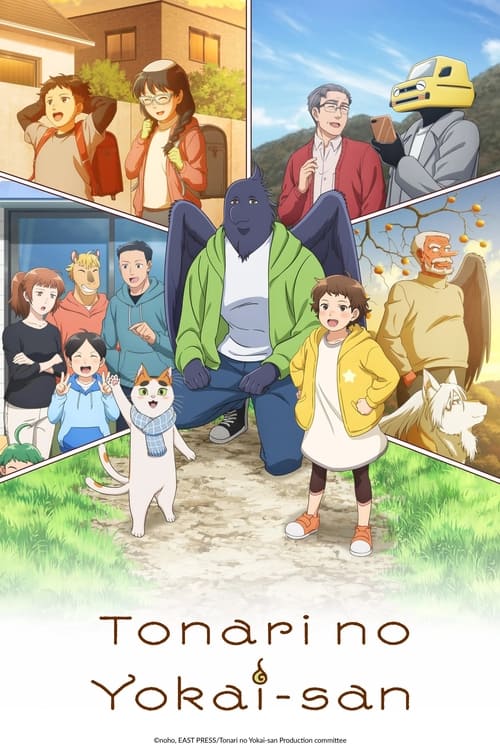
Buchio, a house cat who has lived with the Sugimoto family for twenty years, begins the story on the day his tail splits, marking his transformation into a nekomata, and his family reacts with surprise and affection rather than fear. Buchio is unsettled by the change because he does not yet understand what kind of creature he is becoming, but he is also drawn into the routines of the yokai and human town around him as he starts learning how his new life works.
Soon after, Buchio has to deal with the practical side of becoming a yokai, including registration and the basic social responsibilities that come with his new status, and he begins asking other supernatural residents what abilities he might develop. He is directed toward local yokai who can explain the transition, and he becomes especially interested in learning how to use the powers that come with being a nekomata rather than remaining only a familiar house cat.
At the same time, Mutsumi is introduced as a human girl who lives in Fuchigamori with her mother and grandmother while worrying about her missing father. She keeps hoping he will return, but the story repeatedly shows that his disappearance remains an active wound in her daily life, shaping her mood even when she tries to stay positive.
Jiro, a crow tengu who has protected the town for generations, becomes one of the people who supports Mutsumi emotionally, and the show establishes him as a quiet guardian who understands both the human and yokai sides of the village. The town itself is presented as a place where humans, gods, and yokai coexist openly, and that peaceful coexistence forms the background for the plot as Buchio and Mutsumi each move through their separate concerns.
As Buchio tries to understand what he has become, he receives guidance from other local supernatural beings and starts training to control his form and abilities. His growth is gradual rather than dramatic, and the story emphasizes his uncertainty, his embarrassment about being different, and the encouragement he receives from those around him as he slowly accepts his new identity.
Mutsumi's storyline continues in parallel as she keeps thinking about her father and the mystery around his disappearance. The show frames her search less as a single investigation than as a persistent emotional condition: she listens, waits, and tries to make sense of fragments of information while the adults around her do not provide a full answer.
As the episodes progress, the series widens its scope beyond the town's ordinary supernatural daily life and introduces signs that something larger and stranger is happening across the region. Spatial distortions begin appearing, and rumors spread that the boundary between parallel worlds is breaking down, which draws attention from curious observers and researchers alike.
Takumi becomes excited by the phenomenon and interviews two researchers from a Space-Time Laboratory, but they refuse to explain what they know. Their silence leaves the mystery unresolved, while the increasing distortions suggest that the calm life in Fuchigamori is sitting on top of a much older and more dangerous problem.
Buchio and Takumi later learn the history of Tagenbo, the tengu who served before Tazenbo, and discover that he sacrificed himself in 1523 to save the village from a meteorite. This revelation connects the town's ancient history to the present instability and implies that the rifts are not random but tied to some long-standing supernatural burden.
The distortions worsen, and people begin crossing into or being displaced by parallel-world versions of themselves. One major example is Yuri, who gets caught in a rift and is forced to switch places with another Yuri from a "normal" world because only one Yuri can exist in any given parallel world at the same time.
The growing crisis eventually leads to direct danger for the Sugimoto family, and Jiro raises a magical barrier to protect them from oni. Even with the barrier in place, one oni slips through, showing that the protection is not complete and that the threat cannot be fully held back by force alone.
The story then escalates to a catastrophic collapse in which the dragon god dies and yokai across Japan begin losing their powers. Buchio and Suzu revert to ordinary cats and die, Rain turns into water, and Jiro turns into wind, showing that the identities and bodies of the supernatural beings are being stripped away piece by piece.
Takumi, Ryo, and Mu-chan then awaken in a white void with no memories, cut off from the world and from the people they loved. They recover their memories by talking with each other and remembering their loved ones, and through that act of shared remembrance they are able to use kotodama to restore the yokai to life.
Sanmoto does not return with the others and instead disappears, leaving the restoration incomplete. After the crisis, spring break is extended so the students have time to recover from the trauma, and Takumi decides to pursue filmmaking as his future path.
In the aftermath, Jiro meets with the Tengu Association and explains the true nature of oni, arguing that they became dangerous because kotodama shaped by erroneous human belief turned them into monsters. Ma-san can no longer remember his life as Mu-chan's father, but the Sugimoto family still lets him stay with them, and Rain and Ryo confess their feelings for one another.
The final developments show the characters settling into a changed but continuing life: Ma-san goes to Buchio for advice, and Buchio becomes embarrassed when he realizes he has become someone else's mentor.

What is the ending?
Buchio ends the story having accepted what he has become, and the people around him continue to live together in the same town, now more fully connected through the everyday ties they have built. Mutsumi's search for her father is not presented as a sudden miracle ending in the information available here, but as part of the same quiet life the series has followed, with her supported by the people and yōkai around her.
In the final stretch of the anime, the story's larger supernatural danger comes to a head when cracks in the sky widen and a massive rift opens, allowing aggressive oni to flood into the world. For a moment, the situation makes it seem as if the yōkai themselves may disappear from the earth. Then, in the way this story treats bonds between beings as something real and sustaining, the yōkai are given shape again by the thoughts of the humans who were close to them.
Buchio's end state is that of a nekomata who has come to terms with his transformation and his place among his family and neighbors. He begins the series as a cat whose change into a yōkai creates uncertainty, and by the end he is living within that new identity rather than resisting it. His family's acceptance remains part of that ending, and the story leaves him in a position where he is no longer simply reacting to change, but living with it.
Mutsumi ends as the same gentle, persistent human girl who has been carrying the worry of her missing father throughout the series. The material available here does not show a final reunion for her in a detailed scene-by-scene ending, so the most accurate account is that her arc remains centered on that ongoing absence while she continues to live in the shared community of humans, yōkai, and gods.
Jirou, the crow tengu who has long protected the town, remains one of the figures holding that world together at the end. The series' final conflict confirms his place in a town where supernatural beings are not distant legends but part of daily life, and where their existence is tied to human memory and attachment.
Seen plainly, the ending says that the town survives because its people, humans, yōkai, and gods keep recognizing one another and staying connected. The final images and events focus on endurance, acceptance, and the continued life of the community rather than on a dramatic separation or final defeat.
Is there a post-credit scene?
Yes. The series has post-credits scenes, and the final episode's post-credits scene shows Jiro noting that summer has come around again, ending on a shot of the sky that mirrors the opening image from the first episode.
There are also earlier episode post-credits scenes in the series. One shows students gossiping about a stuffed tanuki in the science room being a vengeful bake-danuki, until Yusuke, an animate anatomical doll, warns them away. Another shows the dragon god reawakening during the New Year's festival, with a dark shadow reaching toward Mu-chan while she remains unaware.
Why does Buchio become a nekomata, and what does that change in his daily life?
Buchio is a 20-year-old housecat who suddenly begins transforming into a nekomata when his tail splits, marking him as a yokai rather than an ordinary cat. The change brings practical burdens as well as emotional ones: he has to handle registration and insurance paperwork, learn what abilities his new form gives him, and adjust to living as part of the yokai community instead of only as a family pet.
What is Mutsumi’s missing father storyline, and how does it affect her?
Mutsumi lives with her mother and grandmother while waiting for the return of her father, who vanished under mysterious circumstances. Her day-to-day life is shaped by hope and uncertainty, and she becomes sensitive to clues and rumors that may explain what happened to him, making his disappearance one of the story's central personal mysteries.
Who is Jiro, and why does Mutsumi keep watching him?
Jiro is a crow tengu who has protected the town for generations and performs ritual Shinto duties. Mutsumi becomes curious about him and observes him closely, so his public role and private routine become part of the story's character-driven mystery, especially as she starts seeing him in a new light.
What role does Yuri play in Buchio’s story?
Yuri is Buchio's yokai companion, a kitsune who helps guide him as he tries to understand his new nekomata life. She is specifically tied to his search for meaning after his transformation, and several descriptions present her as traveling or learning alongside him as he looks for answers about what he has become.
What is the Nue rumor, and why does it matter to the characters?
A rumor spreads that a Nue has appeared in the area, and the Nue is described as a Japanese chimera associated with bad luck and illness. That rumor matters because it adds a concrete supernatural threat to the town's calm routine, raising concern among the characters while they continue their separate personal stories.
Is this family friendly?
Tonari no Yokai-san is mostly family-friendly in tone, but it is not completely child-safe: it is rated PG-13 / TV-14 and is described in parental guides as having moderate sex/nudity, moderate violence/gore, and moderate frightening or intense scenes, with mild profanity and mild alcohol/drug/smoking content.
Potentially upsetting or objectionable elements for children or sensitive viewers include: - Scary or eerie yokai imagery and some frightening/intense scenes. - Fantasy violence or gore at a moderate level, though the series is generally gentle in tone. - Some sexualized or nudity-related content flagged as moderate in the parental guide, even if the show is not primarily sexual. - Mild swearing. - Mild smoking or alcohol use. - Heavier emotional themes such as loneliness, missing family, and death, which reviews note are handled warmly but are still present.
If you want, I can also give you a more specific age recommendation like "safe for 8+ / 10+ / 13+" based on the same content profile.