












Should I watch it?
Ask Your Own Question

What is the plot?
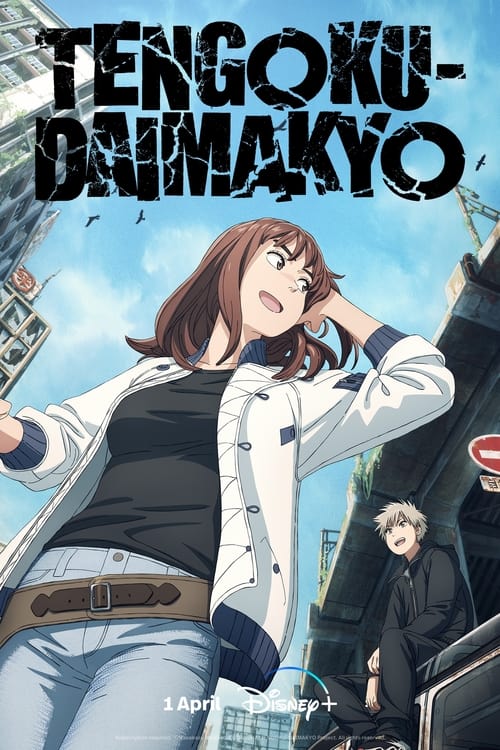
Fifteen years after an unspecified calamity devastates Japan, in a large, pristine, closed facility surrounded by walls and covered corridors, a boy named Kona shows a new drawing to his friend Tokio in an art classroom. Tokio reacts with mild embarrassment and curiosity, while their quiet classmate Shiro watches. Daily life in the facility is orderly and strictly controlled: children attend lessons, eat nutritionally balanced meals, undergo regular health checkups, and play in monitored courtyards under the observation of adult staff in white coats, including the director and several doctors. One day, as Tokio walks alone in a hallway, a message suddenly appears on a wall monitor, addressed only to her: "Do you want to go outside of the outside?" The message disappears as quickly as it came, leaving Tokio unsettled and confused, since she has been taught there is nothing beyond the facility.
That night, Tokio cannot sleep and confides in Mimihime, a slightly older girl with big ears and a reputation for having accurate premonitions. Mimihime tells Tokio that she had a vision: someday, two people will come from outside to save someone in the facility, and one of them will have the same face as Tokio. Mimihime specifies that the person with Tokio's face is a boy. Tokio reacts with disbelief and nervousness but is deeply shaken. The next day, Tokio visits the director in his office and hesitantly asks what the "outside" is really like and whether she can ever go there. The director calmly but firmly tells her that the outside world is "Hell," devastated and full of danger, and that the safest, best life she can have is inside the facility. He warns her not to fixate on impossible ideas and assures her the adults will always protect them. Tokio leaves with the conflict between her curiosity and the director's warnings unresolved.
In the devastated outside world, years after the same catastrophe, a teenage boy named Maru and an androgynous-looking young person named Kiruko travel together through ruined suburbs and overgrown highways. They push a small handcart, scavenge abandoned buildings, and consult a rough map. Kiruko carries a strange pistol-like weapon with a cable and rectangular battery pack, while Maru fights with his fists. They look for a place known only as "Heaven," based on instructions Maru received from his dying caretaker, and they have only the name and the logo engraved on Kiruko's electric gun as clues. One day, they arrive at a rundown inn in a mostly intact town. The innkeeper, a woman named Urat, offers them a room and a meal for money and a bit of work. That evening, as they eat, Urat warns them of "man-eaters" (Hiruko), strange monsters that appear at night. Maru, who has heard of them, is cautious; Kiruko is alert but confident in her fighting ability.
That night, a local boy secretly leads Maru and Kiruko to a dilapidated building, claiming they can see a man-eater's nest. Inside the dark structure, they find eerie organic matter coating the walls and odd, translucent sacks. The boy reveals that villagers sometimes lure outsiders there to satisfy the creature. Before they can retreat, a grotesque monster appears: a floating mass with eyes and tendrils. Kiruko fires the electric gun, producing a blast of energy that damages but does not kill the creature. Maru rushes in, dodging tendrils, and grips the monster's surface with his hands. Concentrating, he uses his special ability: he "reaches" for the creature's core and instantly destroys it from within, causing the monster to deflate and collapse. The boy is horrified and flees. Maru and Kiruko, breathing hard, discuss Maru's ability and how it is their main advantage against Hiruko.
The next morning at the inn, Urat reveals that she lost family to man-eaters and has taken in orphans, including the boy who tricked them. She asks about their journey. Kiruko explains briefly that they are headed for "Heaven," a place possibly connected to a medical facility, and that she is Maru's hired escort. Urat finds this vague but pays them for their help and warns them to avoid certain ruined zones with heavy monster activity. Maru, curious about Kiruko's past and the ray gun, asks again where she got it, but Kiruko dodges the question, insisting they focus on finding clues to Heaven.
Back in the enclosed facility, the children play in an indoor gym, while staff observe from a control room behind one-way glass. A small boy named Tarao suddenly collapses with a cough and a nosebleed. Doctors rush in, put him on a stretcher, and take him away. The staff tell the children Tarao is ill and will receive treatment. Later, Tokio and Mimihime pass by the infirmary and try to look in, but see only closed curtains. Around the same time, Mimihime looks out a window and claims she saw a "strange bird-like creature" outside the wall, but the others assume it is her imagination. In art class, Kona draws more unsettling images of monsters and landscapes he has never seen. Teachers praise his talent, but his drawings disturb some students, especially Tokio, who feels they hint at the "outside" she is not allowed to know.
Maru and Kiruko enter a largely destroyed urban area and check an old printed sheet describing a supposed safe haven. Finding nothing, they continue. On a road, they are confronted by a gang of armed bandits demanding their supplies. Kiruko quickly evaluates the situation, noting their weapons and positions. She pretends to comply, distracting them with conversation, then suddenly draws the electric gun and shoots the leader, incapacitating him with a burst of energy. As the others are stunned, Maru rushes forward, dodges a swing, punches one thug in the face, and knocks another down. The remaining bandits flee. After the fight, Maru excitedly praises Kiruko's skill, while Kiruko chides him for charging in without thinking, though she is quietly impressed with his speed and toughness.
Later, they reach a relatively safe riverside town that runs a ferry. Before boarding, they see a wall with posted notices and news. One flyer includes a rough map and information about an organization involved with rebuilding and with strange research, using a logo that matches the one on Kiruko's gun. This tells Kiruko that somewhere related to this organization may be their "Heaven." They decide to take the ferry toward Tokyo, where more of these facilities probably existed. On the ferry, in a quiet moment at sunset, Maru teasingly flirts with Kiruko, saying that once they find Heaven, maybe they can live there together and even be a couple. Kiruko becomes uneasy, then decides to reveal a hidden truth.
On the deck, as the sky darkens, Kiruko confesses to Maru that, although her body is a woman's, her mind is that of a man. She explains she used to be a boy named Haruki, who had an older sister, Kiriko, a talented electro-kart racer. In flashback, before the catastrophe's full effects were obvious, Haruki admires Kiriko and helps maintain her kart at a track in Tokyo while a mechanic named Robin Inazaki, their adult guardian and coach, supports them. One evening, Haruki and Kiriko receive a job to evacuate a certain person after strange monsters begin to appear in the city. They drive through partially collapsing streets in their kart, Kiriko handling the wheel while Haruki navigates. In a building, they encounter a bizarre, floating, skin-like Hiruko. Kiriko tries to lure it with the kart while Haruki attempts a rescue, but the situation spirals out of control, the kart crashes, and both siblings are gravely injured. Later, Haruki regains consciousness in a strange room, realizing his mind is now in Kiriko's body. He is told Kiriko's body was salvageable but his was not, and that a doctor performed a brain transplant. Kiruko/Haruki remembers Robin's presence in the aftermath and decides to find him for answers. On the ferry deck, Kiruko finishes this story and tells Maru that "Kiruko" is the combined name Haruki chose. Maru is shocked, feels awkward, and steps away for a moment, but he ultimately accepts Kiruko's identity and continues traveling with them, though his romantic feelings now conflict with what he has learned.
In the facility, life continues under strict routines. Tokio becomes increasingly fixated on the message and Mimihime's prophecy. She begins asking other children if they ever saw a message on the monitors, but no one else has. Meanwhile, Kona continues secretly meeting Mimihime at certain corners and hallways. They discuss Mimihime's belief that someone will come from outside, and Kona listens quietly, internalizing her words while saying little. Shiro, who follows Tokio everywhere, also senses something is wrong but cannot define it. One day, doctors inform Mimihime and Tokio separately that their health is fine, though Tokio shows "unusual" hormonal readings, and Tokio is quietly told not to overexert herself.
Maru and Kiruko arrive in a walled farming village run by a man named Kusakabe. The village is surrounded by barricades and fields, and it trades food for labor and protection. Upon seeing Kiruko, an elderly villager recognizes the name "Kiriko Takehaya" and mentions a famous electro-kart racer who once came through Tokyo before everything collapsed, causing Kiruko to feel a pang of recognition and discomfort. Kusakabe offers them a place to stay in exchange for helping with field work and defending against monsters, and Kiruko agrees, partly because she wants to investigate the villagers' memories of "Kiriko."
While working, Maru notices wooden crates in a storehouse stamped with the same logo that appears on Kiruko's electric gun and on the flyer at the ferry port. He opens some crates and finds medical supplies and packaged food, suggesting they came from a research or medical facility connected to Heaven. Maru tells Kiruko, and the two reason that Tokyo must have had a central hub for these shipments. This discovery motivates them to go back to Tokyo city proper after they earn some supplies. That night, they help repel a small monster threat at the village's perimeter. Kiruko uses her gun to stun one creature, while Maru uses his power to destroy its core. The villagers marvel at their effectiveness.
Inside the enclosed facility, the adults organize a "breeding" program. A staff member explains to the teenagers that, as part of their "growth," some of them will be asked to consider being paired to have children in the future, presented as a natural step in their lives. Tokio and Kona are both quietly informed that they have been identified as a good genetic match. They are embarrassed, and Tokio feels both flattered and uncomfortable. Kona later meets Tokio in a private spot and admits he likes her and would not mind being paired, but he seems burdened. He tells Tokio that "the director has expectations" of him and that his drawings sometimes feel like premonitions. Tokio is confused but listens.
Elsewhere in the outside world, Maru and Kiruko leave the village after receiving payment in food and a small wagon. Kusakabe thanks them and warns that heading toward Tokyo means facing more dangerous man-eaters and desperate people. As they travel back toward the ruins of Tokyo, they pass through forests and collapsed suburbs. At an abandoned settlement, they encounter desperate survivors who pretend to be friendly but attempt to drug and capture them to sell as slaves. Kiruko notices something off in their behavior, feigns drowsiness, then springs up and attacks the ringleader, using hand-to-hand combat to disarm him and firing a non-lethal shot to scare the others. Maru helps subdue them. They tie the captors, take back their supplies and leave, with Kiruko more wary of human threats.
In the facility, a new student, a younger girl named Kuku, shows Mimihime and Tokio a secret place she found: a maintenance passage that looks out through a gap in the outer wall. They climb to this hidden spot and look outside, seeing an overgrown landscape and, in the distance, strange shapes moving. Kuku explains that she has seen a large, bird-like monster perched on the outer wall before. While they watch, a grotesque, stork-like creature with a distorted human face and long beak appears and lands near the wall, its body sprouting wing-like appendages. The girls are terrified. The creature spreads its wings and screams silently, then flies away. Later, the staff discover that Kuku, Mimihime, and Tokio have accessed the unauthorized passage. They punish Kuku by restricting her privileges and move to more tightly monitor Mimihime and Tokio, who are scolded and told the outside is dangerous and forbidden.
Maru and Kiruko reach the outer edges of Tokyo, where collapsed skyscrapers, flooded streets, and makeshift settlements coexist with zones completely overrun by vegetation. They inquire about Heaven but only hear rumors of a secret facility where children never age and live in luxury. In one district, they encounter a lone, childlike person named Totori, who has an uncanny, naive demeanor and refers to having "brethren." A local informs them that Totori once traveled with a small gang, but those people recently disappeared. Totori leads Maru and Kiruko to a boarded-up building, saying her "family" is inside.
Upon entering, they find several human corpses, partially eaten, and evidence of a man-eater's nest. Totori appears unaffected, telling them that the others "became food" and that she is alone now. As they explore, a grotesque, amorphous Hiruko emerges from the walls. Kiruko yells for Maru to prepare. Totori watches with childlike curiosity. Kiruko engages, firing her electric gun and dodging, while Maru attempts to close in. The monster produces illusions and internal hallways that confuse them. At one point, Maru is separated and nearly caught by a tendril; he saves himself by punching through a wall and diving away. Kiruko coordinates with him, calling out directions. Finally, Maru manages to get close enough, touches the monster, and uses his power to destroy its core, causing it to collapse. Afterward, they learn Totori is immune to the monsters' attacks and that her gang had exploited this, sending her into nests to scout. Now her gang is dead, leaving her alone. Kiruko and Maru discuss whether to take her along but ultimately decide they cannot, since she would slow them down and they still do not fully trust her. Totori remains behind, smiling faintly, as they leave.
Inside the facility, Tarao's condition worsens. The children are told he is in intensive care. Shiro worries about him, while Tokio becomes even more suspicious, remembering that no one who disappears for "treatment" ever comes back. Tokio sneaks around the corridors, attempts to get close to the director's office, and sees staff moving crates labeled with a logo similar to the one on Kiruko's gun in the outside world. She glimpses a restricted area where embryos or fetuses appear to be stored in tanks. She is caught by a staff member and sternly lectured. The director meets her and calmly insists everything done is for their sake. Tokio, still shaken, asks directly what will happen to Tarao and whether they are being grown for some experiment. The director responds vaguely, implying that some children are "special" and have a greater purpose.
Maru and Kiruko continue through Tokyo's central ruins. They finally reach a building whose exterior logo matches the one on Kiruko's gun exactly. The entrance is collapsed, but they find a side door. Inside, they see decayed interiors with signs of past high-tech medical activity: old monitors, lab benches, and medical beds. They explore floor by floor. On one level, they find desiccated bodies and evidence of a mass death. On another, they discover a room with documents referencing "Takahara Academy" and "Heaven," including diagrams and medical notes about children with unusual abilities and genetic modifications. These notes indicate that the facility they are in may have been one of several linked to a larger complex where children were raised in isolation. Maru and Kiruko realize this likely refers to the "Heaven" they are seeking, but the exact location is unclear.
As they move deeper, they are suddenly attacked by an intruder: a human woman with wild eyes and a makeshift spear, who believes they are invaders trying to steal her domain. Kiruko parries and tries to talk her down. In the skirmish, the woman triggers a trap that releases a contained smaller Hiruko. The creature attacks indiscriminately. Kiruko and Maru are forced to fight both the monster and avoid harming the woman. Maru uses his agility to draw the creature away, then destroys it with his power. The woman, shaken, realizes they are not with whatever group she feared. She tells them she has lived there alone, scavenging, and that long ago, trucks with the same logo transported things underground to a different facility outside central Tokyo. This gives Maru and Kiruko their next lead: Heaven may be elsewhere, reached via underground passage or remote site.
Back in the facility storyline, Tarao dies from his mysterious illness. The staff announce his death formally, and the children mourn. However, some, including Mimihime, feel his death was not natural. They recall Tarao's earlier comments that his body felt "different" and "heavy." Around this time, Tokio discovers she is pregnant. During a routine medical check, the doctor informs her that a fetus is growing inside her, even though she has never had any sexual contact. This shocks her. She is told it is a "spontaneous" event and that she is fortunate. She begins experiencing nausea and fatigue. She confides in Mimihime, who is stunned but supportive, and in Kona, who, when he finds out, realizes that this may connect to the facility's mysterious experiments and perhaps even to his uncanny drawings of strange births.
Kona, disturbed by Tokio's pregnancy, asks the director for an explanation. The director offers no clear answer, only stating that Kona is "special" and implying that his and Tokio's roles were predetermined. Kona considers whether some of his paintings have foretold these events. Meanwhile, staff discuss among themselves that Tokio is part of an experiment involving reproductive processes altered by some unknown factor related to the catastrophe. Tokio grows more and more fearful, not only for herself but for the child inside her and for what the adults intend to do.
Maru and Kiruko leave the central Tokyo facility with new information. They follow hints about an organization involved in reconstruction and research. Along the way, they pass through another settlement, a walled town with strict rules and a hierarchical system. The town's leader enforces order through surveillance and ration control. There, they hear rumor of a doctor named Robin who once passed through, working with a group linked to the same logo. Kiruko reacts intensely at the mention of Robin's name, recognizing her former guardian and the man she has been seeking. She questions locals, piecing together that Robin is involved with a research group that may know about Heaven and the man-eaters. Kiruko's desire to find Robin dovetails with Maru's mission, and she becomes more driven, sometimes pushing them to take riskier routes.
Within the facility, Tokio's pregnancy advances quickly. The staff keep her under close observation, limiting her contact with other children. Mimihime and Shiro try to visit, but are often turned away. Kuku and the younger kids whisper rumors that Tokio's baby will be "special" or is a sign that they will all soon leave. At night, Kona continues drawing, producing increasingly disturbing images of births, monsters, and the outside world's ruins. He hides some of these drawings, fearing staff will confiscate them. Mimihime's premonitions become stronger; she senses that the facility itself may be in danger.
As Tokio's condition deteriorates, alarms trigger in the infirmary. During a checkup, something inside her causes intense pain, and doctors see unusual readings on their monitors. The director orders an emergency procedure to save both Tokio and the fetus if possible. The staff rush her to an operating room. The children are kept in their dorms as sirens blare. Mimihime, Shiro, and Kuku huddle, anxious and scared. Mimihime feels that "the two from outside" she foretold are drawing closer to fulfilling their role, even though in the narrative's timeline, Maru and Kiruko are still far away.
In the outside world line, time passes as Maru and Kiruko continue their journey, encountering more signs of the organization behind Heaven and the man-eaters. They meet other survivors, fend off additional Hiruko using Maru's core-destroying power and Kiruko's ray gun, and gradually refine their understanding that Heaven is likely a high-tech, hidden enclave where children like Maru's twin-like counterpart were raised. They solidify their resolve to find it, believing that answers about Maru's origin, Kiruko's brain transplant, and the monsters themselves lie there. The season ends with Maru and Kiruko still on the road, having narrowed down the search area for Heaven, and with Tokio in the facility undergoing a dangerous medical crisis related to her mysterious pregnancy, while the children and staff await the outcome, the connection between the two timelines implied but not yet fully reached.



What is the ending?
At the end of Tengoku Daimakyo's 2023 anime, Maru rescues Kiruko from Robin, beats Robin half to death but stops short of killing him, and the two leave Ibaraki together in their white truck, reaffirming that Maru cares specifically for the person "Kiruko" has become. Inside the academy, Tokio gives birth, discovers strange defensive powers when the director tries to take her baby, and chaos erupts as the children's world begins to collapse; a post‑credits glimpse shows Mimihime, Shiro, Anzu, and Taka having survived and heading by boat toward a ruined city, hinting at their fates in the outside world.
Now, in order, as if spoken aloud:
We return first to the outside world, in Ibaraki, where Kiruko has vanished for two days after going with Robin to the water filtration plant. Maru waits, uneasy. The promise between them was clear: if she didn't come back, he would go after her. That deadline passes. He acts.
Maru approaches the gate of the plant. Armed guards block his way, taking him for just another stray boy in a ruined world. He does not back down. Tension rises, hands go to weapons, and Maru fights his way through, moving with the efficiency born from his travels and his battles with Hiruko. He forces a path inside, driven by one thought: find Kiruko.
He searches through the industrial complex, finally reaching the room where Robin keeps her. There, Maru finds Kiruko on a bed, naked, wrists bound, the implication of Robin's abuse sickeningly clear. She is conscious, but stunned, shaken to the core. Robin stands there, the man Kiruko once trusted, now revealed in full as her abuser.
Maru's response is immediate and physical. Rage surges up and he attacks Robin. He beats him mercilessly, blows landing again and again, until Robin is left bloodied, half‑conscious on the floor. It is not a quick scuffle; it is a prolonged, furious beating, the sound of fists on flesh echoing in the room. In that moment, Maru is ready to kill him.
Kiruko, still reeling from her trauma and from the terrible confirmation of what Robin did to her former self, stops him. She calls out, halting Maru before he delivers a finishing blow. She does not let Robin die here, even though what he has done is unforgivable. Robin survives the scene, broken and bloodied, but alive, abandoned in that room as Maru and Kiruko leave him behind.
Later, away from Robin and his facility, Maru and Kiruko talk. Kiruko is raw, unsettled, her sense of self shaking as she remembers, pieces together, and accepts what Robin did to Haruki and Kiriko in the past. Maru speaks plainly to her. He tells her he is not in love with Kiriko, the sister whose body she has, nor with Haruki Takehaya, the boy she once was. He confesses that he loves the person standing in front of him now: the present "Kiruko" as she is.
Those words land precisely where they are needed. Kiruko has been clinging to Robin as an anchor to her past, to some semblance of belonging and identity. Hearing Maru separate her from those old identities and still choose her gives shape to a new way of seeing herself. She listens, taking it in, her emotions complicated, but she does not reject him. The two of them then leave the area together.
We next see them on the road again, in their familiar white truck. The sky is open over the ruined landscape. They drive away from Ibaraki, Robin behind them, their mission ahead unresolved: the journey to find "Heaven" and the person in Tomato Heaven who looks like Maru and must receive the syringe he carries. For now, their fate is continued wandering, but they are together. Maru is alive, Kiruko is alive. Robin stays behind, injured, future unknown, no longer the pillar of Kiruko's world.
That is the end state of the post‑apocalyptic duo: Maru and Kiruko, side by side in the truck, traveling on; Robin, grievously beaten but spared, left in Ibaraki.
Inside the walled academy, the so‑called "Heaven," events rush toward crisis.
Tokio is in a room prepared for childbirth. She has gone through labor under the sterile, watchful system of the academy. The birth has already happened. Doctors and staff gather, clinical and tense. There is something unusual: Tokio has given birth to twins. The staff discuss which baby to show her, which baby to hand over, quietly deciding to hide from her the fact that she had two children.
She only sees one infant, placed in her arms. She believes she has had a single baby. Her expression is a mixture of exhaustion, confusion, and fragile affection as she looks down at this child. Around her, the adults are already treating the newborns like components in a larger plan, one of them destined to be taken away.
The director enters the room. Her demeanor is commanding, used to obedience. She demands that the baby be handed over; it is clear she intends to separate TOKIO and her child, to use the child for her own purposes: either as a vessel for her consciousness or as part of the academy's broader project. She gives Mina, the school's controlling supercomputer, an order: take the baby from Tokio by force.
Tokio's body responds before she can think. As Mina tries to execute the order and the staff move to take the infant, something awakens in her. From within Tokio's body, strange, nerve‑like, tentacle‑like structures surge outward. They are not subtle: they burst from her, lashing out as a protective barrier between mother and child. These living extensions are her instinct to protect the baby made literal, physical.
The tendrils strike out toward the director. The scene is sudden and violent. The director, who has ruled this place and its children for years, is attacked directly by the very power she helped create. Her body is impacted and damaged; she is left bloodied, gravely injured. Whether she survives or not is left unresolved in the anime. What is shown is her defeat in that moment: her authority broken, her attempt to seize the baby stopped by Tokio's new, monstrous defense.
Around them, the academy itself is no longer a closed, safe system. Elsewhere, the school has been declared "under attack." Military forces are moving against the facility; the academy's artificial combatants and beam‑weapon defenses are being deployed. The children's supposedly peaceful world is disintegrating into conflict and evacuation.
At the same time, staff like Sakota and Aoshima enact their own plan to free the children. Under the guise of a "test," they help the students leave the academy grounds. The corridors that used to contain their whole universe now serve as routes to escape.
On another part of the grounds, Mimihime and Shiro face their own small but decisive drama. They have left the main area and become lost outside the usual paths. Shiro, raised in the regulated environment of the academy, tries to navigate by simply walking straight, believing he'll hit the fence again eventually. It does not work; the outside terrain is real and uneven.
They reach a slope, and an accident happens: Mimihime tumbles down a bluff. Shiro leaps to save her, and while Mimihime escapes unharmed, Shiro is battered and bloodied by the fall. Injured, he uses this charged moment to confess his feelings to her out loud, feelings that have long been visible but unspoken. Mimihime listens, and the confession becomes part of their shared reality as they stand, still technically children, facing the unknown beyond their former home.
Later, we move beyond the immediate chaos of the attack and the birth. The anime shifts into its final image: a post‑credits scene, some time after the escape plan.
A small boat travels along a body of water toward a distant, ruined city. Inside the boat are four familiar figures from Takahara Academy: Mimihime, Shiro, Anzu, and Taka. They are older than the sheltered children we first met, dressed now for travel outside, no longer in standard academy uniforms but in clothes suited to the wider, harsher world. They look out toward the city, which rises in the distance, broken and overgrown.
There are no words needed here; the shot simply shows them together, alive. This brief scene quietly answers their immediate fate: Mimihime survives the collapse of the academy and escapes. Shiro survives his injuries and the chaos and escapes with her. Anzu, once a rebel within the system, also survives and boards the boat. Taka is with them as well. They are heading toward the ruins that match the kind of world Maru and Kiruko wander through, implying their paths may eventually intersect and that they, too, will face the horrors and mysteries outside.
The anime does not show what happens next to Tokio after she manifests her protective abilities, nor does it show Kona's condition after the birth, nor where each twin goes. One baby is with Tokio in that hospital room after the attack on the director; the other has been removed by the adults as part of their plan. Their long‑term destinies are left for later. What is clear is that Tokio is alive at that moment, using her powers to protect the child she is allowed to hold, while the director lies injured, her grand plan disrupted.
So, as the season closes:
– Maru is alive, having saved Kiruko, and continues traveling in the white truck. – Kiruko is alive, freed from Robin's immediate control, shaken but moving forward with Maru after hearing his honest feelings. – Robin is left behind in Ibaraki, beaten badly but not killed, his future unshown. – Tokio is alive at the birth, newly awakened powers protecting her baby; her and her twins' long‑term fate remains offscreen. – The director is bloodied and gravely wounded by Tokio's tentacles; whether she lives is undisclosed. – Mimihime, Shiro, Anzu, and Taka survive the fall of "Heaven" and are last seen together in a boat, heading toward a ruined city and into the same wider world that Maru and Kiruko wander.
Is there a post-credit scene?
Yes. The 2023 anime Tengoku Daimakyo (Heavenly Delusion) uses post‑credits scenes in multiple episodes, including a final one in episode 13.
The most important post‑credits scene is at the end of episode 13, after the main credits finish. The screen comes back in on a calm stretch of open water under a clear sky. A small boat is cutting slowly across the surface, its engine a low background hum. On board are four of the children who escaped from Takahara Academy: Mimihime, Taka, Shiro, and Anzu. They are no longer inside the sterile, enclosed world of the school. The light is different--brighter, harsher, real sunlight rather than the filtered indoor glow they grew up with.
Mimihime stands or sits near the edge, looking forward with that mixture of gentle curiosity and quiet unease that's typical of her, eyes fixed on what lies ahead. Shiro, physically frail but determined, stays close, his body language still protective and attentive to her, as if he's both buoyed by the freedom and scared of what comes next. Taka and Anzu, more outwardly tough and restless, carry themselves like kids forcing bravery: the way they hold their shoulders and plant their feet is more defiant than relaxed, as if they're telling themselves that leaving the Academy was the right choice and they have to see it through.
In front of them, filling the horizon, rises a dazzling city of intact skyscrapers--tall glass and steel towers catching the sun, a sharp contrast to the ruined, overgrown world that Maru and Kiruko travel through. The city looks almost impossibly pristine from a distance, like a mirage of true "heaven": vertical lines of high‑rises, reflective windows glinting, a sense of density and order. The children's boat is very small against that skyline, emphasizing both the enormity of the world they have entered and how vulnerable they really are.
The emotional tone is bittersweet: visually it looks like hope--a boat of freed children heading toward a shining future--but if you know the story's implications, there is an undercurrent of dread. These are the very kids whose altered bodies and unstable conditions hint that they may become the Hiruko, the man‑eaters that haunt the outside world. The way the scene is framed--lingering on their backs, their faces turned toward the city, the sound of the motor and water, no dialogue spelling things out--lets you sit with both possibilities at once: they are escaping toward a new life, and they are sailing straight toward a fate that will turn them into the monsters seen in Maru and Kiruko's timeline.
Earlier episodes also have short post‑credits tags (for example, episode 3's eerie glimpse of the faceless babies in the Academy, and later episodes' brief added scenes reinforcing mysteries like Maru's origin), but the episode 13 post‑credits boat scene is the major one: it ties the Academy children's escape directly to the wider ruined world and foreshadows their transformation, silently connecting "heaven" to the "hell" outside.
Is this family friendly?
Tengoku Daimakyo (Heavenly Delusion) is not family friendly; it is aimed at adults/older teens and is generally unsuitable for children or very sensitive viewers.
Here are the main potentially objectionable or upsetting elements, described in broad, non‑spoilery terms:
- Violence and injury
- Frequent, sometimes graphic attacks by grotesque monsters, including maiming, dismemberment, and characters being eaten.
-
Human‑on‑human violence with blood, serious wounds, and occasionally lingering shots of injuries.
-
Disturbing and frightening imagery
- Nightmarish creature designs and tense "being hunted" sequences in ruined, post‑apocalyptic settings.
-
Scenes that can feel oppressive, bleak, or emotionally heavy, including death and despair.
-
Sexual content and body‑related themes
- Multiple scenes involving unwanted or uncomfortable touching, including of the chest area.
-
Occasional bathroom/undressing situations and discussions of sexuality and gender that may be too mature for younger viewers.
-
Suicide and self‑harm themes
- At least one depicted suicide by an older character, handled seriously and shown on screen.
-
General themes of hopelessness and psychological strain.
-
Language and adult tone
- Moderate level of profanity in dialogue.
-
Overall tone and subject matter (social issues, trauma, identity) skew strongly toward an adult audience.
-
Neurodivergent/sensitive viewers
- Some episodes are described as particularly depressing or disturbing, with intense emotional content that may be hard to watch for anxious or neurodivergent viewers.
If you are choosing for a child or very sensitive person, this series is better treated as 16+/18+ rather than general family viewing.