
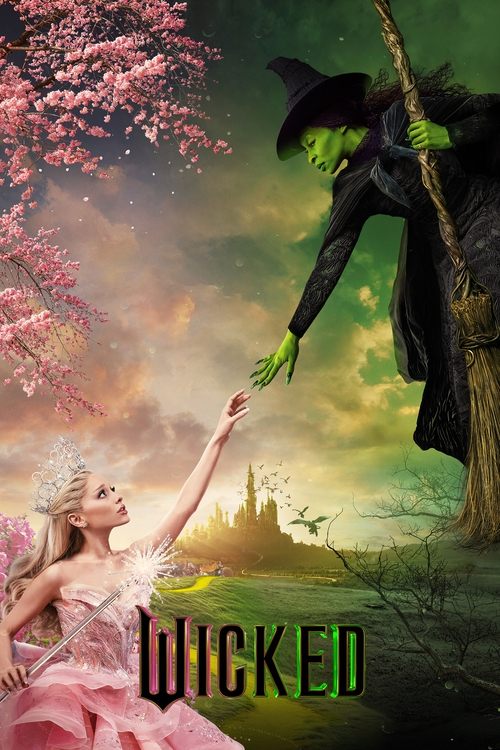

















































































































Popular
Why does Elphaba have green skin in Wicked (2024)?
What happens to Doctor Dillamond in Wicked (2024)?
How does Elphaba escape from Shiz University in Wicked (2024)?
What is the relationship between Elphaba and Fiyero in Wicked (2024)?
Why does Glinda stay behind when Elphaba leaves in Wicked (2024)?
Should I watch it?
Ask Your Own Question

What is the plot?
The film opens in Munchkinland amid a jubilation so complete that confetti and ribbons flutter through the streets as townspeople dance and sing about the end of a tyrant. Glinda the Good steps forward to address a cheering crowd, and when a child asks why someone becomes wicked she pauses, then begins to recount the life of the woman whose death they celebrate: the green-skinned witch. Glinda tells how the witch was born to Melena Thropp after an affair with a traveling salesman who had given Melena a strange green elixir; the infant emerges with unnatural green skin and telekinetic ability. Her father, Governor Frexspar Thropp of Munchkinland, recoils from the child and favors a younger daughter, Nessarose, who grows up unable to walk and dependent on a wheelchair. The crowd listens as Glinda frames the question of whether anyone mourns the witch, and when someone in the audience asks whether she and that witch were friends Glinda replies that they knew each other, then the film cuts to years earlier and to the beginning of that acquaintance.
Elphaba Thropp arrives at Shiz University to see Nessarose installed as a student in the School of Sorcery. Madame Morrible, dean of sorcery, watches Elphaba's temper and the flashes of power that occur when other students slight Nessarose; Morrible offers Elphaba private tutelage, arguing that her magical talent could take her to the Emerald City and to an audience with the Wonderful Wizard of Oz. The offer promises both a way to protect Nessarose and a route to the change Elphaba has longed for: to have her skin altered and her place in society secured. Morrible also assigns Elphaba to a dorm room she must share with Galinda Upland, a popular, coquettish first-year with a taste for social climbing. Elphaba reacts to Galinda's frivolity with icy detachment; Galinda answers with haughty disdain. The two trade barbed remarks and nightly slights as they rehearse their daily routines and attend classes together, and their collision is punctuated by mutual loathing in early encounters across the Shiz campus.
Between lectures, Elphaba goes to hear Dr. Dillamond, the campus history professor who is an anthropomorphic goat and one of the last Animal academics at Shiz. Dillamond confides in Elphaba that Animals across Oz have begun to lose their capacity for speech, that legislative and institutional pressure is building against them, and that his own position is precarious. Elphaba promises to take Dillamond's concerns to the Wizard in the Emerald City, believing him to be a protector of justice. Morrible watches Elphaba's reaction and presses her advantage: she fast-tracks Elphaba into private lessons, presenting the arrangement to Elphaba as a chance to impress the Wizard and secure Nessarose's future.
When Fiyero Tigelaar arrives at Shiz as a charming transfer student, the social order tilts. Galinda immediately gravitates toward Fiyero, giggling and plotting to attract his notice at a nightclub called the Ozdust Ballroom. Boq, a bashful Munchkin who adores Galinda from afar, is enlisted to invite his friend Nessarose to the event so that Galinda can use her as a pretext to dance with Fiyero. Elphaba initially refuses to play along with Galinda's maneuvering, but when Morrible insists that Galinda too be brought into Elphaba's private lessons so she can be molded into a suitable candidate for the Wizard, Galinda relents and the two girls begin to thaw. At the Ozdust, Galinda gives Elphaba a ridiculous pointed hat as a joke; the assembly laughs and Elphaba, humiliated, prepares to leave. Fiyero, however, lingers with Elphaba on the dance floor, and Galinda feels the first crack in her contempt. They share a dance that leaves both girls unsettled and intrigued, and in the days that follow Galinda takes it upon herself to remake Elphaba's look and social manner, smoothing out her blunt edges and teaching her to navigate the rituals of Shiz society.
Within the lecture halls, the campaign against Animals gathers momentum. Dillamond is publicly removed from his classroom; guards seize him and he is led away amid student protest. The university installs Professor Nikidik in his place, a man who displays a mechanical device: a reinforced cage containing a lion cub. Nikidik demonstrates that the cage can prevent an Animal from moving or learning to speak freely, and his demonstration terrifies the students who still care for the Animals. Enraged by the spectacle and the university's complicity, Elphaba responds by scattering poppy dust through the lecture room that sends the entire assembly to sleep--everyone except Fiyero and herself. She and Fiyero slip out of the building, sprint across campus, and together they pry the lion cub from its cage and carry it into the forest beyond Shiz. There, in the shadowed trees, they open their hands and watch the cub scamper free. Afterward, alone with Fiyero, Elphaba confesses that she loves him and that she fears she will never be the one he chooses; he listens without reciprocating, and the moment crystallizes her knowledge that his affections lie elsewhere.
As academic terms wind down, Elphaba receives a summons to the Emerald City: the Wizard wishes to meet her because Morrible has told him of Elphaba's aptitude. Galinda, moved by her own developing conscience and choosing to stand with Dr. Dillamond and those who are being silenced, shortens her name to Glinda and travels with Elphaba and with Madame Morrible to the capital. They ride into the city beneath the glittering green of its walls and walk past throngs filling the streets. In the throne room they find a man who does not resemble the great, awe-inspiring figure they imagined; the Wizard greets them with small talk and a brusque charm rather than miracles. Morrible takes a position beside him as a self-styled press secretary. She presents to Elphaba a dusty, leather-bound book called the Grimmerie, explaining that it contains powerful spells that only someone with innate magical ability can read. The Wizard, having no real magic of his own, needs Elphaba to make certain plans work, according to Morrible.
Morrible urges Elphaba to perform a levitation incantation from the Grimmerie upon the Wizard's monkey servant, Chistery. Elphaba reads the passage and speaks the words; Chistery writhes in violent pain as leathery wings rip free from his back and tear through his fur. The Wizard and Morrible smile at the result; the former sees the potential of winged monkey spies and the latter applauds the strategic advantage. Watching the creature suffer, Elphaba's face drains. She perceives a pattern: the Wizard's administration has been orchestrating the gradual removal of Animals' speech and freedom, and he has been dependent upon others--like Morrible--to produce effects he cannot accomplish himself. In that instant she understands that the very institutions she trusted are complicit in the oppression Dillamond had warned her about and that the Grimmerie has been used as a means to engineer the enslavement of Animals. Horrified by what she has enabled, Elphaba makes a decision.
She snatches the Grimmerie out of the Wizard's hands and bolts. Morrible moves to intercept; Glinda follows, pleading with Elphaba to stop and to return the book, arguing that the Wizard will protect them if they work within his office. Elphaba refuses. She rushes to the nearest broomstick and repeats the levitation incantation, this time using it on herself and the broom; the spell surges with a power that throws chandeliers and rips cables in the throne room. Guards rush the exits as alarm bells clang, yet Elphaba mounts the broom, points toward the western sky, and takes off. The flight is messy: sparks cascade from the broken fixtures below, and shocked onlookers cover their eyes as she climbs into the clouds. From a balcony, Glinda watches with tears and begs her friend to come back; Elphaba looks down and tells her to stay. Morrible seizes Glinda in a calculated embrace, holding her tight while the palace watch binds her hands and the crowd erupts into fearful applause against the woman fleeing the city.
Back at Shiz, word of the tumult reaches Governor Thropp and Nessarose. Thropp, who has spent a lifetime keeping distance from his eldest daughter, clutches his chest and suffers a heart attack when the news of the events in the Emerald City reaches him; Nessarose, cared for by attendants in the governor's quarters, calls for aid as physicians rush to her father. Nearby, Fiyero mounts a horse and leaves campus without fanfare; he rides out under an empty sky, his departure marking another fracture left in his wake.
Madame Morrible moves swiftly to shape public perception. She addresses the citizens of Oz, describing the woman who fled the Wizard with a book of spells as a threat and a villain. She labels Elphaba the Wicked Witch of the West, seeding the streets with posters and proclamations that turn fear into celebration. The film, having begun with that celebration, now returns to its opening image: townspeople dancing in the streets, singing that no one mourns the wicked. Glinda stands before them, held by Morrible and guarded by soldiers, and offers the account of how the witch came to be and how they once were friends.
On the last visible frame before the credits, Elphaba crosses a patchwork landscape and heads west on her broom. She soars away from the Emerald City toward an uncertain horizon, clutching the Grimmerie to her chest. Behind her, the city's lights dwindle; below, guards lead Glinda away while Morrible holds her tightly, a staged consolation and a public display of the new order. The film ends with Elphaba's silhouette receding into the distance as she flies toward parts unknown, leaving Glinda in custody and the citizens of Oz already conjuring a story of wickedness as they celebrate what they believe is her demise. The narrative closes on the image of a lone witch in the sky, the Grimmerie tucked against her, and the murmur of a populace convinced that the threat to their peace has been eradicated.






What is the ending?
Short, Simple Narrative:
At the end of the 2024 movie Wicked, Elphaba discovers that the Wizard and Madame Morrible are not the heroes she believed them to be. After being tricked into giving wings to the Wizard's monkey guards, she realizes their true intentions and flees the Emerald City, escaping on a flying broomstick. Glinda tries to convince her to stay and apologize, but Elphaba refuses and leaves, declaring her independence. Glinda remains behind, torn between loyalty to her friend and her desire to fit in with the powerful. Elphaba is branded a fugitive and the "Wicked Witch," while Glinda is left to face the consequences of her choices.
Expanded Chronological Narrative:
The climax of Wicked (2024) unfolds in the grand palace of the Emerald City, where Elphaba and Glinda have finally been granted an audience with the Wizard. Elphaba, filled with hope, believes she will be able to help end animal discrimination in Oz. The Wizard, with Madame Morrible at his side, presents her with the Grimmerie, a powerful book of spells. He asks her to read a spell from it, claiming it will help him protect the animals. Elphaba, eager to prove herself, reads the spell aloud.
Immediately, the Wizard's monkey guards begin convulsing and screaming as wings sprout from their backs. Elphaba is horrified, realizing she has been tricked--the spell was not meant to protect animals, but to turn them into winged spies for the Wizard and Morrible. She confronts them, but they reveal their true intentions: they do not want to end animal oppression, but to use magic to control and monitor dissent.
Elphaba, enraged and disillusioned, grabs the Grimmerie and flees through the palace. Glinda follows, pleading with her to calm down and apologize to the Wizard, hoping to salvage Elphaba's future and her own standing. Elphaba refuses, insisting she will not betray her principles. As the palace guards close in, Elphaba retreats to a tower where the Wizard's hot air balloon is kept.
Glinda tries once more to convince Elphaba to surrender, but Elphaba is resolute. She opens the Grimmerie and begins to cast the same flying spell she used on the monkeys, this time on a broomstick. Glinda reaches out, but Elphaba steps back, determined to escape. She wraps herself in a blanket Glinda gives her, completing her iconic witch's look.
With the guards banging at the door, Elphaba mounts the broomstick and flies out of the tower. She sings "Defying Gravity," declaring her independence and vowing to fight for the oppressed. Glinda watches from the tower, torn between admiration and fear. Elphaba soars into the sky, leaving the Emerald City behind.
Madame Morrible, using the palace intercom, declares Elphaba an enemy of the state and a fugitive, branding her the "Wicked Witch of the West." Glinda is pressured to help bring Elphaba back, but she remains silent, conflicted. The movie ends with Elphaba flying into the unknown, her fate uncertain, while Glinda is left behind, facing a future of compromise and regret.
Fate of Each Main Character:
- Elphaba: She escapes the Emerald City on a flying broomstick, branded a fugitive and the "Wicked Witch." She is now an outcast, determined to fight against the Wizard and Morrible's tyranny.
- Glinda: She remains in the Emerald City, torn between loyalty to Elphaba and her desire to maintain her status. She is pressured to help capture Elphaba but does not act, leaving her future uncertain.
- The Wizard: He remains in power, having exposed his true nature as a manipulative and oppressive ruler.
- Madame Morrible: She continues to serve the Wizard, using her influence to control and manipulate others, including Glinda.
The ending sets the stage for the sequel, highlighting the growing rift between Elphaba and Glinda, the rise of Elphaba as a symbol of resistance, and the moral compromises Glinda must face.
Who dies?
In the 2024 film Wicked, no main characters definitively die on screen. The story opens with the citizens of Oz celebrating the death of the Wicked Witch of the West (Elphaba), but this is a narrative framing device told by Glinda reflecting on Elphaba's life. Elphaba herself does not actually die in the film; instead, she escapes and fakes her death to evade capture and continue her rebellion against the Wizard's tyranny.
Regarding other characters:
-
Nessarose, Elphaba's younger sister and the eventual Wicked Witch of the East, is implied to die in the broader story context (from the musical and book source material), crushed when Dorothy's house lands on her. This event is a key tragic moment that influences Elphaba's conflict with Dorothy. However, the 2024 film ends before fully depicting this event, so Nessarose's death is not explicitly shown but is referenced as part of the ongoing story.
-
Governor Thropp (Nessarose and Elphaba's father) suffers a heart attack upon receiving distressing news, but he does not die on screen.
-
Fiyero, Elphaba's love interest, survives in the film and does not die. In the original book, he dies, but the film follows the musical's version where he lives and eventually reunites with Elphaba.
-
Dr. Dillamond, a professor and ally to Elphaba, is arrested and removed from his position but does not die in the film, unlike the book where he is assassinated.
The film ends on a cliffhanger with Elphaba fully embracing her role as a rebel, flying away on her broomstick, leaving Glinda behind, and no confirmed deaths of main characters during the film's timeline.
Summary of deaths or implied deaths in the 2024 film Wicked:
| Character | Death Status in Film | Circumstances/Notes | |-----------------|---------------------|-----------------------------------------------------------------------------------------------------| | Elphaba | No | Fakes her death to escape; does not die in the film | | Nessarose | Implied (not shown) | Crushed by Dorothy's house in the broader story; not explicitly shown in the film | | Governor Thropp | No | Suffers a heart attack but survives | | Fiyero | No | Survives and reunites with Elphaba | | Dr. Dillamond | No | Arrested and removed from position; does not die |
Thus, the film focuses on Elphaba's survival and rebellion rather than character deaths, with Nessarose's death remaining a significant but off-screen event in the story's larger context.
Is there a post-credit scene?
There is no post-credits scene in the 2024 movie Wicked. After the final moments of the film, which culminate in Elphaba's defiant performance of "Defying Gravity" and her departure from the Emerald City, the story concludes with a title card announcing the continuation of the story in Wicked For Good. The credits then roll, featuring the main cast and crew, but there are no additional scenes, stingers, or teases during or after the credits. Audiences who stay until the very end will not see any extra footage or narrative continuation beyond what is shown before the credits begin.
Why does Elphaba have green skin in Wicked (2024)?
Elphaba's green skin is a result of her mother drinking a mysterious green elixir during pregnancy, which was intended to make her unborn child more desirable to her husband. Instead, Elphaba is born with green skin, leading to her lifelong struggle with acceptance and prejudice.
What happens to Doctor Dillamond in Wicked (2024)?
Doctor Dillamond, an Animal professor at Shiz University, is forcibly removed from his classroom by guards after the school board bans Animals from teaching. His removal is a pivotal moment that highlights the growing oppression of Animals in Oz and motivates Elphaba to take action.
How does Elphaba escape from Shiz University in Wicked (2024)?
After defying the Wizard and Morrible, Elphaba uses the Grimmerie to levitate a broom and escapes from the city on it, evading the Wizard's guards and flying monkeys. Her escape is marked by the iconic song 'Defying Gravity'.
What is the relationship between Elphaba and Fiyero in Wicked (2024)?
Elphaba and Fiyero develop a romantic connection after they work together to rescue a lion cub from Professor Nikidik's cruel experiment. Their bond grows stronger as they both become disillusioned with the Wizard's regime, though Fiyero is initially dating Glinda.
Why does Glinda stay behind when Elphaba leaves in Wicked (2024)?
Glinda chooses to stay behind because she feels compelled to maintain her position and influence within the Wizard's regime, hoping to effect change from within. She tearfully supports Elphaba's decision to leave but ultimately aligns herself with the Wizard, setting up their future estrangement.
Is this family friendly?
The 2024 movie Wicked is rated PG and is generally family-friendly but may not be suitable for very young children or highly sensitive viewers. It contains some scary action, thematic material, and brief suggestive content that parents should consider before viewing with children.
Potentially objectionable or upsetting aspects include:
- Scary or intense scenes: Flying monkeys undergo a painful transformation and chase sequences that can be frightening; there are also scenes with a large mechanical mask and tense moments involving magical creatures.
- Themes of discrimination and persecution: The story includes bullying based on appearance, mistreatment of animals, and societal oppression, which may be emotionally heavy for younger or sensitive children.
- Mild violence: Light violence such as guards being struck and some perilous action scenes like jumping from heights and sword fights.
- Brief suggestive material: Implied infidelity and subtle innuendos, including a scene with a man grabbing another's head in a suggestive manner, though these are mild and likely to go over younger kids' heads.
- Sad or upsetting moments: Some scenes involve animal cruelty and emotional struggles of the characters, which might be distressing for sensitive viewers or animal lovers.
There is no strong language, explicit sexual content, or graphic violence. The movie's length (about 2 hours and 40 minutes) and some intense scenes may also affect younger children's attention and comfort.
Overall, Wicked is suitable for children roughly aged 7 and older, with parental discretion advised for younger or sensitive children due to the above elements.









