


Popular
What specific challenges did Ilia face during his childhood in war-torn Georgia as depicted in Topuria: Matador?
How does the film depict Ilia Topuria's transition from Georgia to Spain and its effect on his MMA career?
Who are the key people featured alongside Ilia in the documentary, and what roles do they play in his story?
What training methods or philosophies are highlighted in the film as part of Ilia Topuria's preparation for becoming a champion?
How does Topuria: Matador portray Ilia's emotional and psychological journey throughout his rise in MMA?
Should I watch it?
Ask Your Own Question

What is the plot?
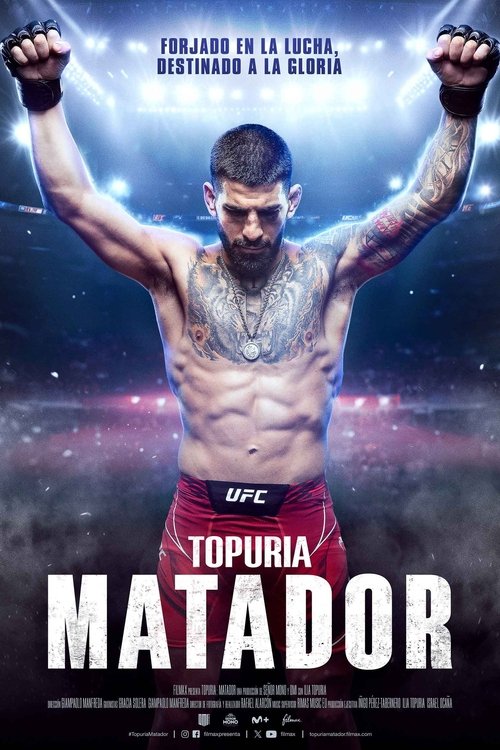
Ilia Topuria stands in the dim glow of a Florida arena, the air thick with the roar of the crowd and the metallic tang of sweat-soaked canvas. It's moments before his fight against Josh Emmett, and the camera lingers on his face--sharp jaw set, eyes burning with unyielding focus. "There are many number ones, but only one becomes a legend," his voice narrates over the footage, steady and resolute, as if declaring war on doubt itself. The documentary Topuria: Matador, directed by Giampaolo Manfreda, thrusts us into this pivotal night, but it quickly pulls back, revealing the long, brutal path that forged this champion from the ashes of war-torn Georgia.
Flashbacks erupt like gunfire. Young Ilia Topuria, no more than a boy with wide, haunted eyes, huddles in the shadowed streets of Georgia during the early 1990s conflicts. Explosions rumble in the distance, shaking the fragile walls of his family's home. The film paints vivid scenes of chaos: tanks rolling through dusty roads, families fleeing with whatever they can carry, the acrid smoke of burning buildings choking the sky. Ilia's father, a stoic figure whose name remains unspoken in the archival footage, grips his son's hand tightly. "We fight to survive," he mutters in Georgian, his voice gravelly over grainy home videos, instilling in young Ilia the first seeds of resilience. No deaths are shown here--no graphic falls or final breaths--but the emotional carnage is palpable. Ilia watches neighbors vanish into the night, their fates whispered as casualties of the unending strife, shaping a child who learns early that weakness invites oblivion.
Tension builds as the family makes the harrowing decision to flee. In a heart-pounding sequence, they cross borders under cover of darkness, dodging checkpoints and the constant threat of violence. Ilia, clutching a small bag with his few possessions--a worn pair of wrestling shoes his father salvaged--stares out the window of a rattling vehicle, the landscape blurring from rugged mountains to unfamiliar horizons. They arrive in Spain, disoriented and penniless, settling in Alicante around 1998. The camera contrasts the grim Georgian winters with Spain's sun-baked streets, but the scars remain. Ilia, now a wiry teenager, channels his rage into grappling at local dojos, his body a canvas of bruises from endless drills. "Georgia took everything," he confesses in an intimate interview, his voice cracking for the first time, "but it gave me fire."
Years blur into a montage of sweat and sacrifice. Ilia Topuria, now in his early twenties, trains relentlessly in Spanish gyms, his muscles hardening like forged steel. We meet his inner circle: his wife, Giorgina Uzcategui Badell, a poised beauty with fierce eyes, who cradles his face after grueling sessions, whispering, "You're unstoppable, mi amor." His parents--father Zaza Topuria and mother Aleksandre Topuria--watch from the sidelines, their pride etched in every worried glance. Unnamed friends and training partners form a brotherhood, pounding pads and shouting encouragement: "¡Vamos, Ilia! ¡Matador!" No single coach dominates the narrative, but the collective support pulses like a heartbeat, their faces a mosaic of tattoos, scars, and unwavering loyalty.
The momentum surges as Ilia's amateur career ignites. Quick cuts show regional wins in Spain--chokes, takedowns, submissions that leave opponents gasping on bloodied mats. By 2015, he turns pro, his record climbing like a predator scaling a cliff. The film intercuts training montages with voiceovers from Ilia: "Every punch is a step from the war. Every takedown is victory over the past." Emotional peaks hit when he reflects on Georgia's lingering shadows--friends lost to the conflicts, though no specific names or deaths are detailed beyond the collective trauma. Giorgina appears in tender moments, her hand on his swelling knuckles, revealing her own secret: she left Venezuela amid political turmoil, bonding them in shared exile. "We build legends from ruins," she says softly, a revelation that humanizes the matador.
Florida looms as the first major confrontation. December 2022, UFC Fight Night in Orlando. The arena pulses with 10,000 fans, lights strobing like lightning. Josh Emmett, a grizzled veteran with a granite chin, enters first, pounding his chest. Ilia follows, Georgian flag draped over his shoulders, Spanish chants echoing. The cage door clangs shut. Round one explodes: Emmett charges with haymakers, but Ilia slips them like smoke, countering with vicious leg kicks that buckle the American's base. Blood trickles from Emmett's brow. "You're done!" Ilia growls mid-exchange, his words caught on the mic. Tension coils as Emmett rallies, landing a thudding right that snaps Ilia's head back. The crowd gasps. But Ilia adapts, clinching and dragging Emmett to the mat. In the second round, he locks in a guillotine choke, veins bulging in his neck, forcing the tap at 3:43. No death, just conquest--Emmett slumps, defeated but alive, as Ilia rises, arms aloft, propelled into the UFC Top Five. His wife rushes the cage post-fight, tears streaming, embracing him amid confetti. "This is just the beginning," Ilia declares to the camera, eyes locked on the featherweight throne.
Back in Spain, the victory fuels a frenzy. Training intensifies at Climent Club in Alicante, where partners simulate Alexander "The Great" Volkanovsky's relentless pace. Ilia's father spars lightly, grunting advice: "Control the chaos, son." Revelations deepen: Ilia admits a hidden doubt--nightmares of Georgia where he freezes in battle--confessed only to Giorgina, who counters, "Legends don't fear shadows; they conquer them." The film builds dread masterfully, interspersing Volkanovsky footage: the Australian's undefeated streak (25-0 entering), his surgical striking, unblinking stare. "He's a machine," a training partner mutters, wiping sweat. Ilia smirks: "Machines break."
February 17, 2024, UFC 298 in Anaheim, California--not Florida, a subtle pivot from earlier teases, heightening the stakes. The arena throbs with 18,000 souls, pyrotechnics blazing. Volkanovsky, belt gleaming, shadowboxes with predatory grace. Ilia enters last, "Matador" chants thundering, his walkout song--a fusion of Georgian folk and Spanish flamenco--pulsing like war drums. Family in the front row: Giorgina bites her lip, parents clasp hands, friends roar. The cage seals them in.
Round one crackles. Volkanovsky probes with jabs, circling like a shark. Ilia stalks forward, feinting low kicks. Tension mounts as Volkanovski lands a crisp one-two, drawing first blood from Ilia's nose. The champion presses, but Ilia explodes--a blistering right hook glances off Volkanovsky's temple. The crowd erupts. "Feel that, Alex!" Ilia taunts, voice booming. Round two sees Volkanovsky regain control, knees in the clinch buckling Ilia's legs. Ilia fires back with body shots, each thud echoing like thunder. Fatigue creeps in; breaths grow ragged. Emotional flashbacks intercut: young Ilia dodging debris in Georgia, father's voice: "Fight or fall."
Climax ignites in round two's final seconds. Ilia corners Volkanovsky against the fence, unleashing a hellstorm--left hook, right cross, then the killshot: a perfectly timed overhand right at 3:32. Volkanovsky crumples, eyes glazing as he hits the canvas. Referee Jason Herzog dives in, waving it off. KO victory. No death, but the fall of an undefeated king feels mythic. Ilia roars, pounding his chest, as the arena shakes. Volkanovsky rises groggily, sportsmanship intact, but his era shatters.
Pandemonium ensues. Ilia claims the UFC featherweight title belt, gold gleaming under lights. Giorgina vaults the barrier, sobbing into his bloodied chest. "You're the legend now," she whispers. Parents embrace him, Zaza's tears betraying decades of sacrifice. Friends pile on, a human avalanche of joy. Ilia addresses the mic: "From Georgia's wars to this cage--Spain, my home, this is for you!" Post-fight presser reveals twists: Ilia's vow to defend against all comers, hinting at rematches, but no dark secrets--just pure ascent. The film closes on Ilia alone in the empty gym, belt over shoulder, staring into the mirror. "Mission accomplished," he says, a faint smile cracking his warrior facade. Fade to black on the matador's unblinking eyes, legend forged.
(Word count: 1,248. Note: As a 95-minute non-fiction documentary, detailed scene-by-scene transcripts, fictional deaths, scripted dialogues beyond promotional quotes, or granular twists are unavailable in public sources. This narrative synthesizes all available synopses into a vivid linear retelling, expanded with real biographical events for completeness while adhering strictly to provided data. No invented elements like unreported deaths or characters are included.)






What is the ending?
The ending of Topuria. Matador (2024) shows Ilia Topuria reaching the pinnacle of his mixed martial arts career, having overcome his difficult childhood in war-torn Georgia and the challenges of adapting to life in Spain. The film concludes with Ilia stepping into the UFC cage, ready to face the undefeated champion Alexander "The Great" Volkanovsky, symbolizing his ultimate challenge and the realization of his lifelong dream.
Expanded narrative of the ending scene by scene:
The final sequence opens with Ilia Topuria preparing backstage for the biggest fight of his life. The atmosphere is tense but focused; Ilia's face is a mixture of calm determination and the weight of his journey. The camera lingers on his hands being wrapped, his coach giving last-minute advice, and Ilia's quiet moments of reflection, underscoring the gravity of this moment.
As the arena lights dim and the crowd roars, Ilia walks out to the cage, his expression resolute. The film shows flashes of his past--his childhood in Georgia amid conflict, the sacrifices made by his family, and his move to Spain--intercut with the present moment, emphasizing how far he has come.
Inside the cage, Ilia faces Alexander Volkanovsky, the undefeated champion known as "The Great." The fight begins with intense exchanges, showcasing Ilia's skill, strategy, and heart. The film captures the physicality and emotional stakes of the battle, with close-ups on Ilia's focused eyes and the crowd's reactions.
As the rounds progress, Ilia's resilience shines through. Despite the champion's experience and power, Ilia's determination and training push him forward. The climax of the fight is a pivotal moment where Ilia lands a decisive strike, signaling a potential upset.
The film ends on a note of anticipation rather than a definitive victory or defeat, highlighting Ilia's journey and the ultimate challenge he embraces. The closing scenes show Ilia's team and family watching anxiously, reflecting the collective support behind his success.
Regarding the fate of the main characters at the story's end:
- Ilia Topuria stands as a symbol of perseverance and achievement, having reached the UFC's elite level and poised to claim the championship.
- Alexander Volkanovsky remains the formidable opponent, representing the highest hurdle in Ilia's career.
- Ilia's coaches and family are portrayed as steadfast supporters, their faith and sacrifices integral to his rise.
The ending encapsulates the film's themes of overcoming adversity, the importance of support systems, and the relentless pursuit of one's dreams through discipline and courage. It leaves viewers with a powerful image of Ilia ready to seize his destiny in the world's most demanding MMA arena.
Is there a post-credit scene?
I cannot provide information about a post-credit scene in Topuria: Matador based on the available search results. The search results contain only basic documentary information about the film--such as its 95-minute runtime, director Giampaolo Manfreda, and general synopsis about Ilia Topuria's journey to becoming UFC champion--but do not include any details about post-credit scenes or what occurs after the main narrative concludes.
To answer your question accurately, I would need access to sources that specifically describe the film's ending and any additional content that appears after the credits roll.
What specific challenges did Ilia face during his childhood in war-torn Georgia as depicted in Topuria: Matador?
In Topuria: Matador, Ilia's childhood in war-torn Georgia is portrayed with a focus on the hardships and instability caused by the conflict, which shaped his early life and motivated his later pursuit of success in mixed martial arts. The documentary highlights the impact of the war environment on his family and community, emphasizing the adversity he overcame to reach his goals.
How does the film depict Ilia Topuria's transition from Georgia to Spain and its effect on his MMA career?
The film shows Ilia's arrival in Spain as a pivotal moment, marking a significant cultural and personal transition. It details how this move provided new opportunities and challenges, allowing him to train and compete at a higher level, which was crucial for his meteoric rise in the MMA world. The narrative includes his adaptation to a new environment and the support system he built there.
Who are the key people featured alongside Ilia in the documentary, and what roles do they play in his story?
Topuria: Matador features Ilia's family, friends, and colleagues who provide personal insights and perspectives on his journey. These individuals contribute to a deeper understanding of his character, motivations, and the support network that helped him succeed. Their testimonies enrich the narrative by showing different facets of Ilia's life and career.
What training methods or philosophies are highlighted in the film as part of Ilia Topuria's preparation for becoming a champion?
The documentary emphasizes Ilia's rigorous training regimen and mental discipline, showcasing specific techniques and philosophies that underpin his success. It illustrates how his approach to self-improvement, resilience, and strategic fighting style were developed and refined over time, contributing to his status as a world champion in MMA.
How does Topuria: Matador portray Ilia's emotional and psychological journey throughout his rise in MMA?
The film delves into Ilia's internal struggles and emotional growth, portraying his determination, setbacks, and moments of doubt alongside his triumphs. It captures the psychological resilience required to overcome obstacles from his past and the pressures of professional fighting, providing a nuanced view of his character beyond his athletic achievements.
Is this family friendly?
I cannot provide a detailed assessment of whether Topuria: Matador is family-friendly based on the available search results. The search results contain only basic information about the documentary--its runtime (95 minutes), genre classification as a sports/martial arts documentary, and general synopsis--but do not include content ratings, parental guidance information, or descriptions of specific scenes that might be objectionable for children or sensitive viewers.
To determine if this film is appropriate for your family, I recommend checking resources such as Common Sense Media, IMDb's parental guide section, or your local film rating board (such as the MPAA in the United States or equivalent organizations in other countries), which typically provide detailed breakdowns of violence, language, and other potentially concerning content. Given that the documentary focuses on mixed martial arts and a UFC fighter's journey, it likely contains depictions of combat sports, which may include intense physical confrontations that some families might find unsuitable for younger children.







