
















Popular
What is the relationship between Dora and Josué throughout the film?
How does Dora's character evolve from the beginning to the end of the film?
What motivates Dora to help Josué find his father?
What challenges do Dora and Josué face on their journey?
How does the setting of Central Station influence the story?
Should I watch it?
Ask Your Own Question

What is the plot?
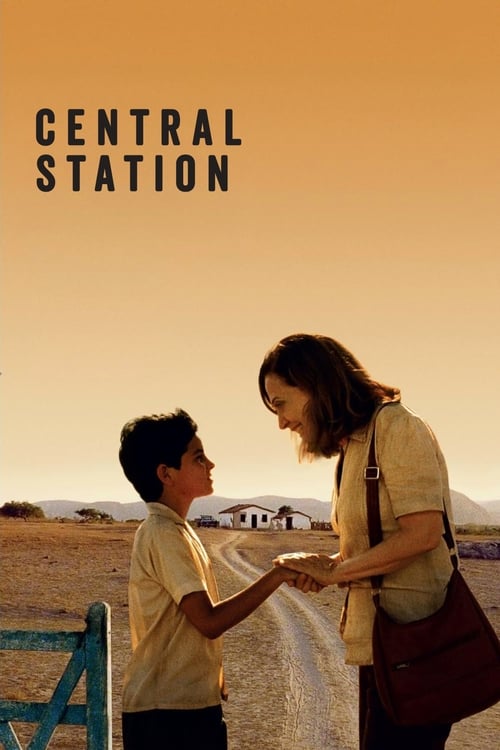
Central Station begins in the humid, noisy crush of Rio de Janeiro's Central do Brasil, where the camera settles on the station as a place of arrivals, departures, and desperate little hopes. Train doors slide, people clamber in through windows, vendors shout, and the whole place feels like a machine grinding up the poor and spitting them back out again. In the middle of that chaos sits Dora, a retired schoolteacher who has turned herself into a letter writer for illiterate strangers. She bends over scraps of paper and gives voice to their longing, their grievances, their love affairs, their family disputes, their requests for forgiveness, money, and reunion. But Dora is not a kind intermediary. She is sharp, skeptical, and tired of everybody's pain. She listens with a face already closed, decides which letters deserve to exist, and often simply does not mail them at all, keeping some in a drawer and tearing others up entirely. She and her neighbor Irene move through this world as two very different women: Irene still responds with some moral heat, while Dora has armored herself against sentiment and turned human suffering into a business.
The first letter that truly changes everything comes from Ana, a mother who arrives with her young son, Josué, asking Dora to write to the boy's father, a man who is absent and living far away. The exact details of the father are unstable in the way memory is unstable in the film--some accounts identify him as Jesus, others as Josué's estranged father in the countryside--but the important fact is the same: Josué is growing up with a father-shaped absence, and his mother still believes in the possibility of contact. Dora writes the letter, but as so often happens with her, the private words of another human being pass through her hands with little respect. Then, almost immediately after this fragile scene of communication, tragedy strikes in the most banal and brutal way possible. Ana steps away from the station and is struck by a bus just outside. The death is sudden, ugly, and final, and it leaves Josué alone in the middle of Rio, a child standing in the wreckage of his mother's last hope.
Josué has no one else in the city except the woman who just wrote his mother's letter, so he follows Dora into the station's orbit, asking her for help. Her first answer is pure rejection: "Scram!" But the boy's vulnerability eventually pierces the shell of her impatience. Dora reluctantly takes him home to her cramped apartment, and the apartment immediately tells us who Dora is when nobody is watching. It is small, crowded, emotionally airless, and filled with the evidence of her private life--letters she has not sent, words she has intercepted, the neat machinery of her detachment. Josué wanders through that space and finds the letter Ana dictated, which contains the address of his father. That discovery becomes the first real hinge of the story. The father is not just an abstract dream anymore; there is a location, a route, a possibility. The boy's grief hardens into purpose, while Dora, for a moment, seems to have been handed a chance to act differently than she always has.
She does not act differently at first. In one of the film's darkest turns, Dora sells Josué to a pair of people who pretend to be in the adoption business. The transaction is chilling because it is so casual: the woman who has been controlling the letters of the poor now literally hands over a child. She then takes the money home and buys a new television, a petty domestic purchase that becomes a symbol of her self-protective, spiritually dead life. But the act does not stay hidden. Irene is horrified when she learns what Dora has done, and she makes the threat explicit: the boy may be killed for his organs. That warning strips away any remaining self-deception. Dora has not simply betrayed Josué; she has placed him into the machinery of child trafficking and possible murder. The confrontation with Irene is one of the film's moral detonations, and it forces Dora to see that her cynicism has become criminal. Guilt hits her hard enough to break the line she has been living on. She steals Josué back before the deal can become irreversible, and now the story changes direction. Dora is no longer just the gatekeeper of letters; she becomes the guardian of the child she tried to destroy.
From there the film opens outward. Dora decides to take Josué to the father's home in northeastern Brazil, and they leave Rio by bus, moving away from the urban station into the wider country. The bus ride itself has the feeling of a fugitive escape, not a redemption yet, but a necessary flight from what Dora has done. The pair are awkward together, bound by dependence rather than trust. Josué watches her carefully, because he has already learned she cannot be trusted; Dora watches him with the defensive irritation of someone not used to being needed. They move through Brazil's changing landscapes--concrete, roadside scrub, open roads, dust, heat--while their relationship shifts in tiny increments. Dora is still trying, in her own way, to keep emotional control, but the journey keeps stripping away the old protections.
At one point Dora tries to abandon Josué on the bus, hoping perhaps to free herself from responsibility or simply to recover the lonely autonomy she once had. The attempt fails because Josué follows her. In the scramble, he loses his backpack, and inside it is the money Dora had given him. The loss matters not just because they are now poorer, but because it reveals how precarious their entire trip is. They are no longer traveling with a safety net or a clear plan. They are two damaged people with one address and dwindling resources, forced to keep moving because stopping would mean surrendering to despair.
Their next rescue comes from an unlikely source: a friendly, religious truck driver who gives them a ride and a temporary shelter. He is explicitly devout, the kind of man whose piety gives the film a brief breath of moral steadiness after all the corruption in Rio. Dora, starved for human warmth, relaxes into his company, but even this fragile possibility collapses because she cannot help revealing her interest in him. The moment becomes painfully awkward. He realizes she is not only grateful; she is attracted to him physically, and he leaves. It is another small humiliation for Dora, another reminder that her hunger for connection does not yet know how to express itself without distortion. The road keeps testing her, and each test exposes a new layer of loneliness beneath the cynicism.
Poverty closes in. In order to continue, Dora trades her watch for another ride, and the journey pushes them into the interior of Brazil, toward a place identified in some summaries as Bom Jesus do Norte, a fictionalized version of Cruzeiro do Nordeste in Pernambuco's Sertânia region. This is the transition from mere travel to spiritual landscape. The city has been left behind, and the film now places Dora and Josué among arid roads, pilgrim crowds, roadside stalls, and rough settlements where faith and survival are braided together. They reach the house they have been searching for, only to discover that Josué's father is not there. The people who live there now explain that he won the house in a lottery and then left. The home Josué imagined as a destination turns out to be another form of absence, another place marked by departure. The film undercuts the fantasy of reunion just as it seems closest, and Josué is forced to confront the possibility that the father he has built up in his mind may never appear in the expected way.
That disappointment does not end the search. Instead, it changes its form. Josué, thinking quickly, suggests that Dora should write letters for the pilgrims who are arriving for a major religious gathering. This is a crucial reversal. The woman who once hoarded and destroyed letters now returns to the same act, but this time not as a fraud or a censor. She writes honestly. She posts the letters. She participates in the circulation of feeling instead of obstructing it. The pilgrimage sequence is one of the film's great moral and visual transformations: the crowd of believers, the dust, the faces lifted in expectation, the handwritten pleas and confessions moving outward into the world. Dora becomes, almost against herself, the person she was never willing to be at the station. Her letter writing is no longer a performance of power over the poor; it becomes a service, an act of recognition. In these scenes she begins to sense that other people's loneliness is not beneath her contempt but inside her own life as well. The emotional thaw is slow, but it is unmistakable.
The search for Josué's father reaches its bleakest revelation when they learn that he has vanished. There is no dramatic entrance, no neatly delivered reunion speech, no sudden transformation of the father into the missing piece of Josué's life. Instead, the story becomes a meditation on incomplete families and inherited absence. Josué finds two half-brothers, which gives him a partial kinship rather than a full resolution, and Dora reads the father's letter--the one he wrote six months earlier. That letter is the film's most important revelation about him. He had gone to Rio in search of Josué's mother and the son he had never seen. He was not merely absent by indifference; he too had searched and failed. The father's disappearance is no longer simple abandonment in the child's imagination. It becomes another layer of loss, another person swallowed by the same world of distance and poverty. The half-brothers infer the painful possibility that he may be dead. The film does not force certainty where there is none; it lets the absence remain unresolved, but morally complicated. Josué does not get the father he dreamed of, but he does receive the truth that the father had wanted him.
That truth changes Dora as much as it changes the boy. She has spent the entire film moving from contempt to guilt to reluctant care, and now she is fully transformed. She is no longer the woman who decides whose words matter. She no longer treats affection as weakness. The child who once depended on her has become the person through whom she learns tenderness. In the final stretch, she offers Josué a more stable life with her, but the offer is made too late to reverse the shape of the story. Josué has found a family connection, however fractured, and Dora has come to understand that letting him go is itself an act of love. The emotional climax is therefore not a confrontation of fists or accusations, but the pain of recognition: the future they can each have is not the same future.
The last morning carries that sorrow in every frame. Josué sleeps while Dora prepares to leave. She takes the bus back to Rio alone, and the old pattern of departure returns--but now it is emptied of cruelty. She is not abandoning him because she no longer cares; she is leaving because she understands that care cannot become possession. Josué wakes too late and runs after the departure, but he cannot stop her. The separation is devastating precisely because it is also cleansing. They have come to mean something real to each other, and the film refuses to pretend that meaning can erase loss. What remains between them is a photograph, an object of memory that both confirms the bond and preserves the distance. It is a small, still image against all the movement that has come before it. Dora returns to Rio changed, carrying the knowledge that she has finally let another life matter to her. Josué remains in the northeast with a wider family, a partial inheritance, and the truth that his father once tried to come looking for him. The final emotional note is not reunion but permanence: Dora and Josué will remember each other, and the people they were at the station will not survive the journey unchanged.






What is the ending?
In the ending of "Central Station," Dora, the main character, finally comes to terms with her past and her relationship with the boy, Josué. After a series of emotional trials, she decides to let him go to a new life with a family that can care for him. The film concludes with a sense of hope and redemption for both characters.
As the film approaches its conclusion, we find Dora and Josué in a precarious situation. After their journey together, they arrive at a small town where they seek out Josué's father, who has been searching for him. Dora, who has been struggling with her own emotional baggage and the loss of her previous life, begins to see the importance of letting Josué find his own path.
In a poignant scene, they arrive at a modest house where Josué's father lives. Dora watches as Josué is reunited with his father, a man who is filled with remorse and longing for his son. The emotional weight of the moment is palpable; Dora's heart is heavy with the realization that she must part with the boy who has become a significant part of her life. She feels a mix of sadness and relief, knowing that Josué will be cared for and loved in a way she could not provide.
As they stand outside the house, Josué looks back at Dora, his eyes filled with uncertainty and a hint of sadness. Dora kneels down to his level, and in a tender moment, she reassures him that he will be okay. She tells him to be brave and to remember her, even as she struggles to hold back her own tears. This moment encapsulates the bond they have formed throughout their journey, a bond that transcends their difficult circumstances.
After saying goodbye, Dora walks away, her heart heavy but also lighter in a way. She has made a choice that reflects her growth as a character. The film closes with a shot of Dora walking through the streets of the town, her expression a mixture of sorrow and newfound strength. The camera lingers on her face, capturing the complexity of her emotions as she steps into an uncertain future, but one that is filled with the possibility of redemption.
In the final moments, the audience is left with a sense of hope. Dora has let go of her past and embraced the idea of moving forward, while Josué is given a chance at a better life. The film ends on a note that suggests that even in the face of hardship, there is the potential for healing and connection.
Is there a post-credit scene?
The movie "Central Station," produced in 1998, does not have a post-credit scene. The film concludes with a poignant ending that encapsulates the emotional journey of the characters, particularly the relationship between Dora, a retired schoolteacher, and Josué, a young boy who has lost his mother. The final moments focus on their connection and the hope for a better future, leaving the audience with a sense of closure without any additional scenes after the credits.
What is the relationship between Dora and Josué throughout the film?
Dora, a jaded and cynical former school teacher, initially views Josué, a young boy who has lost his mother, as a burden. However, as they journey together, her attitude shifts. She becomes a reluctant guardian, and their bond deepens as they face various challenges. Dora's emotional walls begin to crumble, revealing her capacity for love and care, while Josué's innocence and determination inspire her to reconnect with her own humanity.
How does Dora's character evolve from the beginning to the end of the film?
At the beginning of the film, Dora is portrayed as a bitter and self-serving woman, working at the Central Station in Rio de Janeiro, where she writes letters for illiterate people. Her life is marked by loneliness and a lack of purpose. As she reluctantly takes Josué under her wing, her character begins to evolve. Through their shared experiences, she confronts her past and her emotional detachment. By the end, Dora shows signs of redemption and emotional growth, as she learns to care for someone else and finds a sense of belonging.
What motivates Dora to help Josué find his father?
Initially, Dora is motivated by a sense of obligation and guilt after she witnesses Josué's despair following his mother's death. However, as their journey progresses, her motivations shift. She begins to see Josué as a reflection of her own lost potential and unfulfilled dreams. The desire to help him find his father becomes intertwined with her own need for redemption and connection, pushing her to confront her own past and the choices she has made.
What challenges do Dora and Josué face on their journey?
Dora and Josué encounter numerous challenges during their journey, including financial struggles, the harsh realities of life on the streets, and the emotional toll of their circumstances. They face danger from unsavory characters, experience moments of hunger and desperation, and navigate the complexities of their relationship. Each challenge tests their resilience and forces them to rely on each other, ultimately strengthening their bond.
How does the setting of Central Station influence the story?
The Central Station serves as a pivotal backdrop for the film, symbolizing both a place of transition and a crossroads in the characters' lives. It is a bustling hub filled with diverse individuals, representing the chaos and unpredictability of life. The station's atmosphere reflects Dora's initial emotional state--conflicted and detached. As the story unfolds, the setting shifts from the confines of the station to the vastness of Brazil, mirroring Dora's journey from isolation to connection and growth.
Is this family friendly?
"Central Station," produced in 1998, is a poignant drama that explores themes of loss, connection, and the complexities of human relationships. While it is a beautifully crafted film, there are several aspects that may be considered objectionable or upsetting for children or sensitive viewers:
-
Death and Grief: The film opens with the death of a character, which sets the tone for themes of mourning and loss. The emotional weight of grief is a central element throughout the story.
-
Abandonment: The main character, Dora, encounters a young boy who has been abandoned, which can be distressing for viewers, especially children, as it touches on themes of neglect and loneliness.
-
Harsh Realities of Life: The film portrays the struggles of poverty and the harsh realities faced by many characters, including scenes of desperation and survival that may be unsettling.
-
Emotional Turmoil: Characters experience significant emotional pain, including anger, sadness, and frustration, which may be intense for younger audiences to process.
-
Violence and Threats: There are moments that depict violence or threats, which could be alarming, particularly for sensitive viewers.
-
Language and Adult Themes: The film contains some strong language and adult themes that may not be suitable for children.
Overall, while "Central Station" is a deeply moving film, its exploration of heavy themes and emotional struggles may not be appropriate for all audiences, particularly younger viewers.









