






























Popular
Should I watch it?
Ask Your Own Question

What is the plot?
Sorry, we aren't able to watch and write up a full detailed plot yet. Check back in a few days.


What is the ending?
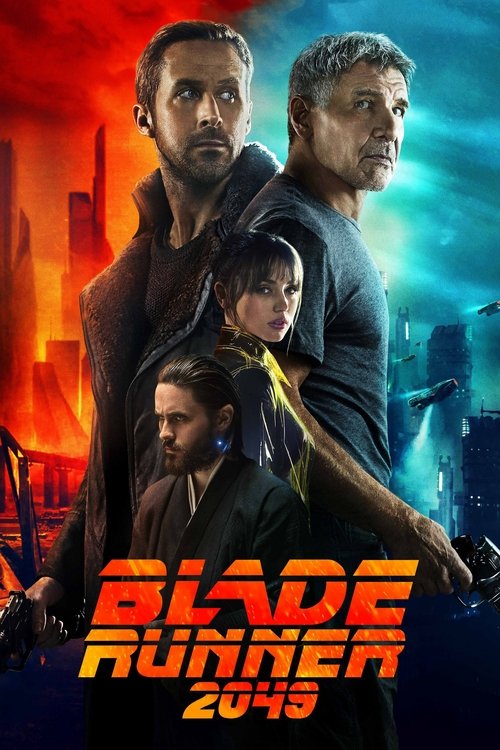
At the end of Blade Runner 2049, K sacrifices himself to save Deckard and allow him to reunite with his daughter. K is mortally wounded but finds peace in his final moments, while Deckard meets his daughter, who is revealed to be the key to the future of replicants.
As the film nears its conclusion, K, the replicant blade runner, has just discovered the truth about his own existence and the significance of the child born to a replicant, which could change the dynamics between humans and replicants forever. After a harrowing confrontation with Luv, the loyal enforcer of Niander Wallace, K fights valiantly but is ultimately overpowered.
In a visually striking scene, K is severely injured but manages to escape the chaos of the fight. He drives through the rain-soaked streets of Los Angeles, his body battered but his resolve unwavering. He knows he must find Deckard, the former blade runner who holds the key to the child's identity.
K arrives at the abandoned, snow-covered ruins of the old Las Vegas, where he finds Deckard held captive by Wallace's forces. In a tense and emotional reunion, K confronts Deckard, revealing the truth about the child and the implications it holds for both their lives. K's internal struggle is palpable; he grapples with his identity and purpose, realizing that he is not the chosen one but still has the power to make a significant choice.
As they are pursued by Luv, K fights to protect Deckard. In a climactic showdown, K faces Luv in a brutal battle. The fight is intense, showcasing K's determination and the emotional weight of his mission. He ultimately defeats Luv, but not without sustaining life-threatening injuries.
In a poignant moment, K, now gravely wounded, helps Deckard escape. He knows that Deckard must reunite with his daughter, who has been hidden away. K's sacrifice is profound; he understands that his own existence, while significant, pales in comparison to the hope of a future where replicants can live freely.
As K lies dying in the snow, he reflects on his journey. The cold, white landscape mirrors his internal peace as he accepts his fate. He watches the snow fall, a serene expression on his face, embodying a sense of fulfillment in his final moments.
Meanwhile, Deckard makes his way to the location where his daughter, Ana, is being kept. The reunion is emotional and filled with unspoken words, as Deckard finally meets the child he thought he would never see. The film closes on this hopeful note, suggesting a new beginning for both Deckard and his daughter, while K's sacrifice serves as a poignant reminder of the complexities of identity, love, and the quest for meaning in a world that often denies it.
In the end, K dies alone but fulfilled, having chosen to protect the future of replicants, while Deckard embarks on a new chapter with his daughter, symbolizing the potential for change and connection in a fractured world.
Is there a post-credit scene?
Blade Runner 2049 does not have a post-credit scene. The film concludes with a poignant and reflective ending that encapsulates the themes of identity, memory, and humanity. After the climactic events, the story wraps up without any additional scenes during or after the credits, leaving the audience to ponder the fates of the characters and the implications of the narrative. The absence of a post-credit scene aligns with the film's tone, emphasizing its contemplative nature rather than setting up for a sequel or additional storylines.
What is K's primary mission in Blade Runner 2049?
K, a replicant and blade runner, is tasked with hunting down and 'retiring' older model replicants. His primary mission in the film is to investigate the discovery of a buried secret that could potentially destabilize the fragile balance between humans and replicants.
What does K discover about the child of Deckard and Rachael?
K discovers that the child of Deckard and Rachael is a replicant who was born, not created, which is a groundbreaking revelation. This child represents a significant shift in the understanding of replicants and their potential for life and emotion.
How does K's relationship with Joi evolve throughout the film?
K's relationship with Joi, an artificial intelligence designed to be a companion, evolves from a simple user-device interaction to a deeper emotional connection. K grapples with his feelings for Joi, especially as he begins to question his own identity and worth, leading to moments of both intimacy and existential crisis.
What role does Niander Wallace play in the story?
Niander Wallace, the CEO of Wallace Corporation, is a key antagonist in the film. He seeks to uncover the secret of replicant reproduction to ensure the future of his replicants and to gain control over the replicant population. His obsession with the child drives much of the conflict in the narrative.
What is the significance of the memory of the wooden horse in K's journey?
The memory of the wooden horse is significant as it serves as a pivotal clue in K's investigation. Initially believed to be a fabricated memory, it becomes a symbol of K's quest for identity and belonging, leading him to question whether he is truly special or just another replicant.
Is this family friendly?
Blade Runner 2049 is not considered family-friendly due to several potentially objectionable or upsetting scenes and themes. Here are some aspects that may be concerning for children or sensitive viewers:
-
Violence: The film contains scenes of intense violence, including shootings, physical confrontations, and the aftermath of violent acts, which can be graphic and disturbing.
-
Death and Loss: Characters experience significant loss, and there are moments that explore themes of mortality and existential despair, which may be heavy for younger audiences.
-
Sexual Content: There are scenes that involve sexual themes, including nudity and suggestive situations, which may not be appropriate for children.
-
Dark Themes: The film delves into complex themes such as identity, humanity, and the nature of existence, which can be abstract and unsettling.
-
Emotional Distress: Characters undergo profound emotional struggles, including feelings of isolation, betrayal, and existential crisis, which may be difficult for sensitive viewers to process.
-
Dystopian Setting: The overall atmosphere of the film is bleak and oppressive, depicting a future filled with despair, which may be unsettling for some viewers.
These elements contribute to the film's mature rating and suggest that it may not be suitable for younger audiences or those who are sensitive to such content.








