


Popular
What is the significance of the character who wakes up after sixty-five years?
How does Black Jack react to the challenges posed by the character's awakening?
What role does the theme of memory play in the interactions between Black Jack and the awakened character?
What are the emotional struggles faced by the character who has awakened after sixty-five years?
How does the episode explore the concept of time through the character's experiences?
Should I watch it?
Ask Your Own Question

What is the plot?
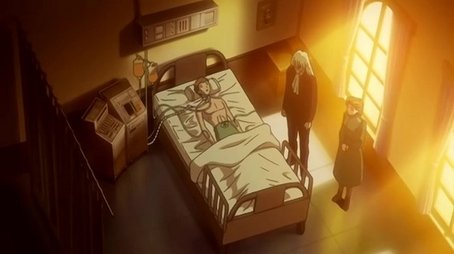
The episode begins with a scene in a hospital room where an elderly man named Kuroda is waking up after being in a coma for sixty-five years. The room is filled with medical equipment, and the atmosphere is tense as Kuroda slowly regains consciousness. He is disoriented and confused, struggling to comprehend the changes in the world around him. The medical staff, including a nurse, are surprised and excited by his awakening, and they begin to check his vitals and ask him questions about his memories.
As Kuroda starts to regain his senses, he recalls fragments of his past, particularly his life before the war. He remembers his family and the events leading up to his coma. The nurse informs him that the world has changed significantly, and he learns about the advancements in technology and medicine that have occurred during his absence. Kuroda's emotional state fluctuates between joy at being alive and sorrow for the lost years and the people he once knew.
Meanwhile, Black Jack, the skilled and unlicensed surgeon, is introduced as he receives a call about Kuroda's case. He is intrigued by the unusual circumstances surrounding Kuroda's awakening and decides to visit the hospital. As he arrives, he observes the medical staff's excitement and begins to assess the situation. Black Jack's demeanor is calm and collected, but there is a hint of curiosity in his eyes as he contemplates the implications of Kuroda's long slumber.
Upon meeting Kuroda, Black Jack engages him in conversation, trying to understand his mental and emotional state. Kuroda expresses a mix of gratitude and confusion, struggling to process the reality of his situation. Black Jack, with his characteristic bluntness, questions Kuroda about his past and the events that led to his coma. Kuroda shares his memories of the war and the trauma he experienced, revealing the deep scars left by his experiences.
As the episode progresses, Kuroda's health begins to deteriorate. He experiences episodes of confusion and distress, which alarm the medical staff. Black Jack, noticing the changes in Kuroda's condition, decides to investigate further. He conducts tests and discovers that Kuroda's body is struggling to adapt to the modern world, and he is suffering from a rare condition caused by the long-term effects of his coma.
In a pivotal moment, Black Jack confronts the medical team about Kuroda's treatment. He argues that they need to take a more aggressive approach to stabilize Kuroda's health. The doctors are hesitant, fearing the risks involved, but Black Jack's confidence and expertise persuade them to follow his lead. He devises a plan to perform a risky procedure that could potentially save Kuroda's life.
As Black Jack prepares for the surgery, Kuroda's emotional state becomes increasingly fragile. He reflects on his lost years and the relationships he can no longer reclaim. The weight of his past weighs heavily on him, and he expresses a desire to make the most of the time he has left. Black Jack, recognizing Kuroda's determination, reassures him that he will do everything in his power to help him.
The surgery takes place in a tense and dramatic sequence. Black Jack operates with precision, navigating the complexities of Kuroda's condition. The scene is filled with close-ups of the surgical instruments, the monitors beeping, and the focused expressions of the medical team. As the procedure progresses, there are moments of uncertainty, but Black Jack remains resolute, driven by his commitment to saving Kuroda.
After a tense operation, Kuroda is stabilized, and the medical team breathes a sigh of relief. Black Jack emerges from the surgery, exhausted but satisfied with the outcome. He visits Kuroda in recovery, where they share a moment of connection. Kuroda expresses his gratitude, and Black Jack, though typically stoic, shows a rare glimpse of warmth.
In the final scenes, Kuroda begins to adjust to life in the modern world. He starts to engage with the staff and other patients, slowly finding a sense of belonging. The episode concludes with Kuroda looking out of the hospital window, contemplating his future and the possibilities that lie ahead. The emotional weight of his journey is palpable, leaving a lasting impact on both him and the viewers.









What is the ending?
In the ending of "Awake After Sixty-Five Years," Dr. Black Jack successfully performs a complex surgery on a patient who has been in a coma for decades. The patient, a woman named Kiyoko, awakens and struggles to adjust to the modern world. Black Jack reflects on the nature of life and the passage of time, while Kiyoko faces the emotional turmoil of reconnecting with a world that has changed drastically. The episode concludes with a poignant moment of understanding between Black Jack and Kiyoko, highlighting themes of loss, adaptation, and the enduring human spirit.
As the episode nears its conclusion, the scene shifts to the hospital room where Kiyoko lies, her eyes fluttering open for the first time in sixty-five years. The sterile environment is filled with the beeping of machines and the soft rustle of nurses moving about. Black Jack stands at her bedside, his expression a mix of relief and concern. He has just completed a delicate surgery, and the weight of the moment hangs heavily in the air. Kiyoko's awakening is slow; she blinks against the harsh fluorescent lights, confusion etched on her face as she takes in her surroundings.
The camera captures the subtle changes in Kiyoko's expression as she processes the reality of her situation. Memories flood back, and her eyes widen with a mixture of fear and wonder. Black Jack, observing her reaction, feels a deep sense of responsibility. He knows that while he has brought her back to life, the world she once knew is gone. The emotional stakes are high; Kiyoko is not just a patient but a woman who has lost decades of her life.
As Kiyoko begins to speak, her voice is shaky, filled with uncertainty. She asks about her family, her life before the coma, and the world outside. Black Jack, maintaining his stoic demeanor, gently informs her that much has changed. He explains the advancements in technology and the passage of time, but his words are laced with empathy. He understands the profound loss she feels, and his heart aches for her.
The scene transitions to Kiyoko's first moments outside the hospital. The bright sunlight floods her senses, and she squints, overwhelmed by the vibrancy of life that surrounds her. Black Jack walks beside her, offering support as she takes tentative steps into this new world. The bustling city, filled with people and sounds, contrasts sharply with the stillness of her previous existence. Kiyoko's emotions are palpable; she is both exhilarated and terrified.
In a quiet moment, Kiyoko expresses her gratitude to Black Jack, acknowledging the gift of life he has given her. Her voice trembles with sincerity, and for the first time, Black Jack allows himself a small smile. He has always been a solitary figure, often shunning emotional connections, but Kiyoko's awakening stirs something within him. He realizes that his work, while often focused on the technical aspects of medicine, is deeply intertwined with the human experience.
As the episode draws to a close, Kiyoko stands at a crossroads, contemplating her future. The camera lingers on her face, capturing the mix of hope and uncertainty. Black Jack watches her, a silent guardian, knowing that while he has helped her reclaim her life, the journey ahead will be fraught with challenges. The final scene fades out with Kiyoko taking a deep breath, ready to embrace the unknown, while Black Jack reflects on the fragility of life and the resilience of the human spirit.
In the end, Kiyoko is left with the daunting task of rebuilding her life, while Black Jack, having faced his own emotional barriers, finds a renewed sense of purpose in his role as a healer. The episode concludes with a powerful message about the complexities of life, the importance of connection, and the courage it takes to face the future after profound loss.
Is there a post-credit scene?
In the episode "Awake After Sixty-Five Years" from the series Black Jack 21, there is no post-credit scene. The episode concludes without any additional content after the credits roll. The focus remains on the main narrative and character developments throughout the episode, leaving no further scenes or revelations to explore after the story wraps up.
What is the significance of the character who wakes up after sixty-five years?
The character who wakes up after sixty-five years serves as a pivotal figure in the episode, representing the clash between past and present. Their awakening brings forth a series of emotional and psychological challenges, as they struggle to adapt to a world that has drastically changed. This character's memories and experiences from the past create a poignant contrast to the current realities faced by the other characters, particularly Black Jack.
How does Black Jack react to the challenges posed by the character's awakening?
Black Jack, known for his stoic demeanor and medical expertise, initially approaches the situation with a sense of professionalism. However, as he delves deeper into the character's past and the implications of their awakening, he becomes emotionally invested. His internal conflict is evident as he grapples with the ethical dilemmas of reviving someone from a bygone era, showcasing his compassion and the weight of his responsibilities as a surgeon.
What role does the theme of memory play in the interactions between Black Jack and the awakened character?
Memory plays a crucial role in shaping the interactions between Black Jack and the awakened character. As the character recounts their memories, Black Jack is forced to confront his own past and the choices he has made. The dialogue is rich with nostalgia and regret, highlighting how memories can both haunt and guide individuals. This theme deepens the emotional resonance of their exchanges, as Black Jack seeks to understand the implications of the character's lost time.
What are the emotional struggles faced by the character who has awakened after sixty-five years?
The character who awakens after sixty-five years faces profound emotional struggles, including confusion, disorientation, and a sense of loss. They grapple with the realization that their loved ones may no longer be alive and that the world they once knew has evolved beyond recognition. This internal turmoil is depicted through their interactions with Black Jack and others, as they oscillate between moments of clarity and despair, making their journey both heartbreaking and relatable.
How does the episode explore the concept of time through the character's experiences?
The episode intricately explores the concept of time through the character's experiences by juxtaposing their memories with the present. Flashbacks are used to illustrate key moments from the character's past, while their current interactions with Black Jack and the modern world highlight the stark differences in societal norms and technology. This exploration of time not only emphasizes the character's struggle to adapt but also serves as a commentary on the inevitability of change and the human experience.
Is this family friendly?
"Black Jack 21," episode 8 titled "Awake After Sixty-Five Years," contains several themes and scenes that may be considered objectionable or upsetting for children or sensitive viewers.
-
Death and Mortality: The episode deals with themes of death, aging, and the emotional weight of losing loved ones, which may be distressing for younger audiences.
-
Medical Procedures: There are depictions of surgeries and medical conditions that could be graphic or unsettling, particularly for those who are sensitive to medical imagery.
-
Emotional Trauma: Characters experience significant emotional pain and trauma related to their pasts, which may resonate deeply and evoke strong feelings.
-
Existential Themes: The narrative explores heavy philosophical questions about life, purpose, and the impact of time, which might be complex for younger viewers to fully grasp.
-
Intense Emotional Moments: There are scenes that depict intense emotional reactions, including grief and despair, which could be upsetting.
These elements contribute to a narrative that, while rich in storytelling, may not be suitable for all audiences, particularly children or those who are sensitive to such themes.