











Popular
What is the deal between Anos Voldigoad and Misa Ilioroagu in season 2?
Who is the mysterious Child of God that appears in The Misfit of Demon King Academy II?
What happens with the Seven Elder Demon Emperors in season 2?
How does the story in season 2 explain the past life of Shin Reglia?
What is the significance of the Great Spirit and the spirit world in season 2?
Should I watch it?
Ask Your Own Question

What is the plot?
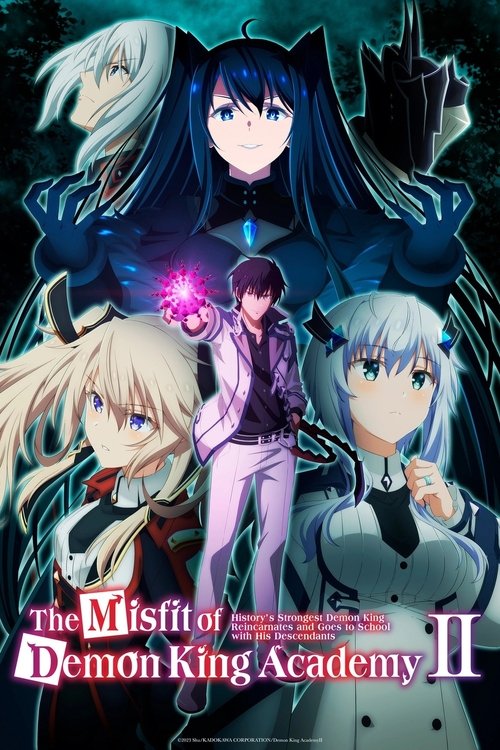
Anos Voldigoad returns after the first season's conflict already having restored a measure of order between demons and humans, but the peace is immediately broken by the appearance of a new enemy connected to the gods and the legend surrounding the Demon King of Tyranny.
The story begins with the Demon King Academy and the surrounding demon world still adjusting to Anos's restored authority when strange divine forces and old distortions in history begin to surface. Anos is drawn into a new conflict involving the "Child of God," the appearance of Avos Dilhevia, and the way the world's memories, identities, and recorded history have been manipulated.
As the season opens its first major arc, Anos becomes involved in a struggle over the true identity of Avos Dilhevia, while the demon hierarchy and several key allies are pulled into the mystery. The conflict escalates around the revelation that Misa is the true Avos Dilhevia, and she orders the eradication of mixed-blood demons, turning what had looked like a hidden identity mystery into a direct ideological and political crisis.
Anos and his allies respond by confronting the forces supporting this false order, and the season's first half moves through battles and revelations that expose how history itself has been tampered with. The conflict is not only physical but also memory-based, with characters gradually learning that what they remember about the past has been deliberately obscured or altered.
In the later part of the season, the plot shifts into a sequence centered on recovering lost memories and uncovering the bond between Anos and his sister figure. The story makes clear that their relationship is not based on blood in the ordinary sense, and the truth of their connection is tied to a memory-seeking process and a hidden divine mechanism that has erased painful truths from everyone involved.
Anos and Sasha pursue the recovered traces of that past, and the narrative reveals that the memories were suppressed because they contain intense pain and suffering. The forgotten truth is not lost by accident; it was erased for what the gods considered "salvation," meaning that remembering the full past would reopen trauma that powerful beings intentionally concealed.
The final stretch centers on a confrontation with the being responsible for preventing those memories from returning. The obstacle is the god associated with locking away forgotten memories, and the story reveals that this figure has been deliberately interfering so the sealed truths cannot be restored. This final resistance becomes the last major obstruction before the underlying history can be exposed.
By the end of the season, the hidden memories, the false identities, and the divine interference all come together as the season closes on the larger implication that Anos's enemies have not merely fought him with force, but have tried to overwrite the world's understanding of itself. The second cour continues this broader conflict into additional episodes, but the season's core trajectory is the restoration of buried truth against divine suppression.

What is the ending?
Anos stops the final threat, restores order, and ends the season with his place as the true Demon King secured. The immediate danger is gone, but one important memory remains missing, leaving the story closed for the moment and still pointing toward unresolved history.
Anos and Arcana are still caught in the strange dream-thread tied to their lost memories, and that search leads them toward the truth behind what was hidden from them. At the same time, the conflict with the false power structures around the Demon King reaches its breaking point, and the series moves into its final confrontation.
Scene by scene, the ending unfolds like this:
Anos presses forward through the last stage of the conflict, still trying to uncover what has been erased from memory and who has been shaping the events around him. The pressure of the gods, the lies surrounding the past, and the struggle over identity all remain active as the final episodes build toward the last battle.
The story then brings the central opposition into focus. Avos Dilhevia, who had been presented as a major enemy, is revealed to be tied to Misa and the traditions and rumors controlling her life. In the final fighting, Anos overwhelms the false Demon King's power and reclaims the throne that belongs to him. The conflict is resolved not by the false story that had been spread, but by Anos taking back his rightful position.
At the same time, Lay fights with the goal of freeing Misa, and Shin also remains part of the struggle against the divine forces behind the conflict. These threads connect back to the season's larger revelation that history has been distorted, including the stories surrounding the hero Kanon and the Demon King.
The ending also includes a decisive move against the final destructive force. According to episode discussion and review material, the last confrontation ends with the threat being stopped, and the season closes with a comparatively resolved ending rather than a cliffhanger. One account of the finale notes that Avos's ending is abrupt, with the character's final defeat coming through a self-inflicted fatal act after the battle turns against her.
As for the main characters at the end:
Anos survives, wins the central conflict, and reclaims his throne as the Demon King.
Misa/Avos is defeated, and the false identity tied to her is ended in the final confrontation.
Lay survives and remains connected to the effort to save Misa.
Shin survives and remains part of the restored order after the conflict.
Arcana is still bound to the unresolved memory mystery, continuing to exist within the dream-linked thread of the story rather than reaching full closure in the ending itself.
The season ends with Anos standing victorious, the immediate war settled, and the false version of history pushed back, while the missing memory and deeper past are left as the remaining open thread.
Is there a post-credit scene?
Yes. The episode's post-credit scene shows a sudden tonal shift into a more intimate, romantic beat: after the credits, the action gives way to a visual gag centered on a sword with a heart motif, which then erupts in an exaggerated "love attack" style burst while two characters' flirtation/relationship is being played up comedically.
The clearest description available from the supplied results is that the scene features a sword with a giant heart around the handle, and it "literally explodes" in a Cupid/Valentine's-Day-style flourish as part of the joke. The commentary also indicates that this is tied to a little love story between the characters involved, making the post-credit tag a humorous romantic payoff rather than a plot-critical reveal.
What is the deal between Anos Voldigoad and Misa Ilioroagu in season 2?
In season 2, Misa Ilioroagu becomes central to one of the story's biggest mysteries because of her connection to the godly side of the conflict and to the events surrounding the false history of the Demon King. The plot repeatedly ties her to hidden truths about the past, her unusual role in the current timeline, and the way her presence intersects with Anos's attempts to uncover who is manipulating history and power behind the scenes.
Who is the mysterious Child of God that appears in The Misfit of Demon King Academy II?
The second season introduces a new "Child of God" who becomes an important antagonist tied to the destruction of the Demon King of Tyranny. This character is presented as part of a larger divine conflict rather than just a school-level enemy, and the season uses that reveal to escalate the story beyond academy rivalry into a battle involving gods, history, and erased identities.
What happens with the Seven Elder Demon Emperors in season 2?
The Seven Elder Demon Emperors remain important as political and magical authorities in the demon world, but season 2 places them under pressure from the growing unrest around Anos, the false history of the Demon King, and the new divine threat. Their role is tied to the wider power structure of the demon society, especially the tension between the established hierarchy and the truths Anos keeps uncovering.
How does the story in season 2 explain the past life of Shin Reglia?
Season 2 expands on Shin Reglia's past by connecting him more deeply to the ancient history that shaped Anos's original era and the present conflict. His story is not treated as background trivia; instead, it becomes part of the emotional and strategic core of the season as the narrative reveals how old loyalties, lost memories, and long-buried sacrifices still affect the current world.
What is the significance of the Great Spirit and the spirit world in season 2?
The spirit world and the Great Spirit matter in season 2 because the series broadens its conflict beyond demons and humans and into the forces that influence existence itself. The season uses this setting to deepen the mystery around certain characters' origins and to show that the truth behind the world's history involves spirits, gods, and hidden rules that even powerful demons do not fully understand.
Is this family friendly?
No, it is not especially family friendly for young children. It is better suited to teens, because it contains fantasy violence, some mild sexual content, and a few intense scenes.
Potentially objectionable or upsetting elements include:
- Fantasy violence and gore: the series is rated moderate for violence and gore, so there are combat scenes and injury-related content.
- Mild sexual content / partial nudity: IMDb notes a nude girl in the intro who is covered in a way that avoids full exposure, but some breast area is visible.
- Intense or frightening moments: the series has mild frightening/intense scenes, which may be upsetting for sensitive viewers.
- No strong language or substance use: IMDb lists no profanity and no alcohol, drugs, or smoking.
For a cautious family, this is generally a "teen-friendly fantasy anime" rather than a show for small children.