




































Popular
What is the significance of the character Sofia in David's life?
How does David's relationship with Julie affect his character development?
What role does the company 'Life Extension' play in the story?
How does the car accident impact David's perception of reality?
What does the recurring motif of the 'vanilla sky' symbolize in the film?
Should I watch it?
Ask Your Own Question

What is the plot?
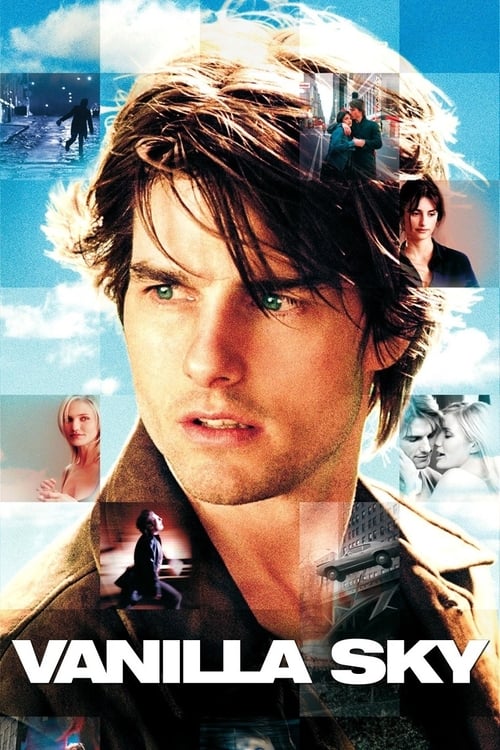
David Aames's story begins with a jolt of disorientation: he is trapped in a prison-like interview room, wearing a pale prosthetic mask over the ruined architecture of his face, and he is speaking to Dr. Curtis McCabe as if the truth can be assembled out of fragments, confessions, and memory. From the beginning, the film makes clear that David is not telling a simple story but trying to explain how a life of money, vanity, and appetite collapses into nightmare. The image of the mask is more than concealment; it is a reminder that whatever David believes himself to be has already been broken, rebuilt, and made unreliable. A soft voice whispers, "Open your eyes," and the film slips backward into the glossy, self-indulgent world that existed before the wreckage.
In that earlier life, David Aames Jr. is exactly what his Manhattan privilege has made him: wealthy, charming, and emotionally hollow, a publishing magnate who inherited control of the family company from his father and then treated that power as another luxury rather than a responsibility. He lives in a plush apartment, moves through New York City with the confidence of a man who believes the world owes him ease, and treats romance like a series of disposable encounters. He is surrounded by socialites, sex, and champagne, but the film keeps stressing that his life is curiously empty underneath the glamour. His best friend, Brian Shelby, functions as the one person who still speaks to him like a real human being, and Brian's presence matters because he is the one who nudges David toward the possibility of actual feeling.
That possibility arrives in the form of Sofia Serrano, whom Brian brings to David's birthday party. Sofia immediately stands apart from the polished women in David's orbit because she is warm, direct, and unguarded in a way that seems almost shocking to him. Their first encounters are charged with a quiet intensity David is not prepared for. He is visibly captivated by her sincerity, and she seems to see through his performance without being repelled by it. Around them, the party glitters with shallow wealth, but the mood narrows as David and Sofia begin to orbit each other in a way that feels unexpectedly delicate and serious. The connection between them is not immediately physical; it is built through conversation, attention, and the strange experience of meeting someone who makes David feel less like a consumer of life and more like a participant in it.
Julie Gianni, by contrast, enters the story as the embodiment of David's careless past. She is obsessive, unstable, and already emotionally attached to him in a way he does not reciprocate. Where Sofia represents possibility, Julie represents consequence. David brushes Julie off casually, but the film never lets that dismissal feel clean, because Julie's fixation on him remains in the background like a pressure system building toward a storm. David's life is therefore split even before the plot's first catastrophe: one woman offers him a future he does not yet know how to deserve, while another carries the violence of his irresponsibility back toward him.
The emotional center of the early film is the night David and Sofia spend together, which unfolds with the tenderness of a dream before the movie makes clear that it will become one. They talk, wander, and connect in a way that feels unforced and almost sacred compared with David's usual life. For a brief span, he seems to recognize the value of intimacy not as possession but as revelation. The visual atmosphere softens around them, and the romance becomes a counterweight to the coldness of his apartment life and the smugness of his social world. But the film never permits this fragile beginning to remain untouched.
The next morning, Julie forces her way back into David's life in the most catastrophic way possible. She appears at his door, determined and wounded, and persuades him to get into her car. What seems at first like a tense personal confrontation turns quickly into a death drive. Julie takes the car onto a bridge and deliberately drives off it in a murder-suicide attempt. Julie Gianni dies in the crash, and her death is caused by her own act of desperation and rage. David survives, but the crash mutilates him so severely that his face is reconstructed into a grotesque, mask-like approximation of the man he was. This is the first major death, and it is both intimate and horrifying: the woman he rejected destroys herself in the act of trying to trap him, and the aftermath leaves him physically and psychologically disassembled.
The crash fractures David's identity. He wakes into a world of pain, surgery, and isolation, now separated from the effortless attractiveness that once structured his self-image. The hospital and reconstructive-surgery setting become spaces where his body is literally remade, but the film makes it clear that repair is not the same as healing. His appearance disturbs him, and the face he sees in the mirror becomes a constant reminder that whatever version of himself existed before the bridge is gone. The people around him react awkwardly, and his confidence collapses into confusion. Sofia's response becomes especially important: when he tries to reconnect with her after the accident, she is unnerved by his changed appearance, and the moment exposes how much of his earlier charm depended on a face and a lifestyle he can no longer inhabit. Their attempted night out ends badly, with David drunkenly collapsing and being rejected in the street, a humiliating scene that makes his fall from grace feel complete.
Yet the story refuses to stop at humiliation. Sofia later has a change of heart, and the two begin a relationship that becomes one of the film's most important emotional threads. For a while, it seems as though David might redeem himself through love, that the injury and pain have stripped away enough vanity for him to become someone capable of real connection. But the film keeps slipping little anomalies into his world: flashes of memory, distortions, and sensations that do not fit together cleanly. David experiences a reality that feels increasingly unstable. Streets seem empty or wrong. Faces blur. Time becomes slippery. He begins to suspect that something is fundamentally broken beneath the surface of his life.
The movie briefly opens with one of these uncanny disturbances: David runs through New York City at what should be rush hour and discovers the streets are eerily deserted, an impossible silence hanging over Manhattan like a warning. He wakes from that vision in his bedroom, and the film then deepens the frame by revealing that he is also under the scrutiny of Dr. Curtis McCabe, a psychologist assigned to his case while David sits in a jail cell or detention setting trying to explain himself. David is accused of a murder he cannot clearly remember, and his testimony becomes the mechanism through which the movie circles its own truth. The questions McCabe asks are clinical, but David's answers are emotional, fragmented, and full of panic. He knows that pieces of his life do not fit, but he cannot yet name the shape of the lie.
As David's mind begins to unravel, Julie appears to come back from the dead, or at least to return in a form that unsettles and terrorizes him. The possibility that she has survived should resolve into reality, but instead it behaves like a haunting. The line between memory, guilt, and manifestation collapses. David sees her where she should not be, and the more he tries to understand her presence, the more the film makes clear that his perception is no longer trustworthy. The emotional charge becomes unbearable when Julie seems to replace Sofia in his life, creating a nightmarish confusion between the woman he loved and the woman who destroyed him. In this state of confusion, David assaults her, driven into violent panic by the impossibility of knowing whom he is looking at. She does not press charges, but the incident further destabilizes his already collapsing sense of moral and psychological control.
The narrative then pushes David toward the deeper truth through a series of clues that feel both mundane and cosmic. At a bar, he is approached by a strange man, a figure known as Tech Support or Edmund Ventura, who tells him that the world around him is not operating the way it seems and that David can, in some sense, influence it. This meeting is crucial because it transforms David's experience from private madness into a system with rules. The stranger hints that the life David thinks he is living is a constructed environment rather than an ordinary one. Around the same time, David encounters a Life Extension advertisement, a corporate clue that begins to expose the hidden structure behind the dream. The name sounds innocuous, even reassuring, but it points toward the machine underneath the illusion.
David and Dr. McCabe go to the headquarters of Life Extension, escorted by a police officer, and this is where the film's central revelation begins to surface in plain language. Rebecca Dearborn informs David that he is a client and that he chose the Lucid Dream package, a fact that devastates him because it reframes everything he has endured after the crash. The horror he has been living through is no longer just psychological distress; it is a manufactured reality shaped by a corporation. David, overwhelmed, bolts from the office and cries out for Tech Support, which brings Edmund Ventura back into the story as the person who can finally explain what happened. Ventura identifies himself as being from "Oasis Project, formerly Life Extension--L.E.," and the language makes the corporate fantasy sound almost futuristic and clinical rather than supernatural.
Tech Support leads David toward the rooftop confrontation that forms the film's climax, and along the way he explains the truth that has been hidden behind the dream. David and Tech Support first met 150 years earlier, before the world changed around him. That time gap is the most shocking revelation in the film: David has not simply lost a few days or months of memory; he has been suspended across more than a century and a half of future history. The simulation he has been living in was built from his memories and subconscious desires, which is why Sofia returns as an idealized love figure and why his face can be restored in the dream even while reality moves on without him. Tech Support refreshes David's memory in a montage that shows him discovering Life Extension, signing the contract, and taking enough pills to end his life, which means his entry into the lucid dream is tied to a self-destructive act in the real timeline. The dream did not begin as a punishment; it begins as an escape, a place where grief, trauma, and desire are softened into illusion.
This is the film's largest twist, and it forces every earlier scene into a new shape. The restored face David sees, the romantic life he rebuilds with Sofia, the strange emptiness of the city, the return of Julie, even the murder charge--all of it belongs to a dream architecture that has become unstable because David's subconscious is damaged and frightened. What he believed was his literal life after the crash is revealed as a lucid dream built to keep him emotionally alive while the real world continues somewhere far beyond his reach. The dream has not merely been a comforting fantasy; because of his unresolved pain and guilt, it has turned into a nightmare.
The final choice is laid out in stark terms on the rooftop. David can remain in the lucid dream, where Sofia still exists, his face is whole, and the world can continue to be organized around his memories, or he can wake up to a future 150 years ahead, where his old life is gone and reality is strange but potentially repairable. Tech Support explains that the glitch has been fixed, and now David has the option to return to the dream world or wake up into the future, where science can potentially rebuild his body and give him a real second chance. The emotional stakes are enormous because the dream offers exactly what David has been trying to recover: love, beauty, and coherence. Waking means loss, uncertainty, and the death of the life he has learned to want.
Before that decision lands, the film stages one last emotional confrontation between David and the idealized Sofia. Their goodbye is drenched in tenderness and grief, because both of them know--within the logic of the scene--that they are parting not merely as lovers but as a man and the last image of the life he wishes he had kept. She tells him, in effect, that he can still find her again in another life, and the line gives the ending a spectral sweetness that does not cancel the pain. The movie's recurring command, "Open your eyes," gathers all its meanings here: wake up, accept reality, stop living inside the wish.
David's final act is the leap. Despite his fear of heights, he steps to the roof's edge and throws himself off the skyscraper, choosing the terrifying unknown over the seductive certainty of the dream. The jump is both literal and symbolic: he is falling out of illusion, out of nostalgia, out of the protected simulation that has preserved his fantasy life at the cost of truth. As he falls, the film flashes through pieces of his life, images that blend memory and awakening into one final rush of sensation. A voice repeats, "Open your eyes," and the command echoes the opening whisper so that the whole film closes into a loop. The screen goes dark, then the final moment suggests that David opens his eye, returning to reality in the future, where he must face the consequences of his choices and the possibility of reconstruction.
By the end, the story has revealed every major truth it has been hiding: Julie Gianni kills herself and nearly kills David in the bridge crash; David survives but is disfigured; Sofia is the love that gives him a glimpse of authentic life; the strange world he inhabits after the accident is a lucid dream created through Life Extension; and the man he thought he was has to be surrendered so that some other version of him can live. Dr. Curtis McCabe's interview frame, the prison setting, the mask, the empty New York streets, the corporate name "Life Extension," the Tech Support guide, and the repeated command to open his eyes all converge in that final leap. The film ends not with closure but with awakening: David chooses reality over fantasy, and the last image leaves him suspended at the edge of a new life, finally forced to see it.
More Movies Like This
Browse All Movies →




What is the ending?
In the ending of "Vanilla Sky," David Aames awakens from his lucid dream and confronts the reality of his life. He chooses to leap from a building, symbolizing his acceptance of reality and the consequences of his past actions. As he falls, he experiences a moment of clarity and peace. The film concludes with him waking up in a new reality, where he is given a choice to live or continue in the dream state.
As the film approaches its conclusion, David Aames, portrayed by Tom Cruise, finds himself in a surreal and disorienting world, grappling with the consequences of his choices. The narrative unfolds in a series of poignant scenes that reveal the depths of his internal struggle.
Scene 1: David is in a stark, white room, surrounded by the sterile environment of the Life Extension facility. He is confronted by Dr. Curtis McCabe, played by Kurt Russell, who has been guiding him through his emotional turmoil. David's mind races as he recalls the events that led him to this moment, including his tumultuous relationships with Sofia, played by Penélope Cruz, and Julie, portrayed by Cameron Diaz. The weight of his past decisions hangs heavily on him, and he feels trapped in a cycle of regret and longing.
Scene 2: In a moment of clarity, David realizes that his life has been a carefully constructed illusion, a lucid dream designed to escape the pain of reality. He reflects on the love he felt for Sofia and the destructive nature of his relationship with Julie. The emotional turmoil is palpable as he grapples with the realization that he has been living in a fantasy, avoiding the consequences of his actions.
Scene 3: David's internal conflict reaches a climax as he stands on the edge of a rooftop, looking down at the city below. The skyline is a blend of beauty and chaos, mirroring his own emotional state. He contemplates the choice before him: to continue living in a dream where he can avoid pain or to embrace the harsh realities of life. The camera captures the intensity of his emotions, showcasing the fear, hope, and desperation that swirl within him.
Scene 4: In a moment of profound decision, David takes a leap off the building. As he falls, time seems to slow down, and he experiences a rush of memories and emotions. The visuals are striking, with the cityscape blurring around him, symbolizing the chaos of his mind. In this moment, he feels a sense of liberation, as if he is shedding the weight of his past.
Scene 5: David awakens in the Life Extension facility, disoriented but alive. He is greeted by Dr. McCabe, who asks him if he is ready to face reality. David's expression shifts from confusion to determination as he realizes that he has a choice to make. The film emphasizes the importance of confronting one's past and the necessity of accepting the consequences of one's actions.
Scene 6: In the final moments, David is given a chance to choose between continuing in the dream state or embracing the reality of his life. He looks into the camera, a direct connection with the audience, and declares, "I want to wake up." This pivotal moment signifies his acceptance of reality, with all its imperfections and challenges.
As the film concludes, the fates of the main characters are revealed. David, having chosen to embrace reality, is poised to start anew, free from the shackles of his past. Sofia, who represents the love and hope he yearns for, remains a symbol of the life he desires. Julie, whose destructive love led to much of David's pain, is left behind in the dream, a reminder of the consequences of his choices.
In this final act, "Vanilla Sky" encapsulates the themes of love, loss, and the quest for redemption, leaving the audience with a sense of hope and the understanding that true freedom comes from facing one's reality, no matter how daunting it may be.
Is there a post-credit scene?
In the movie "Vanilla Sky," there is no post-credit scene. The film concludes with a powerful and thought-provoking ending that leaves viewers contemplating the nature of reality and dreams. After David Aames, played by Tom Cruise, makes the decision to wake up from his lucid dream state, the film ends on a poignant note as he embraces the uncertainty of life. The credits roll without any additional scenes or content following them, allowing the audience to reflect on the themes presented throughout the film.
What is the significance of the character Sofia in David's life?
Sofia, played by Penélope Cruz, represents an idealized love for David Aames, portrayed by Tom Cruise. She embodies the emotional connection and genuine affection that David craves, contrasting sharply with his superficial relationships. Their initial meeting at a party, where David is captivated by her beauty and artistic spirit, sets the stage for a deep emotional bond. As their relationship develops, Sofia becomes a symbol of hope and authenticity in David's chaotic life, ultimately leading him to confront his fears and insecurities.
How does David's relationship with Julie affect his character development?
Julie, played by Cameron Diaz, is a pivotal character in David's life, representing both obsession and the darker side of love. Their relationship begins with passion but quickly reveals Julie's possessiveness and emotional instability. After a night of passion, David's attempt to distance himself from her leads to a violent confrontation, where Julie's desperation culminates in a tragic car accident. This event serves as a catalyst for David's transformation, forcing him to grapple with guilt, loss, and the consequences of his actions, ultimately shaping his journey toward self-discovery.
What role does the company 'Life Extension' play in the story?
Life Extension is a crucial element in 'Vanilla Sky,' representing the intersection of technology and human experience. The company offers a service that allows individuals to enter a lucid dream state, preserving their consciousness after death. After David's life spirals out of control following the accident, he chooses to enter this program, seeking to escape his painful reality. The implications of this choice raise questions about identity, reality, and the nature of happiness, as David navigates the blurred lines between his dreams and waking life.
How does the car accident impact David's perception of reality?
The car accident, which occurs when Julie drives off a bridge in a fit of rage, is a turning point for David Aames. The traumatic event leaves him disfigured and profoundly alters his life. Following the accident, David's perception of reality becomes increasingly distorted, leading him to question what is real and what is a product of his mind. This trauma serves as a catalyst for his journey into the Life Extension program, where he confronts his past and the consequences of his choices, ultimately blurring the lines between his dreams and reality.
What does the recurring motif of the 'vanilla sky' symbolize in the film?
The 'vanilla sky' serves as a powerful visual motif throughout the film, symbolizing the blend of beauty and despair in David's life. It represents moments of clarity and emotional awakening, often appearing during pivotal scenes that reflect David's internal struggles. The sky's ethereal quality mirrors David's journey through love, loss, and the search for meaning, encapsulating the film's exploration of dreams versus reality. As David confronts his choices and the consequences of his actions, the 'vanilla sky' becomes a metaphor for his quest for redemption and understanding.
Is this family friendly?
"Vanilla Sky" is not considered family-friendly due to several potentially objectionable or upsetting scenes and themes. Here are some aspects that may be concerning for children or sensitive viewers:
-
Graphic Violence: There are scenes that depict violence and a car crash that results in severe injuries, which can be distressing.
-
Sexual Content: The film includes sexual situations and nudity, which may not be appropriate for younger audiences.
-
Mental Health Themes: The narrative explores complex themes related to mental health, identity, and existential crises, which may be unsettling for some viewers.
-
Death and Loss: The film deals with themes of death, loss, and grief, presenting emotional and psychological struggles that could be heavy for sensitive viewers.
-
Surreal and Disturbing Imagery: The film features surreal sequences and dream-like states that can be confusing or disturbing, contributing to an overall unsettling atmosphere.
-
Substance Abuse: There are references to drug use and its effects on the characters, which may not be suitable for younger audiences.
These elements contribute to the film's mature rating and may not be appropriate for children or those who are sensitive to such themes.








