
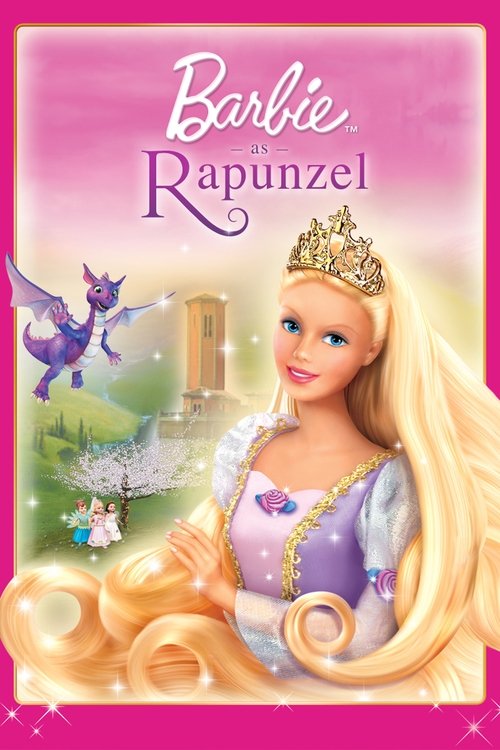
















Popular
Should I watch it?
Ask Your Own Question

What is the plot?
Sorry, we aren't able to watch and write up a full detailed plot yet. Check back in a few days.

What is the ending?
In the ending of "Barbie as Rapunzel," Rapunzel escapes from her tower with the help of Prince Stefan and her magical paintbrush. They confront the evil witch Gothel, who tries to stop them. With the power of love and creativity, Rapunzel defeats Gothel, and she and Stefan are free to live happily ever after.
Now, let's delve into the ending in a more detailed, chronological narrative.
As the climax of the story unfolds, Rapunzel, having discovered her true identity and the power of her artistic talent, is determined to escape the confines of her tower. With the help of her magical paintbrush, she creates a vibrant mural that serves as a portal, allowing her to break free from the prison that Gothel, the wicked witch, has kept her in for so long.
In a tense moment, Rapunzel is joined by Prince Stefan, who has been searching for her. Their reunion is filled with joy and relief, but they know they must act quickly to thwart Gothel's plans. The witch, sensing that her hold over Rapunzel is slipping, confronts them with fury. She attempts to use her dark magic to recapture Rapunzel, but the bond between Rapunzel and Stefan proves to be a powerful force.
As they face Gothel, Rapunzel's courage shines through. She stands firm, wielding her paintbrush not just as a tool for art, but as a symbol of her newfound strength and independence. In a climactic moment, she uses her creativity to create a dazzling light that overwhelms Gothel, who is ultimately defeated by her own greed and desire for control.
With Gothel vanquished, the tower begins to crumble, but Rapunzel and Stefan escape just in time. They emerge into the sunlight, symbolizing their freedom and the beginning of a new chapter in their lives. The scene is filled with warmth and hope as they embrace, knowing that they can now pursue their dreams together.
In the final moments, Rapunzel is reunited with her parents, the king and queen, who had been searching for her all along. The joy of their reunion is palpable, filled with tears of happiness and relief. Rapunzel's journey has not only led her to love but also back to her family, completing her transformation from a captive to a beloved princess.
As the story concludes, Rapunzel and Stefan stand together, looking out over the kingdom, ready to face whatever adventures lie ahead. The film closes with a sense of optimism and the message that love, creativity, and courage can overcome even the darkest of challenges. Each character finds their resolution: Rapunzel embraces her identity, Stefan stands as her equal partner, and Gothel's defeat serves as a reminder of the consequences of selfishness and control.
Is there a post-credit scene?
In the movie "Barbie as Rapunzel," produced in 2002, there is no post-credit scene. The film concludes with a heartwarming resolution to Rapunzel's story, where she is reunited with her true love, Prince Stefan, and they celebrate their happiness together. The ending emphasizes themes of love, freedom, and the triumph of good over evil, leaving viewers with a sense of closure without any additional scenes after the credits.
What is the significance of Rapunzel's hair in the story?
In 'Barbie as Rapunzel,' Rapunzel's long, flowing hair is not only a symbol of her beauty but also serves as a means of connection and freedom. It is magical, allowing her to paint and express herself creatively while also being a tool for her escape from the tower. Her hair represents her strength and individuality, as she learns to harness its power to overcome her challenges.
Who is Gothel and what are her motivations?
Gothel is the main antagonist in 'Barbie as Rapunzel.' She is a sorceress who keeps Rapunzel imprisoned in a tower, driven by her desire for power and control. Gothel uses Rapunzel's hair to maintain her youth and beauty, showcasing her selfishness and manipulative nature. Her motivations stem from a fear of aging and a desire to possess the magical qualities of Rapunzel's hair.
How does Rapunzel meet Prince Stefan?
Rapunzel meets Prince Stefan when he stumbles upon her tower while riding through the forest. Intrigued by the beautiful singing he hears, he climbs up to meet her. Their encounter is filled with wonder and excitement, as they share a moment of connection that sparks a budding romance. This meeting is pivotal, as it ignites Rapunzel's longing for freedom and adventure beyond her tower.
What role does the dragon play in the story?
In 'Barbie as Rapunzel,' the dragon serves as both a guardian and a source of conflict. Initially, it is a fearsome creature that Gothel uses to intimidate Rapunzel and keep her from escaping. However, as the story progresses, the dragon becomes an ally to Rapunzel, showcasing themes of friendship and loyalty. The dragon's transformation from a threat to a protector highlights Rapunzel's bravery and the power of compassion.
What is the significance of Rapunzel's paintings?
Rapunzel's paintings in 'Barbie as Rapunzel' are a crucial aspect of her character development. They represent her dreams, creativity, and desire for freedom. Through her art, she expresses her emotions and imagines a life beyond the confines of her tower. The act of painting becomes a form of escapism for Rapunzel, allowing her to envision a world filled with beauty and adventure, ultimately motivating her to seek her own destiny.
Is this family friendly?
"Barbie as Rapunzel" is generally considered a family-friendly film, suitable for children. However, there are a few scenes and aspects that might be potentially objectionable or upsetting for some viewers, particularly sensitive children:
-
Imprisonment: Rapunzel is kept in a tower by the witch Gothel, which may evoke feelings of fear or sadness regarding captivity and isolation.
-
Witch's Threats: Gothel displays manipulative and threatening behavior towards Rapunzel, which could be unsettling for younger viewers.
-
Emotional Conflict: There are moments of emotional turmoil as Rapunzel grapples with her desire for freedom and her fear of the witch, which may resonate deeply with sensitive audiences.
-
Dangerous Situations: Rapunzel faces perilous situations, including encounters with a dragon and moments of suspense that could be intense for some children.
-
Loss of Trust: The theme of betrayal and the struggle to trust others can be emotionally charged, particularly in Rapunzel's relationship with Gothel.
Overall, while the film conveys positive messages about courage, friendship, and self-discovery, these elements may require parental guidance for younger or more sensitive viewers.








