
















Popular
Why was Trip fired from Santa’s workshop, and what exactly went wrong with his toys?
Who is Elia, and why is he so withdrawn at the start of the movie?
How does Trip first get involved with Elia’s family?
What role does Ivana play in the story, and why is her toy shop under pressure?
Who is Ciocca, and what does he want with Trip?
Should I watch it?
Ask Your Own Question

What is the plot?
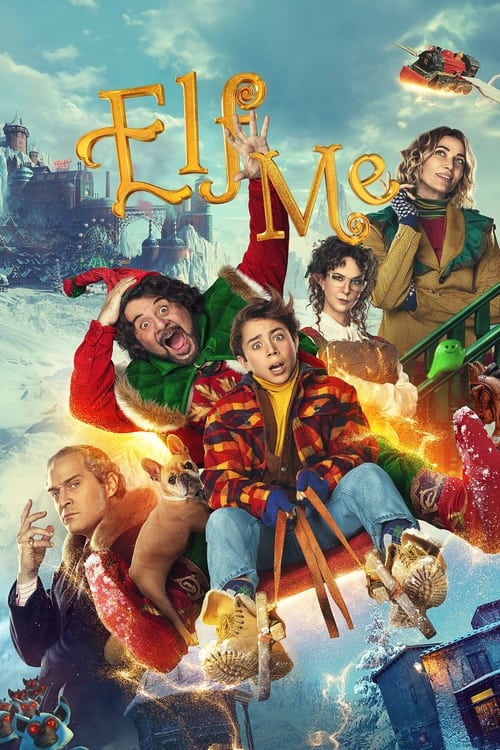
Elf Me opens at the North Pole, where Trip is already a problem elf in a place that is supposed to run on cheerful precision. He is Santa Claus's builder elf, but unlike the other elves who make harmless gifts, Trip keeps creating bizarre, unstable inventions that break, malfunction, or behave in ways no toy should. His failures have gone beyond embarrassment: his place in Santa's workshop is effectively gone, and the movie makes clear that he is treated like a liability, someone whose imagination has turned into a danger rather than a gift.
The story then cuts away from the snow and magic to a small village in the Italian Alps, where ten-year-old Elia lives in a cramped, emotionally tense world defined by loneliness and pressure. Elia is shy, bullied at school, and dyslexic, which he keeps hidden so the other children will not have another reason to target him. He lives with his mother, Ivana, who is fighting to keep her classical toy shop alive while a ruthless competitor, Ciocca, pushes her business toward collapse with unfair competition. From the beginning, the film links Elia's sadness to the larger collapse around him: his home life is unstable, his school life is humiliating, and even Christmas feels like it is slipping away before it arrives.
At first, Elia's one bright expectation is his father. Ivana tells him that his dad is away at work but has promised to be home for Christmas, and Elia clings to that promise with the desperation of a child who needs something to believe in. That detail quietly shapes the emotional spine of the whole movie. While the external plot concerns elves, toys, and a businessman threatening Christmas, Elia's deepest wish is far simpler: he wants his family to be whole again.
Trip's path to Elia begins because of his own exile. He is already on the outs at the North Pole when he attempts to send one of his rejected creations away as a gift, but the plan goes wrong in a way the film treats as both comic and fateful: instead of the rejected object being sent, Trip himself somehow ends up becoming the "present." That odd turn sends him out of the North Pole and into Elia's world, where he arrives not as a majestic Christmas emissary but as a battered, eccentric, slightly chaotic little elf who has no idea how much he is going to matter.
When Trip reaches the village, he is taken in by Elia's household and quickly becomes part of the boy's daily life. The contrast between them is immediate and important. Trip is loud, impulsive, and improvised; Elia is quiet, cautious, and afraid to take up space. Yet Trip's very strangeness is what makes him useful. He does not fit the polished North Pole ideal, but he understands the messy, painful reality of being the one who does not belong. That shared outsider status becomes the basis of their friendship. As the days pass, Trip tries to cheer Elia up, and in his own shambolic way he begins helping the boy do what he cannot manage alone: stand up to the bullies who torment him at school and start feeling like he deserves a place in the world.
The film uses these early scenes to build a warm, uneven bond. Trip is not a perfect mentor; he is more like a spark dropped into dry grass. He makes things happen, often clumsily, and the results are unpredictable. But his confidence rubs off on Elia. The boy begins to speak a little more, to move through his fear, and to imagine a version of himself that is not permanently trapped under other children's ridicule. At the same time, Trip's presence in Ivana's life gives her a strange kind of support. He is not a businessman, not a mechanic, not a salesman, but he is someone who believes the toy shop can still matter. In a story where economic pressure and emotional pressure are linked, that belief matters more than it first appears.
As the narrative moves forward, the village becomes a changing social landscape rather than just a backdrop. Elia, who starts off isolated, eventually begins to make a genuine connection with Giada. Their relationship is not built as a grand romance; it is a small, hopeful thaw in a life that has been emotionally frozen. Giada eventually asks him to go bicycle riding together, and that image--children moving together through the village lanes--signals that Elia is no longer locked away from other people. The film treats this modest social acceptance as an important victory. For a boy who has spent so much of the movie being shamed or overlooked, being invited to ride a bicycle is a kind of miracle in miniature.
But the movie does not let that warmth remain unchallenged. The pressure around Elia and Ivana keeps tightening, and Ciocca remains a looming threat. He is not merely a mean businessman in the abstract; he is the embodiment of how greed can crush smaller, more vulnerable lives. His toy empire threatens Ivana's shop, and his power extends beyond ordinary competition into something more sinister when the story reaches its later stages. The plot gradually shifts from domestic struggle and schoolyard humiliation toward a more overtly fantastical confrontation, and the stakes rise with each scene.
One of the biggest emotional revelations arrives when Elia finally learns the truth about his parents. For much of the film, he has been holding onto the idea that his father will come back for Christmas, and that hope gives the holiday season its emotional charge. Then the truth lands: his parents have separated. The film frames this as a devastating break in his understanding of the world. It is not just that his father is absent; it is that the promise he has been leaning on has been partly false, and the family unity he hoped Christmas would restore is already gone. Elia is crestfallen. The hurt is immediate and deep, because the lie was not malicious in the broad sense, but it was still a lie enough to keep him hoping for something impossible.
This revelation reshapes everything that has come before it. Trip's encouragement, Giada's friendship, the toy-shop struggles, even the Christmas magic--all of it suddenly sits beside the central wound of the film, which is Elia's fear that the people he loves are already too far apart to be brought back together. The emotional tension builds toward Christmas Eve, when all the separate storylines finally collide.
That night, Elia and his friends head to Ciocca's warehouse for the final confrontation. The setting changes the film's texture completely. The warehouse is a hard, industrial space, the opposite of the warm toy shop and the snowy North Pole. It is where Ciocca stores the machinery and, crucially, the Buddy Buddy toys he intends to use as weapons. He does not surrender when the children arrive. Instead, he turns the toys into living armor, commanding them to cling to him and cover his body like a moving shield. The image is grotesque and absurd at once: a greedy adult literally wrapping himself in a manufactured swarm of toys in order to defend his power.
The showdown is chaotic and tense. Elia is no longer the powerless child from the beginning; he has returned to confront the man endangering his family and his holiday. Ivana joins the struggle too, and her role is vital. She throws flubber at Ciocca, disrupting his advantage and throwing his defense into disarray. The moment matters not just as a comic action beat but as a symbolic reversal. Ciocca has spent the movie applying pressure, squeezing others out, and controlling the terms of the fight. Ivana's throw breaks that control. It is an act of direct resistance from the woman who has been trying to protect her family's livelihood all along.
As the night edges toward midnight, the magical side of the story becomes increasingly urgent. Trip, who had long since been weakened by the mounting strain of the adventure, starts to go weak as midnight approaches. That detail gives the climax a ticking-clock feeling: the longer the confrontation lasts, the more the Christmas magic itself appears to be slipping away. The film then adds its final and most spectacular revelation. Just seconds before the clock strikes twelve, Elia sends the return gift letter to the North Pole. The significance of the letter is that it completes the strange gift exchange that brought Trip into the story in the first place. Elia's act is both practical and symbolic: he sends Trip back, but he does it in a way that honors their bond rather than severing it cruelly.
Almost immediately after that, the movie reveals one of its biggest secrets in full view. Santa Claus, Mrs. Claus, and several elves descend to take Trip back to the North Pole. Until this point, Santa has remained a storybook authority figure, something referenced rather than openly present. Now the fantasy world breaks through the human one, and the film stops pretending that the magic has been hidden all along. Elia, Ivana, and the others are stunned to discover that Santa Claus truly exists. The visual of Santa's arrival is the movie's full embrace of Christmas wonder: the impossible becomes visible, and the whole story tilts from local conflict into mythic confirmation.
But the magical world cannot simply reveal itself and remain public. To preserve the secret, the elves erase the memories of Ciocca and the others involved in the supernatural events. This is one of the film's most important rule-based revelations: the Christmas world protects itself by cleaning up after any human who gets too close. The erasure is not presented as cruel; it is presented as necessary, a way to keep the boundary between worlds intact. It also helps explain how the extraordinary events of the night can end without collapsing the larger reality of the village.
After Trip leaves with Santa and the elves, Elia and the rest of the group return home. The emotional energy of the film shifts one final time, away from battle and magic and back toward family. Elia has already lost one illusion, the belief that his parents were still together, so the final question is whether he will gain something real in its place. The answer comes in the form of a simple domestic scene with enormous emotional weight: when he gets home, Elia sees his father waiting there. The movie does not turn this into an elaborate explanation of how the reconciliation happened or how the separation was resolved. It does not need to. The visual of the father at home is enough to fulfill the promise that has driven Elia's Christmas wish from the start.
That final reunion is the movie's emotional payoff. Elia's wish was not for toys or fame or even magic; it was to see his father again, and that wish comes true. The ending does not erase the pain that came before it, but it does reshape it. Elia now has proof that the holiday he feared might pass empty does still have the power to deliver something miraculous, if not in the way he first imagined. Trip is returned to the North Pole, where he belongs, and Elia remains in the village with a restored sense of family and a wider circle of friendship than he had at the start.
The movie closes on a set of quiet but meaningful survivals. No major character dies in the story's present-day action, and the sources do not report any on-screen deaths in the film's main plot. Ciocca is defeated in the sense that his assault on the village and his supernatural advantage are broken, but he is not killed. Trip is not destroyed either; he is taken home. Ivana survives her struggle to protect her shop and her son. Elia survives both bullying and heartbreak and emerges with his wish granted. Giada remains part of his life, now as a friend rather than a distant possibility. The final feeling is not triumph in the explosive sense but restoration: a damaged child, a damaged elf, and a damaged family each find some version of wholeness by the end of Christmas night.
More Movies Like This
Browse All Movies →

What is the ending?
Elia gets his Christmas wish: he finds his father waiting at home, and Trip is taken back to the North Pole after Santa and the elves arrive. Giada and Elia also end the story as friends, after everything that happened between them.
At the end, the story moves into Christmas Eve and the final confrontation at Ciocca's warehouse. Elia and his friends go there to rescue Trip, who has been trapped because Ciocca wants to use him and the Buddy Buddy toys for his own ends.
Ciocca does not surrender. He activates the Buddy Buddy toys and uses them like a living shield, with the toys clinging to him and covering his body as armor.
Ivana steps in with the flubber and throws it at Ciocca. The toys burst, the flubber bursts too, and the warehouse is left coated in a bright neon-green mess that spreads over everyone nearby.
Just before midnight, Elia sends the return-gift letter to the North Pole. That timing matters, because it brings Santa Claus, Mrs. Claus, and several elves down to the village to retrieve Trip.
When Santa arrives, Elia, his friends, and Ivana see that Santa is real. After that, the elves erase the memories of Ciocca and the others so the whole event does not become public knowledge.
After Trip leaves with Santa and the elves, Elia and the others go back home. There, Elia sees his father waiting for him, which fulfills the Christmas wish he had wanted all along.
Giada's ending is simple and quiet: she chooses Elia over the earlier social circle she spent time with, and she invites him to ride bikes together. By the close, she and Elia are spending time together with Elia's friends, moving through the village lanes on their bicycles.
Trip's fate is to return to the North Pole alive and with Santa, after the return letter is sent in time. Elia's fate is to be reunited with his father, which completes his wish. Ivana remains with her son after helping defeat Ciocca, and she is present for the ending at home and during the revelation that Santa exists. Ciocca is defeated in the warehouse confrontation, and his memory of the event is erased along with the others'.
Is there a post-credit scene?
Yes. There is a brief post-credit stinger in Elf Me, but it is not a full extra scene that changes the story. The film closes on a light, playful payoff tied to the ending's magical tone: it briefly teases the elf world one more time after the main credits, functioning as a final joke/tag rather than a sequel setup.
Why was Trip fired from Santa’s workshop, and what exactly went wrong with his toys?
Trip is a Christmas elf who has been laid off from his job at the North Pole because the toys he builds keep having dangerous, even lethal, malfunctions. The story presents this as the reason he arrives in Elia's village determined to prove he still has value, carrying the shame of being blamed for toys that do not work safely.
Who is Elia, and why is he so withdrawn at the start of the movie?
Elia is a dyslexic 10-year-old boy living in a small village in the Alps. He is depressed because he is bullied at school and is also dealing with his parents' recent divorce, which leaves him emotionally isolated and vulnerable before Trip enters his life.
How does Trip first get involved with Elia’s family?
After arriving in the village, Trip is welcomed into Elia's home and stays close enough to see how unhappy Elia is. Rather than arriving as a polished hero, he comes in as a chaotic outsider who gradually inserts himself into the family's daily life while trying to cheer Elia up.
What role does Ivana play in the story, and why is her toy shop under pressure?
Ivana is Elia's mother, and she is struggling to keep her toy shop afloat. The shop is threatened by the unfair competition of Ciocca, a toy manufacturer whose business practices are specifically described as undercutting her livelihood.
Who is Ciocca, and what does he want with Trip?
Ciocca is the ruthless businessman who serves as the main human antagonist. After learning about Trip, he kidnaps him because he wants to use Trip's elvish powers to make toys that can be turned into a force for world domination.
Is this family friendly?
Yes -- Elf Me is generally family-friendly and was intentionally made as a more kid-oriented Christmas adventure-comedy.
Potentially objectionable or upsetting elements for children or sensitive viewers include: - Villain conflict and intimidation: the story centers on a ruthless businessman trying to ruin Christmas, so there is likely some mild menace and tension. - "Dangerous weapons" imagery: the elf character is associated with making bizarre and dangerous weapons, though the film was reworked to be less edgy and more family friendly. - Bullying / emotional sensitivity: the child lead is described as bullied and shy, so there are likely scenes involving teasing, embarrassment, or emotional distress. - Fantasy peril: as a Christmas adventure, it likely includes some action-style danger and slapstick-style mishaps rather than realistic violence.
If you want, I can also give you a very short age-suitability note like "safe for most kids" versus "better for older children."








