














Popular
How does Battler become the new game master in Episode 6, and what changes in his role on the gameboard?
What is the significance of the magical brooch, and which characters are involved in the miracle it is meant to grant?
How is the closed-room mystery involving Erika, Battler, and Kanon explained in Episode 6?
What is the deal with Shannon and Kanon in Episode 6, and how does their identity connection affect the mystery?
How does Ange’s role change in Episode 6, and why is she brought into the island conflict?
Should I watch it?
Ask Your Own Question

What is the plot?
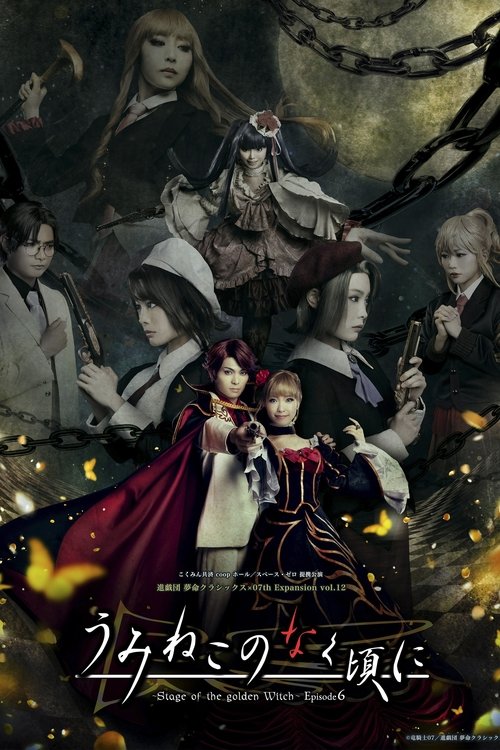
On Rokkenjima, the story opens as a truth-war rather than a simple murder mystery: Battler Ushiromiya is dragged back into the endless game with Beatrice, while the island's locked-room atrocities, family lies, and magical interpretations all start to collapse into one another. In Episode 6, the central struggle is no longer just "who killed whom," but whether love, identity, and the right to exist can survive the demands of a cruel logic battle, and that conflict reaches its most intense form in the guest house sealed under Erika Furudo's scrutiny.
The atmosphere is already poisoned by the island's history. The Rokkenjima conference is rooted in October 4, 1986, when eighteen people are gathered on the isolated island under the shadow of Kinzo Ushiromiya's inheritance, the family's succession dispute, and the legend of the gold hidden behind the epitaph. The core of the mystery still radiates from that old setup: the portrait of Beatrice watches over the family, the epitaph remains unsolved, and the question of who "owns" the truth has become more important than the question of who owns the gold.
As Episode 6 unfolds, the board's real emotional engine becomes the fragile knot tying together George Ushiromiya, Jessica Ushiromiya, Shannon, Kanon, and Beatrice. The game is framed as a "fight for a single miracle," with the reforged magical brooch from Episode 3 becoming the symbolic center of a love struggle that is both romantic and existential. George wants a future with Shannon, Jessica wants her feelings to be recognized, and the identity-linked roles of Shannon and Kanon become a battlefield where the story asks whether these figures are separate people, masks, or pieces of one buried self.
At the same time, Erika Furudo steps into the board as the "uninvited guest," and with her arrival the logic of the island sharpens into cruelty. Her role is not simply to investigate; she is there to force certainty, to corner the story into a shape that can be dissected, and to deny the softness of miracle or romance. Her presence bumps the island's human count back to eighteen after the revelation that Kinzo Ushiromiya has been dead all along, a fact that retroactively reorders the entire closed-circle structure of the mystery. That revelation matters because it means the apparently omnipotent patriarch is not actually part of the living cast, and the island's headcount is always already a lie.
The confrontation begins in the guest house, where the survivors are said to be holed up in two adjoining rooms, the "cousins' room" and the "next room over." The space is ordinary in appearance but unbearable in function: it is a trap, a place where sealed doors, windows, and walls define what can and cannot be believed. Erika's logic attack transforms the guest house into a laboratory of death. She seals the doors, imposes the conditions of the closed room, and then the murders begin to be understood not as random slashes of violence but as pieces in a reconstruction that can be manipulated by whoever controls the board.
One source's solution account describes the closed-room mechanics in precise, tense terms: Erika enters the room and locks it with the chain, then goes into the bathroom, where the noise of the faucet distracts from what is happening elsewhere in the room. While she is occupied, Battler Ushiromiya emerges from his hiding place in the closet, opens the door, and lets Kanon in. Kanon, who is supposedly unable to enter because of the seals Erika has placed on the guest house, is explained as having "magically" gotten in despite those barriers. Then Battler leaves, Kanon locks the door from the inside with the chain, and hides in the closet in Battler's place while Erika is still busy at the sink, only to "magically" disappear from the room again.
The scene is chilling because it turns a murder investigation into a performance of absence. Every motion is half-seen, every body potentially replaceable, every locked door potentially a lie. The closet becomes a chamber of substitution, the bathroom faucet a cover for identity switching, and the room itself becomes a stage for the question at the heart of the episode: if a person can be replaced by another role, what does death even mean? The solution logic presented in the available material insists that Shannon slips out through the window right after Erika leaves and runs to the mansion, where Shannon changes into Kanon. That movement binds the mansion to the guest house, and the act of changing clothing or identity becomes as important as any knife wound.
The first twilight murders are then folded into this layered deception. According to the reconstruction, Erika sets up the seals and kills the victims of the First Twilight who were "playing dead," then heads to Battler's room while being followed by Yasu/Kanon. The detail is important because it makes Erika less a passive detective than an active executor within the logic of the board: she is not merely discovering corpses, she is producing the final shape of the crime scene. The victims are not named in the source material for the stage production, but the implication is that the "dead" are a mixture of people who have fallen in the First Twilight and figures whose survival has been staged long enough to be shattered by Erika's intervention.
The room-by-room tension intensifies because no event can remain literal for long. The story keeps demanding that the audience hold two incompatible ideas at once: that someone is dying, and that someone may be performing death; that a body is absent, and that a body may simply have changed name or role; that a sealed room is impossible, and that the impossible is only a trick of interpretation. This is the core of Episode 6's dramatic power, and it is why the emotional stakes are so much higher than the physical count of victims.
The broader revelations continue to strip away the island's foundations. The death of Kinzo Ushiromiya long before the conference means the "master of the island" is a spectral authority, not a living one. That changes the moral geometry of the story. The family's disputes over inheritance are suddenly exposed as arguments over a throne that is already empty, and the old patriarch's portrait becomes a grotesque symbol of control without presence. Once Kinzo is removed from the living, the game is no longer about obeying a patriarch; it becomes about who gets to write the truth in his place.
From there, the story's emotional center tightens around Shannon, Kanon, George, Jessica, and Beatrice. The "single miracle" they fight for is tied to the magical brooch, a symbol that carries the promise of love made real despite the island's cruelty. In the stage logic described by the sources, this is not a side thread; it is the soul of Episode 6. George's ideal of love, Jessica's yearning, Shannon's hidden selfhood, Kanon's role as an embodiment of disallowed feelings, and Beatrice's insistence on the reality of magic all collide in one impossible demand: that the heart be recognized in a world that only believes in evidence.
That conflict gives the later confrontations their force. Every time Battler challenges Beatrice, he is not merely arguing for a culprit; he is fighting over whether the world can contain tenderness without reducing it to fraud. Beatrice's replies are no longer just taunts. They become a defense of the human need to be seen in forms that reason cannot fully explain. Meanwhile, Erika stands as the embodiment of cold proof, turning the island's mysteries into a forensic arena where even suffering can be rearranged into a neat theory. Her violence against the "victims" in the solution account--described as her going around and decapitating them except Battler--marks the point where logic becomes physical brutality. The horror is not only that bodies are mutilated; it is that certainty itself becomes the weapon doing the cutting.
As the episode's truth-game advances, the identities at the center of the island become even more unstable. The available material emphasizes that Shannon and Kanon are central to the solution logic, and that their identities are tied into the larger Yasu framework, even if the stage-specific transcript is unavailable. The practical effect in the narrative is devastating. Every confession threatens to become another mask. Every love declaration risks being reread as manipulation. Every death risks being another transformation. The story creates a feeling that the island is not simply containing people, but consuming and reassigning them.
The guest house sequence, especially the chain, the bathroom faucet, the closet, and the window, becomes the visual core of this episode's tension. The chain is a mockery of safety, because the room is only as locked as the story wants it to be. The faucet's noise masks the crucial movement of bodies and roles. The closet is where one identity waits while another walks outside it. The window is the one unstable route that allows Shannon to cross from one location to another and become Kanon in the mansion. These details are less about spatial realism than about the story's insistence that people on Rokkenjima are always escaping one imposed identity only to enter another.
The climax of the episode is less a single murder than a total collapse of certainty. Erika's logic, which is meant to dominate the board, exposes its own cruelty by forcing a world of love and ambiguity into a framework of corpses and locked doors. Battler's struggle is no longer only against Beatrice; he is also resisting the reduction of every human bond into a mechanism of proof. The "fight for a single miracle" reaches its emotional peak when the narrative refuses to treat the magical brooch and the relationships around it as trivial sentiment. Instead, the episode treats them as the last proof that the heart exists at all.
The ending state described in the available source material is bleakly unresolved in a literal sense and deeply transformative in a thematic one. The sealed-room aftermath, the investigative violence, and the shifting identities leave the board in a condition where the murder mystery has been outgrown by the battle over truth itself. Erika's role as the uninvited guest has already changed the terms of the game; Kinzo's death has already redefined the population of the island; and the revelation structure around Shannon, Kanon, and Beatrice has already pushed the story beyond ordinary whodunit logic. What remains is not a clean solution but a devastated landscape of competing truths.
The final emotional note is that the story does not end with simple victory for either reason or magic. Instead, it closes on the idea that the battle over the island's truth is still ongoing, with Battler and Beatrice locked into a relationship that is as much about recognition as it is about defeat. The violence of Erika's certainty, the tenderness of the brooch's miracle, and the hidden humanity inside the Shannon/Kanon/Beatrice structure all survive into the aftermath as unresolved, burning questions. The stage adaptation confirmation shows that Episode 6 was indeed brought to the 2025 Stage of the Golden Witch project, but the available materials do not preserve a full transcript of the production's final tableaux or curtain scene, so the exact visual closing of the stage performance cannot be stated with confidence beyond this narrative end-state.
What the story leaves behind is a Rokkenjima where the dead, the disguised, and the loved are all entangled in one final, merciless puzzle. Battler is still fighting for a truth that can save people instead of simply explaining them, Erika has proven that proof can wound as much as any blade, and Beatrice remains the impossible presence at the center of the island's storm. The result is not a tidy resolution but a brutal and beautiful refusal to let either death or love be the last word.




What is the ending?
Battler wins the final game against Beatrice, and the story closes with the mystery no longer centered on murder, but on what the characters chose to believe. Ange is left carrying the last truth she has been given, while the main cast's fate is tied to the ending of the game rather than a simple physical resolution.
Battler and Beatrice stand at the center of the ending. Battler has already broken through Beatrice's game and taken control, and the final stretch of the story shows him reaching a truth that leaves him bleak rather than triumphant. The stage then shifts to the renewed game on Rokkenjima, where the focus is not on another bloodbath, but on the conflict around love, belief, and the possibility of a miracle.
Ange appears with Featherine, who has been posing as the novelist Hachijo and has been writing the earlier games as novels. Featherine gives Ange access to the latest game and asks her to read "Dawn," placing Ange in the role of witness and interpreter. This frames the ending as a continuation of the truth-finding struggle, but from Ange's side.
The story then returns to the human relationships that define the episode's emotional center. George and Jessica each confront the people they love, and Shannon and Kanon each express their own love while also accepting that only one of them can obtain happiness. The ending presents this not as a simple romance, but as a conflict over which identity and which future can survive.
In the final locked-room sequence, the story gives the solution to Battler's closed-room imprisonment. Erika enters the room, locks it with the chain, and works in the bathroom with the faucet while Battler slips from hiding and opens the door for Kanon to enter. Kanon then leaves the room, locks it from the inside, hides in Battler's place, and later disappears from the room entirely. This sequence resolves the prison-like mystery while keeping the sense of concealment and substitution at the center of the scene.
After that, the wedding scene becomes the last major confrontation. Bernkastel chooses to have Erika marry Battler and turn him into a puppet, but the wedding is interrupted by the awakened Chick Beatrice, who arrives with the demons and duels Erika. Beatrice then confirms in red that Kanon locked the door from inside, and that truth kills Erika.
The ending leaves Erika dead, Battler freed from the locked room, and the game decided by the truth Beatrice reveals. Bernkastel walks through the now-empty mansion afterward and meets Featherine, and despite Battler's victory, Bernkastel is appointed as the next game master so the tale can end without unresolved mysteries. Shiva and the game's other figures are left behind as the curtain closes on the mansion, with the story's final state resting on revelation rather than further violence.
If you want, I can also turn this into a stricter scene-by-scene ending recap with each main character's fate listed separately in order.
Is there a post-credit scene?
There is no reliable evidence in the provided sources that this 2025 stage-film adaptation has a post-credit scene, and none of the results explicitly describe one.
What the sources do show is that Episode 6 was staged in September 2025, and one listing notes it as an adaptation of the Tea Party, but it does not mention any post-credit material. Because the available results only confirm the production and synopsis, not the end-of-film structure, I cannot truthfully describe a post-credit scene from them.
How does Battler become the new game master in Episode 6, and what changes in his role on the gameboard?
In Episode 6, Battler returns to the island narrative in a far more active position than before: he is no longer only a participant in the mystery, but becomes the one responsible for creating and managing the gameboard as the new game master. This shift changes the entire tone of the episode, because Battler must now confront the mystery from the side that shapes the rules and confronts Beatrice on equal footing.
What is the significance of the magical brooch, and which characters are involved in the miracle it is meant to grant?
The magical brooch introduced in Episode 3 becomes important in Episode 6 as part of a meta-world conflict centered on a single miracle that would allow several characters to fulfill their love. The characters specifically named in this struggle are George, Jessica, Shannon, Kanon, and eventually Beato, who are drawn into a fight over that miracle rather than over a conventional physical object.
How is the closed-room mystery involving Erika, Battler, and Kanon explained in Episode 6?
One of the key plot questions in Episode 6 is the closed-room structure around Erika, Battler, and Kanon, and Beatrice's explanation is highly specific. Erika enters the room and chains it shut, then goes into the bathroom and becomes occupied with the faucet, which gives Battler time to leave his hiding place in the closet, open the door, and bring Kanon inside. After that, Kanon leaves, locks the door from the inside, hides in the closet in Battler's place, and later appears to disappear, which is the core of the apparent impossibility.
What is the deal with Shannon and Kanon in Episode 6, and how does their identity connection affect the mystery?
Episode 6 uses Shannon and Kanon's identity connection as a major clue in the mystery structure, especially when Beatrice explains how one persona can replace the other in seemingly impossible circumstances. In one proposed sequence, Shannon slips out through a window after Erika leaves, runs to the mansion, changes into Kanon, and then the narrative uses that exchange to support the illusion of multiple separate people acting at once. This is also tied to the broader red-truth argument that there are only eighteen people on the island and no nineteenth person, which constrains how the mystery can be read.
How does Ange’s role change in Episode 6, and why is she brought into the island conflict?
Episode 6 gives Ange a more active role in the larger conflict by making her a deliberate bait in a plan involving Okonogi, Amakusa, and Kasumi. According to the episode analysis, Okonogi wants Amakusa to kill Kasumi because of a deal with the Sumadera head family, so he uses Ange to lure Kasumi onto the island. This places Ange inside a plot that is not just about survival, but about being used as leverage in a wider human scheme.
Is this family friendly?
No, Episode 6 is not family friendly for young children or very sensitive viewers. The series is known for murder-mystery horror, disturbing imagery, and psychological intensity, and the stage adaptation is part of that same Umineko story world.
Potentially upsetting or objectionable elements may include:
- Violence and murder themes; the story centers on a closed-circle mystery involving deaths and accusations.
- Blood, injury, or corpse-related imagery may be referenced or depicted in the source material's horror tone.
- Psychological distress, including paranoia, fear, manipulation, and emotional conflict between characters.
- Heavy death and grief themes, which can be upsetting even when not shown graphically.
- Mature relationship or romantic material in the broader Umineko cast and staging context, which may be unsuitable for children.
If you want, I can also give a more specific age-suitability breakdown for teens vs. adults without spoiling the plot.