


Popular
How does Katy Perry’s character become the half-human, half-machine fighter known as KP143 in the concert narrative?
Who or what is the villain Mainframe, and why is Perry fighting it?
What role do the butterflies play in the story of The Lifetimes Tour?
What are the different quest areas Perry moves through in the show, and how do they affect the story?
How does the show’s storyline connect Katy Perry’s stage character to her older pop persona?
Should I watch it?
Ask Your Own Question

What is the plot?
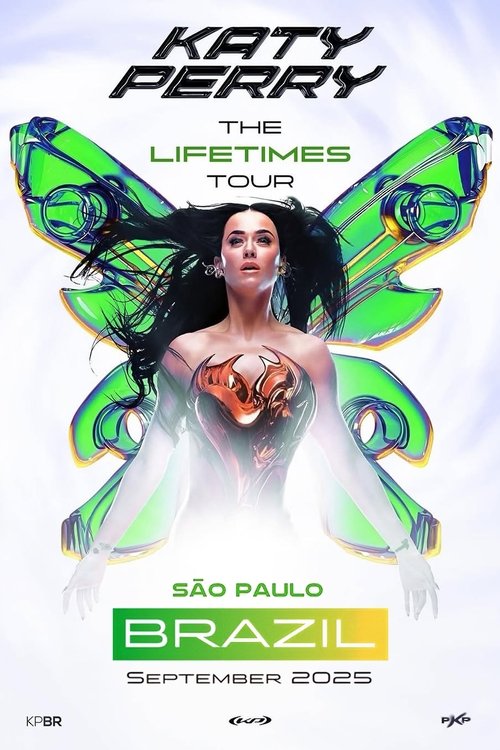
The film you are asking about is not a conventional narrative movie with a cast of fictional characters, on-screen deaths, or a screenplay-style plot. It is a concert film / live performance recording of Katy Perry: The Lifetimes Tour - Live from The Town 2025, built around a stage story in which Katy Perry plays a half-human, half-machine hero fighting an AI antagonist called Mainframe in a stylized sci-fi world.
The story opens as a prologue explains that Mainframe has seized control of the world and stolen its butterflies, leaving the universe warped and out of balance. The concert does not begin like a normal live show; it begins like the opening of a game, with the audience being told that the world is trapped under Mainframe's "relentless control," and that "five realms remain out of Mainframe's reach," each holding a "heartbeat" or "energy capsule" that can be collected to build enough power to fight back. That premise immediately gives the performance the shape of a quest: Katy Perry is not simply entering to sing songs, but stepping into a battle to recover what has been taken and restore the world's lost joy.
As the performance advances, Perry appears as the central protagonist of this fantasy. The production presents her as a hybrid figure, part human and part machine, which visually reinforces the central tension of the show: she belongs to the world she is trying to save, but she is also shaped by the same artificial system that is threatening it. Mainframe is not treated as a simple villain in dialogue-heavy scenes; instead, the production uses narration, stage imagery, and choreography to give it an overwhelming, all-seeing presence. The world itself is depicted as unstable and absurdly transformed, with the opening narration even referring to dogs siding with cats against humans, a strange detail that signals that ordinary reality has been broken and reordered under Mainframe's influence.
From there, the show moves like a sequence of levels in a video game. The "five realms" become the structural backbone of the story, and the quest for the heartbeats or energy capsules turns the concert into a series of escalating trials. Perry's movement through these realms is communicated less through long scenes and more through spectacle: lights flash, metal and neon dominate the stage design, and the show repeatedly frames her as a fighter pushing deeper into Mainframe's territory. The effect is that each song functions like a new stage in the adventure, with the visuals telling the audience that she is collecting strength, resisting control, and moving closer to the final confrontation.
One of the strongest features of the show's narrative is the way it uses physical performance to replace traditional plot exposition. Instead of dialogue-driven confrontations, the conflict is expressed through combat-like choreography, dramatic lighting, and science-fiction imagery. The production includes moments that feel like battles: Perry is shown contending with mechanical forces, moving through the world as if she is breaking through digital resistance, and confronting the oppressive system that Mainframe represents. The visual language makes the conflict feel urgent and personal even without a conventional movie-style villain monologue. Mainframe's control is felt everywhere, and Perry's resistance becomes the emotional center of the entire experience.
The show's middle section deepens the idea that this is a story about recovery and identity, not just victory. The butterflies, which Mainframe has stolen, are not merely decorative symbols; they represent beauty, freedom, and emotional life. Their absence marks the world as spiritually damaged. Perry's quest therefore becomes a symbolic fight to restore wonder itself. The narration's emphasis on the heartbeats hidden in the five realms suggests that the world is not only missing objects but missing pieces of its own living pulse. By gathering these heartbeats, Perry is effectively reassembling the world's vitality. The quest structure gives the concert a sense of momentum, because every new visual sequence suggests that she is getting closer to enough power to challenge Mainframe directly.
A key emotional revelation arrives in the live narrative when Perry declares, "this is what makes me real," a line that functions as the show's thematic turning point. That statement reframes the whole conflict: the issue is not simply defeating an AI, but proving that humanity, emotion, and authenticity are stronger than the artificial system that tries to define reality. The line lands as a moment of self-assertion, as if Perry is not only resisting Mainframe but also reclaiming her own identity from a mechanized world. The performance then uses that emotional breakthrough to push into the final stretch, where the remaining energy and the recovered sense of self converge into the climax.
By the time the show reaches its ending, the narrative has fully shifted from oppression to liberation. The final movement culminates in the butterflies being freed, which serves as the story's decisive symbolic victory. There is no sourced evidence of any character deaths, and this is not presented as a tragedy in which someone dies to break the spell; instead, the resolution comes through release, spectacle, and collective emotional payoff. Mainframe's hold is broken not through sacrifice in a traditional dramatic sense, but through Perry's triumph over the forces that have compressed the world into something cold and controlled.
The ending then swells into a celebratory sequence of songs that completes the story's emotional arc. After the butterflies are liberated, the show moves through "Roar," "Daisies," "LIFETIMES," and "Firework," with "Firework" serving as the final catharsis. That progression matters because it transforms the victory from a private win into a public burst of joy. "Roar" turns the battle into defiance, "Daisies" softens the aftermath into resilience and renewal, "LIFETIMES" grounds the whole experience in endurance and connection, and "Firework" explodes the story into pure release. The finale does not end in ambiguity; it ends in triumph, with the stage language telling the audience that the world has been restored to light and wonder.
The complete narrative therefore moves in a clean arc: Mainframe steals the butterflies and locks the world under artificial control; Perry enters as a half-human, half-machine hero; she is told that five realms still contain the heartbeats needed to resist; she travels through this game-like world gathering power; she confronts the system visually and emotionally; she declares that authenticity is what makes her real; and she finally frees the butterflies and closes the show in a blaze of celebratory songs, ending on the cathartic image of restored joy. The "plot twist," such as it is, is that the show is less about defeating a villain through violence than about proving that feeling, freedom, and human presence can overwhelm a mechanical world order.
More Movies Like This
Browse All Movies →




What is the ending?
Katy Perry ends the show by completing her battle in the story world, freeing the butterflies, and returning to the stage to finish the concert with the emotional payoff of the mission. The ending presents her as having reclaimed her "real" self after the machine demands identity from her.
In the closing stretch, the show's video sequence reaches the point where the trapped butterflies are found inside the machine-controlled world. The machine asks for Katy's identity to unlock them, and the story frames this as the decisive moment of the final conflict. Katy answers that "this is what makes me real," and that line becomes the turning point that releases the butterflies.
After the butterflies are freed, Katy comes back out in person to continue the performance and close the concert with songs including "Roar," "Daisies," "LIFETIMES," and "Firework." In the tour's story, Katy's character is the one who survives the conflict and completes the mission; the machine is overcome, and the butterflies are restored to the world. The concert version presented in São Paulo on The Town 2025 is part of that same Lifetimes Tour narrative, which centers on Katy as KP143, a half-human, half-machine figure battling Mainframe in a video-game-like world.
Is there a post-credit scene?
There is no reliable evidence in the available sources that Katy Perry: The Lifetimes Tour – Live from The Town 2025 includes a post-credit scene. The sources instead describe the concert's ending, where Perry is shown in an animated sequence fighting on her planet, unlocking trapped butterflies, and then returning to perform four final songs: "Roar," "Daisies," "LIFETIMES," and "Firework."
If you meant a final on-screen segment after the main performance rather than a traditional post-credit scene, the closest match is that animated "real you" butterfly-unlocking sequence at the end of the show.
How does Katy Perry’s character become the half-human, half-machine fighter known as KP143 in the concert narrative?
The concert is framed as a video-game-style story in which Katy Perry appears as a half-human, half-machine figure called KP143, and she must battle the AI villain Mainframe after leveling up through quest-like stages.
Who or what is the villain Mainframe, and why is Perry fighting it?
Mainframe is presented as an artificial-intelligence supervillain that has trapped the world's butterflies and uses their energy to keep its power and control over the world.
What role do the butterflies play in the story of The Lifetimes Tour?
The butterflies are central to the conflict: Mainframe has captured them and harvested their energy, so freeing or recovering that energy becomes part of the narrative stakes.
What are the different quest areas Perry moves through in the show, and how do they affect the story?
The tour structure includes two of five different areas that Perry can quest through, and completing those stages lets KP143 gain two hearts before advancing toward the confrontation with Mainframe.
How does the show’s storyline connect Katy Perry’s stage character to her older pop persona?
The show blends a cyborg battle narrative with Perry's familiar bright, playful pop identity, presenting the story as a frothy, family-friendly spectacle rather than a dark sci-fi drama.
Is this family friendly?
Yes -- this concert film is generally family-friendly and is described as a positive, feel-good spectacle with a largely child-oriented audience.
Potentially objectionable or upsetting elements for children or sensitive viewers may include:
- Loud concert volume, flashing lights, and intense stage visuals common to pop concert films.
- Sci-fi battle imagery and video-game-style conflict involving an AI villain, which may feel intense for very young children.
- Songs and performance themes that include self-empowerment, "scorpio-talk," and other stylized pop-concert concepts that may be confusing to younger viewers.
- Mildly dramatic or theatrical visuals rather than realistic violence; the show is presented as a playful, fantasy-like spectacle rather than something grim.
- Audience crowd energy and big-show excitement, which can be overstimulating for sensitive children.
Based on the available descriptions, there is no indication of strong sexual content, graphic violence, or explicit language in this concert presentation.