






Popular
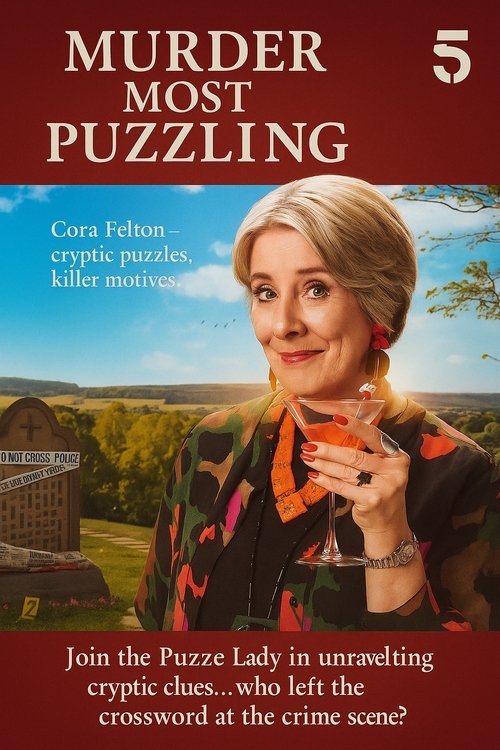
Who is Cora Felton, and why is she called The Puzzle Lady?
Who is Sherry, and what is her relationship to Cora Felton?
Who is the teenage girl found dead in the first murder case, and what clue is left with the body?
Why does Detective DCI Hooper involve Cora in the investigation?
What kinds of specific cases or storylines appear in the later episodes?
Should I watch it?
Ask Your Own Question

What is the plot?
Cora Felton and her niece Sherry arrive in Bakerbury as Cora presents herself to the town as the famous "Puzzle Lady," while in reality Sherry is the true crossword expert and Cora is a cover for her. The pair are in town because they are trying to disappear from a mysterious pursuer from their past, and Cora's public persona is meant to keep attention away from the truth about them.
The story begins when a teenage girl is found dead in Bakerbury Cemetery with a crossword clue placed on her body. The local police are baffled by the strange clue, and Detective DCI Hooper, unable to make progress, turns reluctantly to Cora for help.
Cora throws herself into the investigation and starts examining the murder as a puzzle, with Sherry quietly supplying the real solving power behind the scenes. Journalist Anton Grant quickly becomes involved, following Cora closely and also taking a strong interest in Sherry. Their arrival gives the investigation momentum, but it also draws more attention to Cora's fraudulent identity.
As the police and Cora's makeshift team work the case, they discover that the cemetery killing is tied to a broader pattern. Another woman's death is linked to the case, and Cora's investigation moves from the fresh murder into a cold case that appears connected. Her digging begins to expose a darker truth hidden beneath the town's surface.
The first major breakthrough comes when Cora realises that the apparent single killer is not acting alone. The investigation reveals that the murders were part of a scheme built by an evil husband and his secret lover, who used the myth of a serial killer as cover so the husband could murder his wife and gain her inheritance. The supposed "Graveyard Killer" was therefore not one person but a deliberate false trail created to hide the real motive.
Stuart Tanner is exposed as the serial killer figure behind the episode 1 murders. He wanted to kill his wife Vicky and get away with it without suspicion, because Vicky had inherited an original John Constable painting worth a fortune. His plan depended on making the deaths look like the work of a mysterious serial murderer rather than targeted crimes.
The plan starts to unravel when the third victim proves not to be random. Ally Brindle, the third woman killed, is revealed to be a certified art appraisal expert who had been helping Vicky sell her late mother's possessions because she had discovered something "priceless" in the house. That detail exposes how the killers' scheme had widened beyond the original intended victim and how the murder plot was driven by the painting and the inheritance.
By the end of the first episode's case, Cora has uncovered the truth behind the serial-killer myth: the deaths were engineered by Stuart Tanner and his secret lover to disguise an inheritance murder. In the process, Cora has also placed herself in danger by getting too close to the real killer and by continuing to investigate the older death connected to the new murder.
In the second episode's ending, Cora makes another key identification: Bella Dryver is actually Ida Blunkett, who is Governor Peacock's PA and lover. This revelation adds another hidden identity to the web of lies surrounding Bakerbury's crimes and deepens the sense that the town's murders are tied to secret relationships and concealed motives rather than simple random violence.
Throughout the case, Anton continues to circle both Cora and Sherry, while Cora's false public image as a brilliant puzzle solver remains essential to how she operates in Bakerbury. The episode leaves the town still shadowed by deception, with the central relationships and identities around the murders increasingly exposed but not fully settled.




What is the ending?
In the end, Cora solves the last case in Bakerbury by exposing that the supposed serial-killer story around The Graveyard Killer was a cover created by an evil husband and his secret lover to murder his wife for her inheritance. Sherry and Anton briefly get together, but the relationship immediately falters when Anton admits Becky kissed him and that he "let her," leaving Sherry furious and done with him. Cora ends the story as a social outcast, and Gilbert returns only to have Cora slap him after he confesses his feelings.
Cora has spent the series moving through Bakerbury's murders with a sharp, confrontational certainty, and in the final stretch that force finally reaches the truth behind the killings. The last mystery centers on The Graveyard Killer and the deaths that follow it, and Cora pieces together that the legend of a serial killer was manufactured by an evil husband and his secret lover so they could hide a murder plot built around the wife's inheritance. The pair used the myth to misdirect suspicion while the real motive stayed buried inside their own arrangement. In the process of solving that scheme, Cora also learns how far the deception ran, and the case closes with the killers exposed rather than protected by the story they invented.
At the same time, the series keeps pushing Cora into emotional isolation. Even after she has helped solve several crimes in Bakerbury, she ends the series as something of a social pariah, not welcomed into the town's life in any warm or settled way. When Gilbert appears again, revealing that his real name is Harry and saying that his feelings for Cora are genuine, Cora answers immediately and physically by slapping him across the face. That moment leaves him rejected and her still standing apart from everyone around her.
Sherry's ending is more personal and more abrupt. In the final episode, she and Anton finally stop circling each other and kiss, turning the tension that began in episode 1 into an actual relationship moment. But the scene does not hold. Anton later admits that Becky kissed him and that he "let her," and Sherry learns that this happened on the same night Anton had come to her place and they ended up in bed together. Sherry reacts with anger, cuts him off, and ends the series saying she is "100% sure" she has given up on him.
The fate of the main characters at the end is therefore clear: - Cora solves the final murder conspiracy, but remains socially isolated. - Sherry ends things with Anton after his confession. - Anton loses Sherry's trust after admitting what happened with Becky. - Gilbert/Harry is rejected when Cora slaps him after he confesses his feelings. - The husband and secret lover behind the inheritance murder are exposed as the true killers.
Is there a post-credit scene?
Yes. The series ends with a brief coda rather than a traditional credits stinger: Gilbert, whose real name is Harry, returns and tells Cora that his feelings for her are genuine, and Cora responds by slapping him firmly across the face.
That is the only post-episode button described in the available coverage. The episode also leaves Cora socially isolated in Bakerbury after solving multiple murders, but the last beat specifically highlighted by the reporting is the Gilbert/Harry confrontation.
Who is Cora Felton, and why is she called The Puzzle Lady?
Cora Felton is the eccentric celebrity cruciverbalist at the center of Murder Most Puzzling, and the story presents her as the town's famous "Puzzle Lady." She and her niece Sherry arrive in Bakerbury trying to escape a mysterious pursuer from their past, and Cora is then pulled into the murder investigation when a teenage girl is found dead with a crossword clue on her chest.
Who is Sherry, and what is her relationship to Cora Felton?
Sherry is Cora Felton's niece, and the two move together to the sleepy English town of Bakerbury. The series frames their relationship as close enough that they relocate as a pair, with Sherry accompanying Cora as both a family member and part of the attempt to leave their troubled past behind.
Who is the teenage girl found dead in the first murder case, and what clue is left with the body?
The opening murder centers on a teenage girl who is discovered dead in Bakerbury. A crossword clue is left on her chest, which is the specific detail that draws the local police to seek Cora Felton's help in solving the crime.
Why does Detective DCI Hooper involve Cora in the investigation?
DCI Hooper turns to Cora because the first case in Bakerbury contains a puzzle-like clue that ordinary police methods cannot easily untangle. The murder of the teenage girl, combined with the crossword clue, makes Cora's reputation as The Puzzle Lady directly relevant to the investigation.
What kinds of specific cases or storylines appear in the later episodes?
Later episodes expand beyond the opening murder into other specific plot lines, including a wrongful imprisonment for murder, prison corruption, and a sex tape in the second episode. The third episode includes the killing of a high-profile local businesswoman, Cora being publicly exposed, and the emergence of a possible nemesis for her.
Is this family friendly?
Not really. Based on the trailer, Murder Most Puzzling is a murder mystery/crime drama, so it is likely better suited to teens and adults than young children.
Potentially upsetting or objectionable elements may include: - A dead teenage girl is mentioned in the premise, which may be distressing for younger or sensitive viewers. - Murder and crime investigation are central to the story, so the tone is likely tense and potentially unsettling. - The setting involves a body with a mysterious clue left on it, which suggests at least some morbid or disturbing imagery and dialogue. - Because it is a detective drama, it may include suspense, police questioning, and emotional distress around the killing.
If you want, I can also give a parent-style age suitability judgment such as "safe for 10+, 13+, or adult viewing" based on the available information.