
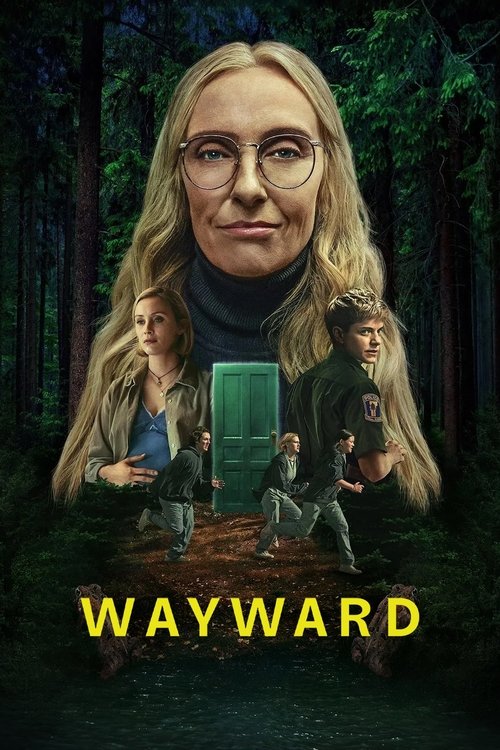












Popular
What is the significance of the psychological phases Burrow, Break, Build, and Ascend at Tall Pines Academy?
How does the relationship between Abbie and Leila evolve during their time at Tall Pines Academy?
What role does Evelyn Wade play in the story, and what is revealed about her character?
What is the significance of the character Rabbit in the series?
How does the series depict the escape attempts from Tall Pines Academy, and what happens to the students who try to flee?
Should I watch it?
Ask Your Own Question

What is the plot?
The series begins in 2003 with a boy fleeing through the woods near Tall Pines Academy, a boarding school for troubled teens. He is haunted by a strange mantra about mothers, doors, and silence, and escapes by diving into a lake.
The story then shifts to present-day Toronto, where best friends Abbie and Leila skip class and smoke weed. Abbie's strict father disapproves of Leila, blaming her for the death of Abbie's sister Jess. Despite being grounded, Abbie sneaks out to see Leila but is abducted in her sleep by staff from Tall Pines Academy. Her parents, convinced by the school counselor Wyatt Turner, believe the school will help her.
Abbie arrives at Tall Pines Academy, run by Evelyn Wade, a charismatic self-help guru who promises transformation through radical methods. The school feels institutional, with students having their hair cut, belongings confiscated, and movements monitored. Students are sorted into psychological phases called Burrow, Break, Build, and Ascend, which are supposed to mark progress. Abbie quickly realizes the school thrives on control and humiliation. In the ritualized "Hot Seat," students are forced to expose and break each other down under the guise of self-growth.
Inside the school, Abbie and Leila navigate the oppressive environment. They witness and endure psychological manipulation and physical control. The staff enforce strict rules, and students are pitted against each other. Abbie resists the process, trying to maintain her identity and sanity. Leila supports her, but the pressure mounts as the school's methods intensify.
Meanwhile, Laura, a pregnant woman who once attended Tall Pines, returns to her hometown with her wife Alex, a new police officer. Alex becomes suspicious of Tall Pines after meeting a runaway teen from the school. He senses that Evelyn and the school are hiding something sinister, despite the town's seemingly peaceful facade. Laura struggles with her past trauma connected to the school while trying to protect her unborn child.
As the story progresses, Abbie and Leila attempt an escape from Tall Pines. Their plan involves sneaking out during a school event, but they are caught. The confrontation is tense: staff members physically restrain them, and Evelyn personally intervenes, delivering a chilling speech about transformation and control. The girls are punished and separated, increasing the psychological pressure on them.
Rabbit, a mysterious and troubled student, plays a key role in the unfolding events. He is deeply affected by the school's methods and tries to protect Stacey, another student. Rabbit attempts to become Stacey's guardian to save her from the school's influence but is ultimately unsuccessful when Stacey is adopted by an interracial family. Rabbit watches her leave, crestfallen.
In the climax, Evelyn is confronted by Rabbit and Alex. They inject her with her own toad poison, which induces a dream-like state. Evelyn experiences a hallucinatory journey where she connects with Laura and relives her trauma. She chants the mantra she has been teaching the students, confronting her past. Evelyn sees a vision of herself with multiple doors at the back of her throat, symbolizing her fractured psyche. As Rabbit continues the mantra, Evelyn's body lies limp in the water, and it is implied she dies, though this is left ambiguous.
The series ends with the fate of the students partially revealed. Stacey is adopted and appears happy, while Rabbit remains isolated. Laura gives birth to a healthy baby, symbolizing hope beyond the trauma of Tall Pines. The town's dark secrets remain partially uncovered, leaving an unsettling atmosphere about the true nature of the school and its impact on generations of teens.








What is the ending?
Short, Simple Narrative of the Ending
In the finale of Wayward, Abbie and Leila escape Tall Pines after a risky plan, but Leila changes her mind and returns, influenced by Evelyn's manipulations. Alex, after discovering the truth about Daniel's death and confronting his own trauma, chooses to stay in Tall Pines with his family, rejecting a fantasy of escape. Evelyn, injected with her own hallucinogenic poison, experiences a surreal, traumatic vision and is left limp in the water, presumed dead. The fates of the students vary: Stacey is adopted by a new family, while Rabbit is left heartbroken. The series ends ambiguously, leaving key mysteries--like the truth about Laura's parents--unresolved.
Expanded, Chronological, Scene-by-Scene Narrative
The final episode of Wayward begins with Abbie and Leila executing their escape plan from Tall Pines. They trigger a power outage, use a car Alex left for them, and drive away from the town. The tension is palpable as they navigate the dark roads, both girls desperate for freedom. However, as they near the edge of town, Leila suddenly asks Abbie to stop the car. Leila, visibly conflicted and emotionally drained, tells Abbie she cannot leave. Despite Abbie's pleas, Leila exits the vehicle and walks back toward Tall Pines, her face a mix of resignation and something like relief. Abbie, devastated but resolute, continues alone into the night, her future uncertain but her escape definitive.
Meanwhile, Alex Dempsey, the local police officer, has been grappling with the discovery of Daniel's body and the dark secrets of Tall Pines. He is captured by his partner, Dwayne, who is complicit in the town's corruption. In a tense confrontation, Alex overpowers Dwayne, using a rock to defend himself--a moment that echoes the ambiguous story of Laura's parents' deaths. Alex, bloodied and shaken, makes his way to Evelyn's residence, where the final confrontation unfolds.
Evelyn Wade, the manipulative head of Tall Pines, is losing control. She is confronted by Rabbit and Alex, who inject her with the same hallucinogenic toad poison she has used to control others. As the drug takes effect, Evelyn collapses into a bathtub filled with water. Her consciousness fractures; she experiences vivid, traumatic visions, reliving her own past and the pain she has inflicted. She sees multiple versions of herself, doors multiplying in her mind, and hears the mantra she has forced upon her students. The scene is surreal, the camera lingering on Evelyn's limp body as Rabbit, standing over her, continues to chant the mantra. The implication is clear: Evelyn is dead or dying, her reign over Tall Pines ended in the same hallucinogenic haze she imposed on others.
Alex, in the aftermath, experiences a brief fantasy sequence where he imagines escaping Tall Pines with Abbie, driving into a new life. The vision is bright, hopeful--a stark contrast to the grim reality. But the fantasy dissolves, and Alex is shown standing in his home, holding his baby, looking at his wife. He closes the door, both literally and metaphorically, choosing to remain in Tall Pines with his family. His face is a mixture of sorrow and resolve, the weight of his decision evident in his posture.
The fates of the other students are shown in brief vignettes. Stacey, one of the girls from Tall Pines, is seen being adopted by a new, loving family. She smiles as she gets into their car, a rare moment of joy in the series. Rabbit, who had hoped to adopt Stacey herself, watches from a distance, her face a mask of grief and disappointment.
The series does not provide clear answers to all its mysteries. The truth about Laura's parents' deaths remains ambiguous: Evelyn claims Laura killed them, but the show leaves room for doubt, suggesting Evelyn herself may be responsible. Laura's ultimate fate is also left unresolved, her story a shadow over the town.
Fates of the Main Characters at the End
- Abbie: Successfully escapes Tall Pines, driving away alone, her future uncertain but free from Evelyn's control.
- Leila: Initially escapes with Abbie but chooses to return to Tall Pines, seemingly under Evelyn's influence, her fate left ambiguous but tied to the town.
- Alex Dempsey: Chooses to stay in Tall Pines with his wife and baby, rejecting a fantasy of escape, his future bound to the town's secrets.
- Evelyn Wade: Injected with her own poison, experiences a traumatic hallucination, and is left limp in the water, presumed dead.
- Stacey: Adopted by a new family, shown smiling as she leaves Tall Pines, a rare positive outcome.
- Rabbit: Heartbroken after failing to adopt Stacey, her future uncertain, left to grapple with her loss.
- Laura: Her ultimate fate is unresolved; the truth about her parents' deaths remains a mystery, her story haunting the town.
The ending of Wayward is deliberately ambiguous, leaving viewers with questions about truth, trauma, and the possibility of escape--both physical and emotional. The characters' choices reflect the show's central themes: the weight of the past, the difficulty of breaking cycles of abuse, and the elusive nature of freedom.
Is there a post-credit scene?
Yes, the TV show Wayward Season 1 ("Limited Series," 2025) includes a post-credits scene. After the main finale events, the scene shows the newborn baby delivered by Laura in an inflatable pool. Immediately following the birth, the graduates of Tall Pines Academy surrounding them remove their shirts and bras to conduct skin-to-skin contact with the infant. Laura explains to Alex that the baby is "everyone's" and that this communal bonding is "the only way to break the pattern," symbolizing a collective effort to end the cycle of trauma and control perpetuated by the cult-like academy.
What is the significance of the psychological phases Burrow, Break, Build, and Ascend at Tall Pines Academy?
The psychological phases Burrow, Break, Build, and Ascend at Tall Pines Academy represent the supposed progress stages the students must go through as part of the school's control and transformation methods. These phases are part of the institution's ritualized system designed to break down and rebuild the teens under the guise of self-growth, but in reality, they enforce control and humiliation.
How does the relationship between Abbie and Leila evolve during their time at Tall Pines Academy?
Abbie and Leila, best friends who initially skip class and share a rebellious bond, face severe challenges when Abbie is abducted by Tall Pines staff. Their relationship is tested by the school's oppressive environment and Abbie's strict father's disapproval of Leila. Despite these pressures, their friendship remains a central emotional thread, highlighting their resistance against the school's control.
What role does Evelyn Wade play in the story, and what is revealed about her character?
Evelyn Wade is the charismatic self-help guru running Tall Pines Academy, promoting transformation through controversial methods. She is revealed to be manipulative and controlling, using mind-control techniques like 'The Leap' on students. Her backstory includes a disturbing secret that her daughter Laura killed her own parents, and her fate is left ambiguous after an overdose induced by Alex, reflecting her complex and dark role in the narrative.
What is the significance of the character Rabbit in the series?
Rabbit is a student at Tall Pines who ultimately betrays Evelyn upon realizing her lack of genuine concern for the students. Rabbit plays a pivotal role in Alex's escape by warning him about Evelyn's overdose and guiding him through the school's twisted rituals, acting as a catalyst for the turning point against Evelyn's control.
How does the series depict the escape attempts from Tall Pines Academy, and what happens to the students who try to flee?
The series shows that at least 18 kids have vanished after trying to flee Tall Pines Academy, indicating a sinister pattern. The school staff, including Dwyane, insist that the missing students either return or leave as troubled individuals. The escape attempts are fraught with danger, and the school uses psychological and physical control to prevent students from leaving, underscoring the academy's oppressive and dark nature.
Is this family friendly?
The TV show Wayward (Season 1, "Limited Series," 2025) is not family friendly and is rated TV-MA, meaning it is intended for mature audiences only.
Potentially objectionable or upsetting content includes:
- Violence and gore: Moderate levels of violent scenes and some grisly moments.
- Mature themes: Dark and complex themes involving troubled teens, psychological manipulation, and sinister elements in a boarding school setting.
- Sexual content and nudity: Moderate, including some sexual situations.
- Profanity: Mild use of strong language.
- Substance use: Depictions of drug use, including smoking pot, and alcohol consumption.
- Frightening or intense scenes: Suspenseful and unsettling moments, including cult-like and mind control elements, which may be disturbing for sensitive viewers.
Because of these mature and intense elements, Wayward is not suitable for children or sensitive viewers. Parents should exercise caution and consider these factors before allowing younger audiences to watch.









