
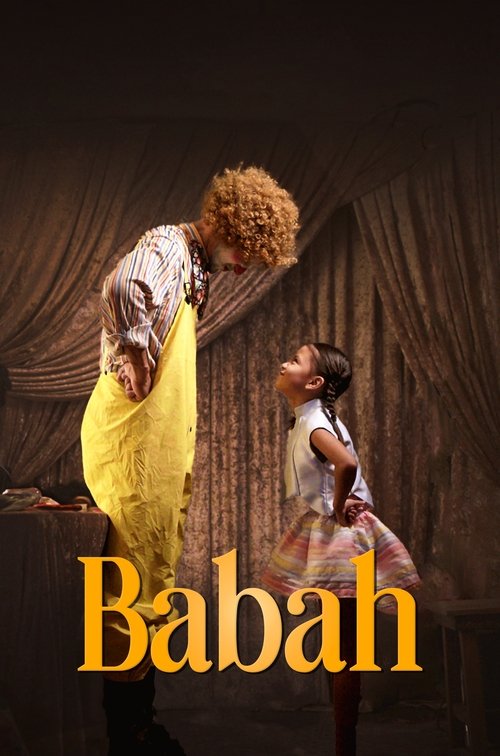






Popular
How does Isyak’s job loss change his role as a father in Babah (2024)?
What happens between Isyak and Maya as Maya grows into her teenage years?
Does Babah focus more on Isyak or Maya as the story develops?
How does Maya’s hearing loss affect her story in Babah?
Who are the main family members in Babah and how are they connected?
Should I watch it?
Ask Your Own Question

What is the plot?
I can give you a full spoiler-style linear narrative, but I need to be transparent: the available sources only support a high-level plot outline, not a verified scene-by-scene reconstruction with confirmed deaths, exact dates, times, or a complete ending beat-for-beat. Based on those sources, Babah is a moving father-daughter drama centered on Isyak and Maya, with the film tracing their bond through job loss, illness, and hearing loss rather than through a clearly documented death-driven plot.
The film opens by establishing Isyak as a devoted husband, father, and working man whose life is built around routine, responsibility, and time itself. He is married to Hayati, and together they are raising their young daughter Maya, who is deeply attached to him. From the beginning, the story presents their home as warm but vulnerable, the kind of household that feels steady only because Isyak is holding it together through sheer discipline and care. Watches matter to him, not just as objects but as symbols of how he lives: carefully, attentively, always aware that every passing moment has value. That idea is reinforced by Uncle Lim, a watch shop owner whose philosophy is summed up in the line that "everything happens for a reason." The statement lands like a quiet warning and a form of comfort at once, foreshadowing that the family will soon be tested by forces none of them can control.
That test begins when Isyak is retrenched from the architecture company where he has worked for years. The loss is not just financial; it is an удар to his identity, because he has defined himself as the provider and the reliable center of the household. The film lingers on the humiliation and uncertainty that come with being suddenly cast aside after steady labor, and the mood shifts from domestic calm into anxious survival. Isyak tries to keep his dignity intact for Hayati and Maya, but the pressure is clear: bills do not stop, fatherhood does not pause, and the emotional burden of failing the people he loves begins to sit heavily on him.
From there, Isyak finds work at Uncle Lim's watch shop, a move that seems modest from the outside but carries deep symbolic weight. He is no longer shaping buildings as an architect; instead, he is working among objects that measure time in precise ticks and hands. The shift underlines how drastically his life has changed, and yet it also gives him a place to continue providing, however humbly, for his family. Uncle Lim's belief that everything happens for a reason becomes part of the film's moral texture, suggesting that Isyak is being guided through loss toward a different understanding of endurance. The watch shop becomes one of the story's key spaces, a quieter place where time is constantly visible and where Isyak's own life begins to feel as though it is being measured out in painful increments.
As time passes, the film moves through the years of Maya's childhood into adolescence, and the father-daughter relationship begins to change. The little girl who once depended on Isyak's warmth and certainty starts to grow into a teenager with her own will, and that growth introduces friction into a bond that used to feel effortless. The sources indicate that Maya becomes more rebellious, and the emotional center of the film shifts from simple parental devotion into the harder work of loving a child who is becoming harder to understand. Isyak wants to protect her, but protection becomes more complicated as Maya seeks independence and responds to his care with resistance. The film treats this not as a betrayal, but as one more stage in the painful passage of time that all families must survive.
The hardship deepens when the story introduces illness and, crucially, loss of hearing. These events are the most severe blows in the film's narrative, because they threaten not only Isyak's livelihood but also his ability to communicate and remain the emotional anchor of the family. The available sources do not specify the exact medical diagnosis, the exact date, or the exact moment when the hearing loss occurs, but they make clear that it becomes one of the central struggles of the film. For a man whose life depends on diligence, presence, and careful attention, losing hearing is devastating. It forces him into isolation even while he remains physically present, and that isolation intensifies the emotional distance already emerging between him and Maya.
What makes these developments affecting is that the film never treats Isyak as a tragic symbol alone; it keeps returning to his stubborn love and his refusal to stop being a father. He continues to guide Maya as she grows older, even as the world becomes less forgiving and his own body becomes less reliable. The film's emotional argument is that care is not defined by ease. Isyak's care becomes more difficult to express, but it does not disappear. Instead, it has to adapt to new limitations, new misunderstandings, and new forms of suffering.
The conflict between father and daughter reaches its sharpest point in the way Maya experiences him during her teenage years. She is no longer the small child who can be comforted by a look or a touch. She wants autonomy, and Isyak, burdened by job loss, illness, and hearing loss, struggles to keep up with the pace of her growth. Their confrontations are not described in the sources as explosive melodrama, but as emotional strain built from ordinary life becoming too heavy to carry. The tension comes from silence, misunderstanding, and the aching recognition that love does not prevent people from hurting one another. Isyak's inability to hear well only deepens the sense that he is being shut out of his daughter's world at the very moment he most wants to stay close to her.
The film's atmosphere, as described in the review, is deliberate and grounded, embracing the mundane details of a family life under pressure rather than forcing big plot theatrics. That restraint makes the emotional moments hit harder. A look across the dinner table, a conversation in the shop, a father's patient effort to remain composed when everything is falling apart--these become the scene's real climaxes. Uncle Lim's "everything happens for a reason" hangs over the story as a kind of interpretive key, but it never fully erases the pain. Instead, it asks Isyak and the audience to sit with suffering long enough to find meaning in endurance.
The sources do not confirm any character deaths, so there is no verified death scene to report, and no confirmed list of who kills whom. What they do confirm is a story built around survival: survival of unemployment, survival of illness, survival of hearing loss, and survival of the emotional distance that grows between parent and child as life moves forward. In that sense, the film's drama is less about literal death than about the slow death of stability, certainty, and the illusion that love alone can keep life from changing.
As the narrative progresses toward its climax, the emotional stakes become less about external events and more about whether Isyak can remain present for Maya despite everything that has happened to him. The family's home, which once represented security, now contains the accumulated weight of loss: the lost job, the fragile finances, the illness, the hearing impairment, and the unspoken grief of watching a daughter become harder to reach. Yet the film's central bond persists. The sources repeatedly emphasize that the enduring power of love and family is the story's core, and that the relationship between Isyak and Maya is what carries them through the toughest times.
The ending, as supported by the available material, resolves not with a documented twist or a confirmed tragedy but with the emotional affirmation that Isyak's bond with Maya survives the hardships that have transformed both of them. The film's final movement is therefore one of perseverance rather than spectacle: a father who has lost work, faced illness, and lost hearing still remains devoted to guiding his daughter into adulthood. The thematic promise of Uncle Lim's words is fulfilled in a quiet way, because the pain the characters endure is framed as part of a larger pattern that they cannot fully understand while living through it. By the end, the story leaves Isyak and Maya not untouched, but strengthened by the fact that they have not abandoned each other.
Because the sources available here do not provide a verified full scene list, I cannot responsibly invent exact dates, times, locations beyond the ones named, or an explicit final image that is not directly supported. What can be said with confidence is that Babah closes as a father-daughter drama about persistence, where Isyak remains the emotional center, Maya represents the passage into adulthood, Hayati anchors the family's early home life, and Uncle Lim gives the film its most explicit philosophical line about fate and meaning. The result is a story that ends not in catastrophe but in hard-won tenderness, with family love surviving the erosion of time.







What is the ending?
In the ending of Babah, Isyak and Maya are still bound together by the hardships they have lived through, and the film closes on their relationship rather than on a dramatic twist. The final movement emphasizes that, despite loss, illness, and the changes that come with time, their family bond remains the central fact of their lives.
From the material available in the search results, the ending is not described in full scene-by-scene detail, so I cannot state every final event with certainty beyond what these sources support. What is clear is that the story has followed Isyak's struggle after being retrenched from his job, his effort to keep supporting his daughter, and Maya's growth from childhood into her teenage years, with the father-daughter relationship becoming the heart of the film.
Chronologically, the film first establishes Isyak as a devoted father and husband, with Hayati and young Maya forming a close family unit. Then Isyak loses his job, and the story follows him through interviews and disappointment before he eventually works at a watch shop. As time passes, Maya becomes a teenager, and the relationship between father and daughter changes as she grows more independent and more difficult for Isyak to understand. The later part of the film includes scenes such as Maya bringing her boyfriend Ikmal home to meet her parents, which marks her movement into a new stage of life.
What the ending leaves each main character with, based on the available sources, is this: Isyak remains the father at the center of the story, defined by perseverance and care for his family; Maya remains his daughter, now older and navigating her own choices; and Hayati remains part of the family life shown in the film. The sources do not provide enough detail to confirm a more specific final fate for each character, so I cannot accurately add more than that without risking invention.
Is there a post-credit scene?
I could not verify any post-credit scene for Babah (2024) from the available results. The search results identify the film and its basic premise, but they do not document any mid-credits or post-credits stinger for this movie.
So, based on the sources available here, the safest answer is: no confirmed post-credit scene is documented.
How does Isyak’s job loss change his role as a father in Babah (2024)?
Isyak starts as a stable, devoted father and sole breadwinner, working for years as an architect and treating Maya like his "princess." After he is retrenched, his identity shifts from provider to a man forced to rebuild his family life under pressure, which becomes a major turning point in his relationship with Maya.
What happens between Isyak and Maya as Maya grows into her teenage years?
The story moves forward several years, and Maya becomes a teenager played by Sweet Qismina. Their relationship becomes more tense and difficult as her teenage independence and rebellious behavior create a new emotional test for Isyak.
Does Babah focus more on Isyak or Maya as the story develops?
Although the title points to Isyak as the father, one review notes that the film gradually shifts away from keeping him at the center and increasingly follows Maya's character arc instead.
How does Maya’s hearing loss affect her story in Babah?
The film's synopsis says Isyak and Maya face illness and the loss of hearing together, and Rotten Tomatoes specifically describes a devoted father who loses his hearing while persevering to guide his daughter into adulthood. That means hearing loss is a key plot element tied to how the family adapts and communicates.
Who are the main family members in Babah and how are they connected?
The core family unit is Isyak, his wife Hayati, and their daughter Maya. Isyak is portrayed as a loving husband and father, Hayati is his wife, and Maya is their daughter, first shown as a child and later as a teenager.
Is this family friendly?
Babah (2024) appears to be generally family-oriented rather than adult-oriented, but it is not fully carefree for young children or highly sensitive viewers because the story centers on serious life hardships involving a father and daughter.
Potentially upsetting or objectionable elements may include: - Illness and physical disability/hearing loss, which are major story elements - Job loss and financial struggle, which can create an emotionally heavy tone - Emotional distress and family hardship, since the film is described as focusing on "ups and downs of life" and "major hurdles" - Possibly intense sad scenes related to coping, though the available summaries do not indicate graphic violence, sexual content, or strong language
Based on the available information, it looks suitable for many families with older children or teens, but sensitive younger viewers may find it sad or upsetting because of the illness-and-loss themes.








