




Popular
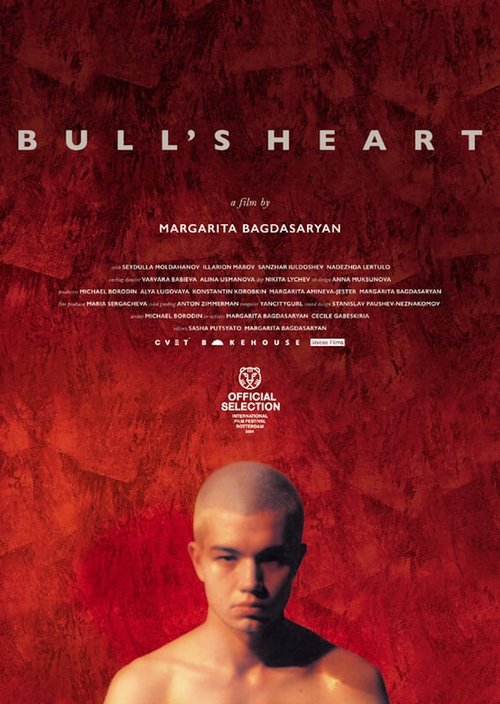
How does the lonely, hard-working father’s relationship with his son shape the story of Bull's Heart?
Who is the son secretly in love with in Bull's Heart, and how does that relationship affect his choices?
What kind of father is the main father character in Bull's Heart, and why is he so central to the film’s emotional conflict?
How does Bull's Heart portray the son’s internal conflict between love and family responsibility?
What specific scenes or interactions reveal the emotional distance between the father and son in Bull's Heart?
Should I watch it?
Ask Your Own Question

What is the plot?
Bull is a two-year-old Staffordshire Bull Terrier mix living with his human family in Chicago. From the first moments of the story he displays a compulsive habit of humping anything that draws his attention, an impulse that earns him exasperated scolding from people and bemused tolerance from his canine companions. He shares the neighborhood with Rocco, a proud British-accented boxer who carries himself like a gentleman; Fetch, a dachshund with influencer ambitions who practices poses and angles; and Lucky, a rough-and-tumble Jack Russell who revels in pain and obliviousness. All three of Bull's friends have already been neutered and bear the quiet scars of that procedure, which turns them into targets for the scorn of Sterling, an aloof, self-important Borzoi show dog who preens in front of his handlers. Bull also keeps company with his neighbor Honey, a graceful Borzoi show dog; Bull harbors a nervous crush on her but lacks the nerve to confess his feelings.
One morning Bull notices his owners fussing over him in ways that set his alarm bells ringing: they present special treats, offer toys, and serve him Kool-Aid–flavored toilet water. The same sequence had preceded the neutering of Luther, a Great Dane who previously underwent the operation, and Bull interprets the attention as a prelude to losing his intact status. Panic and dread take over; he lashes out at the comforts and the friends who try to soothe him, and, fearful of the impending surgery, he bolts from his home into the city streets to avoid being sterilized.
Bull's flight leads him into a dangerous urban backlot where a large clowder of feral alley cats confronts him aggressively. The cats surround him, yowling and swiping, and Bull finds himself cornered. Before the conflict escalates, Rocco, Fetch and Lucky locate Bull and come to his rescue. They break up the cat encirclement through a chaotic scramble of bites, barks and frantic dodging; Rocco uses his size and stance to intimidate the felines, Fetch distracts them by darting between legs, and Lucky charges headlong into the fray. The four dogs manage to extricate Bull and retreat from the alley cats' territory, bruised, scolding one another for reckless choices and reconciled by the narrowness of their escape.
Having survived the scuffle, Bull decides he must face his fate and return home for the scheduled surgery. Rocco, however, persuades him to make the most of the hours left before the operation: they will give Bull one last night of freedom so that he can have memories of being intact. The group agrees to a string of raucous nocturnal adventures that take them across different neighborhoods and venues.
Their first caper is an impromptu infiltration of a prestigious dog show where Honey competes alongside Sterling. The dogs slip past handlers and security in a sequence of coordinated misdirection: Fetch creates a diversion by strutting in front of the judges' table with ludicrous confidence, Lucky slips into the grooming area and releases a cloud of powder to obscure cameras, and Rocco and Bull weave through the racks of ribbons. Inside the ring, Honey moves with poise and Sterling displays commanding showmanship; Bull, seeing Honey under the lights, at last summons the courage to step forward and tell her that he is attracted to her. Honey hears Bull's confession but the show continues: the judges announce Sterling and Honey as the winners in a paired category, and Sterling basks in the triumph. Bull, wounded by the sight of Honey and Sterling declared victors, slips away from the ring to lick his emotional wounds.
The group then visits The Humphouse, an after-hours, dog-friendly venue that functions like a canine equivalent of a strip club. The club operates with raucous energy: lights pulse, a DJ booth thumps bass, and dogs of many breeds crowd around as performers display physical feats that draw howls and applause. Lucky meets Frankie, the club's imposing Dobermann bouncer who presents with an intersex body, and Lucky becomes infatuated at first sight. The two dogs form an awkward, affectionate bond in which Lucky worships Frankie's toughness and Frankie tolerates Lucky's adoration with dry amusement.
At The Humphouse Bull catches the eye of Molasses, a striking red Borzoi whose style and manner remind him of Honey. Molasses pursues Bull with an explicit, targeted attention: she flatters him, draws him onto a secluded balcony area behind the club, and distracts him with whispered promises that cater to his impulse to feel wanted. While Lucky blissfully pursues a tentative romance with Frankie, Bull spends time with Molasses in private. During this period Honey, who has abandoned the official show to search for Bull, stumbles upon Bull and Molasses in this private space and confronts him with anger and betrayal. The encounter escalates into a heated argument: Honey presses Bull on whether he betrayed his feelings for her, Bull tries to explain that he was vulnerable and confused, and Molasses withdraws with a satisfied, aloof smirk.
The confrontation ends abruptly when animal control officers, tipped off about suspicious canine activities around town, arrive and begin picking up dogs. The officers capture Bull, Honey and several others, placing them in cages and transporting them to the municipal dog pound. At the pound the dogs are processed, photographed and scanned for microchips. The staff contact the registered owners associated with Honey's microchip, and her owners arrive to retrieve her after confirming her identity. Honey's release from the pound leaves the other dogs still confined and facing uncertain fates in the kennels.
While incarcerated, Bull and his companions learn that because Honey and Sterling are winners of the dog show event together, Honey's handlers expect her to breed with Sterling as part of show-breeding plans. Bull realizes that Honey's victory with Sterling will lead to a controlled mating that could produce puppies, and that outcome makes him frantic and desperate: he cannot accept the idea of Honey pairing with Sterling under human direction. That evening Rocco spearheads a breakout plan. The dogs cooperate to create a diversion: Fetch manipulates a cooling fan into blowing open a door by nudging its control, Lucky gnaws through a seam in the kennel bars with surprising persistence, and Bull uses his weight to push a stacked cart into a security gate. The mixed improvisation allows the group to slip past stunned attendants and flee the pound.
After their escape the dogs race through back alleys toward Bull's house, trying to determine how to stop Honey and Sterling from being paired. Lucky, however, separates from the group en route in order to reunite with Frankie, who has been released from the club's temporary holding pen by a sympathetic human staff member. Lucky and Frankie leave together toward the club, exchanging goofy grins and clumsy declarations, while Bull, Rocco and Fetch continue on toward Bull's neighborhood.
On returning to the residential block, Bull discovers Honey preparing to be taken by handlers who intend to proceed with the mating arrangements. Bull physically interposes himself between Honey and Sterling to block their handlers and prevent the anticipated pairing. The human handlers try to force a separation; Sterling, focused on the process and confident in his show-dog superiority, reacts with forceful mounting behavior aimed at Honey. In the confusion of the scuffle, a case of mistaken identity occurs when Sterling engages with the wrong animal in the press of bodies--Sterling performs the action he intends for Honey upon Bull instead. The moment is chaotic and humiliating for Bull; he endures the assault, then steps away and apologizes to Honey, telling her he loves her and that he is sorry for letting events spin out of control. Honey, shaken, listens to Bull's admission. After the confrontation, Bull withdraws from the scene and goes home, emotionally raw and uncertain.
Later that night Honey seeks Bull at his family's property and leads him up into a backyard treehouse. There, away from handlers, flashing lights and public scrutiny, Honey and Bull exchange direct, unguarded declarations: Honey tells Bull that she loves him in return, and he confesses the depth of his feelings and his fear of losing what they have. The two dogs share a private moment together in the treehouse. Following the night in the treehouse, human schedules resume: despite Bull's resistance and the interventions of his friends, he is brought to a veterinary clinic and undergoes the neutering operation he had tried to avoid. The procedure takes place under sedation, the staff conduct standard prep and surgery, and Bull wakes afterward to groggy, tender discomfort. His owners carry him home and tend to his incision.
Three months after the events surrounding the pound and the dog show, Bull and Honey appear together with a pack of thirteen puppies. The puppies' arrival confirms that a litter has been born and that Bull and Honey are the parents. The newborns fill the household and the neighborhood with the pandemonium of feeding, sleeping and play. The dogs who once worried about sterility now contend with the responsibilities and chaos of a large brood. Meanwhile Sterling discovers that he, too, will be neutered by his handlers; the realization terrifies him and he reacts with indignation and dismay while Luther, who previously underwent the procedure without much fuss, mocks Sterling's squeamishness.
In the time after Bull's surgery and the birth of the puppies, the group's social life returns to a kind of routine punctuated by spectacle. Honey, accompanied by a clique of female friends from the show circuit, visits The Humphouse to view a headline act: a grizzly bear performer executes a twerking routine that elicits raucous howls and applause from the audience. The spectacle delights the assembled crowd; Bull, Rocco, Fetch and Lucky watch with astonishment and a mixture of amusement and disbelief. The story ends with these scenes of domestic chaos and night-club revelry--Bull healed from his surgery, Honey at his side with their large litter, Rocco and Fetch providing companionship, Lucky in a contented relationship with Frankie, and Sterling facing a scheduled neutering that undermines his previous haughtiness. No human or canine character dies during the events portrayed in the narrative; the conflicts resolve into new domestic arrangements, punctuated by the comedic and sometimes painful realities of urban dog life.
More Movies Like This
Browse All Movies →

What is the ending?
Bull's Heart appears to be a documentary rather than a narrative feature, so there is no fictional "ending" with character fates to summarize in the way a story film would have. The available information describes it as a film about Dimitris Papaioannou and his company shaping a poetic performance, with the emphasis on rehearsal, anxiety, trust, loss, and creation.
Expanded version:
The film's ending is not presented as a plot twist or a final conflict resolution. Instead, it closes within the world of rehearsal and performance-making, where the company has been working through movement, uncertainty, and artistic trust. The final movement of the film sits in the space between labor and creation, showing the performers and Papaioannou continuing the process of turning loss into art.
Scene by scene, the ending stays rooted in the rehearsal environment. The company remains inside the demanding atmosphere of making the performance, where bodies are tested, adjusted, and shaped through repeated effort. The emotional tone is controlled but fragile, with the film highlighting anxiety, uncertainty, and the trust required among the people involved. Rather than concluding with a dramatic incident, the film appears to end by preserving the atmosphere of creation itself.
Dimitris Papaioannou's fate at the end is not death or disappearance, but continuation: he remains within the artistic process as the central creative presence. The company's fate is likewise not a story resolution but a shared completion of a work in progress, with the film emphasizing that they are carrying loss into form and turning it into performance. The ending leaves the characters in the act of making, rather than in a finished narrative conflict.
Is there a post-credit scene?
No reliable result in the provided sources confirms a 2023 film titled Bull's Heart or Bullx27s Heart, so I can't verify whether it has a post-credit scene.
The search results do include information about a different film, Bull (2021), and that source says it does not have any post-credits scene. They also include unrelated results for other movies with post-credit scenes, but nothing specific to a 2023 title matching your query.
If you meant a different movie title, send the exact title and I can check that specific film.
How does the lonely, hard-working father’s relationship with his son shape the story of Bull's Heart?
The father's emotional distance and daily labor create the central tension of the film, with the son's hidden love intensifying the family's private grief and restraint. Their relationship appears to unfold through small, charged moments rather than direct confrontation, making the father's fatigue and the son's secrecy equally important to the drama.
Who is the son secretly in love with in Bull's Heart, and how does that relationship affect his choices?
The son's secret love is one of the story's key plot drivers, because it places his private desire against the pressure of family duty and the father's hard-working, emotionally closed world. His decisions are shaped by concealment, longing, and the risk that exposure could disrupt the family's fragile balance.
What kind of father is the main father character in Bull's Heart, and why is he so central to the film’s emotional conflict?
He is presented as a lonely, hardworking man whose life is defined by labor and endurance, which makes him both physically grounded and emotionally inaccessible. His centrality comes from the way the son's secret life seems to unfold in the shadow of his silence, creating a quiet but severe emotional divide.
How does Bull's Heart portray the son’s internal conflict between love and family responsibility?
The son is caught between private devotion and the weight of his place in the household, and that tension gives the story its emotional force. His internal conflict is likely expressed through restrained behavior, hesitation, and the painful need to keep part of himself hidden from his father.
What specific scenes or interactions reveal the emotional distance between the father and son in Bull's Heart?
The story's emotional distance is conveyed through their shared domestic and work routines, where physical proximity does not translate into intimacy. Scenes likely emphasize quiet observation, unspoken tension, and the contrast between the father's labor and the son's hidden emotional life, making their separation feel present even when they are together.
Is this family friendly?
Bull's Heart appears to be a short documentary about Greek choreographer Dimitris Papaioannou and his creative world, not a conventional narrative family film. Based on the available information, it does not look like it has explicit sex, graphic violence, or strong profanity listed in the sources, but it does appear to be more of an art-house or mature documentary than a child-oriented title.
Potentially upsetting or not-family-friendly aspects for children or sensitive viewers may include: - Abstract or surreal imagery tied to stage performance, which could be unsettling for younger children. - Mature artistic themes and a documentary format focused on an adult creator's work rather than light entertainment. - Possible emotionally intense or unusual imagery associated with contemporary performance art, though the available sources do not list specific graphic content.
I would treat it as not clearly family-friendly for young children and recommend parental discretion, especially for kids who are easily startled by surreal visuals or slower, more adult art-documentary pacing.









