



Popular
What is the significance of the character Giorgio Gaber in the film?
How does the film depict the relationship between Gaber and his contemporaries?
What role does music play in the development of Gaber's character?
How does the film portray Gaber's struggles with censorship and artistic freedom?
What is the significance of the setting in which Gaber performs his music?
Should I watch it?
Ask Your Own Question

What is the plot?
Io, noi e Gaber is not a fictional 2022 narrative at all but a 2023 documentary portrait of Giorgio Gaber, so there is no true death-filled plot, no murder mystery, and no conventional climax to spoil in the way a drama or thriller would. The film instead unfolds as a reflective journey through Gaber's life, work, and legacy, moving through Milan and Viareggio and assembling its story from memories, testimony, and performance rather than from fictional events.
The film opens in a mood of reverence and remembrance, immediately establishing that what follows is a portrait built from fragments of a life that continues to resonate. Riccardo Milani shapes the documentary as an intimate and collective act of recall, using the voices of those who knew Giorgio Gaber best to reconstruct the man behind the public figure. The first emotional anchor is Dalia Gaberscik, Gaber's daughter, whose presence gives the film its most personal thread. She speaks not as an analyst but as someone carrying the weight of inheritance, and the film lets her reflections guide the viewer into the private world of her father. Around her, the documentary gathers those who were closest to him over the years, creating a sense that the film is less a single story than a chorus of memories returning to the same figure from different angles.
From there the narrative drifts into Milan, one of the two principal cities that shape the film's geography and emotional structure. Milan is not merely a setting but a memory-laden landscape, a place tied to Gaber's artistic formation and to the urban Italy that helped define his sensibility. The camera and testimonies evoke the city as both professional stage and emotional home, a place where his public identity took shape and where the restless intelligence of his work was nourished. The documentary emphasizes that Gaber is not remembered only as a singer, but as an artist who kept changing form, moving from popular music into the more intellectually and theatrically demanding space of teatro canzone. That shift is treated as one of the central revelations of his artistic life: Gaber refuses to remain what the industry wants him to be, and instead becomes something more singular, more difficult, and ultimately more lasting.
The film deepens this portrait by moving to Viareggio, the other key location in the story. If Milan represents creation, public life, and artistic ambition, Viareggio carries the atmosphere of retreat, intimacy, and personal history. The contrast between the two places gives the documentary its emotional rhythm. In Viareggio, the film seems to slow down and breathe, allowing the recollections of those around Gaber to become more tender and contemplative. The places themselves appear to hold traces of him, and the documentary uses that sense of inhabited geography to suggest that a life is not only made of achievements but also of recurring spaces, habits, and relationships. The result is a portrait built from presence rather than from plot: the viewer feels less that events are happening than that a life is being carefully reassembled.
As the documentary continues, it broadens from the private voice of Dalia Gaberscik into a wider ensemble of artists, collaborators, and admirers. The film includes figures such as Ombretta Colli, Claudio Bisio, Ivano Fossati, Ricky Gianco, Paolo Jannacci, Lorenzo Jovanotti, Mogol, Vincenzo Mollica, Gianni Morandi, Massimiliano Pani, Fabio Fazio, Michele Serra, Pier Luigi Bersani, Mario Capanna, Guido Harari, Paolo Dal Bon, and others, all appearing as themselves. Their contributions do not function like plot twists; instead, they gradually expand the emotional and intellectual scale of the film. Each voice adds another facet of Gaber's character, another angle on his humor, discipline, restlessness, and artistic courage. The effect is cumulative. What emerges is not a hidden secret but a deepening recognition that Gaber occupied a rare place in Italian culture: he was both widely beloved and artistically uncompromising, both popular and exacting, both intimate and political.
One of the documentary's strongest movements is its attention to Gaber's transformation from successful entertainer into a figure of theatrical and civic significance. That shift is not presented as a betrayal of the audience but as an act of artistic necessity. The film repeatedly returns to the idea that Gaber did not want to be trapped by success or repetition. He pushes toward a form where words, music, and stage presence merge into a single expressive force. This becomes the film's real dramatic center: not a conflict between characters, but a conflict between comfort and artistic truth. The people speaking about him remember a man who demanded honesty from himself and from the culture around him. In their recollections, his work becomes a response to the exhaustion of slogans and the emptiness of easy consensus.
Because the documentary is built from testimony, the emotional peaks come in the moments when individual voices sharpen into admiration, grief, or astonishment. When the participants speak about Gaber's intelligence or his precision, the film lets those remarks land with the force of revelation. The viewer is invited to understand that his importance lies not only in what he performed, but in how he thought and how he listened. There is no conventional antagonist in the film, yet there is tension in the way the archive of memory resists simplification. The speakers do not merely praise him; they reconstruct the difficulty of being near a person who continually insisted on deeper meanings. That tension gives the documentary momentum, making it feel alive even in the absence of a fictional plot.
The title itself, Io, noi e Gaber, reflects the film's structure. "Io" points to the individual self, the singular artist and the private man. "Noi" suggests the collective, the audience, the friends, the collaborators, the country that received him. "Gaber" is the figure who stands between those poles, transforming personal experience into shared cultural language. The documentary gradually reveals that this triangle is the film's true argument. Gaber cannot be reduced to biography alone, because his art was always about the relationship between self and society. That is why the film feels both intimate and civic. It is a remembrance of a man, but also a meditation on the kind of public voice that can still speak to private life.
No deaths occur in the documentary's present-tense story, and there is no sequence of violent confrontations or criminal outcomes. The film's emotional weight comes instead from absence: the absence of Gaber himself, the absence of the living encounter that can no longer happen, and the gap between memory and presence. That absence becomes especially poignant as the testimonies accumulate. The speakers do not merely describe a famous artist; they seem to reach for someone still felt in language, gesture, and attitude. The documentary's climax is therefore not a shocking event but a deepening recognition of endurance. Gaber's voice, even when mediated through others, remains active. His work survives not as museum material but as something that still troubles, provokes, and accompanies.
Toward the end, the film gathers its threads into a sustained elegiac feeling. The Milan/Viareggio geography becomes less about movement and more about return, as though the documentary is circling back through the same emotional places to show how a life can continue to reverberate after death. The participants' recollections, the archival textures, and the careful pacing all build toward a final sense that Gaber's legacy is communal. He belongs not only to those who knew him personally but to the broader cultural memory of Italy. The final scenes do not resolve a mystery; they affirm an inheritance. The film closes with the sense that Gaber's art remains unfinished in the best possible way, because it continues to be interpreted, quoted, and felt by others.
So the complete "spoiler" is that there is no hidden twist, no murderer, no last-minute betrayal, and no character deaths to expose. The documentary ends by honoring Giorgio Gaber as an artist whose life moved from music into teatro canzone and whose memory persists through the people who loved, worked with, and admired him. Its final resolution is emotional rather than dramatic: the film leaves the viewer with a fuller sense of a man who transformed Italian performance culture, and with the quiet conviction that his voice still belongs to the present.







What is the ending?
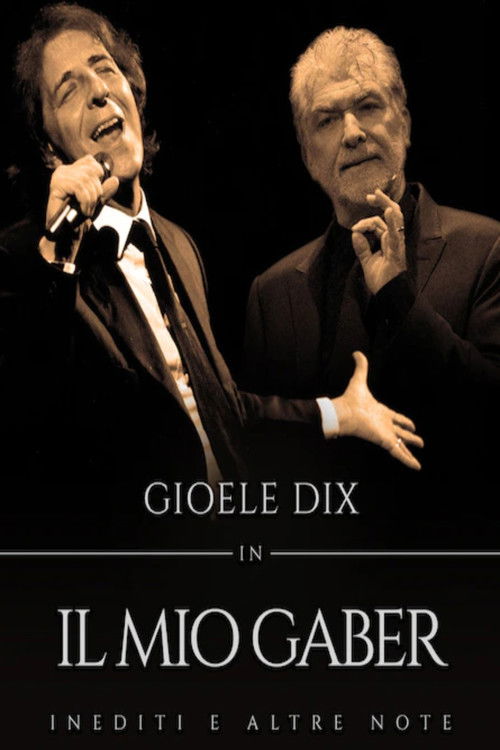
In the ending of "Il mio Gaber," the protagonist reflects on the legacy of Giorgio Gaber, culminating in a poignant performance that encapsulates his journey and the impact of Gaber's work on his life. The film concludes with a sense of closure and appreciation for the power of music and art in shaping identity and understanding.
As the final scenes unfold, the protagonist stands alone on a dimly lit stage, the atmosphere thick with anticipation. The audience is hushed, their faces illuminated by the soft glow of the stage lights. He takes a deep breath, his heart racing as he prepares to deliver a performance that is both a tribute and a personal catharsis. The weight of his journey is palpable; he has grappled with his own identity, the influence of Gaber's music, and the struggles of his past.
The first notes of the song fill the air, and he begins to sing, his voice trembling with emotion. Each lyric resonates deeply, reflecting his internal conflicts and the lessons he has learned. As he performs, flashbacks intersperse the scene, showing moments from his life where Gaber's music provided solace and clarity. We see him as a young man, lost and searching, discovering Gaber's work for the first time, and how it sparked a flame of inspiration within him.
The camera pans to the audience, capturing their reactions--some are moved to tears, others nod in recognition, and a few smile, recalling their own connections to Gaber's music. The protagonist's performance becomes a bridge between generations, uniting people through shared experiences and emotions.
As the song reaches its climax, he pours every ounce of his being into the final notes, his voice soaring with passion. The stage lights brighten, casting a warm glow over him, symbolizing his acceptance of his past and his embrace of the future. The audience erupts into applause, a standing ovation that echoes through the venue, affirming the power of art to heal and connect.
In the aftermath of the performance, the protagonist steps off the stage, visibly shaken yet exhilarated. He is met by friends and family who embrace him, their faces beaming with pride. This moment signifies not just a personal victory but a collective celebration of Gaber's legacy and the impact of music on their lives.
As the credits roll, we see glimpses of the protagonist continuing to share Gaber's music with others, teaching and inspiring a new generation. The film closes on a hopeful note, emphasizing the enduring influence of art and the importance of remembering those who have shaped our lives. Each character, from the protagonist to the audience members, leaves with a renewed sense of purpose, carrying forward the spirit of Gaber's message.
Is there a post-credit scene?
In the movie "Il mio Gaber," produced in 2022, there is indeed a post-credit scene that adds a poignant touch to the film's exploration of the legacy of Giorgio Gaber.
As the credits roll, the screen fades to black before transitioning to a dimly lit stage reminiscent of a small theater. The atmosphere is charged with nostalgia, and the faint sound of applause can be heard in the background. The camera slowly zooms in on an empty microphone stand at center stage, symbolizing Gaber's enduring presence in the world of music and theater.
Suddenly, a spotlight illuminates the stage, revealing a young musician, inspired by Gaber's work, who steps forward with a guitar slung over his shoulder. He appears nervous yet determined, embodying the spirit of a new generation influenced by Gaber's artistry. The musician begins to strum a few chords, and the audience can feel the weight of expectation and hope in the air.
As he starts to sing a reimagined version of one of Gaber's iconic songs, the lyrics reflect themes of love, freedom, and social commentary, echoing Gaber's own style. The young artist's voice is filled with emotion, capturing the essence of Gaber's influence while also infusing it with his own contemporary perspective.
The scene conveys a sense of continuity, illustrating how Gaber's legacy lives on through new artists who draw inspiration from his work. The camera pans out, showing the empty theater gradually filling with an audience, symbolizing the timeless connection between Gaber's music and the hearts of those who continue to seek meaning in it.
As the musician finishes his performance, the applause grows louder, and the screen fades to black once more, leaving viewers with a sense of hope and the reminder that art transcends time, continually inspiring future generations.
What is the significance of the character Giorgio Gaber in the film?
Giorgio Gaber is portrayed as a pivotal figure whose music and philosophy deeply influence the narrative. His character embodies the struggles and aspirations of the Italian people during the socio-political changes of the 20th century. The film explores his journey as an artist, highlighting his internal conflicts and the impact of his work on society.
How does the film depict the relationship between Gaber and his contemporaries?
The film illustrates Gaber's interactions with other artists and intellectuals of his time, showcasing both camaraderie and rivalry. These relationships are marked by mutual respect and occasional tension, reflecting the competitive nature of the artistic landscape in Italy during the era.
What role does music play in the development of Gaber's character?
Music serves as a vital expression of Gaber's emotions and thoughts throughout the film. Each performance is a window into his psyche, revealing his struggles with identity, societal expectations, and personal beliefs. The film uses musical sequences to convey his evolution as an artist and a person.
How does the film portray Gaber's struggles with censorship and artistic freedom?
The film delves into Gaber's confrontations with censorship, illustrating the challenges he faces in expressing his views through music. These moments are charged with tension, showcasing his determination to maintain artistic integrity despite external pressures, which adds depth to his character.
What is the significance of the setting in which Gaber performs his music?
The settings of Gaber's performances are carefully chosen to reflect the cultural and political climate of the time. From intimate venues to larger stages, each location enhances the emotional weight of his songs, allowing the audience to connect with the historical context and the personal stakes involved in his artistry.
Is this family friendly?
"Il mio Gaber," produced in 2022, is a biographical film that explores the life and artistic journey of the iconic Italian singer-songwriter Giorgio Gaber. While the film is primarily a tribute to Gaber's music and philosophy, it does contain some themes and scenes that may be sensitive for children or those who are particularly sensitive.
-
Themes of Existentialism: The film delves into deep philosophical questions about life, identity, and societal issues, which may be complex for younger viewers to fully grasp.
-
Emotional Struggles: There are scenes depicting Gaber's personal struggles, including moments of sadness and introspection that may evoke strong emotions.
-
Social Commentary: The film addresses political and social issues, which may include references to conflict, injustice, and societal disillusionment that could be upsetting for some viewers.
-
Mature Language: There are instances of strong language and adult themes that may not be suitable for younger audiences.
-
Depictions of Loss: The narrative includes elements of loss and grief, which could be distressing for sensitive viewers.
Overall, while "Il mio Gaber" is a celebration of art and music, its exploration of complex themes and emotional depth may require parental guidance for younger audiences.