











Popular
What is the significance of the sky in the movie Over the Sky?
How does Yuna's relationship with her father evolve throughout the film?
What role does the character of the mysterious boy play in Yuna's journey?
What challenges does Yuna face in her quest to reach the sky?
How does the theme of friendship manifest in Yuna's interactions with other characters?
Should I watch it?
Ask Your Own Question

What is the plot?
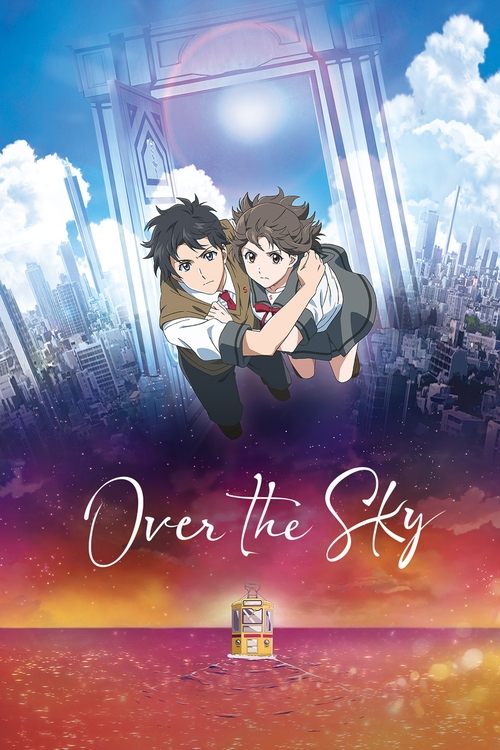
At Ikebukuro's school, Over the Sky opens as a quiet, almost fragile coming-of-age story before it tips into fantasy. Mio Miyamasu is a high-school girl who drifts through classes and afternoons with her childhood friend Arata Kishimo and her best friend Madoka, but beneath the casual routine Mio is already carrying the private weight of first love. She likes Arata, yet every time she thinks about saying it out loud, fear clamps down on her chest: if she confesses, she might destroy the easy three-person friendship they have built over years.
The first important emotional fracture arrives when Madoka tells Mio that she also likes Arata. Mio is stunned into silence, then into panic. Instead of being able to admit what she feels, she swallows it down and lies, telling Madoka she will help instead of competing. That lie becomes the story's first major turning point, because from that moment Mio begins to act colder toward Arata, as if distance can protect everyone from the mess of truth. The result is only more pain: the three friends' balance starts to crack, and Mio's own guilt grows heavier by the day.
Mio and Arata spend time together in Ikebukuro, moving through the ordinary city spaces that define their shared world, and one day they visit a fortune-telling shop. There, Arata notices something no one else can see: several strange white orbs drifting in the air. The moment carries a faint, eerie charge, as if the film briefly lets the audience glimpse a hidden layer beneath the everyday city. Arata reacts abruptly, grabbing Mio and pulling her out of the tent before she can understand what is happening. Mio, already raw from confusion and jealousy and the pressure of Madoka's confession, takes his behavior as another sign that he is shutting her out. She scolds him, hurt and angry, and then runs off before he can explain himself.
That argument becomes the film's second emotional break. Mio goes home upset, then sits alone with the pain she has created for herself. She knows she must repair things, and the need to apologize blends with a stronger, more dangerous impulse: she wants to confess her love to Arata before the distance between them becomes permanent. The evening atmosphere shifts as rain begins to fall, turning Ikebukuro's familiar streets into slick reflections of neon and streetlight. Mio leaves to meet Arata in the pouring rain, determined to make things right, and in that moment the story's emotional realism and supernatural fate collide.
On the way, Mio is struck by a car in a traffic accident. The film treats the crash as the decisive rupture: one instant she is a girl rushing through rain toward a boy she cannot bring herself to lose, and the next she is severed from normal life. No major named character dies in the available plot summaries, and the accident is presented as the life-threatening event that triggers the fantasy plot rather than as a confirmed death. This is the closest the story comes to mortality in the explicit summaries, and it is the force that sends Mio across the boundary between worlds.
When Mio regains consciousness, she expects something familiar, but the world around her is wrong in ways that are both subtle and unsettling. At first she thinks she has simply returned to a normal school-day reality, but Arata does not notice her and does not speak to her at all, as if she has become transparent. The strange sense of being out of place intensifies on the train ride home, when the ordinary commuter space becomes a threshold and Mio is abruptly transported into the World Border, a mysterious realm that resembles Ikebukuro but is not the same. The film makes the setting feel hauntingly intimate: the streets, transit lines, and familiar urban textures remain, but something essential is missing, as if the world has been emptied of memory and meaning.
Mio's beloved stuffed animal suddenly comes alive in this world and becomes Gimon, her guide and protector. The moment is whimsical on the surface, but emotionally it lands as comfort and disorientation at once: a childhood object becomes a speaking companion in a place where Mio no longer trusts her own senses. Gimon initially tells her that she can begin a fresh life here and forget everything, but Mio recoils from that possibility because forgetting Arata is exactly what she cannot allow. Her resistance makes the film's central conflict clear. This is not only a journey through a magical afterlife-like place; it is a struggle over memory, identity, and the one feeling Mio has spent the whole story trying not to name.
Before Mio can understand the rules of the World Border, she is stopped by Kiku-chan, a kimono-wearing girl who acts as a guide to the realm's logic. Kiku-chan explains that Mio did not die, but arrived here through an out-of-body experience. That revelation changes the shape of the story. Mio is not a lost soul in a vague fantasy afterlife; she is separated from her body, and the human world still exists beyond the boundary. Kiku-chan also tells her the crucial mechanism of return: Mio needs a train ticket and the inner desire to go back to the human realm. The ticket is a literal object, but the desire is something much more difficult. It means Mio must recover what she truly wants, not merely what she thinks she should want. The film thus turns the supernatural quest into an emotional one, where memory and self-knowledge are the real locks on the door home.
Mio reaches out across worlds, and the story answers with one of its strangest and most important bridges. She contacts Arata, and he mysteriously answers while at a hospital visiting Mio's unconscious body. The scene confirms the split between body and spirit and deepens the romance under the fantasy: Arata is still tethered to her even when she is separated from herself. At the hospital, Arata stands beside the girl's motionless body, confronted by the physical proof of the accident and the emotional absence it has created. His presence there sharpens the urgency of the quest. Mio is alive somewhere else, but the body he knows is still lying helpless in a hospital bed.
As Mio moves through the World Border with Gimon and Kiku-chan, the narrative starts to layer revelation on top of revelation. The white orbs Arata saw at the fortune-telling shop now feel less like random supernatural decoration and more like foreshadowing of a hidden boundary that was always there, invisible until the moment it opened. Mio's inability to move forward is no longer just fear of the unknown; it is also fear of the truth she has avoided in ordinary life. She cannot tell the lost-and-found officer at the Forgotten Things Counter the memories she has with Arata, because those memories are too emotionally loaded to speak cleanly. The story externalizes this by making memory itself the currency of escape, and Mio's silence becomes almost physical obstruction. She must articulate what Arata means to her if she wants to return.
The film's world-building sharpens when Mio and Gimon visit the goddess, Mrs. This encounter, mentioned in the plot summary, functions as part of the broader machinery of the World Border and reinforces the sense that this place is governed by rules larger than Mio understands. Even so, the deepest rule remains internal: she must remember what matters most. The story keeps circling back to the same emotional truth, each time in a different form. Mio is not just trying to get back to her body; she is trying to face the feeling she buried when Madoka admitted her own love for Arata. She lied to preserve friendship, but the lie has only prolonged the agony. In the World Border, the cost of that avoidance becomes literalized: if she cannot remember her desire, she may remain trapped and forget everything.
Arata, meanwhile, does not remain safely in the human world. Following Mio's mysterious call, he returns to the fortune-teller for help, and then his soul suddenly leaves his body and arrives in the World Border as well. This is one of the story's major twists, because it proves that the boundary can be crossed from both sides and that Arata is not merely a distant love interest waiting in the hospital. He becomes an active participant in Mio's return, brought into the strange realm through the same supernatural logic that took her away. The emotional stakes rise sharply here: their connection is strong enough to pull him into her world, but not yet strong enough to resolve the pain between them.
At the same time, the Guardian of the World Border, Mogari, appears as a direct obstacle. Even after Mio successfully obtains a ticket from the lost-and-found officer, Mogari prevents her from returning to the human realm. The guardian's role turns the return journey into a confrontation rather than a simple rescue. Mio has the necessary object, but not yet the complete inner clarity needed to use it. The barrier stands between her and the life she left behind, insisting that she must earn the return not through desperation alone but through emotional honesty.
The final stretch of the story becomes a race against forgetting. With help from Gimon, Kiku-chan, and Arata, Mio finally makes her way back toward the human realm, though even then she cannot immediately reunite with her body. The separation is agonizing: she is so close that the shape of home is in front of her, yet the film refuses an easy reunion because the real blockage is still inside her. Arata brings Mio's unconscious body to the cliff where he has a precious memory with her, hoping that the emotional weight of that place will pull her soul back. The cliff scene is visually and emotionally crucial, because it gathers together the entire film's themes in one place: memory, longing, the edge between worlds, and the hope that love can be strong enough to call someone home.
At the cliff, Mio finally understands. Her deepest wish is not simply to survive, and not even merely to return by habit or obligation. What she truly wants is to tell Arata Kishimo that she loves him. This is the revelation the entire narrative has been moving toward: the "desire" Kiku-chan spoke of is not abstract at all but the exact emotion Mio has been suppressing since Madoka's confession and the fortune-teller argument. She remembers it at last with full force, and that remembrance transforms the whole story's logic. The key to going home was never only a train ticket or a supernatural rule. It was honesty. It was Mio accepting that her heart belongs to Arata and that losing the chance to say so would be a greater loss than embarrassment or fear.
With that realization, Mio firmly resolves to return to the human realm. The film gives the decision emotional finality: she no longer hesitates, no longer hides behind the possibility of friendship alone, and no longer allows fear to define what she does next. She succeeds in returning to the human world and reunites with Arata. The ending resolves both the fantasy and the romance in one movement. Mio is back in her body, back from the World Border, and back in the life she almost forgot. Arata is there, not as a distant memory but as the person she can finally face directly.
The final emotional effect is of release after pressure: the story begins with a girl who cannot speak her feelings, passes through a strange world that threatens to erase them, and ends with the confession those feelings were all along preparing for. No named character is confirmed dead in the available summaries, and the only major physical catastrophe is the car accident that sends Mio into the supernatural realm. What the film does instead is stage a near-loss of self, then restore Mio through memory, desire, and love. By the end, the "over the sky" idea from the classroom conversation has become more than a phrase about astronomy; it is the distance Mio crosses to reach the truth about herself and the person she loves.
More Movies Like This
Browse All Movies →


What is the ending?
In the ending of "Over the Sky," the protagonist, a young girl named Yuna, confronts her fears and the reality of her situation. After a series of emotional trials, she finds the strength to face her challenges, leading to a resolution that brings her closer to her family and herself. The film concludes with a sense of hope and renewal as Yuna embraces her journey.
As the final act unfolds, we find Yuna standing at the edge of a vast, open field, the sky above her painted in hues of orange and pink as the sun begins to set. The air is thick with tension, a reflection of her internal struggle. She has just experienced a series of vivid dreams that have forced her to confront her deepest fears and insecurities. The weight of her past decisions hangs heavily on her shoulders, and she feels isolated, grappling with the loss of her mother and the distance that has grown between her and her father.
In a pivotal scene, Yuna recalls a moment from her childhood, where her mother encouraged her to always look up at the sky, reminding her that it is a place of dreams and possibilities. This memory ignites a flicker of hope within her. As she stands there, she takes a deep breath, allowing the warmth of the sun to wash over her, and she begins to walk forward, symbolizing her decision to move past her fears.
The scene shifts to her father, who is at home, surrounded by remnants of their shared past. He is lost in thought, reflecting on the strained relationship with Yuna. He feels the weight of his own regrets and the realization that he has not been there for her as he should have. The camera captures the sorrow in his eyes, a man burdened by the loss of his wife and the emotional distance that has grown between him and his daughter.
As Yuna approaches home, she is met with a sudden storm, the sky darkening ominously. The rain begins to pour, mirroring the turmoil within her. Yet, she presses on, determined to reach her father. The storm serves as a metaphor for the chaos in her life, but it also represents the cleansing that is about to occur.
When Yuna finally arrives home, she finds her father sitting alone, his face illuminated by the flickering light of a candle. The atmosphere is heavy with unspoken words. Yuna hesitates at the door, her heart racing, but she knows she must confront the silence that has enveloped them. She steps inside, and the moment their eyes meet, a wave of emotion crashes over them.
In a powerful exchange, Yuna and her father begin to communicate, breaking down the walls that have kept them apart. They share their grief, their fears, and their hopes for the future. The dialogue is raw and heartfelt, filled with pauses that speak volumes. As they talk, the storm outside begins to subside, the rain softening to a gentle patter, symbolizing the healing process that is taking place between them.
The film culminates in a scene where Yuna and her father step outside together, the clouds parting to reveal a clear sky filled with stars. They stand side by side, looking up, and for the first time in a long while, they feel a sense of connection and understanding. Yuna's face lights up with a smile, and her father, too, begins to smile, the weight of their shared grief lifting slightly.
In the final moments, the camera pans up to the sky, capturing the vastness above them, a reminder of the dreams and possibilities that lie ahead. The film closes on this hopeful note, leaving the audience with a sense of renewal and the understanding that while the past cannot be changed, the future is still unwritten, filled with potential for healing and growth.
Yuna's journey has led her to a place of acceptance, and her father, too, has taken the first steps toward reconciling his own pain. Together, they stand united, ready to face whatever comes next, embodying the film's central themes of resilience, connection, and the enduring power of love.
Is there a post-credit scene?
In the movie "Over the Sky," there is indeed a post-credit scene that adds an intriguing layer to the story. After the main credits roll, the screen fades back in to reveal a serene landscape, reminiscent of the dreamlike world that the protagonist, a young girl named Aoi, often visits.
In this scene, Aoi is seen sitting on a grassy hill, gazing up at the sky, which is painted with vibrant hues of orange and pink as the sun sets. Her expression is one of contemplation and hope, reflecting her journey throughout the film. As she watches the clouds drift by, a familiar figure appears in the distance--her friend, who had been a significant part of her adventures.
The friend approaches, and they share a warm, knowing smile, suggesting a bond that transcends the challenges they faced. Aoi stands up, and together they begin to walk towards the horizon, symbolizing new beginnings and the endless possibilities that lie ahead. The scene captures a sense of optimism and the idea that their adventures are far from over, leaving the audience with a feeling of wonder and anticipation for what might come next.
This post-credit moment encapsulates the film's themes of friendship, resilience, and the beauty of dreams, inviting viewers to reflect on their own journeys and the connections that shape their lives.
What is the significance of the sky in the movie Over the Sky?
In 'Over the Sky', the sky serves as a metaphor for freedom and escape. The protagonist, a young girl named Yuna, often gazes at the sky, dreaming of a life beyond her current struggles. The sky represents her hopes and aspirations, contrasting with the challenges she faces on the ground.
How does Yuna's relationship with her father evolve throughout the film?
Yuna's relationship with her father is strained at the beginning of the film due to his overprotectiveness and her desire for independence. As the story progresses, they face various challenges that force them to communicate and understand each other's perspectives, ultimately leading to a deeper bond and mutual respect.
What role does the character of the mysterious boy play in Yuna's journey?
The mysterious boy, who appears to Yuna in her dreams, acts as a catalyst for her personal growth. He encourages her to confront her fears and take risks, symbolizing the adventurous spirit that Yuna yearns for. His presence challenges her to break free from her limitations and pursue her dreams.
What challenges does Yuna face in her quest to reach the sky?
Yuna faces numerous challenges, including her own self-doubt, the disapproval of her father, and the physical obstacles in her environment. Each challenge tests her resolve and determination, pushing her to confront her fears and ultimately strive for her dreams of freedom and adventure.
How does the theme of friendship manifest in Yuna's interactions with other characters?
Friendship plays a crucial role in Yuna's journey, particularly through her interactions with her peers. They provide support and encouragement, helping her to navigate her struggles. Their camaraderie highlights the importance of connection and solidarity in overcoming personal challenges.
Is this family friendly?
"Over the Sky," produced in 2020, is generally considered family-friendly, but it does contain some scenes that may be potentially objectionable or upsetting for children or sensitive viewers.
-
Emotional Turmoil: The film explores themes of loss and longing, which may evoke strong emotions. Characters experience sadness and moments of despair that could be intense for younger viewers.
-
Conflict and Tension: There are scenes of conflict that may create tension, including arguments and misunderstandings between characters. These moments could be distressing for sensitive audiences.
-
Mild Peril: Some scenes may involve characters in situations of danger or distress, which could be unsettling, particularly for younger children.
-
Themes of Isolation: The film touches on feelings of isolation and loneliness, which might resonate deeply and could be upsetting for some viewers.
Overall, while the film is suitable for a family audience, parents may want to consider these elements when deciding if it is appropriate for their children.









