


Popular
What are the main challenges Bert Visscher faces throughout the film?
How does Bert's relationship with his family evolve in the film?
What role does humor play in Bert's coping mechanisms?
How does Bert's character develop from the beginning to the end of the film?
What specific events trigger Bert's moments of self-reflection in the film?
Should I watch it?
Ask Your Own Question

What is the plot?
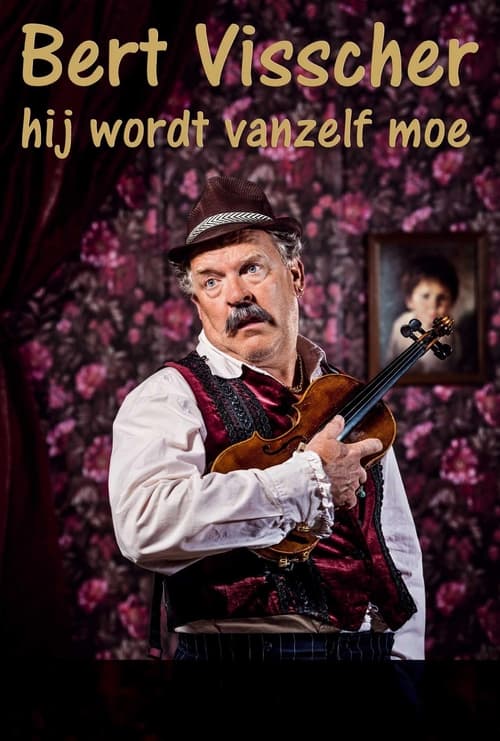
Bert Visscher: Hij wordt vanzelf moe is not a conventional narrative film but a cabaret special built around a loose story frame, so the "plot" is really a comic escalation of one absurd crisis after another. It opens in Groningen, where the show is recorded live in September 2021, and the audience is dropped into the world of the Tokko Pepetto family, whose brightly colored woonwagenkamp stands on land that is suddenly needed for redevelopment.
The first image is one of domestic precariousness: three vividly painted caravans sit together like a tiny fortress, and Bert Visscher appears as Tokko Pepetto, the loud, frantic patriarch who refuses to let the camp be pushed aside. The threat is absurdly specific and therefore perfect for Visscher's style--an industrial project is coming, described in different accounts as a strijkijzerfabriek, strijkijzerhandel De Uitstrijk, or a factory tied to windmill construction, and it is meant to take over the very ground where the family lives. That single ridiculous premise immediately creates the tension that powers the entire special: the Pepetto family is "home," but the world around them insists that this home should not exist there at all.
Tokko Pepetto reacts with a mixture of outrage, panic, and stubborn comedy. He is not a calm resister; he is a man who seems to be inventing his own disaster in real time, then sprinting to keep up with it. The show keeps returning to the same basic contradiction: zigeuners are supposed, in Visscher's comic logic, to live on the move, yet Tokko is now fighting desperately for a fixed place to stay. That contradiction becomes one of the running jokes of the frame story, and it also gives the special its emotional engine. The camp is not just a collection of caravans; it is identity, family memory, and a stage for chaos all at once.
As the conflict becomes clearer, the family's response hardens into open resistance. The Pepettos do not quietly negotiate or pack up; they come "in verzet," and the show treats that resistance as a full comic campaign. Tokko's world is filled out by supporting figures who appear and disappear through the caravans, especially the flamenco dancer Rosita, described as a hardened, weathered performer who adds glamour and extra absurdity to the already overstuffed camp. Two assisting actors help Bert Visscher populate the world, but the reviews make clear that they serve mainly to support his whirlwind performance rather than anchor the story on their own.
The special keeps widening from the central land dispute into a parade of Visscher-style digressions, and those digressions become part of the narrative rather than interruptions from it. Visscher breaks character and speaks as himself, talking about his diving adventures on Bonaire and his affection for the TV show Ik vertrek. These detours do not change the basic plot, but they deepen the sense that the entire special is about people who keep trying, badly and heroically, to manage forces larger than themselves. In that way, the camp's fight against the factory becomes one more example of the same universal Visscher theme: order is impossible, and yet everyone keeps pretending they can impose it.
The visual world stays centered on the set. The three woonwagens are the key physical objects in the story, and the action repeatedly flows in and out of them, making the stage feel like a tiny village under siege. The set gives the impression that the Pepettos are constantly being cornered, whether by the factory project or by each other's exaggerated tempers and catastrophes. Because this is a cabaret special, the conflict never settles into a single line of cause and effect; instead, it spreads sideways into comic anecdotes, character bits, and escalating farce.
At the heart of the frame story is the idea that the family is trying to return home even though home has become impossible. That contradiction is what makes the premise funny and sad at the same time. Tokko Pepetto speaks and behaves as if the camp should obviously belong to him, while the outside world treats the site as an ordinary plot of land ready to be repurposed. The result is a showdown without weapons, where the stakes are displacement, dignity, and the right to remain ridiculous in a place that is no longer theirs on paper.
As the evening goes on, the crowd of "old acquaintances" and oddball figures grows, and the special becomes less about whether the Pepettos can truly save the camp than about how spectacularly they can fail while trying. Rosita's appearances add heat and theatricality, and the family's reactions keep bouncing between melodrama and slapstick. The reviews emphasize that Visscher is "trying to save what is basically no longer saveable," and that phrase captures the arc of the special perfectly. Nothing about the situation becomes rational; if anything, every new attempt to solve it only makes the mess bigger.
The most important revelation is not a secret hidden in a twist, but the full shape of the absurd conflict itself: the Pepetto camp is being squeezed out by a development project that treats their lives as an inconvenience. Once that is established, every later scene becomes a variation on the same theme. The family does not discover a hidden traitor, a buried document, or a shocking betrayal; instead, the revelation is that the system has already moved against them, and all that remains is the comic theater of resistance. That is why the special can keep spinning out without needing a classic dramatic payoff. The farce is the payoff.
There are no confirmed deaths in the special, and no source describing the show reports a murder, fatal accident, or concluding body count. Likewise, there is no evidence of a final tragic sacrifice or violent climax; the confrontation is comic, verbal, and theatrical rather than lethal. The tension comes from humiliation, improvisation, and the looming threat of removal, not from bloodshed.
By the end, the special resolves in the only way a Bert Visscher cabaret can: with the chaos still alive and the resistance still unfinished. The Pepettos remain trapped between defiance and absurdity, and Tokko Pepetto continues to rage, bluff, and improvise as if sheer volume might keep the bulldozers away. The final feeling is not one of closure but of endurance. The family has not won in any ordinary sense, and the factory threat has not magically vanished, yet the show ends with the same unruly energy that drives it from the start: a world in which everything is going wrong, everyone is talking too much, and nobody quite knows how to stop the disaster from becoming entertaining.
The final scene leaves the camp's fate effectively unresolved in conventional terms, but emotionally clear in Visscher's comic universe: Tokko Pepetto still stands at the center of the wreckage, refusing to accept that the story is over. That refusal is the real ending. Rather than a clean victory or defeat, the special closes on the stubborn image of people who will keep making noise, keep performing, and keep fighting long after reason has left the stage.



What is the ending?
In the ending of "Bert Visscher: Hij wordt vanzelf moe," Bert confronts his own limitations and the reality of aging. He reflects on his life and career, ultimately finding peace with his choices and the passage of time. The film concludes with a sense of acceptance and a celebration of the moments that have shaped him.
As the final scenes unfold, Bert Visscher stands on stage, the spotlight illuminating his figure against the darkened theater. The audience is captivated, their faces a mix of admiration and nostalgia. Bert, feeling the weight of his years, begins to share stories from his past, weaving humor with poignant reflections. His voice carries a tremor, revealing the vulnerability beneath his comedic exterior.
In a flashback, we see Bert in his younger days, full of energy and ambition. He recalls the laughter and the joy of performing, but also the struggles he faced along the way. The juxtaposition of his youthful exuberance and his current state creates a bittersweet atmosphere. As he reminisces, the audience is drawn into his journey, feeling the highs and lows alongside him.
Transitioning back to the present, Bert pauses, taking a deep breath. He acknowledges the inevitability of aging, the physical toll it has taken on him, and the moments of doubt that have crept in. Yet, there is a warmth in his acceptance. He shares a heartfelt message about cherishing the fleeting moments of life, urging the audience to embrace their own journeys, no matter how challenging.
As the final curtain approaches, Bert's emotional state shifts from one of melancholy to a profound sense of gratitude. He looks out into the audience, his eyes glistening with unshed tears, and expresses his appreciation for their support throughout his career. The applause swells, a thunderous acknowledgment of his impact on their lives.
In the closing moments, Bert steps back from the microphone, allowing the applause to wash over him. He smiles, a genuine expression of contentment, and takes a bow. The lights dim, and the screen fades to black, leaving the audience with a lingering sense of hope and reflection.
The fate of Bert Visscher is one of acceptance and peace. He has come to terms with his past, embracing both the joys and the sorrows that have shaped him. The film ends on a note of celebration, not just of his career, but of life itself, encouraging viewers to find meaning in their own experiences.
Is there a post-credit scene?
In the movie "Bert Visscher: Hij wordt vanzelf moe," there is indeed a post-credit scene that adds a humorous and reflective touch to the film. After the credits roll, the scene opens with Bert Visscher sitting alone in a dimly lit room, surrounded by various props and memorabilia from his career. He appears contemplative, a slight smile playing on his lips as he reminisces about his journey.
As he begins to speak directly to the audience, he shares a light-hearted anecdote from his past, showcasing his signature blend of humor and vulnerability. The camera captures his expressive face, highlighting the warmth in his eyes as he recalls a particularly funny moment from one of his performances. His laughter is infectious, and it feels as if he is inviting the audience into an intimate conversation.
Suddenly, the scene shifts to a playful twist. Bert stands up and pretends to be exhausted, dramatically slumping against a wall, exclaiming, "I told you I would get tired!" This self-referential joke ties back to the film's title and theme, emphasizing his comedic persona. The scene ends with him chuckling, leaving the audience with a sense of connection and joy, reinforcing the film's overall message about the ups and downs of life and the importance of laughter.
What are the main challenges Bert Visscher faces throughout the film?
Bert Visscher encounters various personal and professional challenges that test his resilience and humor. He grapples with the pressures of his career as a comedian, the expectations of his audience, and his own self-doubt. These challenges are depicted through a series of comedic yet poignant moments that highlight his struggles with fatigue and the demands of his profession.
How does Bert's relationship with his family evolve in the film?
Throughout the film, Bert's relationship with his family is explored in depth. Initially, there is a sense of distance as he prioritizes his career over family time. However, as the story progresses, he begins to recognize the importance of these relationships, leading to heartfelt moments of reconciliation and understanding, particularly with his children, who provide him with emotional support.
What role does humor play in Bert's coping mechanisms?
Humor is a central theme in Bert's coping mechanisms. He uses comedy not only as a way to entertain but also as a shield against his vulnerabilities. The film showcases various stand-up performances where Bert's jokes reflect his internal struggles, allowing the audience to see how he navigates his feelings of exhaustion and the pressures of his career through laughter.
How does Bert's character develop from the beginning to the end of the film?
At the beginning of the film, Bert is portrayed as a weary and somewhat jaded comedian, overwhelmed by the demands of his life. As the narrative unfolds, he embarks on a journey of self-discovery, learning to balance his career with personal fulfillment. By the end, he emerges more self-aware and content, having embraced both his comedic identity and his role as a family man.
What specific events trigger Bert's moments of self-reflection in the film?
Several key events trigger Bert's moments of self-reflection, including a particularly challenging performance that leaves him questioning his career choices, interactions with his family that reveal the emotional distance he has created, and encounters with fellow comedians that force him to confront his own insecurities. These moments are pivotal in prompting him to reassess his priorities and the impact of his lifestyle on his well-being.
Is this family friendly?
"Bert Visscher: Hij wordt vanzelf moe" is a film that blends humor with deeper emotional themes, reflecting on life, aging, and personal struggles. While it is primarily a comedy, there are elements that may not be suitable for all children or sensitive viewers.
-
Mature Themes: The film explores themes of aging, mortality, and existential reflection, which may be heavy for younger audiences to fully grasp or appreciate.
-
Emotional Moments: There are scenes that delve into feelings of sadness, loneliness, and vulnerability, which could be upsetting for sensitive viewers.
-
Humor Style: The humor may include sarcasm and irony that might not resonate with children or could be misinterpreted.
-
Mild Language: There may be instances of mild swearing or adult language that could be considered inappropriate for younger viewers.
-
Life Challenges: The film addresses personal and familial challenges that could evoke strong emotional responses, particularly regarding relationships and personal struggles.
Overall, while the film has comedic elements, its deeper themes and emotional content may require parental discretion for younger audiences.