
























Popular
What motivates the main character, Renato Vallanzasca, to become involved in a life of crime?
How does Renato's relationship with his love interest, Francesca, evolve throughout the film?
What are the key events that lead to Renato's downfall?
How does the film portray the relationship between Renato and his criminal associates?
What role does the police play in Renato's life and criminal activities?
Should I watch it?
Ask Your Own Question

What is the plot?
Sorry, we aren't able to watch and write up a full detailed plot yet. Check back in a few days.


What is the ending?
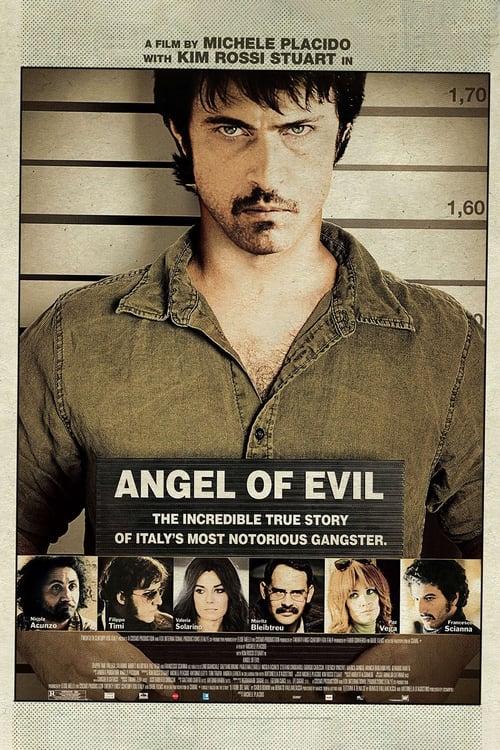
In the ending of "Angel of Evil," the main character, Renato Vallanzasca, faces the consequences of his violent life as he is captured by the police. The film concludes with his imprisonment, reflecting on his past and the choices that led him to this point.
As the final act unfolds, we see Renato Vallanzasca, portrayed with a mix of charisma and menace, navigating the treacherous waters of his criminal life. The tension escalates as he becomes increasingly isolated from his former allies. The police, having been on his trail for years, finally close in on him.
In a pivotal scene, Renato is cornered in a hideout, surrounded by law enforcement. The atmosphere is thick with suspense; the sound of sirens blares in the background, and the weight of his past decisions hangs heavily in the air. Renato, once a figure of power and fear, now finds himself vulnerable and desperate. He attempts to negotiate his way out, showcasing his charm and wit, but the police are resolute.
As the standoff intensifies, Renato's internal conflict becomes palpable. He reflects on his life choices, the betrayals, and the fleeting moments of camaraderie with his gang. The flashbacks of his earlier days, filled with excitement and rebellion, contrast sharply with his current predicament. The emotional turmoil is evident on his face as he grapples with the reality of his situation.
Ultimately, Renato is apprehended, and the scene shifts to his time in prison. The stark, cold environment of the prison contrasts with the vibrant life he once led. He is shown in solitary confinement, a stark reminder of the freedom he once took for granted. The camera lingers on his face, capturing the mix of defiance and resignation as he contemplates his fate.
The film closes with a montage of Renato's life, interspersed with images of his past crimes and the relationships he forged and lost along the way. His former accomplices, who once stood by him, are either dead or imprisoned, leaving him to face the consequences of his actions alone. The final shot lingers on Renato's expression, a blend of regret and acceptance, as he comes to terms with the legacy of violence he has created.
In summary, Renato Vallanzasca's fate is sealed as he is imprisoned, reflecting the inevitable outcome of a life steeped in crime and betrayal. The film leaves the audience with a haunting image of a man who once thrived on chaos, now reduced to a solitary figure grappling with the ghosts of his past.
Is there a post-credit scene?
The movie "Angel of Evil," directed by Michele Placido and released in 2010, does not feature a post-credit scene. The film concludes its narrative without any additional scenes or content after the credits roll. The story wraps up with a focus on the life and struggles of the main character, Renato Vallanzasca, a notorious Italian criminal, and his tumultuous journey through crime, love, and betrayal. The ending emphasizes the consequences of his actions and the emotional weight of his choices, leaving the audience with a sense of closure regarding his story.
What motivates the main character, Renato Vallanzasca, to become involved in a life of crime?
Renato Vallanzasca, portrayed as a charismatic yet troubled figure, is driven by a combination of his tumultuous upbringing and a desire for power and respect. Growing up in a poor neighborhood, he feels the need to assert himself and gain control over his life, leading him to embrace a life of crime as a means of achieving status and financial success.
How does Renato's relationship with his love interest, Francesca, evolve throughout the film?
Renato's relationship with Francesca is complex and tumultuous. Initially, their romance is passionate and intense, with Renato being captivated by her beauty and spirit. However, as Renato becomes more entrenched in his criminal activities, the strain of his lifestyle begins to take a toll on their relationship, leading to moments of jealousy, betrayal, and ultimately heartbreak.
What are the key events that lead to Renato's downfall?
Renato's downfall is marked by a series of escalating violent crimes, betrayals, and police confrontations. Key events include his involvement in high-profile robberies, the increasing pressure from law enforcement, and the betrayal by those closest to him, which culminates in his eventual arrest. Each event builds on the previous one, showcasing how Renato's choices and the consequences of his actions lead to his tragic end.
How does the film portray the relationship between Renato and his criminal associates?
The film depicts Renato's relationships with his criminal associates as both collaborative and fraught with tension. While they share a bond forged through their shared criminal endeavors, there are underlying rivalries and power struggles. Renato's charisma often places him in a leadership role, but his unpredictable nature and ambition create friction, leading to conflicts that threaten their unity.
What role does the police play in Renato's life and criminal activities?
The police are portrayed as relentless adversaries in Renato's life, constantly pursuing him and his gang. Their efforts to apprehend him are depicted through intense chase scenes and strategic operations, highlighting the cat-and-mouse dynamic between law enforcement and criminals. The police's determination to bring Renato to justice serves as a catalyst for many of his decisions, pushing him further into a life of violence and desperation.
Is this family friendly?
"Angel of Evil," a 2010 film, is not considered family-friendly due to its mature themes and content. The film explores the life of a notorious criminal, which includes several potentially objectionable aspects:
-
Violence: The film contains graphic depictions of violence, including scenes of physical confrontations and criminal activities that may be disturbing to younger viewers.
-
Crime and Morality: The narrative revolves around criminal behavior, including theft and murder, which may present complex moral dilemmas that could be unsettling for children.
-
Substance Abuse: There are references to drug use and the impact of addiction, which may be inappropriate for younger audiences.
-
Emotional Turmoil: Characters experience intense emotional struggles, including betrayal, loss, and guilt, which could be distressing for sensitive viewers.
-
Adult Themes: The film addresses themes of betrayal, loyalty, and the consequences of a life of crime, which may not be suitable for children.
Overall, the film's mature content and themes make it more appropriate for adult audiences.








