



















Popular
What motivates the main character, a motorcycle courier, to take on the dangerous mission in Quick?
How does the character of the antagonist, the bomber, influence the plot of Quick?
What are the key challenges K faces while trying to complete his mission in Quick?
How does K's relationship with his girlfriend evolve during the course of Quick?
What role do the supporting characters play in K's journey in Quick?
Should I watch it?
Ask Your Own Question

What is the plot?
Sorry, we aren't able to watch and write up a full detailed plot yet. Check back in a few days.



What is the ending?
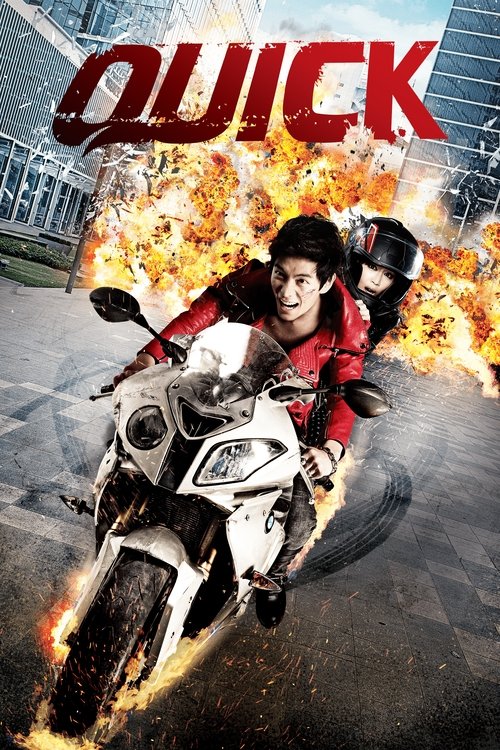
In the ending of "Quick," the protagonist, a motorcycle courier named Ki-soo, faces a tense showdown with the antagonist, who has been orchestrating a series of deadly events. Ki-soo ultimately manages to save the day, but not without significant sacrifice and loss. The film concludes with a sense of resolution, as Ki-soo reflects on the chaos that has unfolded.
As the climax approaches, Ki-soo races against time to prevent a catastrophic explosion that threatens the lives of many. He confronts the villain, who has been manipulating events from the shadows, and a fierce battle ensues. Ki-soo's determination and quick thinking allow him to outmaneuver the antagonist, but not without personal cost. The emotional weight of the situation is palpable as Ki-soo grapples with the consequences of his actions and the lives at stake.
In the final moments, Ki-soo emerges victorious, but the victory is bittersweet. The film closes with him contemplating the fragility of life and the impact of his choices, leaving the audience with a lingering sense of reflection on the nature of heroism and sacrifice.
As the film nears its conclusion, the tension escalates dramatically. Ki-soo, the motorcycle courier, is racing through the bustling streets of Seoul, his heart pounding as he navigates the chaos around him. The clock is ticking, and he knows that a bomb has been planted, threatening countless lives. His mind is a whirlwind of thoughts--he must act quickly, but he also feels the weight of responsibility for those he loves.
Scene by scene, the narrative unfolds. Ki-soo receives a frantic call from his friend, who has been caught in the web of the antagonist's schemes. The urgency in his friend's voice drives Ki-soo to push his limits, weaving through traffic with a fierce determination. The camera captures the intensity of his ride, the wind whipping past him, the city blurring into a backdrop of urgency and fear.
As he arrives at the location where the bomb is set to detonate, Ki-soo is met with the antagonist, a shadowy figure who has been orchestrating the chaos. The confrontation is electric, filled with tension as they exchange words that reveal the antagonist's motivations. Ki-soo's resolve hardens; he knows he must stop this man at all costs. The stakes are personal, and the emotional turmoil is evident on Ki-soo's face as he recalls the lives that hang in the balance.
The fight that ensues is a visceral clash of wills. Ki-soo uses his agility and quick reflexes to dodge attacks, but the antagonist is relentless. Each blow exchanged is not just physical; it carries the weight of Ki-soo's desperation to protect his friends and the innocent lives at risk. The choreography of the fight is intense, with close-ups capturing the sweat and determination etched on Ki-soo's face.
In a pivotal moment, Ki-soo manages to gain the upper hand, using his knowledge of the city and his skills as a courier to outsmart the antagonist. He disarms the bomb just in time, the countdown halting at the last possible second. Relief washes over him, but it is short-lived as he realizes the cost of the confrontation. The antagonist, defeated but not without a final act of defiance, attempts to escape, leading to a dramatic chase through the streets.
In the aftermath, Ki-soo stands amidst the chaos, the adrenaline still coursing through his veins. He looks around at the people he has saved, their faces a mix of gratitude and shock. However, the victory feels hollow as he reflects on the friends he has lost along the way, the sacrifices made in the name of heroism. The emotional weight of the moment is heavy, and Ki-soo's expression reveals a deep sense of loss and contemplation.
As the film draws to a close, Ki-soo rides away from the scene, the city sprawling before him. The camera lingers on his face, capturing the complexity of his emotions--relief, sorrow, and a newfound understanding of the fragility of life. The final shot is a poignant reminder of the journey he has undertaken, leaving the audience with a sense of closure yet an awareness of the ongoing struggles that lie ahead for him and those he cares about. The fate of Ki-soo is one of resilience, having faced the darkness and emerged, but forever changed by the experience.
Is there a post-credit scene?
In the movie "Quick," produced in 2011, there is indeed a post-credit scene. After the main story concludes, the scene opens with a light-hearted tone, contrasting the intense events that preceded it.
The camera pans to a bustling street where the protagonist, a young man named Ki-soo, is seen walking with a sense of relief and newfound purpose. He is accompanied by his friends, who are joking and laughing, celebrating their survival and the resolution of the chaos they faced.
As they walk, Ki-soo suddenly receives a phone call. The atmosphere shifts slightly as he answers, and the audience can see a flicker of concern on his face. The voice on the other end is familiar, and it hints at a new adventure or challenge that awaits him. Ki-soo's expression transforms from relief to determination, suggesting that while the immediate danger has passed, his life is still filled with unpredictability and excitement.
The scene ends with Ki-soo looking back at his friends, a smile breaking through as he prepares to embrace whatever comes next, leaving viewers with a sense of hope and anticipation for his future. This post-credit moment encapsulates the film's themes of resilience and the ongoing journey of life, reinforcing the idea that even after overcoming significant obstacles, new challenges and adventures are always on the horizon.
What motivates the main character, a motorcycle courier, to take on the dangerous mission in Quick?
The main character, a motorcycle courier named 'K' (played by Lee Min-ki), is driven by a sense of urgency and desperation when he learns that his girlfriend, who is a hostage, is in grave danger. His love for her and the need to save her from a bomb threat pushes him to take on the perilous task of delivering a bomb to a specific location within a limited time frame.
How does the character of the antagonist, the bomber, influence the plot of Quick?
The antagonist, a mysterious bomber, plays a crucial role in the plot as he orchestrates the entire situation, using K's girlfriend as leverage. His psychological manipulation and the ticking clock create a tense atmosphere, forcing K to navigate through various obstacles while trying to save her, which heightens the stakes and drives the narrative forward.
What are the key challenges K faces while trying to complete his mission in Quick?
Throughout his mission, K faces numerous challenges, including evading law enforcement, navigating through heavy traffic, and dealing with rival couriers who attempt to sabotage him. Each challenge tests his skills as a courier and his determination to save his girlfriend, showcasing his resourcefulness and resilience under pressure.
How does K's relationship with his girlfriend evolve during the course of Quick?
K's relationship with his girlfriend is central to the plot, and it evolves from a typical romantic connection to one filled with urgency and desperation. As K races against time to save her, flashbacks reveal their past moments together, deepening the emotional stakes and highlighting the bond they share, which ultimately fuels K's determination to succeed.
What role do the supporting characters play in K's journey in Quick?
The supporting characters, including fellow couriers and law enforcement officers, add depth to K's journey. Some provide assistance, while others create obstacles. Their interactions with K reveal different facets of his character, showcasing his determination, bravery, and the moral dilemmas he faces as he navigates through the chaos of the mission.
Is this family friendly?
"Quick," produced in 2011, is a South Korean action-comedy film that contains several elements that may not be suitable for children or sensitive viewers. Here are some potentially objectionable or upsetting aspects:
-
Violence: The film features action sequences that include gunfights, car chases, and physical confrontations, which may be intense and graphic.
-
Language: There are instances of strong language that may not be appropriate for younger audiences.
-
Mature Themes: The plot revolves around themes of crime, revenge, and the consequences of violence, which may be complex and unsettling for children.
-
Death and Injury: Scenes depicting injury and the aftermath of violent encounters could be distressing.
-
Dark Humor: The film employs dark comedic elements that may not resonate well with all viewers, particularly younger ones.
These aspects contribute to a tone that may be more suitable for older teens and adults rather than a family-friendly audience.








