
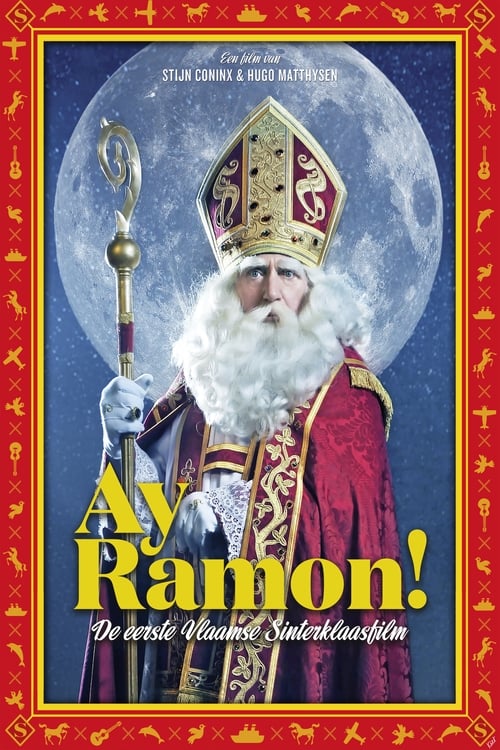
















Popular
What motivates Ramon to pursue his dreams despite the challenges he faces?
How does Ramon's relationship with his family evolve throughout the film?
What role does the character of the mentor play in Ramon's journey?
What obstacles does Ramon face in his pursuit of success, and how does he overcome them?
How does the setting influence Ramon's journey in the film?
Should I watch it?
Ask Your Own Question

What is the plot?
In Ay Ramon! the story begins in the familiar ritual of Sinterklaas season, with Sinterklaas leaving Spain by steamboat for Antwerp while his faithful horse caretaker Ramon Iglesias makes the journey over land with the horse Slechtweervandaag, because the animal gets seasick at sea. That practical arrangement immediately gives the film its split-path structure: the official Sinterklaas procession glides across the water with Zwarte Piet and the other companions, while Ramon travels separately as the indispensable guardian of the horse, making sure the beloved animal reaches Belgium safely.
The first movement of the story is one of anticipation. Sinterklaas expects the usual reunion with Ramon and Slechtweervandaag at the port of Antwerp, where they are supposed to rejoin the party at the agreed time. But when the steamboat arrives, Ramon and the horse are nowhere to be seen. The absence is not a minor delay; it is the first crack in the holiday machinery, and the people around Sinterklaas immediately feel that something is wrong. The mood shifts from ceremonial excitement to unease, because without Ramon and the horse, Sinterklaas cannot complete the traditional ride over the rooftops to bring gifts to the children by 6 December.
As the search begins, the film reveals what has happened in parallel: Ramon and Slechtweervandaag have been kidnapped on their overland route. The abductress is Tikkelotje, a woman associated with an unsuccessful or failing theatre business who notices that Ramon is not only a loyal companion and horse caretaker, but also a gifted musician. In one version of the synopsis, she sees him "playing the guitar and singing," and in others his "undeniable singing talent" becomes the reason she takes him prisoner. She does not simply want to scare him or ransom him; she wants to use his voice and performance skills to revive her failing theatre and turn him into a new attraction. That twist changes the conflict from a simple disappearance into a calculated exploitation plot: Ramon is not missing by accident, but because his talent has become a commodity in Tikkelotje's eyes.
The kidnapped pair are taken to Tikkelotje's theatre space, described variously as a poor, unsuccessful, or dying little theatre, a place that feels worn down and desperate rather than glamorous. This setting matters because it mirrors Tikkelotje's own state of panic and ambition; she is not a grand villain plotting world domination, but someone clinging to a failing act and trying to force success out of desperation. Ramon's music, which is a joyful part of his character, becomes the tool she believes can save her business. The kidnapping therefore carries a strange emotional double edge: it is cruel and coercive, but it is also driven by a twisted appreciation of what Ramon can do.
Back in Antwerp, Sinterklaas is devastated when he realizes Ramon is missing. The emotional stakes rise sharply because Ramon is not just a helper; he is a trusted companion, and the horse is essential to the entire holiday operation. Professor Van den Uytleg steps forward as the man who understands the situation and knows why Ramon has vanished. He becomes one of the key drivers of the rescue effort, alongside Conchita Garcia, Zwarte Piet, and the captains Paelinckx and Verscheepen. The search is no longer abstract; it becomes an urgent mission to find both Ramon and Slechtweervandaag before the deadline of 6 December makes the traditional gift delivery impossible.
The rescue effort is launched in a flurry of teamwork and improvisation. Professor Van den Uytleg and Conchita even use pigeons to help with communication and searching, while Zwarte Piet joins the chase in the hope of bringing Ramon back quickly. The plot's momentum comes from the repeated failure of these attempts: each ally who tries to help becomes another victim of Tikkelotje's trap. One by one, the would-be rescuers are ambushed, trapped, or imprisoned. The story becomes a chain reaction of setbacks, each failure increasing the pressure on Sinterklaas and making the villain seem more entrenched in her scheme.
The film's most important escalation is that Tikkelotje proves to be prepared for every searcher who comes her way. Professor Van den Uytleg is drawn in first, then Conchita, then Zwarte Piet, and each is caught in the same net of cunning and bad luck. The result is that Sinterklaas's circle shrinks until he is left with no choice but to go after the missing pair himself. This is a major turning point in the narrative because it strips the story down to its core: the legendary gift-bringer must stop relying on his helpers and personally confront the threat that has been threatening the entire Sinterklaas tradition.
Sinterklaas's emotional state at this point is one of mounting desperation. He has lost not only his horse and his faithful caretaker, but also the support network that was supposed to help him solve the crisis. The film's tension comes from that piling up of losses: first Ramon disappears, then the horse, then the searchers are swallowed up by Tikkelotje's traps, until the situation feels almost absurdly out of control. Yet the story keeps returning to one simple necessity: Sinterklaas must continue the tradition, and the children's wishes must still be gathered and delivered. The holiday deadline gives every scene an almost ticking-clock rhythm, even when the action turns into comic chaos.
A key revelation emerges in the way the kidnappings are explained. Tikkelotje's motive is not random malice; she wants Ramon specifically because of his singing and guitar playing, and she wants that talent deployed onstage in her theatre. This is the film's central twist, because it reframes Ramon from being merely a victim of convenience into the very reason the villain acts. At the same time, the horse Slechtweervandaag remains bound to Ramon's fate, because the overland arrangement exists only to protect the horse from seasickness. If Ramon cannot be recovered, Sinterklaas loses both the caretaker and the horse, and the entire festive delivery system breaks down.
The story's geography stays tightly linked to this urgency. Spain is the starting point of the annual journey, and Antwerp is the destination where everyone is supposed to reunite. The steamboat symbolizes the official, public side of Sinterklaas's arrival, while the overland route belongs to Ramon and Slechtweervandaag, the hidden logistical side that usually goes unnoticed. Tikkelotje's interception on the road disrupts that hidden machinery before it can reach the port. The theatre where she holds or intends to exploit Ramon becomes a second, shadowy stage set against the bright public rituals of the holiday.
As the search collapses around him, Sinterklaas is forced into a solo mission. This is the moment when the film shifts from ensemble rescue comedy into a more personal quest: he goes out on his own to find both his horse and his friends. The loneliness of that decision deepens the stakes, because it means that the responsibility for saving the season now rests on the shoulders of the one figure who is supposed to embody the season itself. The trail leads him through the mess that Tikkelotje has created, and the danger is no longer merely that Ramon is captive, but that everyone who comes near the rescue effort risks becoming trapped too.
The final stretch is defined by the confrontation between persistence and control. Tikkelotje has kept capturing each searcher in turn, demonstrating that she is the one directing the action and forcing Sinterklaas to move in reaction to her plans. Sinterklaas, by contrast, is now stripped down to determination and duty. The sources do not give a beat-by-beat scene of the last confrontation, but they do make clear that the goal is to recover Ramon, free the horse, and rescue the imprisoned companions before the Christmas deadline arrives. That is the decisive dramatic engine of the ending: everything must be repaired in time for Sinterklaas to ride over the roofs and deliver the gifts.
No deaths are reported anywhere in the available plot information, and the film's conflict is built entirely around kidnapping, imprisonment, and rescue rather than fatal violence. The danger is real, but it is not lethal in the sources provided; the worst outcome described is being trapped or held captive. That gives the story a family-adventure tone, even when it uses high-stakes urgency.
In the end, what the film resolves is the disruption of the Sinterklaas machine itself. Sinterklaas's mission, the children's wishlists, the steamboat arrival, the horse on the road, and the promise of gift-giving all depend on Ramon's safe return and Slechtweervandaag's recovery. The final movement of the story is about restoring that chain before 6 December, and the rescue effort is framed as the last chance to preserve the holiday tradition. Tikkelotje's theatre scheme, built on greed and desperation, is ultimately opposed by the collective loyalty of Sinterklaas and his companions, even if the exact mechanics of her defeat are not fully specified in the available summaries.
The closing emotional note is therefore one of relief earned through struggle: the missing pair must be found, the captives must be freed, and Sinterklaas must be able to resume his role as the gift-bringer to the children. What begins as a routine annual arrival from Spain turns into a frantic rescue journey, and the film's drama comes from turning a familiar seasonal ritual into a race against time.




What is the ending?
In the ending of "Ay Ramon!", the main character, Ramon, faces the consequences of his actions and ultimately finds a sense of closure. The film concludes with a poignant moment of realization and acceptance, as Ramon reconciles with his past and the people he has affected.
As the final scenes unfold, we see Ramon grappling with the fallout from his decisions. He stands alone in a dimly lit room, reflecting on the chaos that has ensued in his life. The weight of his choices presses heavily on him, and he feels the isolation that comes from his past mistakes.
In a pivotal moment, he reaches out to his estranged family, seeking forgiveness and understanding. The tension in the air is palpable as he approaches them, his heart racing with anxiety and hope. The family members, initially hesitant, begin to soften as they see the sincerity in Ramon's eyes.
The scene shifts to a family gathering, where emotions run high. Ramon's mother, who has been a steadfast figure throughout his struggles, embraces him tightly, tears streaming down her face. This moment signifies a turning point for Ramon, as he realizes the importance of family and the power of forgiveness.
As the film draws to a close, we see Ramon taking steps to rebuild his life. He is shown engaging in community activities, helping others, and slowly mending the relationships he once took for granted. The final shot captures him smiling, a sense of peace washing over him as he walks away from the camera, symbolizing his journey towards redemption.
In summary, the ending of "Ay Ramon!" encapsulates themes of forgiveness, family, and personal growth, as Ramon learns to confront his past and embrace a brighter future.
In the final act of "Ay Ramon!", the narrative builds towards a climactic resolution that encapsulates the emotional journey of the characters.
The scene opens with Ramon sitting alone in a sparsely furnished room, the shadows of the evening creeping in through the window. He stares blankly at the wall, lost in thought, as the weight of his past decisions looms over him. The camera lingers on his face, capturing the turmoil within him--regret, sorrow, and a flicker of hope. He knows he must confront the consequences of his actions, and the internal struggle is evident.
As the scene transitions, we find Ramon standing outside his childhood home, the familiar structure now a symbol of his fractured relationships. He hesitates at the door, his heart pounding in his chest. Memories flood back--laughter, arguments, and moments of love. With a deep breath, he knocks, and the door creaks open to reveal his mother, her expression a mix of surprise and apprehension.
The tension is thick as they exchange words, both hesitant yet yearning for connection. Ramon's voice trembles as he apologizes for the pain he has caused, his eyes pleading for understanding. His mother, initially guarded, begins to soften as she sees the sincerity in his eyes. The emotional weight of their shared history hangs in the air, and slowly, she steps forward, embracing him tightly. Tears flow freely as they hold each other, a moment of catharsis that signifies the beginning of healing.
The scene shifts to a family gathering, where relatives have come together, their faces a mixture of skepticism and hope. Ramon stands at the center, feeling the intensity of their gazes. He speaks from the heart, sharing his journey, the mistakes he has made, and the lessons he has learned. The atmosphere is charged with emotion as family members begin to share their own stories of struggle and forgiveness.
As the camera pans across the room, we see the gradual transformation of expressions--from doubt to understanding, from anger to acceptance. Ramon's sister, who had been particularly hurt by his actions, steps forward, her voice trembling as she expresses her own pain. In a moment of vulnerability, they embrace, signaling a reconciliation that had seemed impossible.
The final scenes depict Ramon actively engaging in his community, volunteering at local shelters, and helping those in need. The camera captures his interactions with others, showcasing his newfound purpose and commitment to making amends. He smiles genuinely, a stark contrast to the troubled man we met at the beginning of the film.
In the closing shot, Ramon walks away from the camera, the sun setting behind him, casting a warm glow. His silhouette is a symbol of hope and redemption, embodying the film's message about the power of forgiveness and the importance of family. The screen fades to black, leaving the audience with a sense of closure and the understanding that while the journey of healing is ongoing, it is one worth pursuing.
In this ending, each character finds their own path towards resolution. Ramon learns to embrace his past and seek forgiveness, his mother finds solace in reconnecting with her son, and the family as a whole begins to heal from the wounds of the past. The film concludes on a note of optimism, emphasizing the potential for change and the strength of familial bonds.
Is there a post-credit scene?
In the movie "Ay Ramon!" produced in 2015, there is indeed a post-credit scene. After the main credits roll, the scene opens with a lighthearted atmosphere, showcasing a small gathering of friends and family celebrating together. The camera pans across the room, capturing laughter and joy as they reminisce about the events that transpired throughout the film.
In this scene, Ramon, the protagonist, is seen engaging in playful banter with his friends, reflecting on the lessons learned and the bonds strengthened during their journey. His demeanor is relaxed and cheerful, a stark contrast to the struggles he faced earlier in the film. The warmth of the moment highlights his growth and newfound appreciation for the people in his life.
As the laughter continues, one of the characters playfully challenges Ramon to a karaoke contest, which he reluctantly accepts. The scene ends with him taking the microphone, a mix of excitement and nervousness on his face, as the music starts to play. This light-hearted moment serves as a reminder of the importance of friendship and joy, leaving the audience with a sense of hope and connection.
What motivates Ramon to pursue his dreams despite the challenges he faces?
Ramon is driven by a deep desire to prove himself and escape the limitations of his current life. He feels a strong sense of responsibility towards his family and is determined to create a better future for them. This internal conflict fuels his ambition and pushes him to take risks.
How does Ramon's relationship with his family evolve throughout the film?
Initially, Ramon's family is skeptical of his dreams, leading to tension and misunderstandings. As the story progresses, they begin to see his determination and passion, which fosters a sense of pride and support. This evolution highlights the importance of family bonds and understanding.
What role does the character of the mentor play in Ramon's journey?
The mentor serves as a guiding figure for Ramon, providing wisdom and encouragement. This character helps Ramon navigate the complexities of his aspirations, offering both practical advice and emotional support, which is crucial for Ramon's growth and self-discovery.
What obstacles does Ramon face in his pursuit of success, and how does he overcome them?
Ramon encounters various obstacles, including financial difficulties, self-doubt, and familial pressure. He overcomes these challenges through resilience, creativity, and the support of his mentor and friends, showcasing his determination to succeed against the odds.
How does the setting influence Ramon's journey in the film?
The setting plays a significant role in shaping Ramon's experiences. The contrast between his humble beginnings and the vibrant, competitive world he aspires to enter highlights the challenges he faces. The environment serves as both a backdrop for his struggles and a catalyst for his growth.
Is this family friendly?
"Ay Ramon!" is a Filipino comedy-drama that revolves around themes of family, love, and the complexities of relationships. While the film is generally light-hearted and comedic, there are a few aspects that may be considered objectionable or upsetting for children or sensitive viewers:
-
Family Conflicts: The film explores familial tensions and misunderstandings, which may resonate with viewers who have experienced similar issues. These conflicts can evoke strong emotions and may be distressing for younger audiences.
-
Romantic Relationships: There are elements of romantic relationships that may include misunderstandings, jealousy, and emotional turmoil. These themes might be complex for younger viewers to fully grasp.
-
Loss and Grief: The film touches on themes of loss, which can be emotionally heavy. Characters may express sadness or deal with the consequences of losing loved ones, which could be upsetting for sensitive viewers.
-
Mature Humor: Some comedic elements may include innuendos or jokes that are more suitable for older audiences, potentially leading to confusion or discomfort for younger viewers.
-
Cultural References: Certain cultural nuances and references may not be easily understood by children, which could lead to a lack of connection with the story.
Overall, while "Ay Ramon!" is primarily a comedy, it does contain moments that may require parental guidance for younger audiences due to its emotional depth and mature themes.







