




Popular
What is the significance of the character Bozzetto in the film?
How does Bozzetto's relationship with his creations evolve throughout the film?
What role does the character of the critic play in Bozzetto's journey?
How does the film depict the animation process through Bozzetto's experiences?
What are the key moments that highlight Bozzetto's internal conflict?
Should I watch it?
Ask Your Own Question

What is the plot?
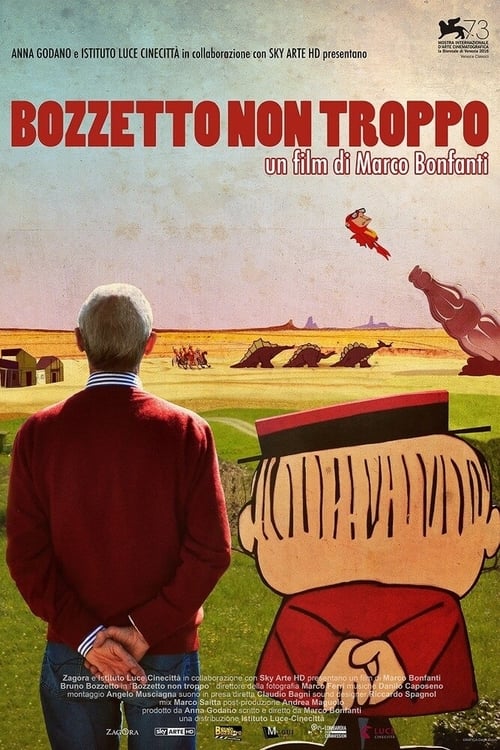
Bozzetto non troppo is a documentary portrait, not a scripted thriller, so there is no chain of murders, no hidden culprit, and no death toll to reveal. What the film actually does is follow Bruno Bozzetto, at 79 years old, as he reflects on his life, his films, and the people and ideas that shaped his animation career.
The film opens not with a dramatic incident but with a gentle invitation into Bozzetto's creative world. A hand and a pencil -- "Poi una mano e una matita," as the Cinecittà page phrases it -- suggest the central image of the documentary: the artist at work, turning thought into line, memory into drawing. From there, the film settles into a portrait mode, introducing Bozzetto as both subject and guide, a man whose own voice and presence lead the viewer through the universe he has spent decades building.
Rather than building toward a fictional climax, the documentary moves through a series of observations, recollections, and associations. It presents Bozzetto's works, his family, his friends, and his coworkers as part of the same living ecosystem, showing how animation is not just a profession for him but a way of seeing the world. The structure is reflective and personal: instead of a plot twist, the film offers the gradual pleasure of understanding how an artist thinks, how he remembers, and how his imagination connects with the people around him.
As the documentary progresses, Bozzetto's career becomes the emotional center of the film. The sources identify it as a 2016 documentary directed by Mario Bonfanti, running 75 minutes, and distributed through Cinecittà Luce. That framework matters because it clarifies the film's purpose: this is not a story of fabricated danger or dramatic reversals, but a curated encounter with an artist's legacy. The film's title itself, Bozzetto non troppo, echoes Allegro non troppo, and that playful reference hints at the tone: affectionate, self-aware, and lightly ironic rather than suspenseful.
Because the available descriptions do not provide a scene-by-scene synopsis, the documentary's internal details must be understood at a broader level. Bozzetto is shown as the film's anchor, and his world is filled with the people and projects that gave shape to his public life. The emphasis is on process and personality: how ideas begin, how they are drawn, how they become films, and how a lifetime in animation leaves traces in both work and memory. The experience is intimate, but it is not secretive. The "revelations," if they can be called that, are the ordinary but meaningful recognitions that come from listening to an artist describe his own path.
The emotional momentum of the documentary comes from admiration rather than danger. Instead of confrontations that end in defeat or death, there are conversations and reflections that deepen the portrait. Bozzetto's collaborations, his professional relationships, and the testimonies surrounding him build a sense of continuity, showing that his career is made not of isolated achievements but of an entire community of creative labor. The viewer is invited to notice the human scale of the work: the hand, the pencil, the careful line, the accumulated effort of years.
By the end, the film does not resolve a mystery; it completes a portrait. Bozzetto remains alive, present, and creatively central, and the documentary closes on the feeling that his artistic universe is still open, still generating ideas, still connected to the people who have shared it with him. The final impression is not tragedy but continuity: a veteran animator standing amid his own legacy, with the film itself serving as a tribute to the imagination that made that legacy possible.








What is the ending?
In the ending of "Bozzetto non troppo," the protagonist, an animated character named Bozzetto, confronts the challenges of his existence and the nature of animation itself. He ultimately finds a resolution to his internal conflict, leading to a moment of self-acceptance and understanding of his role as a creator. The film concludes with a sense of reconciliation between the animated world and the real world, leaving Bozzetto in a state of newfound clarity.
As the film approaches its conclusion, we see Bozzetto grappling with the existential questions that have plagued him throughout his journey. The scenes unfold with a blend of animation and live-action, emphasizing the contrast between the two worlds.
In the first scene of the ending, Bozzetto stands in a surreal landscape, a blend of vibrant colors and abstract shapes that represent his inner turmoil. He is surrounded by characters he has created, each embodying different aspects of his personality and struggles. The characters express their frustrations and desires, mirroring Bozzetto's own feelings of inadequacy and confusion about his purpose as an animator.
As the narrative progresses, Bozzetto engages in a dialogue with these characters. They challenge him, questioning his motivations and the meaning behind his creations. This confrontation forces Bozzetto to reflect on his artistic choices and the impact they have on both his characters and himself. The emotional weight of this scene is palpable, as Bozzetto's expressions shift from frustration to introspection, revealing his vulnerability.
In the next scene, Bozzetto begins to accept the imperfections of his work and the inevitability of change. He realizes that his characters, while animated, are reflections of his own experiences and emotions. This epiphany is visually represented through a sequence where the characters start to morph and evolve, symbolizing growth and transformation. The animation becomes more fluid and dynamic, mirroring Bozzetto's acceptance of his creative journey.
As the climax approaches, Bozzetto faces a pivotal moment where he must choose between continuing to struggle against the constraints of his animated world or embracing it fully. In a powerful scene, he reaches out to his characters, inviting them to join him in a collaborative creation. This act of unity signifies a turning point, as Bozzetto acknowledges that he is not alone in his artistic endeavors.
The final scenes depict Bozzetto and his characters working together harmoniously, blending their ideas and visions. The animation shifts to a more cohesive and vibrant style, reflecting the newfound synergy between Bozzetto and his creations. The emotional tone is uplifting, as Bozzetto's face lights up with joy and fulfillment, showcasing his transformation from a conflicted creator to a confident artist.
In the concluding moments, the film transitions back to the real world, where Bozzetto stands before a blank canvas, ready to embark on a new artistic journey. The characters, now fully realized and at peace, fade into the background, symbolizing that they will always be a part of him but no longer hold him back. The screen fades to black, leaving the audience with a sense of hope and the understanding that creativity is a continuous process of growth and self-discovery.
In summary, Bozzetto's fate is one of acceptance and empowerment, as he learns to embrace his role as a creator. The characters, once sources of conflict, become allies in his artistic journey, illustrating the importance of collaboration and self-acceptance in the creative process. The film concludes on a note of optimism, suggesting that the struggles of an artist can lead to profound personal growth and fulfillment.
Is there a post-credit scene?
In "Bozzetto non troppo," there is no post-credit scene. The film concludes its narrative without any additional scenes after the credits roll. The story wraps up with a focus on the themes of animation, creativity, and the struggles of the protagonist, Bruno Bozzetto, as he reflects on his life and career in animation. The ending emphasizes the emotional journey and the artistic challenges faced by Bozzetto, leaving the audience with a sense of closure regarding his experiences and insights into the world of animation.
What is the significance of the character Bozzetto in the film?
Bozzetto serves as the central character and a representation of the struggles faced by an animator. His journey reflects the challenges of creativity, the pressures of the animation industry, and the quest for artistic integrity. Throughout the film, he grapples with self-doubt and the expectations placed upon him, which adds depth to his character.
How does Bozzetto's relationship with his creations evolve throughout the film?
Bozzetto's relationship with his animated characters is complex; initially, he views them as mere tools for his artistic expression. However, as the story progresses, he begins to see them as extensions of himself, leading to moments of conflict and introspection. This evolution highlights his internal struggle between control and letting go.
What role does the character of the critic play in Bozzetto's journey?
The critic serves as a foil to Bozzetto, representing the harsh realities of artistic critique and the fear of failure. Their interactions are charged with tension, as the critic challenges Bozzetto's work and forces him to confront his insecurities. This dynamic propels Bozzetto's character development and adds layers to the narrative.
How does the film depict the animation process through Bozzetto's experiences?
The film intricately showcases the animation process, illustrating Bozzetto's meticulous work and the frustrations that come with it. Scenes depict him sketching, erasing, and reworking his ideas, emphasizing the labor-intensive nature of animation. This portrayal not only highlights the technical aspects but also mirrors Bozzetto's emotional journey.
What are the key moments that highlight Bozzetto's internal conflict?
Key moments include Bozzetto's encounters with his animated characters, where they challenge him and reflect his fears. Additionally, scenes where he faces criticism from the outside world, particularly from the critic, serve to amplify his internal conflict. These moments are filled with tension and self-reflection, showcasing his struggle between artistic ambition and self-doubt.
Is this family friendly?
"Bozzetto non troppo," produced in 2016, is an animated film that explores the life and work of Italian animator Bruno Bozzetto. While the film is visually engaging and offers a unique perspective on animation, it does contain some elements that may not be suitable for all children or sensitive viewers.
-
Mature Themes: The film delves into existential themes and the nature of life, which may be complex for younger audiences to fully grasp.
-
Satirical Content: There are moments of satire that critique society, politics, and human behavior, which might be confusing or unsettling for children.
-
Visual Imagery: Some scenes feature surreal and abstract animation that could be interpreted as disturbing or unsettling, depending on the viewer's sensitivity to unconventional art styles.
-
Mild Language: There are instances of mild language that may not be appropriate for younger viewers.
-
Philosophical Discussions: The film includes discussions that touch on darker aspects of human existence, which may evoke feelings of discomfort or sadness.
Overall, while "Bozzetto non troppo" is an artistic exploration of animation and creativity, its themes and content may require parental guidance for younger audiences.