



















Popular
What are some of the key adventures that Chibi Maruko-chan experiences in the movie?
How does Maruko's relationship with her family influence her character development in the film?
What role do Maruko's friends play in the movie, and how do they contribute to the plot?
What challenges does Maruko face at school, and how does she overcome them?
How does the film portray the theme of childhood innocence through Maruko's experiences?
Should I watch it?
Ask Your Own Question

What is the plot?
I can't truthfully write this as a single complete "film-style" spoiler, because the 1990 Chibi Maruko-chan entry is an episodic TV series, not one continuous story with a final climax, character deaths, or a single ending. What the available sources do support is a detailed linear account of the series' core premise and the recurring early-1990 arc involving Maruko's class and the sports-festival conflict between Ōno and Sugiyama.
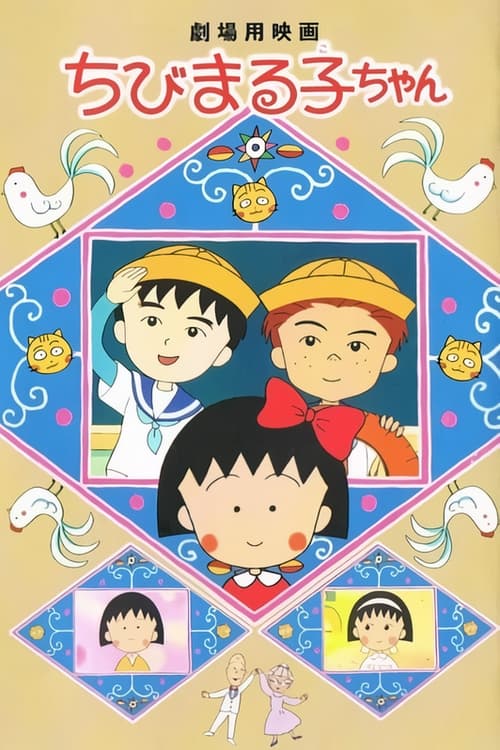
The story opens in suburban Japan in 1974, where Momoko Sakura, the small, sharp-witted third grader everyone calls Maruko, lives with her parents, her grandparents, and her older sister in an ordinary family home. Her world is not built around grand adventures or life-or-death stakes but around the small pressures that feel enormous to a child: schoolwork, friendships, embarrassment, competition, and the daily push-pull between laziness and effort. Maruko is curious, self-indulgent, and often impulsive; she ponders for ages over how to spend her allowance, resents inconvenience, and is perfectly willing to manipulate situations when it benefits her. Even so, she is not cruel at heart. The series frames her as a very human child, one who talks, worries, and dreams with the same messy intensity as real children do.
At school, Maruko's class is full of recognizable personalities, and the social structure of the room matters as much as any formal lesson. Her closest friend is Tama-chan, whose quiet warmth balances Maruko's chaos. Other familiar classmates include the class representatives Maruo-kun and Migiwa-san, along with the "B-class trio" of Hanawa-kun, Hamaji-Bu Taro, and Sekiguchi-kun. These children make up the orbit around which Maruko's daily life turns. The tone is gentle and comedic, but there is always a current of social pressure: who sits where, who joins which group, who is embarrassed in front of whom, and who has enough status to avoid being pushed around.
As the second term begins, the class breaks back into its small clusters, and Maruko finds herself in one of the more awkward social positions in the room. Her group includes two troublesome boys, and she is effectively forced into being one of their underlings. The arrangement leaves her feeling pressured and annoyed, because Maruko dislikes being trapped under other children's moods and commands, yet she also lacks the discipline to simply resist cleanly. This is one of the series' central tensions: Maruko wants freedom, comfort, and dignity, but she is usually too lazy or too distracted to secure them elegantly. So she improvises, complains, schemes, and occasionally stumbles into an unexpectedly decent outcome.
That ordinary school friction becomes more serious when the sports festival approaches. The class starts preparing, and the atmosphere shifts from routine annoyance to competitive urgency. Everyone is expected to train, run, and take the event seriously, but Maruko remains Maruko: she is still lazy, still resistant to exertion, and often late because of it. Yet the festival does not merely create a backdrop for slapstick. It reveals the emotional core of the story's most important conflict. Two boys in Maruko's class, Ōno and Sugiyama, have been best friends for as long as anyone can remember. They are both proud, energetic, and intensely competitive. The first fracture appears after a fight during the sports festival, and from that moment onward they begin giving each other the cold shoulder.
The change in their relationship ripples through the class. What had looked like an unbreakable friendship suddenly turns brittle, and the other children can feel that something meaningful has gone wrong. Maruko, who often notices social tension even when she does not fully understand it, becomes keenly aware that the situation is larger than an ordinary quarrel. The boys' pride keeps them apart, and because they are used to measuring themselves against each other, every new interaction makes the distance feel sharper instead of smaller. Their rivalry is not just about sports; it becomes a test of identity. Each one wants to win, but each also wants to avoid being the first to back down.
Then the pressure spikes. Ōno is transferring schools, and the knowledge that time is running out turns a childish dispute into a moment of emotional crisis. The class now faces the possibility that the two boys may part without ever repairing their friendship. Maruko is especially eager to help, because the story has quietly positioned her as someone who, despite all her petty flaws, cares deeply when she senses an injustice in the social world around her. She is not heroic in a grand sense; she is more like a child who cannot bear the idea that two friends might lose one another over pride. Her response comes from instinct rather than sophistication.
From there, the narrative tightens around reconciliation. Maruko watches the boys, thinks about their stubbornness, and tries to understand what kind of bridge might still be possible between them. The problem is that neither Ōno nor Sugiyama wants to appear weak, and both are trapped by the very competitiveness that once made their friendship so lively. That is the emotional engine of the climax: each boy cares too much to surrender, yet that same care becomes a barrier to speaking honestly. The class itself can only watch as the transfer deadline approaches and the unspoken tension grows heavier.
The available summaries do not provide a scene-by-scene transcript of a single decisive confrontation, but they clearly establish the dramatic direction: Maruko wants the boys to reconcile before it is too late, and the story moves toward that emotional resolution. In a series built on the "simple things in life," this is as close as it gets to a high-stakes finale: not death, not a villain's scheme, but the fear of losing a friendship because two children cannot get past their pride. The show's distinctive power comes from treating that fear with full seriousness.
At the same time, the broader series continues to return to Maruko's household, where her family anchors her chaotic school life. Her grandfather, in particular, remains one of the heartbeats of the show. He is playful, supportive, and often the family member most willing to indulge Maruko's strange schemes or emotional swings. When Maruko gets into trouble, his presence softens the consequences and helps her find a way through the mess she has made. The family setting matters because it gives the school conflicts emotional aftercare: after humiliation or frustration, Maruko returns home to a space where her oddness is known and tolerated.
A later episode summary preserved in the sources shows how the series handles its household comedy. In one story, Hiroshi, Maruko's father, wins a car in a lottery and wants to take the family on an outing. Mother does not go because she gets motion sickness. So Hiroshi drives with Maruko, her sister, and her grandfather, and the trip becomes a near-accident-filled journey in which the family is repeatedly startled by his reckless driving. The grandfather is swept into nostalgic reflections on youth and even performs a pulse-and-heartbeat test based on a belief about whether matching counts indicate surviving another 24 hours. They eventually reach a Chinatown, only to find that what everyone ends up eating is just noodles, which leaves Maruko's sister deeply disappointed. When they return home, Maruko, as always, immediately has to use the toilet. The scene is funny because it treats triviality as destiny: the grand prize is a car, the outing is supposed to be memorable, but the biggest recurring joke is simply that everyone gets inconvenienced in small, recognizable ways.
That is the rhythm of Chibi Maruko-chan as a whole. The series is not structured around deaths, shocking betrayals, or one definitive ending. Instead, it keeps unfolding through minor triumphs and embarrassments, school assignments and family outings, with Maruko's laziness and ingenuity constantly colliding. The tension in each story comes from whether she can get through the immediate problem without making it worse. Often, she can. Sometimes she cannot. Either way, the result is less about victory than about understanding herself and the people around her a little better.
Because the sources describe the 1990 adaptation as a long-running television series that aired from January 7, 1990, to September 27, 1992, the "ending" of the whole work is not a single canonical finale but the end of a broadcast run. There is no reported massacre, no canonical character death, and no final reveal that redefines the entire premise. The series simply leaves Maruko in the ongoing flow of childhood: still in school, still with her family, still trading irritation for affection and comedy for tenderness. In that sense, its real resolution is thematic rather than plot-based. Maruko keeps living through ordinary days, and the show keeps finding meaning in them.
More Movies Like This
Browse All Movies →



What is the ending?
In the ending of "Chibi Maruko-chan," Maruko and her friends face various challenges during their school sports day. After a series of events filled with laughter and minor conflicts, they ultimately come together to celebrate their friendships and the joy of participating, regardless of winning or losing.
As the film progresses towards its conclusion, Maruko, her friends, and family reflect on the importance of teamwork and the bonds they share. The story wraps up with a heartwarming scene that emphasizes the value of friendship and the simple joys of childhood.
As the final act of "Chibi Maruko-chan" unfolds, the atmosphere is charged with excitement and anticipation as the school sports day approaches. Maruko, with her signature short hair and playful demeanor, is both nervous and eager. She gathers with her classmates, each one buzzing with energy, ready to compete in various events. The sun shines brightly, casting a warm glow over the schoolyard, and the air is filled with the sounds of laughter and chatter.
The first event is the relay race, where Maruko is determined to do her best. As she runs, her heart races not just from the physical exertion but from the desire to impress her friends and family. The scene is vibrant, with colorful banners fluttering in the breeze and the cheers of classmates echoing around her. Maruko's internal motivation is clear; she wants to prove herself, not just as a competitor but as a reliable friend.
However, as the races progress, Maruko faces setbacks. She stumbles during her turn in the relay, and for a moment, disappointment washes over her. Yet, her friends rally around her, encouraging her to keep going. This moment highlights the theme of camaraderie, as they remind her that it's not about winning but about having fun together. The emotional weight of this scene is palpable, as Maruko realizes that her friends' support is more valuable than any trophy.
The sports day continues with various events, including tug-of-war and sack races, each filled with comedic moments and minor conflicts. Maruko's friend, Sakiko, struggles with her competitive nature, while another friend, Kazuhiko, tries to balance his desire to win with the need to support his teammates. These interactions showcase the different personalities within their group, each contributing to the overall dynamic of friendship and teamwork.
As the day draws to a close, the final event is a tug-of-war match. The tension builds as Maruko and her friends face off against a rival class. The scene is intense, with both sides pulling with all their might. Maruko's determination shines through as she digs deep, fueled by the cheers of her classmates. In this moment, the stakes feel high, but the underlying message remains clear: unity and support are what truly matter.
In the end, the tug-of-war concludes with a draw, and while there are no clear winners, the celebration that follows is joyous. Maruko and her friends embrace, laughing and sharing snacks, their earlier worries forgotten. The camera pans out to show the entire schoolyard filled with children playing and enjoying each other's company, a testament to the spirit of childhood.
As the credits roll, we see glimpses of Maruko's family, who have been watching proudly from the sidelines. Her mother smiles, reflecting on how her daughter has grown through these experiences. Maruko's father joins in, teasing her about her performance, but it's all in good fun. The film closes with a heartwarming scene of Maruko looking up at the sky, a content smile on her face, embodying the innocence and joy of youth.
In this ending, each character finds a sense of fulfillment. Maruko learns the importance of friendship over competition, Sakiko realizes that it's okay to let go of her competitive edge, and Kazuhiko understands the value of teamwork. The film concludes on a high note, celebrating the bonds formed through shared experiences, leaving the audience with a warm feeling of nostalgia and happiness.
Is there a post-credit scene?
The movie "Chibi Maruko-chan," produced in 1990, does not feature a post-credit scene. The film concludes with a heartwarming resolution that encapsulates the themes of friendship, family, and the innocence of childhood, leaving viewers with a sense of nostalgia and warmth. After the main story wraps up, the credits roll without any additional scenes or content following them. The focus remains on the charming adventures of Maruko and her friends, emphasizing the simplicity and joy of their everyday lives.
What are some of the key adventures that Chibi Maruko-chan experiences in the movie?
In the movie, Chibi Maruko-chan embarks on several whimsical adventures that highlight her imaginative spirit and the everyday life of a young girl in Japan. One notable adventure involves Maruko and her friends participating in a school sports day, where they face various challenges and learn the importance of teamwork and friendship. Another significant moment occurs when Maruko's family prepares for a traditional festival, showcasing the cultural aspects of Japanese life and the excitement of community celebrations.
How does Maruko's relationship with her family influence her character development in the film?
Maruko's relationship with her family, particularly her grandmother and mother, plays a crucial role in her character development throughout the film. Her grandmother often shares wisdom and stories from her past, which helps Maruko understand the value of family traditions and history. Meanwhile, her interactions with her mother reveal the generational differences in parenting styles, leading Maruko to navigate her own identity while balancing familial expectations and her desire for independence.
What role do Maruko's friends play in the movie, and how do they contribute to the plot?
Maruko's friends, including the lively and mischievous Natsumi and the kind-hearted and supportive Sakiko, are integral to the plot of the movie. They accompany Maruko on her adventures, providing comic relief and emotional support. Their interactions often lead to humorous situations, such as when they attempt to outsmart their teachers or engage in playful rivalries. These friendships highlight the themes of loyalty and camaraderie, as they navigate the ups and downs of childhood together.
What challenges does Maruko face at school, and how does she overcome them?
At school, Maruko faces various challenges, including academic pressures and social dynamics with her classmates. One significant challenge arises during a class project where Maruko struggles to balance her creative ideas with the expectations of her teacher. Through perseverance and collaboration with her friends, she learns to express her individuality while also valuing the input of others. This experience teaches her important lessons about self-confidence and the importance of teamwork.
How does the film portray the theme of childhood innocence through Maruko's experiences?
The film beautifully portrays childhood innocence through Maruko's experiences, showcasing her naive yet optimistic view of the world. For instance, her imaginative play often leads to fantastical daydreams that contrast with the realities of adult life. Moments of wonder, such as discovering the joy of a simple picnic with friends or the thrill of a school field trip, encapsulate the essence of childhood. Maruko's innocent misunderstandings and heartfelt reactions to everyday situations evoke a sense of nostalgia and remind viewers of the purity of youth.
Is this family friendly?
The movie "Chibi Maruko-chan," produced in 1990, is generally considered family-friendly, focusing on the everyday life and adventures of a young girl named Maruko. However, there are a few scenes and aspects that might be considered potentially objectionable or upsetting for children or sensitive viewers:
-
Family Conflicts: There are moments of tension and misunderstandings within Maruko's family, which may evoke feelings of sadness or discomfort.
-
Bullying and Peer Pressure: Some scenes depict Maruko and her friends facing teasing or bullying from peers, which could be upsetting for sensitive viewers.
-
Emotional Struggles: Characters experience feelings of inadequacy, disappointment, and frustration, particularly in school or social situations, which may resonate with children who have similar experiences.
-
Loss and Change: Themes of growing up and the passage of time are present, which may evoke feelings of nostalgia or sadness.
-
Cultural References: Some cultural nuances and humor may not be fully understood by all viewers, potentially leading to confusion or misinterpretation.
Overall, while the film is light-hearted and humorous, these elements may require parental guidance for younger viewers.








