

Popular
How do the relationships between the characters evolve throughout the film?
What is the significance of the character Juan in the story?
How does the setting of the theater influence the events of the film?
What role does the character of the director play in the narrative?
What is the impact of the political backdrop on the characters' decisions?
Should I watch it?
Ask Your Own Question

What is the plot?
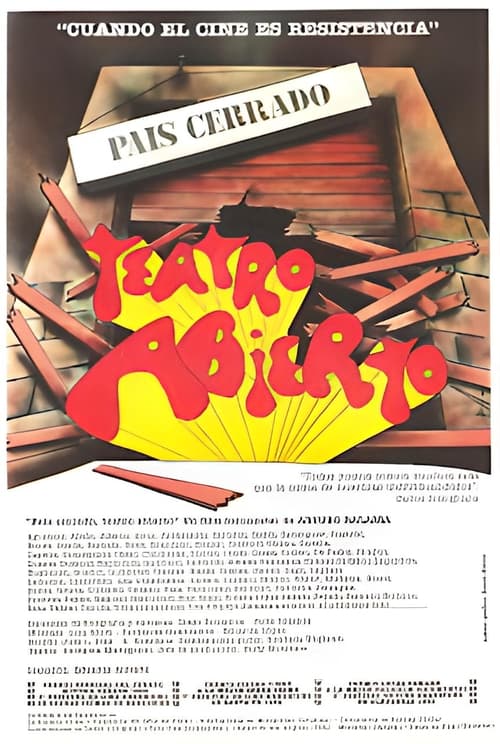
País cerrado, teatro abierto opens not as a fictional drama with a conventional cast of characters and deaths, but as a documentary reconstruction of a cultural uprising: the birth of Teatro Abierto in Argentina under the shadow of the last civic-military dictatorship. The film's opening movement establishes a country enclosed by fear and artistic suffocation, where theater, film, and television workers have been pushed to the margins by censorship, blacklists, unemployment, and the constant threat of punishment. From the beginning, the emotional center is not a single protagonist but a collective body of artists trying to recover the right to speak in public.
The documentary frames this world as one of pressure and silence. It draws on film and photographic material from rehearsals and performances, and it also uses interviews with the movement's participants to rebuild the atmosphere that made Teatro Abierto necessary. The historical background is clear: under the dictatorship that lasts from 1976 to 1983, artists are monitored, censored, and often rendered jobless, while the broader society lives under what the film presents as a climate of fear and gradual impoverishment in everyday life. What matters dramatically is that the repression is not abstract. It is felt in the empty spaces of theaters, in silenced careers, and in the shared conviction among artists that something must be done before Argentine culture is permanently broken.
As the documentary moves forward, it traces how that pressure turns into organization. Toward the end of 1980, a broad call is made for a theater showcase, bringing together people from different branches of the performing arts who are all being pushed toward the margins. The project is born not as a luxury of the privileged, but as a response to exclusion: authors, actors, students, directors, technicians, and other theater workers begin to converge around the same idea, that theater can function as a public act of defense. The film emphasizes that this is not merely an artistic initiative. It is a collective refusal to disappear.
The chronology reaches its key turning point on 28 July 1981, the date Teatro Abierto is formally initiated. The documentary presents this moment as a cultural eruption in the middle of dictatorship, when a group of artists and theater workers--including Osvaldo Dragún, Gonzalo Núñez, Jorge Rivera López, Luis Brandoni, and Pepe Soriano--come together to launch a public response against authoritarian control. The movement is shown as simultaneously artistic and political: it creates a space where the public can gather, listen, and judge, and where culture becomes a way of reclaiming a fragment of the public sphere from the state.
The film then deepens the tension by showing how Teatro Abierto had to speak in a language shaped by censorship. Rather than direct slogans alone, the movement relies on metaphor, ellipsis, indirect reference, and suggestion. The documentary highlights this as a new theatrical language, one able to allude to the past or the foreign in order to communicate what could not be spoken openly under authoritarian rule. That aesthetic strategy gives the project its urgency: the artists are not only resisting by gathering; they are also inventing forms that can survive surveillance. The result is a theater of implication, where meaning travels through image, gesture, and coded reference as much as through explicit speech.
As the documentary continues, it broadens from the origin story into a portrait of collective momentum. The first cycle of Teatro Abierto, preserved in the film's recorded material, is described as running across the period from April to September 1981. This gives the narrative a lived texture: rehearsals, performances, and the physical presence of the artists and audiences become evidence that the theater is alive despite repression. The documentary stresses that the initiative begins with writers from cinema, theater, and television, then expands to actors and theater students, demonstrating both the existence and the vitality of Argentine theater at a moment when many had tried to deny or suppress it. The atmosphere is one of cautious hope that becomes collective determination. The public does not merely watch; it participates in a shared act of refusal.
The names attached to the movement matter because the film insists on the breadth of the coalition. Alongside the foundational figures already mentioned, the documentary's subject is associated with many important theater artists, including Roberto "Tito" Cossa, Carlos Gorostiza, Eduardo Aliverti, Gastón Breyer, Villanueva Cosse, Rodolfo Mederos, Diana Raznovich, Ricardo Monti, Antonio Monaco, Rúbens Correa, Jorge Hacker, Roque de Pedro, Mene Arnó, Alfredo Alcón, Eduardo Pavlovsky, Héctor Alterio, Aída Bortnik, Daniel Arroscaeta, and Pacho O'Donnell. Their presence underscores that Teatro Abierto is not the story of one genius but of a large artistic front. The documentary's emotional force comes from that scale: an entire cultural community steps forward at once, despite the risks.
The film's visual and dramatic movement reaches its climax in the act of performance itself. Rather than a single showdown, the peak is the collective decision to stage theater in public under conditions designed to discourage public speech. The documentary presents this as a confrontation with the dictatorship by other means. Every rehearsal, every performance, and every audience gathering becomes a form of resistance. The artists are not shown defeating the regime directly; instead, they expose its limits by continuing to create. In that sense, the most important "outcome" is not a physical victory but a symbolic one: the public proves that it can still assemble, and theater proves that it can still speak.
There are no documented deaths in the supplied sources, and the documentary is not presented as a fictional narrative built around killings or murders. Likewise, the available material does not support a scene-by-scene reconstruction of private confrontations, secrets, or individual fatalities. What it does support is a different kind of drama: the dramatic survival of art under repression, the pressure of censorship, and the risky courage required to turn a theater program into a civic act. Any claim about deaths, assassinations, or personal resolutions would go beyond the evidence provided.
In the final movement, the documentary closes its historical arc by showing Teatro Abierto as more than a passing event. It presents the movement as a breakthrough that helps reopen public expression in Argentina and leaves a strong social imprint beyond the immediate performances. The significance of the final scenes lies in what they demonstrate: the theater is no longer isolated, and the artists are no longer speaking only for themselves. They have turned performance into a shared public declaration that culture can challenge fear even while the dictatorship still exists. The ending is therefore not a conventional resolution with winners and losers, but a historical affirmation. Teatro Abierto survives as proof that, in a closed country, the stage can still be opened.




What is the ending?
In the ending of "País cerrado, teatro abierto," the characters confront the harsh realities of their lives and the oppressive political environment. The play within the film culminates in a powerful moment of realization and acceptance, leading to a sense of resignation among the characters as they grapple with their circumstances.
As the film progresses towards its conclusion, the characters find themselves in a tense atmosphere, reflecting the struggles they have faced throughout the narrative. The emotional weight of their experiences culminates in a poignant scene where they acknowledge the futility of their fight against the oppressive regime. Each character's fate is intertwined with the broader themes of despair and resilience, leaving them to confront their realities with a mix of sorrow and acceptance.
In a more detailed narrative:
The final act begins with the characters gathered in a dimly lit space, the air thick with tension. They are weary from their struggles, their faces etched with the lines of hardship and disappointment. The stage is set for a confrontation, not just with each other but with the oppressive forces that have dictated their lives.
As they engage in a heated discussion, the atmosphere is charged with emotion. Each character voices their frustrations, revealing their internal conflicts and desires. The protagonist, a passionate and idealistic figure, stands at the center, embodying hope despite the overwhelming odds. Their voice trembles with conviction as they plead for change, for a better future, but the others respond with a mix of skepticism and resignation.
One character, burdened by the weight of past decisions, expresses a deep sense of loss. Their eyes glisten with unshed tears as they recount the sacrifices made and the dreams that have been shattered. This moment is pivotal, as it highlights the personal stakes involved in their struggle. The audience can feel the palpable sorrow, a reflection of the broader societal despair.
As the discussion escalates, the characters begin to realize that their individual battles are part of a larger narrative of oppression. They share stories of their families, their hopes, and the dreams that have been stifled by the regime. The protagonist's fervor begins to wane as they confront the reality that change may not come easily, if at all.
In a climactic moment, the characters decide to perform a final act, a symbolic gesture of defiance against the oppressive forces. They take to the stage, their movements filled with a mix of desperation and determination. The performance is raw and emotional, a cathartic release of their pent-up frustrations. As they act out their struggles, the audience is drawn into their world, feeling the weight of their pain and the flicker of hope that still lingers.
However, as the performance reaches its peak, the oppressive forces make their presence known. The lights flicker, and a sense of foreboding fills the air. The characters are forced to confront the reality that their fight may be in vain. The protagonist, once filled with hope, now stands at a crossroads, grappling with the realization that the system is far more powerful than they had anticipated.
In the final moments, the characters are left in a state of emotional turmoil. They look at one another, their expressions a mix of resignation and solidarity. The protagonist, now weary and disillusioned, acknowledges the harsh truth: change may not come in their lifetime. The others nod in agreement, their faces reflecting a shared understanding of their plight.
As the curtain falls, the characters are left to face their uncertain futures. The audience is left with a lingering sense of melancholy, a reminder of the struggles faced by those who dare to dream of a better world. Each character's fate remains uncertain, but their shared experience binds them together in a poignant moment of collective resilience, even in the face of despair.
Is there a post-credit scene?
"País cerrado, teatro abierto," produced in 1990, does not feature a post-credit scene. The film concludes its narrative without any additional scenes or content after the credits roll. The focus remains on the story and themes presented throughout the film, which explores the complexities of life in a closed society and the struggles of its characters. The ending leaves viewers with a sense of reflection on the issues raised during the film, rather than providing a continuation or additional commentary in a post-credit sequence.
How do the relationships between the characters evolve throughout the film?
The relationships are dynamic and complex, often shifting as characters confront their fears and desires. For instance, the bond between Juan and the actress deepens as they share their vulnerabilities, while tensions arise between the director and the cast as they navigate their differing visions for the production. These evolving relationships highlight the themes of trust, betrayal, and solidarity.
What is the significance of the character Juan in the story?
Juan serves as a pivotal character who embodies the struggles of the marginalized in society. His journey reflects the emotional turmoil and the quest for identity amidst the backdrop of political oppression. His interactions with other characters reveal his internal conflicts and motivations, particularly his desire for freedom and self-expression.
How does the setting of the theater influence the events of the film?
The theater acts as a microcosm of society, where characters confront their realities and aspirations. It becomes a space for both escape and confrontation, allowing characters to express their suppressed emotions and desires. The physical space of the theater amplifies the tension and drama, as it is where the characters' lives intersect and unfold.
What role does the character of the director play in the narrative?
The director is a crucial figure who symbolizes authority and creativity. His vision for the play reflects the broader societal issues at play, and his interactions with the cast reveal the struggles between artistic integrity and commercial pressures. His character grapples with the responsibility of using art as a means of resistance against oppression.
What is the impact of the political backdrop on the characters' decisions?
The political climate heavily influences the characters' choices and motivations. Characters are often seen grappling with the fear of censorship and the consequences of speaking out. This backdrop creates a sense of urgency and desperation, driving characters to make bold decisions that reflect their longing for change and the desire to reclaim their voices.
Is this family friendly?
"País cerrado, teatro abierto" is a film that delves into complex themes and societal issues, which may not be suitable for all audiences, particularly children or sensitive viewers. Here are some potentially objectionable or upsetting aspects:
-
Political Tension: The film addresses themes of political repression and social injustice, which may be difficult for younger viewers to understand and could evoke feelings of discomfort.
-
Emotional Struggles: Characters experience significant emotional turmoil, including despair and hopelessness, which may be distressing for sensitive individuals.
-
Violence and Conflict: There are scenes that depict conflict and violence, reflecting the harsh realities of the political climate, which could be unsettling.
-
Themes of Oppression: The portrayal of oppression and the struggles of individuals against a repressive regime may be heavy and thought-provoking, potentially leading to feelings of sadness or anxiety.
-
Mature Language: The dialogue may include strong language or themes that are more appropriate for mature audiences.
These elements contribute to a narrative that is rich in social commentary but may not be suitable for younger viewers or those who are sensitive to such themes.









