












Popular
What role does the character of the police officer play in the investigation?
Who is the main character in Tre colonne in cronaca and what motivates their actions throughout the film?
How does the relationship between Marco Ferreri and his editor evolve throughout the film?
What specific challenges does Marco face while investigating the murder case?
What is the significance of the title 'Tre colonne in cronaca' in relation to the plot?
Should I watch it?
Ask Your Own Question

What is the plot?
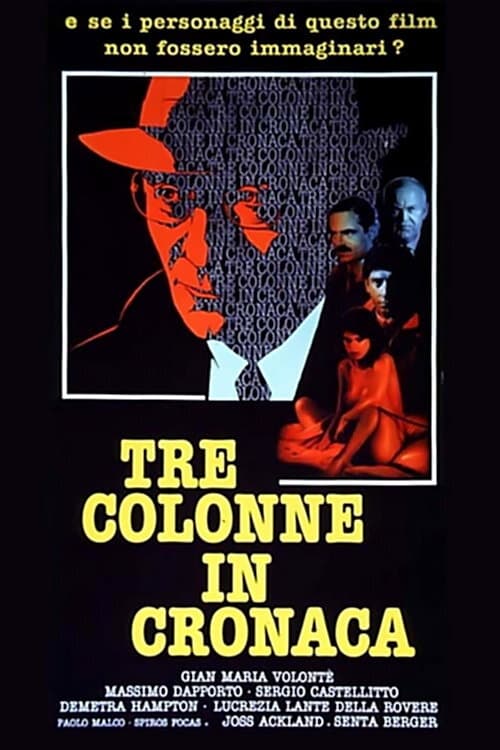
The film opens in Milan, where an agent of exchange named Bonaveri is found dead in his apartment in what looks like a suicide, but the image of the body is already wrong in a way that lingers in the air and makes the scene feel staged rather than tragic. The first shock is not just the death itself, but the quiet suggestion that someone has arranged it to look like something else, and that deception becomes the film's governing mood from the first minutes onward.
Commissario Dante Morisi takes the case, and at first he is simply a police investigator dealing with what appears to be a routine death in a rich city apartment. But Morisi is not satisfied with appearances. He studies the scene, follows the contradictions, and realizes that Bonaveri has not killed himself at all: he has been murdered. That realization changes everything. The case stops being a single death and becomes the first visible crack in a much larger structure of power, money, and manipulation.
At the same time, the film begins to reveal the world around Bonaveri's death: a hostile newspaper in Rome is under pressure from political and financial interests that want to seize control of it. The paper is directed by Alberto Landolfi, a man described as cunning, ambiguous, and willing to do almost anything to hold on to his position. Around him work journalists who understand that the newspaper is not just a business but a battleground. Among them is Quinto, the courageous reporter who will become Morisi's ally in the investigation.
The hidden architect of the whole operation is Onorevole Aurelio Spanò, a politician who wants to take over the newspaper because it stands politically against him. Spanò does not act openly. He moves through intermediaries and uses other people as tools. One of those tools is Bassouri, a Lebanese terrorist, and another is Gaetano Leporino, a cynical businessman and financier from Lombardy or Milan, depending on the source's wording. These men give Spanò a way to apply pressure without exposing his own hands, and that concealment is the essence of the plot.
Bassouri receives the order to kill Bonaveri. In some accounts, the killing is carried out by a "terrorista arabo" or "ragazza araba," and the sources agree that the murder of the stockbroker is immediately followed by the death of the Arab woman who killed him, because she too becomes a loose end that threatens the larger plan. The logic is ruthless: once the first killing has served its purpose, anyone who might reveal the chain of responsibility is removed as well. The film turns this into a grim pattern of disposal, as if people are not characters to the conspirators but temporary instruments to be broken and thrown away.
Morisi follows the trail through the initial death, and the more he looks, the more the case stops resembling a homicide investigation and starts resembling a map of the entire Italian power system. The sources repeatedly describe the conspiracy as a mesh of politics, finance, criminal maneuvering, and pressure around a major newspaper. That is exactly how the film feels: the personal and the institutional are never separate. Bonaveri's death is private only on the surface; underneath it, the event has been manufactured to destabilize a media company and open the door for a takeover.
As Morisi digs further, he discovers that he cannot keep the investigation in Milan for long. After understanding that Bonaveri was murdered, he is transferred to Rome. That transfer gives the story a new geographic center and also a new texture: Milan holds the cold machinery of the original crime, while Rome becomes the arena where the real battle over the newspaper plays out. In Rome, Morisi reconnects with Quinto, the journalist who is already inside the world of the threatened paper and understands that the investigation is not just a police matter but an attack on the press itself.
The partnership between Morisi and Quinto gives the film one of its strongest tensions. Morisi brings method, persistence, and the authority of the state; Quinto brings access, instinct, and the anger of someone whose profession is being cornered by men with money and political power. Together they start to see the shape of the conspiracy. They understand that Bonaveri's murder was meant to trigger a chain reaction of blackmail and deception, each step designed to weaken the newspaper and make it easier to seize. They also learn that the people around Spanò are not sentimental opportunists. They are disciplined in their cynicism, and their power lies precisely in their willingness to use violence only when useful and to hide it when necessary.
The newspaper itself becomes the central object of desire. Landolfi directs it, but he is not a heroic editor standing above the corruption of the world; he is described by the sources as sharp, ambiguous, and self-preserving. That ambiguity matters because the paper is full of competing loyalties, and the men trying to take it over understand that internal weakness is as important as outside force. Spanò does not merely want to silence a critic. He wants to own the critic's platform, to turn opposition into control, and to do it through deniable intermediaries so that the takeover looks like finance, not coercion.
The conspiracy widens around Leporino, whose role is to connect the political plan to money and cover. He is described as a slick, cynical businessman and "faccendiere," a man of deals and manipulation rather than ideology. In some accounts he leans on a wealthy Swiss entrepreneur, Peter, and on Bruno Lachioma, another unscrupulous adventurer, to help build the financial scaffolding of the operation. Even if the film's public summaries do not spell out every sub-deal, the direction is clear: Spanò's political ambition depends on a financial structure elaborate enough to disguise itself as ordinary business.
The pressure on the newspaper escalates as the investigation closes in. Quinto, who has become Morisi's ally, pays a price for getting too close to the truth: his car is blown up on Spanò's order. It is a sudden, brutal gesture that feels like both a warning and a demonstration. The message is simple: the conspiracy can reach anyone, anywhere, and it is willing to escalate as soon as someone becomes difficult to control. The explosion also deepens the bond between Quinto and Morisi, because after that attack the danger is no longer abstract. The journalist's courage has been answered with open violence.
The death count continues to rise. Leporino is also killed. The sources do not dwell on the exact mechanics of his death, but the fact of it matters immensely because it removes one of the key intermediaries between Spanò's political will and the financial machinery of the takeover. This is a common pattern in the story: once a person's usefulness has expired, the conspiracy devours its own agents. The film keeps tightening that noose, and each elimination is both a cover-up and an admission that the architecture is unstable enough to require constant pruning.
Morisi's investigation eventually brings him to the point where he is about to catch Bassouri himself. The sources place this moment near a hotel in Milan, where Morisi attempts to make the arrest but is blocked by the intervention of the services. This is one of the most revealing moments in the film because it shows that the police are not operating in a neutral space. The state itself is divided, or compromised, or simply overruled by powers more secretive than the official chain of command. Morisi is so close to the truth that he can almost touch it, and then it is taken away from him in real time.
The failure to arrest Bassouri is devastating because it confirms that the conspiracy is protected from above. Morisi is not merely outmatched by criminals; he is neutralized by a system that knows how to absorb and redirect legal action. This is where the film's tension becomes especially bitter. The police investigator and the journalist can assemble the truth, but assembling it is not the same as enforcing it. The men behind the takeover know how to move faster than accountability, and they know how to use institutions against themselves.
The sources also note that Odessa, an Austrian woman and friend of the dead Bonaveri, is implicated in the initial murder investigation. Her presence adds another layer of ambiguity to the crime's social world. Around the corpse there are not only hired killers and power brokers but also people entangled through intimacy, access, and opportunism. The investigation thus becomes a web of human connection as much as a chain of command. Morisi must sort through suspicion, misdirection, and the possibility that people around the victim are either participants or witnesses who do not yet understand what they have seen.
Visually, the film moves between the austere spaces of investigation and the polished interiors of power. Milan provides the original death scene, the apartment where the false suicide is staged, and the hotel where Bassouri is nearly captured. Rome provides the newspaper offices, the political theater, and the sense that the real decisions are being made in rooms where official language covers predatory intent. The two cities feel like opposite ends of the same machine: Milan is where the violence is executed, Rome is where the meaning of the violence is converted into leverage.
As Morisi and Quinto compare what they know, the conspiracy finally comes into focus. Spanò wants to seize the newspaper because it is politically opposed to him, and his strategy is not just to intimidate it but to break its ability to function as an independent force. The murder of Bonaveri is the spark, but the real weapon is the sequence of blackmail, fear, and institutional interference that follows. Every move is calculated to produce paralysis. If the paper resists, it risks more violence. If the police advance, the services step in. If intermediaries talk, they are killed or removed. The whole structure is designed to make truth incomplete.
The climax therefore does not arrive as one clean showdown but as a tightening spiral of near-discovery and suppression. Morisi and Quinto understand enough to identify the players: Spanò as the political mastermind, Bassouri as the hired killer, Leporino as the financial facilitator, and Landolfi as the man standing at the center of the threatened newspaper, trying to keep control while the world around him turns into a battlefield. But the more they understand, the more obvious it becomes that understanding alone cannot stop the machinery already in motion.
The final confrontation is not a triumphant exposure but a defeat disguised as progress. Morisi is close to Bassouri, close to the heart of the plot, and close to proving how Bonaveri's murder fits into the larger takeover. Yet when the moment arrives, the services intervene and the arrest fails. That failure is the film's sharpest statement: the truth exists, but the political system can still bury it. Spanò's "abili e spregiudicate mosse," as the sources describe them, are enough to muzzle the investigation before it can become a public reckoning.
The ending leaves Morisi and Quinto with knowledge but no victory. They have traced the death of Bonaveri back to Spanò's plan, they have seen how finance and terrorism are enlisted to seize a newspaper, and they have identified the network of manipulation that turns murders into leverage. But the political machine is still stronger than their evidence. The conspiracy is not destroyed; it is only partially illuminated, like a room half-opened to light before the door is shut again.
What remains at the end is the uneasy sense that the story's real ending is the continuation of the same system, now briefly exposed but still intact. Bonaveri is dead, the Arab woman who killed him is dead, Leporino is dead, Quinto has been targeted, Morisi has been obstructed, and Bassouri has slipped away from arrest. Spanò, meanwhile, has achieved what the plot summaries call his goal in the bleakest possible sense: he has managed to silence the inquiry enough to prevent a full public reckoning. The newspaper remains the prize, the truth remains partial, and the final feeling is one of suffocation rather than resolution, as if the film ends not with justice denied once, but with justice permanently delayed.
What is the ending?
In the ending of "Tre colonne in cronaca," the main character, a journalist named Marco, uncovers the truth behind a series of murders linked to a powerful politician. As he publishes his findings, he faces threats and violence but ultimately stands firm in his commitment to justice. The film concludes with Marco's determination to continue his work, despite the dangers, highlighting the ongoing struggle for truth in the face of corruption.
As the film approaches its climax, Marco, the journalist, finds himself in a precarious situation. He has been investigating a series of murders that seem to be connected to a high-profile politician, and the tension in his life escalates. The scene shifts to Marco in his office, surrounded by piles of documents and photographs, his brow furrowed in concentration. He is driven by a fierce desire to expose the truth, but the weight of the threats against him looms large.
In a pivotal moment, Marco receives a warning from an anonymous source, urging him to back off from the investigation. The camera captures the flicker of fear in his eyes, but it quickly transforms into resolve. He knows that backing down would mean allowing the corruption to continue unchecked. The stakes are high, and the emotional turmoil is palpable as he grapples with the potential consequences of his actions.
The narrative then shifts to a tense confrontation between Marco and the politician, who is portrayed as a charismatic yet menacing figure. In a dimly lit room, the two engage in a heated exchange. The politician attempts to intimidate Marco, using veiled threats and promises of power. Marco, however, stands his ground, fueled by a sense of justice and the memory of the victims whose stories he seeks to tell. The tension in the air is thick, and the audience can feel the weight of the moral conflict as Marco refuses to be silenced.
As the climax unfolds, Marco publishes his exposé, revealing the connections between the murders and the politician. The scene transitions to a bustling newsroom, where his colleagues rally around him, their faces a mix of anxiety and hope. The atmosphere is electric as they prepare for the fallout from the publication. Marco's heart races, knowing that he has crossed a line that cannot be uncrossed.
In the aftermath of the publication, the film depicts the immediate consequences. The politician's allies retaliate, and Marco faces threats to his safety. A scene shows him receiving a menacing phone call, the voice on the other end dripping with malice. Yet, despite the fear, Marco's determination only grows stronger. He understands that the fight for truth is fraught with danger, but he is unwilling to compromise his principles.
The final scenes of the film depict Marco walking through the streets, a sense of purpose in his stride. He is aware of the risks, but he is also aware of the impact his work can have. The camera captures the resolve in his expression, a man transformed by his commitment to justice. The film closes with a shot of Marco looking out over the city, a symbol of hope and resilience in the face of corruption.
In the end, Marco's fate is one of continued struggle. He remains a journalist, dedicated to uncovering the truth, even as he faces the ongoing threat from those in power. The film leaves the audience with a sense of the relentless pursuit of justice, underscoring the importance of standing up against corruption, no matter the cost.
Is there a post-credit scene?
The movie "Tre colonne in cronaca," produced in 1990, does not feature a post-credit scene. The film concludes its narrative without any additional scenes or content after the credits roll. The story wraps up with the resolution of the main plot, focusing on the characters' journeys and the themes explored throughout the film.
What role does the character of the police officer play in the investigation?
The police officer, Inspector De Santis, plays a crucial role in the investigation of the murder case that Marco Ferreri is covering. He is portrayed as a diligent and somewhat skeptical figure who initially clashes with Marco's aggressive journalistic approach. De Santis is motivated by a desire to solve the case and uphold the law, but he also grapples with the pressures of bureaucracy and the media's influence on public perception.
Who is the main character in Tre colonne in cronaca and what motivates their actions throughout the film?
The main character in 'Tre colonne in cronaca' is a journalist named Marco Ferreri, portrayed by the actor Nino Frassica. Marco is driven by a deep sense of justice and a desire to uncover the truth behind a series of mysterious events surrounding a high-profile murder case. His motivations are fueled by personal ambition, a commitment to his profession, and a need to expose corruption within the system.
How does the relationship between Marco Ferreri and his editor evolve throughout the film?
Marco Ferreri's relationship with his editor, played by a character named Giulia, evolves from one of tension to mutual respect. Initially, Giulia is frustrated with Marco's reckless pursuit of the story, fearing it could jeopardize their publication. However, as Marco uncovers critical evidence and demonstrates his dedication, Giulia begins to support him, recognizing his talent and commitment to journalism. This shift highlights the complexities of their professional dynamic and the challenges faced in the media industry.
What specific challenges does Marco face while investigating the murder case?
Throughout the investigation, Marco faces numerous challenges, including threats from powerful individuals who want to suppress the truth, the risk of losing his job due to his controversial reporting, and the emotional toll of delving into the dark aspects of the case. He also struggles with the ethical dilemmas of journalism, as he must balance the pursuit of truth with the potential consequences for those involved, including innocent parties.
What is the significance of the title 'Tre colonne in cronaca' in relation to the plot?
The title 'Tre colonne in cronaca' refers to the three columns in a newspaper that are typically reserved for significant news stories. This title is significant as it symbolizes the weight of the truth that Marco seeks to uncover and the impact that his findings could have on public awareness and justice. It reflects the film's focus on the role of journalism in society and the responsibility that comes with reporting on sensitive issues.
Is this family friendly?
"Tre colonne in cronaca," produced in 1990, is a drama that delves into serious themes and contains elements that may not be suitable for children or sensitive viewers.
-
Violence and Crime: The film addresses themes of crime and violence, including scenes that depict the darker aspects of human nature and societal issues.
-
Mature Themes: The narrative explores complex adult themes such as betrayal, moral dilemmas, and the impact of crime on families, which may be difficult for younger audiences to understand.
-
Emotional Distress: Characters experience significant emotional turmoil, including grief, anger, and despair, which could be upsetting for sensitive viewers.
-
Language: There may be instances of strong language or adult dialogue that could be inappropriate for younger audiences.
-
Realistic Portrayal of Crime: The film presents a realistic view of the consequences of crime, which might be disturbing for children or those who are sensitive to such topics.
Overall, the film's serious tone and mature content suggest that it may not be family-friendly and could be better suited for adult audiences.






