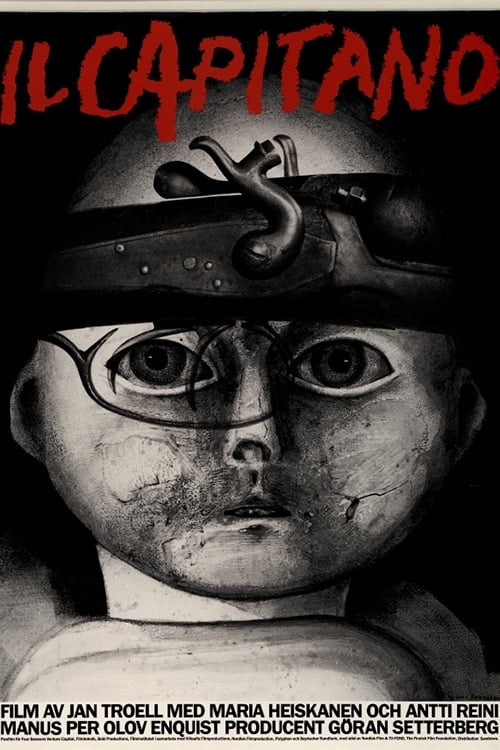




Popular
What role does the setting play in shaping the characters' experiences?
What is the significance of the character of Captain in the film?
How does the relationship between the Captain and his crew evolve throughout the film?
How does the character of the young soldier impact the Captain's journey?
What are the key moments that highlight the Captain's internal conflict?
Should I watch it?
Ask Your Own Question

What is the plot?
The film opens in a police interrogation room, where Minna is already under questioning and the story begins as a memory being dragged out of her. She is asked bluntly why Jari shot, whether she was afraid of him, whether they always slept in the car, and how they met, and those questions frame everything that follows as a retrospective account of fear, dependency, and fatal drift. The structure immediately signals that this is not a conventional whodunit but a reconstruction of a relationship collapsing into murder, and the nine chapter titles--Småtjuven, Drömmen, Separation, Resan, Sandkornen, Kortleken, Kaninerna, Flykten, and Rekonstruktion--promise a movement from petty theft toward aftermath and explanation.
In the first chapter, Jari emerges as the dominant force long before he is fully named as a killer. He is a Finnish drifter with a criminal record, a socially dysfunctional young man who survives through theft and who styles himself "Il Capitano," "the Captain," as though he can command reality by declaring himself in charge. Minna, younger and more uncertain, is attached to him in a way that looks at once defiant and submissive. One source describes her as his more mature "soldier," while others stress that she wants independence but cannot truly break away from him. Their relationship is not built on tenderness but on a tense mutual dependence that keeps tightening as they move through northern Sweden in stolen cars, sleeping in the vehicle at the edge of roads, living off shoplifting and burglary, and carrying a sawed-off shotgun with them like an extension of their instability.
The early movement of the film is all motion without direction. Summer in Sweden surrounds them with bright, harsh light, but their existence is cramped, dirty, and rootless. They drift through country roads and small towns, one stolen car after another, never settling, never truly stopping long enough to imagine a future. The road-trip form gives their lives the appearance of freedom, but the film steadily reveals that this freedom is only another name for being trapped together. Jari commands; Minna follows; Minna resists; Jari pulls her back. The emotional texture is all imbalance. He is the one who needs control, and the film makes that need feel like a weapon long before the actual gun is used.
As the story continues, the relationship's instability deepens into visible fracture. Minna wants away from Jari, but desire for independence is continually defeated by attachment, fear, and habit. Jari's insistence on dominance is not presented as a momentary temper but as the core of who he is. He needs to dominate to feel real, and the film repeatedly suggests that his identity as "Il Capitano" is not just a nickname but a psychological performance, a fantasy of authority that masks his fragility. Minna is pulled into that fantasy even as she sees through it. Their conversations, silences, and moments in the car build a suffocating intimacy: they are bound not only by love or need, but by criminal routine, mutual dependence, and the inertia of a life that has no outside.
The film's chaptered design keeps advancing them toward catastrophe. They continue stealing, sleeping in vehicles, and traveling through the Swedish countryside, their aimlessness becoming a form of suspense because the viewer understands that something irreversible is approaching. The atmosphere is one of suspended violence. The sawed-off shotgun visible in the car is not merely a prop; it is a visual promise that their drifting life already contains the capacity for murder. In the background of their wandering, the relationship between Jari and Minna keeps shifting between intimacy and separation, but each attempted break only exposes how entangled they are.
The turning point arrives when they steal a bicycle. Sources consistently identify this as the incident that triggers the killings: a family intervenes to stop the theft of the son's bike, and the situation turns lethal. The bicycle is such a trivial object that its importance feels almost grotesque, and that is exactly the point. The film reveals how a petty crime, committed by a couple already living on the edge, detonates into murder because Jari cannot tolerate resistance, interruption, or humiliation. The family's intervention is not framed as a complex confrontation or a planned attack; it is a sudden collision between ordinary domestic life and a pair of armed fugitives whose entire existence has been drifting toward this kind of violence.
The final approach to the crime is suffused with dread. Night falls, and the country setting becomes darker, more enclosed, as if the open road has been collapsing inward all along. The confrontation erupts in the darkness, and the film's sources describe it as the moment when two shots ring out in the night. Those shots are enough to kill. Jari fires on the family, and the three victims--a young boy and his parents--are murdered because they try to stop the theft of the son's bicycle. The boy dies first in the immediate violence of the confrontation, and the parents die in the same incident as the escalation turns from struggle to execution. The sources do not provide their names, only that they are a family of three, and the film itself is less interested in naming them than in showing how quickly Jari's need for dominance becomes fatal when challenged.
In that moment, the film's emotional logic snaps into place. Jari is not acting like a misunderstood rebel or a man driven by accident; the murder is the culmination of his entire mode of being, a final assertion of control when a powerless situation threatens his authority. Minna is trapped inside the event not just as a witness, but as someone whose dependence on him has already helped carry them to the edge. The film does not depict her as causing the shooting, but it does show her as unable to prevent it, and the opening interrogation makes clear that she is being forced to account for her own proximity to the crime.
After the murders, the story does not escape into action or chase. Instead, it turns inward and backward. The chapter "Rekonstruktion" signals that what remains is the act of piecing together what happened, and the film becomes less about escape than about the moral and emotional shape of the crime after the fact. Minna's questioning in the interrogation room functions as the narrative's anchor, returning the film to the first image and making the present tense of the story double back onto itself. The police ask whether she feared Jari, how she met him, whether they always slept in the car, and why he shot, and those questions expose the relationship in fragments, as if the film is forcing its way through denial toward the core truth.
This final movement also reveals the film's larger purpose. It is not simply recounting a sensational murder case; it is examining how a marginalized couple with no prospects, moving through Sweden in stolen vehicles and living by petty crime, arrive at a moment where a bicycle becomes the trigger for a triple homicide. Jari's self-coronation as "Il Capitano" is exposed as a delusion of command, an identity built to compensate for social failure and emotional instability. Minna's tragedy is that she can see enough to want out, but not enough to free herself in time. Their bond is mutual dependence, yet it is not equal: he dominates, she adapts, and the film lets that imbalance harden until it becomes irreversible.
The final scenes do not offer redemption or escape. Instead, the film closes on the fact of the crime itself and on the retrospective frame that has held the whole story together. According to one source, it ends with a stark written statement: "Natten till den 3 juli 1988 mördades på en kyrkogård i en by i Västerbotten tre oskyldiga människor: man, hustru och deras femtonårige son. Därför denna film." That closing text makes the ending explicit and final: on the night of 3 July 1988, three innocent people are murdered in a village in Västerbotten, and the film exists because of that event. The story therefore ends not with the killers' triumph or punishment, but with a blunt memorial to the victims and a refusal to soften the violence that brought them down.
By the time the interrogation and reconstruction reach their end, what remains is the bleak recognition that the movie has been tracing a straight line from drift to death all along. Jari lives only as the controlling, violent figure whose fantasy of being "the Captain" collapses into murder, and Minna survives as the witness whose testimony opens and frames the story. The three members of the family die in the bicycle confrontation, and the film leaves no doubt that Jari is the one who kills them. The resolution is not justice in a dramatic sense but exposure: the relationship, the thefts, the road, the shotgun, the dependency, and the fatal bicycle all fit together into one terrible sequence, and the final image is of a crime fully named, fully remembered, and impossible to undo.



What is the ending?
In the ending of "Il Capitano: A Swedish Requiem," the story culminates in a tragic confrontation between the characters, leading to a resolution that reflects the deep emotional scars and unresolved conflicts they carry. The captain, haunted by his past and the weight of his decisions, faces the consequences of his actions. The film concludes with a sense of loss and reflection, leaving the characters to grapple with their fates.
As the final scenes unfold, we find ourselves in a dimly lit room, where the captain sits alone, the shadows of his past looming large. The atmosphere is heavy with tension, and the silence is punctuated only by the distant sounds of the sea. The captain's face is etched with weariness, a testament to the burdens he has carried throughout the film. He reflects on the choices he made, the lives he impacted, and the haunting memories that refuse to fade.
In a flashback, we see the captain's earlier interactions with his crew, filled with camaraderie and hope. However, these moments are now tainted by the knowledge of betrayal and loss. The captain's internal struggle is palpable; he grapples with guilt and regret, knowing that his decisions have led to irreversible consequences.
As the narrative shifts back to the present, the captain is confronted by a figure from his past, a representation of the unresolved conflict that has haunted him. Their exchange is charged with emotion, revealing the depth of their shared history and the pain that lingers between them. The captain's voice trembles as he speaks, revealing his vulnerability and the weight of his remorse.
In the final moments, the captain makes a choice that signifies his acceptance of his fate. He steps away from the confrontation, choosing to embrace the solitude that has defined his journey. The camera lingers on his face, capturing the mixture of sorrow and resignation as he walks away from the past, leaving behind the ghosts that have haunted him.
The film closes with a haunting image of the sea, a metaphor for the vastness of loss and the inevitability of moving forward. The captain's fate is left ambiguous, but it is clear that he carries the scars of his experiences, forever changed by the journey he has undertaken.
In summary, the ending of "Il Capitano: A Swedish Requiem" encapsulates the themes of loss, regret, and the search for redemption, leaving the audience to ponder the complexities of the human experience and the weight of our choices.
Is there a post-credit scene?
Il Capitano: A Swedish Requiem does not have a post-credit scene. The film concludes its narrative without any additional scenes after the credits roll. The story wraps up with a poignant reflection on the themes of loss, memory, and the impact of war, leaving the audience to contemplate the emotional weight of the characters' journeys. The absence of a post-credit scene aligns with the film's somber tone and focus on the profound experiences of its characters.
What role does the setting play in shaping the characters' experiences?
The film is set against the backdrop of a war-torn landscape, which amplifies the characters' emotional states. The desolate environments reflect their inner turmoil and the chaos of their circumstances, influencing their actions and decisions throughout the narrative.
What is the significance of the character of Captain in the film?
The Captain serves as a complex figure representing authority and the burdens of leadership. His internal struggles reflect the moral dilemmas faced by those in power, particularly in the context of war and its consequences.
How does the relationship between the Captain and his crew evolve throughout the film?
Initially, the Captain maintains a strict, authoritative demeanor, but as the story progresses, the crew's loyalty is tested by the harsh realities of their situation. The dynamics shift as they confront their fears and the Captain's decisions, leading to moments of tension and camaraderie.
How does the character of the young soldier impact the Captain's journey?
The young soldier represents innocence and the harsh realities of war. His interactions with the Captain challenge the latter's views on duty and sacrifice, forcing the Captain to confront his own beliefs and the consequences of his actions.
What are the key moments that highlight the Captain's internal conflict?
Key moments include his reflections on past decisions, confrontations with his crew about their fears, and moments of vulnerability when he questions the morality of his orders. These scenes reveal his struggle between duty and compassion, ultimately shaping his character arc.
Is this family friendly?
"Il Capitano: A Swedish Requiem" is a film that deals with heavy themes and contains several elements that may not be suitable for children or sensitive viewers. Here are some potentially objectionable or upsetting aspects:
-
War and Violence: The film explores the impact of war, including scenes that depict violence and the emotional toll it takes on individuals and families.
-
Death and Grief: There are moments that address loss and mourning, which may be distressing for younger audiences or those sensitive to themes of death.
-
Emotional Turmoil: Characters experience deep emotional struggles, including despair and existential crises, which may be challenging for some viewers to process.
-
Mature Themes: The narrative delves into complex adult themes such as betrayal, loyalty, and the moral ambiguities of war, which may be difficult for children to understand.
-
Intense Emotional Scenes: There are scenes that evoke strong feelings of sadness and conflict, which could be upsetting for sensitive viewers.
Overall, the film's exploration of these serious themes may not be appropriate for a family-friendly viewing experience.