












Popular
What role does the character of the drug lord play in the story?
What is the main conflict that Inspector Lee faces in Her Fatal Ways 2?
How does Inspector Lee's character develop throughout the film?
How does the relationship between Inspector Lee and her partner evolve in the film?
What specific challenges does Inspector Lee face while investigating the murders?
Should I watch it?
Ask Your Own Question

What is the plot?
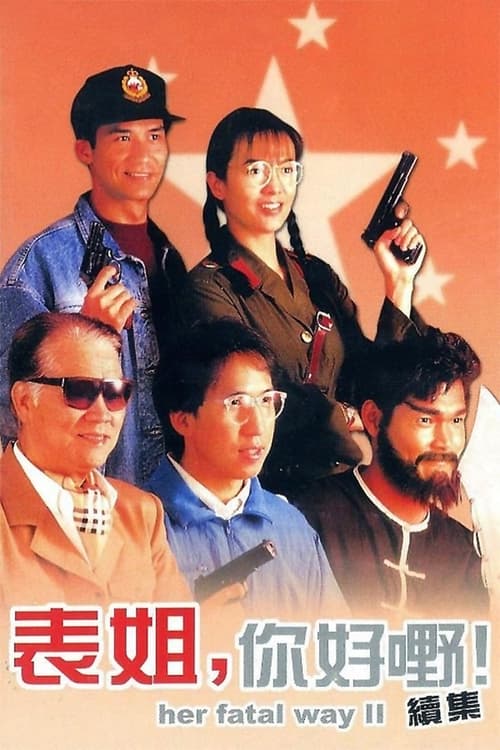
Her Fatal Ways 2 opens with mainland police inspector Cheng Shih-Nan back in command after the events of the first film, now carrying herself with even more authority because her past success has earned her greater respect on the mainland. She is no longer simply the rigid, anti-capitalist cop who once looked down on Hong Kong from afar; she is a celebrated officer, yet her pride and habits remain intact, and they immediately create friction with the people around her. Her assistant and cousin Hsiao Sheng stays at her side, and the film quickly makes clear that his usefulness is mixed with comic awkwardness, while another police aide, policeman Niu or Tiger depending on the source's transliteration, rounds out her team as the blunt, physically imposing but somewhat simple muscle of the group.
The story begins on the mainland, where Cheng is enjoying the status she has gained from her previous exploits, but her attention is soon pulled back into duty when a new case develops that links the mainland and Hong Kong. The trigger is a murder connected to a Hong Kong trip, and the case is serious enough that Cheng is sent south again with her team to follow the trail. The film immediately leans into its culture-clash comedy: Cheng carries herself with stern political certainty, while the world she is about to enter is faster, looser, more glamorous, and, in her eyes, far more morally suspicious. Even before the investigation properly begins, the film is already setting up the contrast between mainland discipline and Hong Kong's "capitalist" social life, including nightlife and karaoke, which the story treats as both seductive and absurd.
When Cheng arrives in Hong Kong, the local police side is already in motion, and the first important local figure she meets is Hong Kong police detective Wu Hsiung / Wu Wei-kuo's relative, a man connected to the earlier film's Hong Kong law-enforcement circle. The different sources vary in naming, but they consistently present him as the Hong Kong detective who becomes drawn into the case and forced into cooperation with Cheng. He is more westernized in manner and outlook than Cheng, and that difference becomes one of the film's central comic engines: she judges him as soft, compromising, and too accommodating to Hong Kong ways, while he sees her as rigid, domineering, and almost comically severe. Their partnership is not voluntary in spirit, only in necessity, because the murder and the wider criminal web require both police systems to work together.
The investigation begins with the murder itself. The Hong Kong side is first pulled into the matter when a witness sees a killing in a hotel, and that witness becomes one of the key pivots in the story. The sources do not name the dead person in a way that can be stated with certainty, but they do make clear that the hotel killing is the crime that launches the central plot and that the witness to that murder is the Hong Kong cop who becomes entangled with Cheng. That murder is not a random act of violence; it is the surface eruption of a much larger criminal structure involving drug running, gun running, and triad activity. What begins as a murder inquiry quickly broadens into a hunt for the identities of the killers and the people behind them, because the case is tied to smuggling routes and underworld power.
As soon as Cheng and the Hong Kong detective are forced into cooperation, the film turns their partnership into a battleground of personality and ideology. Cheng criticizes the local police for their informality, and she is openly contemptuous of Hong Kong society's freedoms and consumer pleasures. She treats local manners, entertainment, and social customs as symptoms of decadence, while the Hong Kong officers try to work around her bluntness and her refusal to adapt. At the same time, the story does not paint her as simply foolish; her discipline, intelligence, and persistence make her formidable, and the local police are repeatedly forced to admit that her methods are effective even when her tone is unbearable. The tension is not merely comic. Every meeting, every exchange of jurisdiction, and every step of the inquiry becomes a small contest over who controls the case and whose worldview is correct.
Cheng's team expands with the inclusion of Hsiao Sheng and the rougher mainland aide described in some sources as Tiger or policeman Niu. Hsiao Sheng functions as Cheng's loyal assistant and cousin, and he often seems to absorb the absurdity of the situation before anyone else does. Tiger, by contrast, is the sort of man whose presence seems designed to intimidate criminals and embarrass bureaucrats; one source describes him as beefy and possibly simple, which fits the film's comic pattern of mixing practical competence with foolishness. Together, the trio creates a moving contrast to the Hong Kong officers: Cheng is severe, Hsiao Sheng is earnest and off-balance, and Tiger is physically imposing but socially inept. Their presence deepens the chaos of the joint investigation, but it also gives Cheng enough backup to keep pushing forward when local cooperation turns sour.
The case grows more dangerous as the police begin to uncover the full shape of the underworld plot. What appeared to be a single murder is revealed as part of a larger network that spans trafficking, smuggling, and organized crime. The investigators are not merely chasing one killer; they are tracing a chain of criminal relationships that connects the victim, the hotel, the witnesses, and a larger set of suspects with money and weapons moving through Hong Kong. One of the main revelations is that the criminals are not operating in isolation but within a broader system of drug and gun running, which means the stakes keep rising as the police get closer to the truth. Every new clue tightens the net, and every new confrontation makes it more obvious that the killers are willing to strike again to protect their operation.
The partnership between Cheng and the Hong Kong detective becomes less about professional cooperation and more about mutual dependence. They clash constantly, but the investigation keeps forcing them into proximity, and the film uses that friction to build both tension and chemistry. His local knowledge and her uncompromising force prove to be complementary. When one approach fails, the other compensates. Cheng sees through the moral fog of the case with a certainty that often proves useful, while the Hong Kong detective understands the city's criminal movement and social patterns in ways Cheng cannot. Their exchanges sharpen the film's pacing: arguments are followed by chases, chases by interrogations, and interrogations by new discoveries that push the plot deeper into the criminal network.
At the same time, the film keeps returning to Cheng's experience of Hong Kong itself. She moves through restaurants, streets, and social spaces with a mixture of suspicion and fascination, still resistant to the city's freedoms but no longer entirely immune to them. The sources specifically mention karaoke and the "mysteries" of Hong Kong capitalism as part of the sequel's comic texture. These details matter because they show Cheng's character changing under pressure. She does not become easygoing, and she does not abandon her ideological identity, but Hong Kong leaves an impression on her again, just as it did in the first film. The city is not merely a backdrop; it is a test of her certainty.
The midpoint of the story is marked by increasing danger. As the investigators move closer to the real culprits, they find themselves in situations where the underworld's violence is no longer abstract. The criminals behind the trafficking operation begin to threaten the team's safety directly, and the atmosphere shifts from comic irritation to real suspense. The sources do not provide a fully scene-by-scene account of every encounter, but they do establish that the team's discoveries put all of them "in danger," and that success will require their "individual skills" to work together. That phrase is telling: the film's structure depends on the idea that each character contributes something different, and that the investigation can only be solved by combining disciplined police work, local street sense, physical strength, and stubborn persistence.
One of the key twists is that the murder case is tied to a larger movement between mainland and Hong Kong, with the criminals exploiting the border and the differences between police systems. What initially looks like a straightforward homicide inquiry becomes a broader exposure of smuggling routes and organized criminal behavior. The police begin to realize that the people involved are not just random thugs but part of a coordinated underworld operation whose reach is wider than the first crime scene suggests. This revelation changes the emotional weight of the story. Cheng is no longer just reacting to a single murder; she is confronting a criminal structure that humiliates both jurisdictions if it is not stopped.
The film's confrontations are defined by both action and embarrassment. Cheng and the Hong Kong detective repeatedly collide over procedure, and the local officers are often exasperated by her uncompromising attitude. Yet the tension never fully breaks the alliance, because the investigation keeps proving that cooperation is necessary. The criminals, for their part, are patient until they are cornered, at which point the story drives toward its climax through tightening pressure rather than long exposition. The hotel murder, the witness testimony, and the widening smuggling trail all converge into the final stretch, where the police are finally close enough to identify the people responsible and to understand why the murder happened in the first place.
The climax resolves around the exposure of the underworld plot and the defeat of the criminals behind it. The sources do not supply a shot-by-shot account of the final confrontation, but they consistently state that the investigators uncover the identities of the killers and their motives, and that the combined team's efforts succeed in bringing the case under control. This means the film's final action is not about one symbolic duel so much as the collapse of the criminal network once the police finally close in. Whatever escape routes or tactical advantages the smugglers think they have are overcome by the teamwork of Cheng's group and their Hong Kong allies. The case that began with a hotel murder ends with the broader operation exposed and neutralized.
No source available here gives a verified, named death count beyond the murder that starts the story, so only that death can be stated with confidence. The victim of the hotel killing is not identified in the materials provided, and there is no reliable source here that names additional deaths or attributes them to specific characters. What is clear is that the murder is the inciting death, and the criminals' wider operations place the investigators in mortal danger before the plot is resolved. If more deaths occur in the film, the available synopses do not describe them precisely enough to identify them responsibly.
By the end, Cheng and the Hong Kong detective have succeeded in bringing the case to resolution, but the story does not let the victory feel simple or triumphant. The entire arc is shaped by cross-border friction, and the final emotional note remains one of reluctant respect rather than instant harmony. Cheng has spent the film judging Hong Kong's lifestyle, yet she is also forced to acknowledge that its people, institutions, and even its pleasures are not as shallow as she first believed. The Hong Kong detective, in turn, has learned that Cheng's sternness conceals genuine competence and a kind of integrity that cannot be dismissed as political posturing. Their cooperation ends the criminal threat, but it also leaves both sides changed.
The movie closes in the same spirit that drives the rest of the sequel: crime is defeated, the police have done their job, and the comic-cultural tension remains alive in the characters' attitudes even after the immediate danger is gone. Cheng does not become a different person overnight, but Hong Kong has once again complicated her certainty, and the film ends with that blend of victory, irritation, and dawning familiarity that defines the series' appeal.



What is the ending?
In the ending of "Her Fatal Ways 2," the main character, Inspector Lee, confronts the antagonist, leading to a tense showdown. After a series of dramatic events, justice is served, and Inspector Lee reflects on her journey, realizing the importance of her relationships and the cost of her duty.
As the climax unfolds, the scene opens with Inspector Lee, portrayed by the determined and fierce actress, standing in a dimly lit warehouse. The atmosphere is thick with tension as she faces off against the villain, who has been orchestrating a series of crimes throughout the film. The air is heavy with the scent of oil and rust, and the flickering fluorescent lights cast eerie shadows on the walls.
Inspector Lee's heart races as she recalls the lives affected by the antagonist's actions. Her internal struggle is palpable; she is torn between her duty as a police officer and her desire to protect those she loves. The stakes are high, and she knows that failure could mean more innocent lives lost.
As the confrontation escalates, the villain taunts her, revealing their twisted motivations and the chaos they have caused. Lee's resolve hardens, and she channels her anger into a fierce determination to bring the criminal to justice. The scene is punctuated by the sounds of a struggle, the clashing of bodies, and the echo of gunfire that reverberates through the warehouse.
In a pivotal moment, Lee manages to outsmart the antagonist, using her wit and training to gain the upper hand. The fight culminates in a dramatic showdown where she finally apprehends the villain, handcuffing them with a sense of triumph mixed with relief. The camera captures her expression, a blend of exhaustion and satisfaction, as she realizes that she has not only fulfilled her duty but also avenged the wrongs done to her community.
As the dust settles, the scene shifts to a quieter moment where Lee stands outside the warehouse, the sun beginning to rise on the horizon. The warm light symbolizes hope and new beginnings. She reflects on the sacrifices made along the way, particularly the toll her job has taken on her personal life and relationships. The emotional weight of her choices hangs in the air, and she acknowledges the importance of balancing her career with her connections to others.
In the final moments, Lee reunites with her colleagues, who express their gratitude and admiration for her bravery. They share a moment of camaraderie, reinforcing the bonds formed through shared experiences. The film closes with Lee looking out at the city, a sense of peace washing over her as she contemplates her future, knowing that while her work is never truly done, she has made a difference.
The fates of the main characters are as follows: Inspector Lee emerges victorious, having confronted her demons and reaffirmed her commitment to justice. The antagonist is taken into custody, facing the consequences of their actions. Lee's colleagues stand by her side, united in their mission, while the community begins to heal from the turmoil caused by the villain's reign of terror. The ending encapsulates the themes of duty, sacrifice, and the importance of human connection amidst the chaos of life.
Is there a post-credit scene?
In "Her Fatal Ways 2," there is no post-credit scene. The film concludes without any additional scenes after the credits roll. The story wraps up with the main characters resolving their conflicts, and the narrative reaches a satisfying conclusion, leaving no further plot points to explore in a post-credit sequence. The focus remains on the main storyline and character arcs throughout the film.
What role does the character of the drug lord play in the story?
The drug lord in Her Fatal Ways 2 serves as the primary antagonist, orchestrating the criminal activities that Inspector Lee is trying to dismantle. His cunning and ruthlessness create a palpable tension in the film, as he poses a significant threat not only to Lee but also to the innocent lives caught in the crossfire of his operations.
What is the main conflict that Inspector Lee faces in Her Fatal Ways 2?
In Her Fatal Ways 2, Inspector Lee faces the challenge of solving a series of murders that are intricately linked to a drug trafficking ring. As she delves deeper into the investigation, she encounters various obstacles, including corrupt officials and dangerous criminals, which test her resolve and skills as a detective.
How does Inspector Lee's character develop throughout the film?
Throughout Her Fatal Ways 2, Inspector Lee evolves from a determined and somewhat naive officer into a more seasoned and strategic investigator. Her experiences in the field, particularly the emotional toll of the cases she handles, force her to confront her own vulnerabilities and adapt her approach to law enforcement.
How does the relationship between Inspector Lee and her partner evolve in the film?
Inspector Lee's relationship with her partner undergoes significant changes in Her Fatal Ways 2. Initially, there is a sense of camaraderie and mutual respect, but as the stakes rise and the investigation becomes more dangerous, tensions flare. Their differing approaches to the case lead to conflicts, forcing them to reassess their trust and reliance on each other.
What specific challenges does Inspector Lee face while investigating the murders?
During her investigation in Her Fatal Ways 2, Inspector Lee encounters numerous challenges, including navigating the complexities of international crime, dealing with uncooperative witnesses, and facing threats from the drug trafficking network. These obstacles not only test her investigative skills but also put her life in jeopardy, heightening the film's suspense.
Is this family friendly?
"Her Fatal Ways 2," produced in 1991, is a crime-comedy film that contains several elements that may not be considered family-friendly. Here are some potentially objectionable or upsetting aspects:
-
Violence: The film includes scenes of crime and violence, which may be intense for younger viewers. There are confrontations and action sequences that depict physical altercations.
-
Mature Themes: The storyline involves themes of crime, law enforcement, and moral ambiguity, which may be complex and unsettling for children.
-
Language: There may be instances of strong language or suggestive dialogue that could be inappropriate for younger audiences.
-
Adult Situations: The film features adult relationships and situations that may not be suitable for children, including romantic entanglements and implications of infidelity.
-
Emotional Tension: Characters experience significant emotional turmoil, including stress and conflict, which could be distressing for sensitive viewers.
Overall, while the film has comedic elements, its themes and content may not be appropriate for all audiences, particularly children.









