
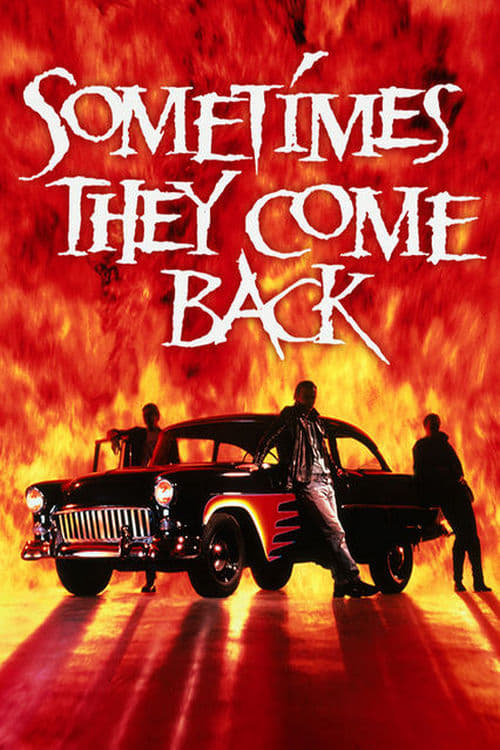














Popular
What happens to Jim Norman's brother, and how does it affect Jim's character?
Who are the members of the gang that returns to haunt Jim, and what are their motivations?
How does Jim's relationship with his wife, Sally, evolve throughout the film?
What role does the setting play in the story, particularly the high school and Jim's childhood home?
What is the significance of the train in the story, and how does it relate to the gang's fate?
Should I watch it?
Ask Your Own Question

What is the plot?
Sorry, we aren't able to watch and write up a full detailed plot yet. Check back in a few days.
More Movies Like This
Browse All Movies →



What is the ending?
In the ending of "Sometimes They Come Back," Jim Norman confronts the ghostly figures of his past, ultimately facing the leader of the group, who is responsible for his brother's death. In a climactic showdown, Jim manages to defeat the spirits, but not without significant emotional turmoil. The film concludes with Jim coming to terms with his past, as he finds a sense of closure.
Expanding on the ending in a detailed narrative:
As the film reaches its climax, Jim Norman stands in the dimly lit school hallway, the air thick with tension and the echoes of his past. The ghostly figures of the bullies who tormented him and killed his brother, Wayne, materialize before him, their faces twisted in malevolent glee. Jim's heart races, a mix of fear and anger coursing through him as he recalls the trauma that has haunted him since childhood.
The leader of the group, a sinister figure named DeSoto, steps forward, taunting Jim with memories of his brother's death. Jim's internal struggle is palpable; he is not just fighting for his own life but also for the memory of Wayne, who was taken from him too soon. The confrontation escalates as Jim, fueled by a surge of determination, confronts DeSoto and the others, demanding they leave him and his family alone.
In a desperate bid for survival, Jim recalls the advice of his wife, who had urged him to face his fears. He gathers his courage and, with a fierce resolve, challenges DeSoto. The confrontation is intense, filled with supernatural elements as the spirits attempt to overpower him. Jim's emotional state shifts from fear to anger, and finally to a sense of empowerment as he realizes that he must not only fight for himself but also for the peace of his brother's spirit.
In a pivotal moment, Jim manages to turn the tables on DeSoto, using the very memories that once tormented him as a weapon against the spirits. He confronts them with the truth of their actions, and one by one, they begin to dissipate, their hold on him weakening. The final showdown is a battle of wills, and Jim's determination ultimately prevails. With a final surge of energy, he banishes DeSoto and the other spirits, watching as they dissolve into nothingness, their laughter replaced by silence.
As the dust settles, Jim stands alone in the hallway, breathing heavily, the weight of his past finally lifting. He feels a sense of closure wash over him, knowing that he has not only defeated the ghosts of his childhood but has also found a way to honor Wayne's memory. The emotional turmoil that had plagued him for so long begins to fade, replaced by a newfound strength.
In the aftermath, Jim returns home to his wife, who has been anxiously waiting for him. Their reunion is tender, filled with unspoken understanding. Jim's journey has transformed him; he is no longer the haunted man he once was. He embraces his wife, and in that moment, he knows that he can finally move forward, leaving the past behind.
The film concludes with a sense of hope and renewal, as Jim looks toward the future, ready to embrace life without the shadows of his past looming over him. The fate of the main characters is clear: Jim has triumphed over his fears, while the spirits of DeSoto and his gang are vanquished, allowing Jim to reclaim his life and honor his brother's memory.
Is there a post-credit scene?
The movie "Sometimes They Come Back," produced in 1991, does not have a post-credit scene. The film concludes with a climactic resolution to the central conflict, focusing on the protagonist, Jim Norman, confronting the ghosts of his past. After the final confrontation with the supernatural elements, the story wraps up without any additional scenes or hints at further developments after the credits roll. The ending emphasizes Jim's emotional journey and the closure he seeks regarding his traumatic experiences, leaving no room for a post-credit sequence.
What happens to Jim Norman's brother, and how does it affect Jim's character?
Jim Norman's brother, a young boy named Wayne, is brutally murdered by a gang of bullies when they are children. This traumatic event haunts Jim throughout his life, shaping his character and motivations. As an adult, Jim becomes a high school teacher, but the memories of his brother's death resurface when the gang members, who died in a train accident, return as supernatural entities. Jim's internal struggle is fueled by guilt and the desire for revenge, leading him to confront his past.
Who are the members of the gang that returns to haunt Jim, and what are their motivations?
The gang consists of four members: the sadistic leader, a tough enforcer, a cunning trickster, and a violent brute. They return from the dead to seek revenge on Jim for the pain they caused him and to reclaim their former power. Their motivations are rooted in their unresolved anger and the desire to torment Jim, as they believe he is responsible for their deaths. Each member embodies a different aspect of their past cruelty, making their return a manifestation of Jim's unresolved trauma.
How does Jim's relationship with his wife, Sally, evolve throughout the film?
Initially, Jim and Sally share a loving relationship, but as the supernatural events unfold, tension rises. Jim becomes increasingly obsessed with confronting the gang, which strains their marriage. Sally worries about Jim's mental state and the danger he faces. As the haunting intensifies, Sally's fear for Jim's safety grows, leading to moments of emotional conflict. Ultimately, their bond is tested as they navigate the horrors of Jim's past and the threat posed by the returning gang.
What role does the setting play in the story, particularly the high school and Jim's childhood home?
The high school serves as a significant backdrop for Jim's confrontation with his past, symbolizing both his professional life and the return of his childhood trauma. The familiar hallways and classrooms become a battleground for Jim as he faces the resurrected gang. Jim's childhood home, where the initial tragedy occurred, is also pivotal; it represents his lost innocence and the source of his nightmares. The settings evoke a sense of nostalgia and dread, amplifying Jim's emotional turmoil as he grapples with his memories.
What is the significance of the train in the story, and how does it relate to the gang's fate?
The train is a crucial element in the story, symbolizing both death and the passage of time. The gang members die in a train accident, which serves as a turning point in the narrative. Their return is tied to this event, as they come back seeking vengeance against Jim for their deaths. The train represents the inescapable nature of the past and the consequences of unresolved trauma. It also serves as a physical manifestation of the danger they pose to Jim and his family, culminating in a climactic confrontation.
Is this family friendly?
"Sometimes They Come Back," produced in 1991, is a horror film that may not be considered family-friendly due to its themes and content. Here are some potentially objectionable or upsetting aspects that could affect children or sensitive viewers:
-
Violence and Gore: The film contains scenes of violence, including confrontations that lead to injuries and death. There are moments that depict blood and physical harm.
-
Supernatural Elements: The presence of ghosts and supernatural occurrences may be frightening for younger audiences, contributing to a tense atmosphere.
-
Themes of Death and Grief: The narrative explores heavy themes such as loss, revenge, and the impact of past traumas, which may be emotionally challenging for some viewers.
-
Intense Emotional Scenes: Characters experience significant fear, anger, and despair, which could be distressing for sensitive individuals.
-
Mature Language: The dialogue includes strong language that may not be suitable for younger viewers.
Overall, the film's horror elements and emotional weight make it more appropriate for mature audiences.








