


Popular
What challenges does the main character face while trying to fit into the Aspen lifestyle?
How does Kelly's relationship with her love interest develop throughout the film?
What role does the setting of Aspen play in the characters' development?
What are the key turning points in Kelly's journey of self-discovery?
How do secondary characters influence Kelly's decisions throughout the film?
Should I watch it?
Ask Your Own Question

What is the plot?
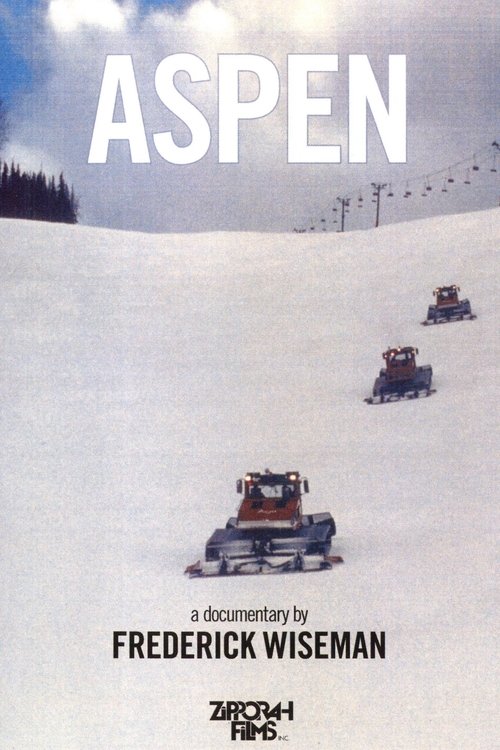
Frederick Wiseman's Aspen opens not with a plot hook but with a place, and the first impression is almost monastic in its calm: the film begins in a Benedictine monastery just outside Aspen, Colorado, before widening outward into the winter life of the town itself. From the start, Aspen is presented as a place of dual identity, a town famous in the nineteenth century for silver mining and now known for its scenic splendor, mountains, skiing, hiking, music, intellectual activity, and fashionable people. Wiseman does not introduce protagonists in the usual dramatic sense. Instead, he begins building a living social portrait out of institutions, work routines, public spaces, and the people who move through them, and the opening establishes the film's governing idea: Aspen is not one thing, but many overlapping worlds that share the same landscape.
The monastery scene sets a tone of reflection and collective identity, and then the film flows into the broader winter ecosystem of Aspen, where the ski resort and the town's year-round civic life sit side by side. Wiseman's camera observes without commentary as people live, work, visit, and play, and that observational method replaces conventional exposition. There is no single hero, no villain, no hidden scheme waiting to be uncovered; the "story" is the accumulation of real moments that reveal how Aspen functions socially and economically. One of the film's central revelations is built into its structure: Aspen is not merely a playground for wealthy visitors, but a working community with labor, service, culture, faith, and daily obligations running beneath the glamour.
As the winter scenes unfold, the ski resort emerges as one of the film's major spheres of activity. The slopes and resort facilities represent the most visible face of Aspen's identity, the version outsiders come to consume. People arrive to ski, to be seen, to participate in a seasonal economy that depends on beauty, snow, leisure, and money. The film lingers on the mechanics of that world, showing not only recreation but also the labor that makes it possible. Employees, instructors, workers, and administrators keep the resort functioning, and Wiseman's editing creates a steady rhythm between performance and maintenance, pleasure and toil. In one moment Aspen appears glamorous and effortless; in the next it is revealed as a place organized by work.
At the same time, the town itself becomes the second major arena, and this is where the documentary deepens its perspective. The film keeps turning away from the slopes and back to the lives of permanent residents, institutions, and public spaces that exist whether or not the tourists are present. That contrast is crucial. Aspen's winter population may swell with visitors and recreation, but the town also contains a stable social fabric made up of local residents, workers, clergy, cultural organizers, and institutions that shape its identity year-round. The documentary's power lies in showing how these two worlds overlap without ever fully merging: the resort economy and the town's civic life coexist, depend on one another, and yet remain distinct.
One of the most striking aspects of the film is its attention to Aspen's cultural and intellectual life. The town is not shown only as a ski destination; it is also presented as a place of music, discussion, ceremony, and thought. That matters because it complicates the cliché of a resort town. Wiseman includes moments that suggest Aspen understands itself as cultured, thoughtful, and socially varied, not simply affluent and recreational. The film's observational logic lets that idea emerge through juxtaposition rather than assertion. A scene in one institution may be followed by another in a completely different social space, and the cumulative effect is to show a town constantly negotiating between beauty and labor, privilege and community, sophistication and routine.
A key conceptual revelation comes from Aspen's history. The town's identity has shifted from silver-mining center to modern resort destination, and that transformation is one of the film's deepest underlying subjects. The documentary does not dramatize this as a single historical flashback; instead, it lets the present-day Aspen stand as evidence of that transformation. The mountains that once represented extraction and industry now represent luxury and leisure. That contrast gives the film much of its quiet tension. The land has not changed, but the social meaning of the place has, and the documentary keeps making the viewer feel that layered past beneath the polished present.
Because the film is observational, there are no fictional deaths, no murder, no tragic reversals caused by a single antagonist, and no climactic body count. There are also no dramatic confrontations in the conventional narrative sense, because the film does not build around one conflict that escalates to a final showdown. Its tensions are social rather than melodramatic: visitor versus resident, work versus play, appearance versus reality, seasonal spectacle versus year-round life. Those tensions are felt most strongly in the film's rhythms, in the way it keeps moving from one social world to another and showing how each depends on the other while remaining incomplete without it.
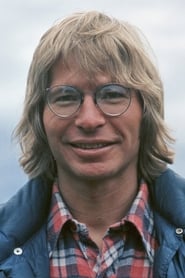
The documentary's one identifiable named public figure in the available source material is John Denver, listed as appearing as himself. His presence reinforces Aspen's cultural aura, since the town is associated with celebrities, arts, and fashionable visitors as much as with mountain recreation. But even that presence is not turned into a star vehicle. Wiseman does not isolate Denver as the center of the film. Instead, he becomes one more element in a broader social portrait, another sign of Aspen's layered public identity. The film remains committed to its ensemble-like observational vision, in which the town itself is the subject and every person, institution, and scene contributes to that portrait.
As the winter day-to-day continues, the film keeps moving through institutions and communal spaces, always returning to the contrast between Aspen as a resort and Aspen as a living town. The monastery at the beginning and the evangelical sermon near the end frame that movement with explicitly spiritual language. According to the source describing the film's final movement, Aspen ends as an evangelical pastor delivers a sermon: "Lord, please make us--an imperfect and varied people coming from such a wide variety of backgrounds--please build us together, join us together." That closing prayer crystallizes one of the film's central ideas. Aspen is shown as a place of differences--class differences, seasonal differences, institutional differences, and differences of purpose--but also as a place where people are trying, in their own ways, to be joined together into a coherent community.
The emotional force of that ending lies in the contrast between the film's observational neutrality and the pastor's direct appeal. Wiseman has spent the entire film refusing to impose a voice-over interpretation, allowing the town to define itself through behavior, routine, and conversation. Then, at the end, the sermon gives verbal form to what the film has been showing all along: Aspen is a "varied people" brought together by circumstance, geography, history, faith, work, and seasonal life. The prayer does not resolve conflict in any neat dramatic way, but it does provide a human vocabulary for the film's underlying social question--how a place so divided by function and status can still be held together as a community.
The final scenes do not offer a thriller-style payoff or a tragic ending, because there is no plot machinery to pay off in that way. Instead, the documentary ends in the same mode in which it begins: with observation, procession, and the sense of a place continuing beyond the frame. The effect is cumulative and reflective. By the end, Aspen has been shown as a winter town of many identities: a luxury resort, a working community, a cultural destination, a religious community, and a place whose present cannot be separated from its mining past. The film's last movement, anchored by the sermon's plea for unity, leaves the viewer with the sense that Aspen's real drama is not a sequence of deaths or twists, but the ongoing effort to make a shared life out of difference.









What is the ending?
In the ending of "Aspen," the main characters confront their personal struggles and relationships. The film culminates in a series of emotional revelations and decisions that lead to a sense of closure for the characters involved.
As the story unfolds, we see the characters grappling with their desires and the consequences of their actions. The film concludes with a sense of resolution, as each character finds a path forward, albeit not without challenges.
The final scenes of "Aspen" begin with a picturesque view of the snowy mountains, the sun setting behind them, casting a warm glow over the landscape. The atmosphere is charged with a mix of tension and hope as the characters prepare for the final events of their journey.
Scene 1: The ski lodge is bustling with activity, but the mood is somber. The main character, a young woman named Sarah, is seen sitting alone by the fireplace, her expression a mix of contemplation and sadness. She reflects on her relationships and the choices she has made throughout the film. The warmth of the fire contrasts with the coldness she feels inside, symbolizing her internal conflict.
Scene 2: Meanwhile, Sarah's love interest, Mark, is outside, struggling with his own feelings. He watches other skiers glide down the slopes, feeling a sense of isolation despite being surrounded by people. Mark's internal battle is evident as he grapples with his commitment to Sarah and his fear of vulnerability. He takes a deep breath, deciding to confront his feelings head-on.
Scene 3: Back in the lodge, Sarah's friend, Lisa, approaches her, sensing her distress. Lisa encourages Sarah to open up about her feelings for Mark. The conversation is heartfelt, with Lisa sharing her own experiences of love and loss. This moment of connection highlights the importance of friendship and support in navigating emotional turmoil.
Scene 4: As the night progresses, a party is held in the lodge, filled with laughter and music. Sarah and Mark find themselves drawn to each other amidst the festivities. They share a dance, and the chemistry between them is palpable. However, the weight of their unresolved issues looms over them. Mark finally musters the courage to express his feelings, admitting his fears but also his desire to be with Sarah.
Scene 5: In a pivotal moment, Sarah responds with honesty, revealing her own insecurities and the fear of being hurt again. Their conversation is raw and emotional, filled with vulnerability. They both realize that their love is worth the risk, and they decide to take a leap of faith together.
Scene 6: The film concludes with a montage of the characters moving forward in their lives. Sarah and Mark are seen skiing together, laughing and enjoying each other's company, symbolizing their newfound commitment. Lisa is shown pursuing her own passions, having learned from her experiences. The final shot captures the breathtaking beauty of Aspen, a metaphor for the journey of self-discovery and the importance of love and friendship.
In the end, each character finds a sense of purpose and direction, having faced their fears and embraced the complexities of their relationships. The film closes on a hopeful note, suggesting that while challenges remain, the bonds formed through love and friendship can lead to personal growth and fulfillment.
Is there a post-credit scene?
The movie "Aspen," produced in 1991, does not have a post-credit scene. The film concludes without any additional scenes or content after the credits roll. The story wraps up with the main characters' arcs resolved, leaving the audience with a sense of closure regarding their journeys throughout the film.
What challenges does the main character face while trying to fit into the Aspen lifestyle?
The main character, a young woman named Kelly, struggles to adapt to the high-society lifestyle of Aspen. She faces challenges such as navigating the social dynamics of wealthy ski enthusiasts, dealing with the pressure to conform to the glamorous image of the elite, and overcoming her insecurities about her background. Her journey is marked by moments of self-doubt and the desire to prove herself worthy of acceptance.
How does Kelly's relationship with her love interest develop throughout the film?
Kelly's relationship with her love interest, a charming and wealthy skier named Brad, evolves from initial attraction to deeper emotional connection. Initially, Brad is drawn to Kelly's authenticity, contrasting with the superficiality of his usual social circle. As they spend time together, their bond strengthens, but Kelly's insecurities and Brad's commitments to his social status create tension. Their relationship is tested by misunderstandings and external pressures, ultimately leading to a pivotal moment where Kelly must choose between her true self and the allure of wealth.
What role does the setting of Aspen play in the characters' development?
The setting of Aspen serves as a backdrop that amplifies the characters' struggles and aspirations. The picturesque snowy landscapes and luxurious ski resorts symbolize both the allure of wealth and the isolation that can accompany it. As Kelly navigates the slopes and social events, the setting reflects her internal conflicts--her desire for acceptance versus her longing for authenticity. The vibrant atmosphere of Aspen also highlights the stark contrasts between the characters' lifestyles, influencing their interactions and personal growth.
What are the key turning points in Kelly's journey of self-discovery?
Key turning points in Kelly's journey include her initial arrival in Aspen, where she feels out of place among the elite; a moment of vulnerability when she opens up to Brad about her insecurities; and a climactic confrontation with a rival who embodies the superficiality Kelly despises. Each of these moments forces Kelly to confront her values and ultimately leads her to embrace her true self, culminating in a decision that reflects her growth and newfound confidence.
How do secondary characters influence Kelly's decisions throughout the film?
Secondary characters play significant roles in shaping Kelly's decisions. Her friend, who embodies the carefree spirit of Aspen, encourages her to embrace the fun and excitement of the lifestyle, while a wealthy socialite serves as a foil, highlighting the pressures of conformity. Additionally, Brad's friends often challenge Kelly's authenticity, pushing her to either conform or stand her ground. These interactions create a complex web of influence that ultimately guides Kelly toward her path of self-acceptance.
Is this family friendly?
The movie "Aspen," produced in 1991, is generally considered to be family-friendly, but it does contain some elements that may be objectionable or upsetting for children or sensitive viewers. Here are a few aspects to consider:
-
Mild Language: There are instances of mild profanity that may not be suitable for younger audiences.
-
Romantic Themes: The film explores romantic relationships, which may include scenes of flirtation and dating that could be awkward for younger viewers.
-
Emotional Conflicts: Characters experience personal struggles and conflicts that may evoke feelings of sadness or discomfort, particularly in scenes involving relationship tensions or misunderstandings.
-
Skiing Accidents: Given the film's setting in a ski resort, there are scenes that depict skiing accidents, which could be alarming for some viewers, especially those sensitive to physical injuries.
-
Social Dynamics: The film touches on themes of social status and peer pressure, which may resonate differently with children and could lead to discussions about bullying or exclusion.
Overall, while "Aspen" is not overtly inappropriate, parents may want to preview it or discuss its themes with younger viewers to ensure it aligns with their comfort levels.