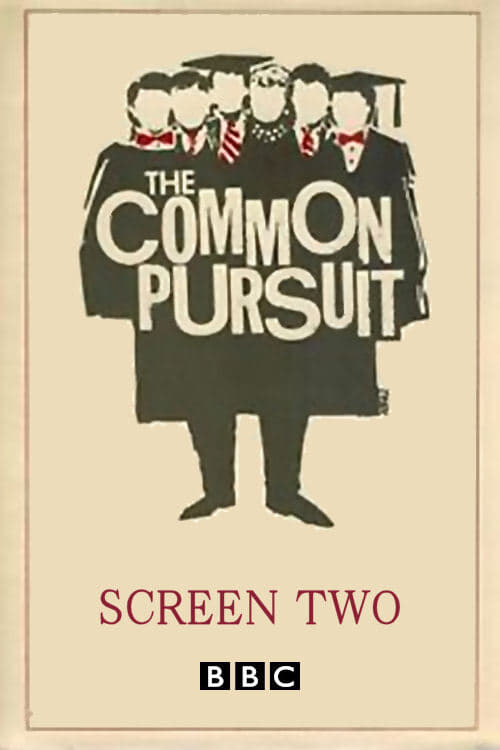









Popular
What are the main character's motivations throughout the film?
How does the relationship between Edward and his mentor evolve?
What role does the character of Liz play in the story?
How do the friendships among the characters change over the course of the film?
What is the significance of the theater setting in the film?
Should I watch it?
Ask Your Own Question

What is the plot?
Common Pursuit opens in Cambridge, circa 1968, in Stuart Thorne's rooms, where six undergraduates gather around a bright, slightly absurd idea: they are going to launch a literary magazine called The Common Pursuit. What begins as an earnest meeting of clever young people who believe literature, criticism, and intellectual seriousness can shape their lives slowly turns into a long, melancholy study of how time, compromise, sex, ambition, and failure erase the clean lines of youth.
Stuart Thorne is the one who pulls the group together, and at the start he seems like the organizing principle of the whole enterprise: focused, idealistic, and certain that something lasting can be made from their shared enthusiasms. Around him are the people who will define the shape of the story for the next twenty years: Marigold Watson, who is initially Stuart's beloved and is described as being very much in love with him; Nick Finchley, who wants to become a theatre critic; Humphry Taylor, who dreams of becoming a philosophy professor; Martin Musgrove, who is set on publishing; and Peter Whetworth, whose main interest seems to be chasing women. Their personalities are sketched quickly and cleanly, but the play is already planting the seeds of future disappointment, because each of these ambitions is precarious, and each of these people is already carrying private flaws that will matter later.
The first meeting has the feel of a youthful covenant. They talk as if the magazine is not merely a publication but a proof that they matter, that they belong to a generation capable of seriousness. The title itself carries an almost moral charge, echoing the kind of Cambridge intellectual world shaped by F. R. Leavis and by the idea that literature is not decoration but discipline. At this early stage, the group's common life still looks coherent. Stuart is the center, Marigold is beside him, and the others orbit the project with varying degrees of enthusiasm and vanity. Yet even here the play's dramatic irony is already active: the audience is being shown the first bright hour of a long unmaking.
As the story moves forward through the years, the magazine becomes less important as a practical object than as a symbol of the selves these people wanted to become. The play follows them across roughly two decades, from Cambridge undergraduates into adulthood, and the change is not gentle. Their friendships survive in fragments, but their lives are increasingly shaped by careers, marriages, betrayals, disappointments, and the ordinary pressure of having to live rather than merely think. What once looked like a shared intellectual destiny becomes a record of divergence.
The early years are filled with ambition, but ambition alone is not enough to protect anyone from compromise. Nick Finchley's theatrical seriousness does not guarantee artistic success; Martin Musgrove's path into publishing does not promise idealism; Humphry Taylor's devotion to moral philosophy does not make him morally secure; Peter Whetworth's charm does not make him loyal; and even Stuart, who seems most committed to the group's original vision, discovers that commitment itself can be compromised by the realities of money and family. The play tracks this erosion patiently, allowing small humiliations and practical decisions to accumulate until they become existential facts.
One of the most important pressures in the story is domestic life, especially the question of whether a family strengthens or destroys a person's ambitions. The play is explicitly concerned with "the pressure of having (or not having) a family," and it treats that pressure not as a background issue but as one of the central forces that shapes the characters' futures. The bright promises of student life, in which identity feels self-created, are replaced by the more intractable realities of marriage, children, and obligation. Even success, when it comes, does not arrive cleanly. In the review of one stage production, the world "grows colder and crueller," and the publishing venture that once sounded high-minded becomes "coffee table tripe," a sour joke about how ideals get turned into products.
The play's emotional center deepens as secrets begin to surface. The most striking revelation mentioned in the available sources concerns Stuart Thorne's wife: she has had an economically motivated abortion just as Stuart's magazine secures an Arts Council grant. That revelation lands with particular force because it splits the scene between public triumph and private cost. Stuart may appear saintly and principled on the surface, but the hidden reality is that the life behind the ideal has already been shaped by hard necessity and painful compromise. The timing matters: the grant arrives at the same moment as the abortion, so that artistic validation and bodily sacrifice become entangled in a way the younger characters would once have found unthinkable. The result is not simply a plot twist but a moral collapse of the kind this play specializes in--an exposure of the distance between the stories people tell about their lives and the lives themselves.
Humphry Taylor emerges as the play's sharpest moral observer and, eventually, one of its saddest figures. He begins as the most philosophically serious of the group, the one who wants to become a professor and presumably believes that ideas can still govern conduct. But the sources describe him as the "prickly commentator," Cambridge's "most promising moral scientist," and note that he comes to "a sad and sticky end." That phrase points to the play's tragic undertow: the man most committed to moral clarity is not rewarded by life, and his end is tied to the work's larger skepticism about whether intelligence and principle can survive adulthood intact. The exact mechanism of his death is not fully documented in the available sources, but the fact of his tragic end is clearly emphasized as one of the story's most devastating outcomes.
The narrative repeatedly returns to the group as they "happen to coincide again" at different moments over the years, and each reunion is a test of what is left of the original friendship. These gatherings are never nostalgic in a simple way. They are charged with the memory of what was once possible and the embarrassment of what has become of those possibilities. The younger selves of these characters seem to haunt the older ones, and the play's structure--moving back and forth across time--keeps forcing the audience to see the contrast between aspiration and result.
At some point in the later years, Stuart is no longer merely a bright student but a man with an office in Holborn, and the play's social texture changes accordingly. The world of Cambridge rooms gives way to professional spaces, late afternoons, early summers, and evenings in offices where the glow of youthful certainty is gone. The setting shift matters because it visually represents the characters' loss of innocence: the cramped, private space where they dream together is replaced by the bureaucratic and commercial spaces where those dreams are measured, negotiated, and often diluted. The magazine itself, once a symbol of seriousness, now sits in the middle of a broader career path, vulnerable to market logic and to the compromises required to keep it alive.
One of the play's most revealing tensions is between friendship and self-interest. Peter Whetworth, whose role at the beginning is largely defined by his appetite for women, reflects the way the play refuses to romanticize its male characters as a unified intellectual generation. Nick Finchley's desire to be a theatre critic likewise suggests that art can become a career and a performance, not just a calling. Martin Musgrove's publishing ambitions place him closest to the machinery that turns literature into business. Each man's later life seems to move him farther from the purity of the original meeting and closer to the compromises of the adult world. By the time they reappear in the 1980s, the flared trousers have vanished, but so has the confidence that they were all once going somewhere special.
The emotional temperature rises as the hidden fractures in the group become impossible to ignore. The play's "damaging secrets" do not arrive as melodramatic shocks but as revelations that confirm what the audience has slowly been suspecting: no one's life has stayed as noble as the first meeting implied. Stuart, who once seemed to be the moral center of the enterprise, is forced to make unexpected decisions when business demands collide with the private truth of his marriage. The abortion revelation is the clearest instance of this collision, because it exposes the cost of maintaining the outward appearance of artistic and domestic stability. It also suggests that the successes the group once imagined are themselves built on hidden losses.
The play's confrontations are often verbal before they become anything else. The sources preserve one sharp line from the BBC adaptation: Nick Finchley asks, "Would you really have hit me a moment ago?" That single question implies a near-physical confrontation charged with old grievances, and it shows how far the relationships have decayed from the convivial atmosphere of the Cambridge rooms. The line lands because it is not just about the threat of violence; it is about the surprise that old friends can become people one might actually strike. It reveals the emotional truth beneath the polite surfaces: betrayal, resentment, and long-simmering disappointment have become part of the common life.
As the years pass, the story's mood darkens into something close to elegy. The review material repeatedly emphasizes that the play is about thwarted literary aspirations, the pressure of family, infidelity, and moral philosophy, and that its ending is melancholy. That melancholy is not a single event but the cumulative effect of watching intelligent people age into compromise. The "audacious youth" of the early scenes gives way to "subdued" and even "grim early middle age," and that shift is what the play is really about. It is not just that dreams fail; it is that people learn to live with the failure and then call the result maturity.
The final structural trick of the play gives the ending an especially poignant shape. One source notes that "the last few minutes of the very first scene aren't actually seen until the very end of the play," which means the audience eventually returns to the opening situation and experiences it again with the burden of everything that has happened since. This is not merely a clever device. It means the story closes by folding time back on itself, so the hopeful beginning is re-seen through the lens of regret. What once looked like the start of a project now looks like the origin of a pattern that could not be escaped. The unfinished business of the first scene becomes emotionally complete only after the audience has witnessed years of disappointment.
By the final movements, the play is no longer asking whether The Common Pursuit magazine will succeed in any literary sense. It is asking what remains of shared ideals once life has had its way with them. The answer is both sad and humane. These people do not become monsters; they become ordinary adults with compromised marriages, diminished ambitions, and memories they cannot quite stop revisiting. The emotional force of the ending comes from the recognition that the original bond was real, even if it could not survive intact. The audience has watched six intelligent, hopeful people begin with a belief in literature and end in the knowledge that life is more coercive than talent, more humiliating than theory, and less tidy than the ideals of youth.
Humphry Taylor's tragic end hangs over this conclusion as a grim marker of what the years have done. His fate gives the ending its strongest note of loss, even though the sources do not specify the precise circumstances of his death. The play does not offer catharsis in a conventional sense. Instead, it offers recognition: each character has been altered by time, and the group's common pursuit has become the pursuit of a vanished self. The title, once hopeful, now feels almost ironic. What they were chasing was never only a magazine or a career; it was a coherence that adulthood would not allow.
The final scenes therefore do not resolve into victory or neat reconciliation. They end in the key the play has been tuning all along: reflective, bruised, and quietly devastating. The characters who survive do so with their illusions reduced, their relationships scarred, and their original ideals irretrievably changed. Stuart's early certainty has been exposed as vulnerable to private pain and public necessity. Marigold's place in the story is inseparable from the emotional cost of that early love. Nick, Martin, Peter, and Humphry each carry forward some version of the compromises the play has been tracing from the beginning. The ending completes the opening scene not by undoing time but by revealing what time has done.
More Movies Like This
Browse All Movies →








What is the ending?
In the ending of "Common Pursuit," the characters confront their personal and professional aspirations, leading to a series of revelations and decisions that shape their futures. The film concludes with a sense of unresolved tension, as the characters grapple with their ambitions and relationships.
As the film approaches its conclusion, the setting shifts to a gathering of the main characters in a familiar space, where they reflect on their past experiences and the choices they have made. The atmosphere is charged with a mix of nostalgia and uncertainty. Each character reveals their inner struggles, showcasing their desires and disappointments.
The first character, a playwright, faces the reality of his unfulfilled dreams. He acknowledges the sacrifices he has made for his art, yet feels the weight of his failures. His emotional turmoil is palpable as he grapples with the fear of never achieving the recognition he craves.
Another character, a struggling writer, confronts the harsh truths of the publishing world. She expresses her frustrations about the industry and her own insecurities, revealing a deep-seated desire for validation. Her vulnerability resonates with the group, highlighting the shared struggles of creative individuals.
As the characters engage in heated discussions, tensions rise, leading to confrontations that expose long-held resentments and unspoken feelings. The dialogue is sharp and revealing, as each character's motivations come to the forefront. The playwright's ambition clashes with the writer's need for acceptance, creating a rift that threatens their friendship.
In a pivotal moment, the characters are forced to confront their choices. They reflect on the sacrifices they have made for their art and the impact those choices have had on their relationships. The emotional stakes are high, as they realize that their pursuit of success has come at a personal cost.
The film culminates in a bittersweet resolution. The characters make decisions about their futures, some choosing to pursue their dreams despite the risks, while others opt for stability and security. The playwright decides to take a leap of faith, vowing to continue writing, while the writer contemplates a new direction in her career.
As the final scene unfolds, the characters share a moment of camaraderie, acknowledging their shared journey and the complexities of their aspirations. The film ends on an ambiguous note, leaving the audience to ponder the characters' fates and the ongoing struggle between ambition and personal fulfillment.
In summary, the ending of "Common Pursuit" encapsulates the characters' internal conflicts and the challenges they face in their pursuit of success, ultimately leaving their futures open to interpretation.
Is there a post-credit scene?
The movie "Common Pursuit," produced in 1992, does not have a post-credit scene. The film concludes without any additional scenes or content after the credits roll. The story wraps up with the characters' arcs and themes fully explored within the main narrative, leaving no further material for a post-credit sequence.
What are the main character's motivations throughout the film?
The main character, a young playwright named Edward, is driven by his desire for success and recognition in the competitive world of theater. His ambition often leads him to make choices that strain his relationships with friends and colleagues, revealing his internal conflict between personal aspirations and loyalty.
How does the relationship between Edward and his mentor evolve?
Edward's relationship with his mentor, a seasoned playwright named Henry, begins with admiration and respect. However, as Edward's ambition grows, he starts to resent Henry's influence and guidance, leading to tension and conflict. This evolution highlights Edward's struggle between seeking independence and the need for mentorship.
What role does the character of Liz play in the story?
Liz serves as a grounding force in the narrative, representing both a romantic interest and a moral compass for Edward. Her character often challenges Edward's decisions, pushing him to confront the consequences of his ambition and the impact it has on their relationship.
How do the friendships among the characters change over the course of the film?
The friendships among the group of aspiring playwrights are tested as ambition and jealousy surface. Initially supportive, the dynamics shift as competition intensifies, leading to betrayals and reconciliations that reflect the complexities of their aspirations and personal connections.
What is the significance of the theater setting in the film?
The theater setting serves as a microcosm for the characters' ambitions and struggles. It is a place of creativity and collaboration, but also of rivalry and heartbreak. The physical space of the theater amplifies the emotional stakes, as characters navigate their dreams and the harsh realities of the industry.
Is this family friendly?
"Common Pursuit," produced in 1992, is a film that explores themes of ambition, relationships, and the struggles of aspiring writers. While it does not contain overtly graphic content, there are several elements that may be considered objectionable or upsetting for children or sensitive viewers.
-
Adult Themes: The film delves into complex adult relationships, including romantic entanglements and the challenges of personal ambition, which may not be suitable for younger audiences.
-
Language: There are instances of strong language that may be inappropriate for children.
-
Emotional Turmoil: Characters experience significant emotional struggles, including jealousy, disappointment, and existential crises, which could be distressing for sensitive viewers.
-
Depictions of Failure: The characters face setbacks in their careers and personal lives, which may resonate negatively with those who are particularly sensitive to themes of failure or rejection.
-
Substance Use: There are scenes that involve alcohol consumption, which may not be suitable for younger viewers.
Overall, while "Common Pursuit" is not explicitly graphic, its mature themes and emotional depth may make it more appropriate for older teens and adults.