
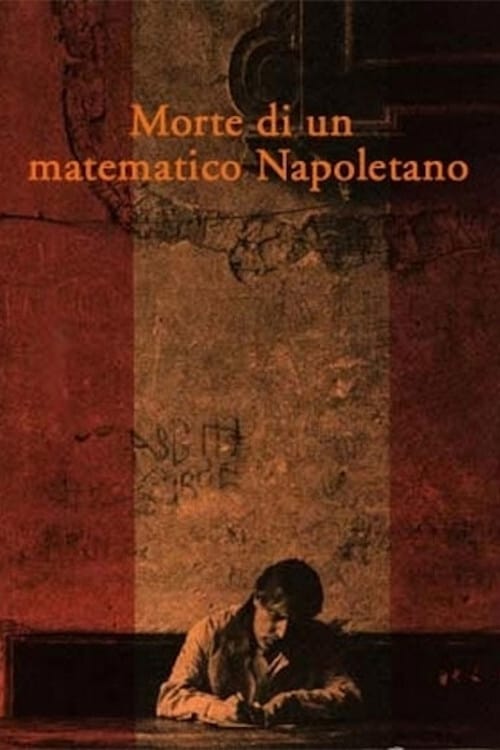




























Popular
What is the significance of the character Renato Caccioppoli in the film?
How does Caccioppoli's relationship with his mother influence his character?
What role does the setting of Naples play in the film?
How does Caccioppoli's academic work impact his personal relationships?
What is the significance of the mathematical concepts presented in the film?
Should I watch it?
Ask Your Own Question

What is the plot?
Sorry, we aren't able to watch and write up a full detailed plot yet. Check back in a few days.




What is the ending?
In the ending of "Death of a Neapolitan Mathematician," the protagonist, the mathematician Renato Caccioppoli, struggles with his mental health and the pressures of his academic life. Ultimately, he decides to take his own life, leaving behind a legacy of brilliance intertwined with personal turmoil. His friends and colleagues are left to grapple with the loss and the implications of his tragic decision.
As the film approaches its conclusion, we find Renato Caccioppoli increasingly isolated in his thoughts. The scenes shift to his home, where the atmosphere is heavy with a sense of impending doom. Renato is seen pacing in his dimly lit apartment, surrounded by stacks of papers filled with his mathematical theories. His mind is a whirlwind of genius and despair, reflecting his internal conflict between his passion for mathematics and the overwhelming weight of his existential crisis.
In a poignant scene, Renato meets with his friend and fellow mathematician, who expresses concern for his well-being. The dialogue is laced with tension, as Renato brushes off the worries of those around him, insisting that he is fine. However, the audience can sense the deepening chasm of loneliness that envelops him. His friend's attempts to reach out are met with Renato's defensive demeanor, showcasing his struggle to connect with others while feeling trapped in his own mind.
As the narrative unfolds, we witness Renato's interactions with his lover, who embodies both a source of comfort and a reminder of his isolation. Their conversations are filled with unspoken words, as she tries to understand his turmoil. Renato's emotional state fluctuates between moments of tenderness and sharp detachment, revealing the complexity of his character. He is torn between his love for her and the suffocating grip of his mental anguish.
The climax of the film arrives when Renato, in a moment of despair, makes the fateful decision to end his life. The scene is hauntingly quiet, with the camera lingering on his face, capturing the resignation and sorrow etched into his features. He prepares for his final act with a sense of calm, as if he has found a release from the torment that has plagued him for so long. The audience is left to witness the tragic culmination of his internal battle, as he steps away from the world that has become too heavy to bear.
In the aftermath of Renato's death, the film shifts to the reactions of his friends and colleagues. They gather to mourn his loss, grappling with the shock and sadness that accompanies such a tragedy. The atmosphere is somber, filled with a sense of regret and reflection. Conversations among them reveal their struggles to comprehend the depth of Renato's pain and the brilliance that was lost. Each character is left to confront their own feelings of helplessness and the impact of Renato's absence on their lives.
The film concludes with a lingering sense of melancholy, as the camera pans over the empty spaces that Renato once occupied. His legacy as a mathematician is acknowledged, but it is overshadowed by the tragedy of his life. The final scenes serve as a poignant reminder of the fragility of genius and the often-hidden battles that individuals face, leaving the audience to ponder the complexities of mental health and the importance of connection in the face of despair.
Is there a post-credit scene?
The movie "Death of a Neapolitan Mathematician," produced in 1992, does not contain a post-credit scene. The film concludes its narrative without any additional scenes or content after the credits roll. The focus remains on the life and tragic death of the mathematician Renato Caccioppoli, exploring his struggles with mental health, his relationships, and his profound contributions to mathematics. The ending leaves viewers reflecting on the themes of genius, isolation, and the impact of personal turmoil on intellectual pursuits.
What is the significance of the character Renato Caccioppoli in the film?
Renato Caccioppoli is the central character, a brilliant but troubled mathematician whose life and work are deeply intertwined with his emotional struggles. His character embodies the conflict between intellectual pursuit and personal despair, as he grapples with his own existential crises and the pressures of academic life.
How does Caccioppoli's relationship with his mother influence his character?
Caccioppoli's relationship with his mother is complex and fraught with tension. She represents both a source of support and a figure of suffocating expectation. Her influence is evident in his emotional turmoil, as he seeks to break free from her control while simultaneously yearning for her approval.
What role does the setting of Naples play in the film?
The setting of Naples is crucial to the film, as it reflects Caccioppoli's inner turmoil and the vibrant yet chaotic nature of his life. The city's rich history and cultural backdrop serve as a contrast to his isolation and despair, highlighting the dissonance between his intellectual pursuits and the world around him.
How does Caccioppoli's academic work impact his personal relationships?
Caccioppoli's dedication to his mathematical work often alienates him from those around him. His obsession with his theories leads to strained relationships with colleagues and friends, as they struggle to understand his genius and the depths of his emotional struggles. This isolation exacerbates his mental health issues, creating a cycle of loneliness.
What is the significance of the mathematical concepts presented in the film?
The mathematical concepts in the film serve as a metaphor for Caccioppoli's internal conflicts and his quest for meaning. His work reflects his desire for order and understanding in a chaotic world, and the struggles he faces in his mathematical pursuits parallel his personal battles with depression and existential dread.
Is this family friendly?
"Death of a Neapolitan Mathematician" is a film that delves into the life and struggles of the mathematician Renato Caccioppoli, exploring themes of existential despair, mental illness, and the complexities of human relationships. While it is a thought-provoking narrative, there are several aspects that may be considered objectionable or upsetting for children or sensitive viewers:
-
Mental Health Struggles: The film portrays Renato's battle with depression and existential crises, which may be distressing for some viewers, particularly those who have experienced similar issues.
-
Suicidal Themes: The narrative includes references to suicide and the impact of Renato's mental state on his life and relationships, which could be triggering for sensitive audiences.
-
Family Conflict: There are scenes depicting tension and conflict within Renato's family, showcasing emotional distress and strained relationships that may be unsettling.
-
Isolation and Loneliness: The film explores themes of isolation, which can evoke feelings of sadness and discomfort, particularly in how it affects Renato's character.
-
Intense Emotional Moments: The film contains several emotionally charged scenes that may be overwhelming, as they delve into the depths of despair and the human condition.
Overall, while the film is rich in intellectual and emotional depth, its exploration of heavy themes may not be suitable for younger audiences or those who are sensitive to such topics.









