






















Popular
What specific films are discussed in relation to censorship in the documentary?
How does the documentary portray the impact of the MPAA on filmmakers during the 90s?
What role do interviews with filmmakers play in the narrative of the documentary?
How does the documentary address the public's reaction to explicit content in films?
What specific examples of censorship are highlighted in the documentary?
Should I watch it?
Ask Your Own Question

What is the plot?
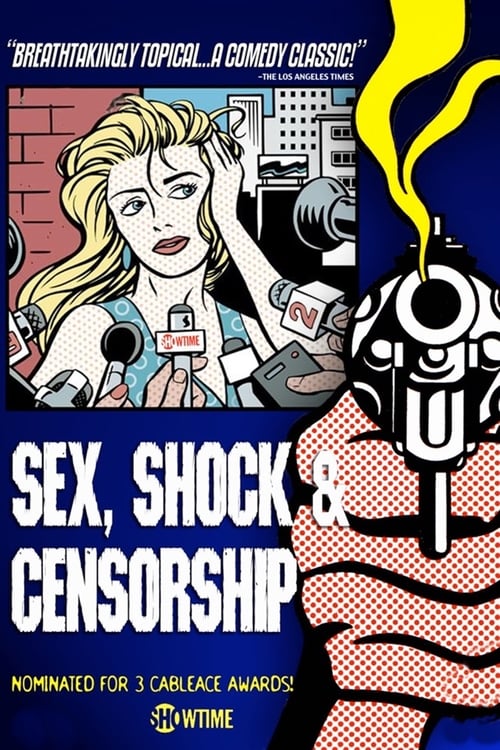
Sex, Shock & Censorship in the 90's is not a conventional story film, so there is no real chain of characters, deaths, or a climactic ending in the usual dramatic sense. It plays instead like a satirical mock-news special, with Fay Sommerfield acting as the outraged anchor who guides the viewer through a parody of early-1990s media panic over violence, profanity, and sacrilege.
The special opens as if it were a serious television exposé, with Fay Sommerfield positioned as a polished newswoman delivering her commentary in the authoritative style of programs like Primetime Live or 20/20. From the outset, her tone is stern, righteous, and knowingly excessive, as though she is presenting evidence in a cultural emergency. The program's basic joke is that it treats sensational entertainment as if it were a public menace, and the contrast between her grave delivery and the absurdity of the material creates the mock-documentary style that drives the whole piece.
As the special begins to unfold, Sommerfield frames early-1990s pop culture as a battlefield of moral decay. She speaks in the language of alarm, condemning what she presents as the era's flood of excessive violence, foul language, and blasphemous imagery. Rather than telling a single plotted story, the special cuts between her on-camera commentary and fake excerpts from supposed hit films and music videos, using these invented examples to parody the kind of evidence actual news programs might assemble when attacking a cultural trend. The effect is cumulative: each clip, no matter how ridiculous, is presented as one more horrifying proof that entertainment has gone too far.
The narrative momentum comes not from character development but from escalation. Fay Sommerfield's outrage grows more intense as she moves from example to example, as if she is building a case in real time. Her presentation turns the special into a parody of investigative journalism, where each segment feels like a new "revelation," though the revelations are really satirical amplifications of the same theme. The viewer is led through a sequence of staged outrages, each one selected to mock the public discourse around censorship and "decency" that was prominent in the early 1990s.
Because the special is built around commentary and clip montage rather than dramatic action, there are no named protagonists with secret agendas, no hidden villains to unmask, and no plot twists in the thriller sense. The "twist," if it can be called that, is the form itself: the special behaves like a hard-hitting exposé while actually functioning as a parody of such programs. Sommerfield's performance depends on that tension. She sounds absolutely sincere, but the audience is meant to recognize that the outrage is exaggerated for comic effect. The more forcefully she condemns the material, the more the special exposes the absurdity of censorship panic.
There are likewise no deaths to catalog. No one is killed, no murder mystery develops, and no confrontation ends in physical destruction. The "conflict" is ideological and performative: the special stages a moral struggle between a censorious media voice and the lurid entertainment products she attacks. Any confrontations are verbal and rhetorical, carried entirely by Sommerfield's delivery and by the juxtapositions of the mock clips. The program's energy comes from the friction between the seriousness of the host and the silliness of the targets.
As the special progresses, it keeps returning to the same satirical structure. Sommerfield's commentary gives the impression that she is exposing a dangerous cultural epidemic, while the fake movie and music-video material suggests exactly the kind of sensationalism she claims to denounce. That double edge is the core of the piece's humor. It mimics the format of moral outrage television so closely that the viewer is invited to laugh at both the mocked entertainment and the self-importance of the attack against it. The special does not move toward an emotional resolution so much as it repeatedly reinforces its central joke.
The ending follows naturally from that structure. Rather than culminating in a revelation, showdown, or tragic finale, the program simply completes its satirical argument and stops. Fay Sommerfield's role as the outraged guide remains intact to the end, and the special closes as a parody of a broadcast that has taken itself far too seriously. There is no final rescue, no death scene, and no character arc to resolve. The resolution is thematic: the special leaves the viewer with a satire of 1990s censorship anxiety, having turned the language of concern into the joke itself.
What remains most striking is the way the program uses form to make its point. By presenting itself as a news-magazine exposé, it channels the rhetoric of media alarm while filling that framework with fake examples of the very culture it condemns. That structure is the entire "story," and Fay Sommerfield is the engine that drives it from opening to end.








What is the ending?
In the ending of "Sex, Shock & Censorship in the 90's," the film culminates in a reflection on the impact of censorship and the evolving landscape of sexual expression in cinema. The documentary wraps up by showcasing the ongoing debates surrounding artistic freedom and the societal implications of censorship, leaving viewers with a sense of the unresolved tensions between creative expression and societal norms.
As the film approaches its conclusion, it revisits key moments from the 1990s that highlight the clash between filmmakers and censorship boards. The narrative shifts to a montage of various films that faced scrutiny, interspersed with interviews from directors, critics, and cultural commentators who discuss the implications of censorship on their work. The emotional weight of these discussions is palpable, as many express frustration and a sense of loss over the limitations imposed on their artistic visions.
The final scenes focus on the broader cultural shifts that have occurred since the 90s, emphasizing the ongoing struggle for freedom of expression in the arts. The film closes with a powerful statement about the importance of challenging censorship and advocating for the rights of artists to explore complex themes, including sexuality, without fear of retribution. The screen fades to black, leaving the audience to ponder the future of artistic expression in a world still grappling with the legacy of censorship.
In this way, the film concludes not with a definitive resolution for its characters but rather with an open-ended reflection on the societal issues at play, encouraging viewers to consider their own positions on censorship and artistic freedom.
Is there a post-credit scene?
The movie "Sex, Shock & Censorship in the 90's," produced in 1993, does not contain a post-credit scene. The film primarily focuses on the cultural and political climate surrounding the censorship of films during the 1990s, exploring the impact of sexuality and shock value in cinema. It features interviews and discussions with filmmakers, critics, and cultural commentators, but concludes without any additional scenes or content after the credits. The film wraps up its exploration of the era's controversies and debates, leaving the audience to reflect on the themes presented throughout.
What specific films are discussed in relation to censorship in the documentary?
The documentary discusses several films that faced censorship issues, including 'The Last Temptation of Christ,' 'Basic Instinct,' and 'Nymphomaniac.' Each film is examined for the controversies it sparked and the societal reactions it provoked.
How does the documentary portray the impact of the MPAA on filmmakers during the 90s?
The documentary illustrates the MPAA's influence by showcasing how filmmakers had to navigate the rating system to avoid censorship. It highlights specific cases where directors had to alter their films to secure a more favorable rating, thus affecting their artistic vision.
What role do interviews with filmmakers play in the narrative of the documentary?
Interviews with filmmakers such as Paul Verhoeven and others provide personal insights into their experiences with censorship. These interviews reveal their frustrations, motivations, and the creative compromises they faced while trying to express their artistic intentions.
How does the documentary address the public's reaction to explicit content in films?
The documentary explores various public reactions, including protests and calls for boycotts against films deemed too explicit. It captures the emotional responses of audiences and activists, illustrating the cultural divide over what constitutes acceptable content.
What specific examples of censorship are highlighted in the documentary?
Specific examples include the cuts made to 'The Last Temptation of Christ' to avoid an NC-17 rating and the backlash against 'Basic Instinct' for its sexual content. The documentary details how these instances reflect broader societal attitudes towards sexuality and morality in cinema.
Is this family friendly?
"Sex, Shock & Censorship in the 90's" is a documentary that explores the cultural landscape of the 1990s, focusing on the controversies surrounding sexuality, censorship, and the impact of media on society. Given its subject matter, it is not considered family-friendly.
Potentially objectionable or upsetting aspects include:
-
Graphic Discussions of Sexuality: The film features candid interviews and discussions about sexual themes, which may be inappropriate for younger audiences.
-
Censorship and Controversial Content: It addresses various instances of censorship in media, including explicit content that could be distressing or confusing for children.
-
Visuals of Provocative Art and Media: The documentary includes clips and images from films, performances, and artworks that may be considered shocking or offensive.
-
Emotional Testimonies: Some interviews may evoke strong emotional responses, discussing the impact of censorship on artists and creators, which could be upsetting for sensitive viewers.
-
Cultural Critique: The film critiques societal norms and values regarding sexuality, which may lead to uncomfortable conversations for younger viewers.
Overall, the film's exploration of adult themes and its critical lens on societal issues make it more suitable for mature audiences.