










Popular
How does the relationship between the protagonist and their companion evolve throughout the film?
What motivates the main character to embark on their journey in From the Snow?
What challenges do the characters face while navigating the snowy terrain?
What is the significance of the snow as a setting in the film?
How does the protagonist's past influence their decisions during the journey?
Should I watch it?
Ask Your Own Question

What is the plot?
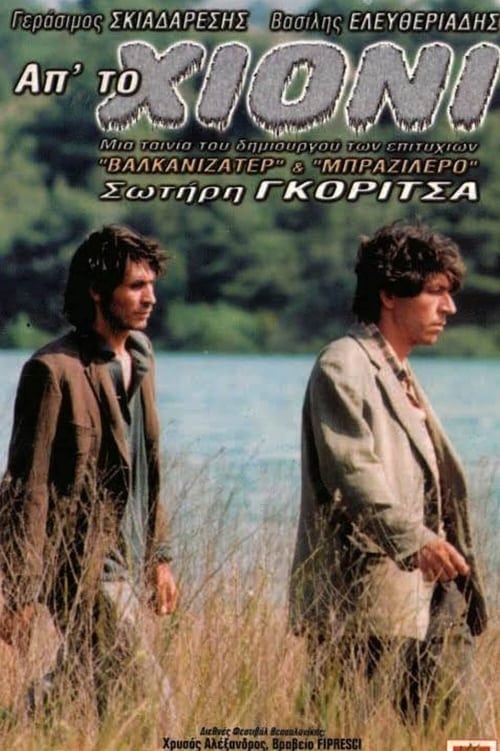
From the Snow opens in a cold, displaced world where identity itself is unstable, and from its first moments the film frames migration not as a journey toward safety, but as a passage into humiliation, loss, and erasure. The story centers on two young men, Thomas and Achilleas, whose lives are bound up with the Greek-Albanian border and the harsh pressures of survival; in the available plot descriptions, they are joined by a child named Nikos, whose mother has already been killed by Albanian guards, making the child's presence feel like both an orphaned burden and a living accusation. The film is set in the early 1990s, and one source places its Greek release in September 1993 while another notes a March 16, 1993 release date, underscoring that the film belongs to the immediate post-communist moment when border crossings, ethnic suspicion, and economic desperation are reshaping life in the region.
At the start, Thomas and Achilleas move through a landscape defined by snow, darkness, and danger, making an illegal late-night run at the Greek border with a urgency that suggests they have already crossed more than just a physical frontier. The border crossing is not presented as a clean escape or a triumphant act; it is clandestine, tense, and morally loaded, with the two young men pushing forward through uncertainty while carrying the weight of what they are fleeing and what they hope to find. Nikos enters their path as a child marked by violence and loss, his mother dead at the hands of Albanian guards, and his presence transforms the pair's flight into something more layered than simple self-preservation. He is not merely accompanying them; he is a reminder that the border has already taken lives, and that the world they are trying to enter is structured by grief as much as by geography.
The late-night crossing into Greece becomes one of the film's first major emotional thresholds. The trio are not welcomed as travelers but as bodies in motion, and the title From the Snow feels apt as the white landscape seems to swallow them and spit them out into a country that will never fully accept them. They make it across, but the crossing does not resolve anything; instead, it initiates the central contradiction of the film, because the land Thomas and Achilleas have "missed and dreamed of so often" is not a homeland in any simple sense once they reach it. Athens is supposed to represent return, possibility, and belonging, yet what greets them is a city and a society already prepared to misrecognize them. The film's social tension quickly sharpens into something personal and humiliating: the locals refer to the trio as "Albanians" throughout, refusing to accept them as Greek and flattening them into a slur that strips away their identity.
That misidentification is one of the film's most important revelations, because it collapses the fantasy of home. Thomas and Achilleas have crossed into the place they imagined would be theirs, but the return is emotionally inverted: they are treated as outsiders in the land they thought would restore them. The racism they encounter is not abstract; it is embedded in everyday interactions, in the language people use, and in the refusal to acknowledge their history or belonging. Some people do help them, and the available synopsis makes clear that the film does not present Athens as uniformly hostile, but those moments of assistance are overwhelmed by the broader atmosphere of exclusion and contempt. The sense of momentum shifts from travel-story excitement into a quieter, more corrosive despair. The city is not a destination but a test of how much humiliation they can endure before their hope collapses.
Thomas and Achilleas struggle on in Athens, trying to make some kind of life out of a place that will not see them clearly. They are not simply confronting poverty; they are confronting the social violence of being renamed by others. Nikos, as a child already marked by loss, stands at the center of this emotional strain. His future is even more precarious than theirs, and the film uses him to intensify the feeling that the world has no stable shelter for the vulnerable. The trio's bond becomes the only structure that resists the city's indifference, and that bond is what makes Thomas's fate so devastating later on. The story does not move toward reinvention in the urban setting. Instead, it tightens toward attrition.
The most tragic turning point comes when Thomas dies accidentally while working at a building site to make ends meet. The death is not the result of murder, war, or a dramatic confrontation; it is an accident, which makes it feel brutally ordinary, almost bureaucratic in its cruelty. Thomas has already been worn down by border crossings, racism, and the exhaustion of survival, and the construction site becomes the place where all that pressure finally breaks him. The film's emotional force here comes from the fact that his death is not a grand sacrifice but a meaningless loss, one that underlines how precarious undocumented or marginalized labor can be. The building site, a symbol of Athens being literally built up, becomes the place where one of its most vulnerable inhabitants is destroyed.
Thomas's death is the film's central death, and from the available sources it is the only one explicitly described after the opening backstory about Nikos's mother. The earlier death of Nikos's mother, killed by Albanian guards, hangs over the entire narrative as an offscreen trauma that has already fractured the child's life before the main action begins. In that sense, the film is structured by deaths that occur at both ends of the migration journey: one death pushes Nikos into motion, and another strips Thomas away once the trio has reached Athens. The pattern is devastatingly circular, suggesting that neither border nor city can preserve life once people are trapped in histories of violence and exclusion.
After Thomas dies, the atmosphere of the film changes again. His death is not followed by cathartic justice or a successful assimilation into Greek society. Instead, it pushes Achilleas and Nikos to confront the full emptiness of the dream that brought them there. The city has not become home; it has become another site of rejection, where even survival is provisional. The narrative then reaches its final major decision: Achilleas and Nikos decide to return to their Albanian village rather than remain in Athens. This is not framed as a clean victory or a happy ending. It is an act of refusal, a recognition that Athens has no place for them and that staying would mean continuing to live inside a lie about belonging.
The return home is the film's emotional resolution, but it is a resolution shaped by loss rather than closure. Thomas is gone, Nikos has been orphaned by the border and then pushed through a second abandonment in the city, and Achilleas is left to carry the memory of everything that has happened. The decision to go back to the Albanian village reads less like a triumphant homecoming than like a retreat to the only place that still recognizes their existence, even if that recognition is incomplete or painful. By the end, the film has reversed the normal migration arc: the journey does not end in arrival, and the promise of Greece collapses under racism, labor exploitation, and grief. What remains is not hope in the usual sense, but the fragile persistence of life after illusion has been destroyed.
Because the available plot material is limited, the film's most specific confrontations are the ones already embedded in the synopsis: the border crossing itself, the experience of being called "Albanians" in Athens, and the final unbearable confrontation with Thomas's accidental death at the building site. These are not staged as isolated action scenes so much as as cumulative pressures, each one pushing the characters farther from any stable identity. The dialogue detail that survives most clearly is the repeated insult used by locals, who call the trio "Albanians" even as they refuse the reality of who they are. That single word becomes a recurring act of social violence, collapsing nation, ethnicity, and status into a form of contempt that the film exposes rather than endorses.
In the final movement, the emotional tone is one of exhausted clarity. Achilleas and Nikos do not stay to argue with Athens or prove themselves to it; they leave, and that choice functions as the film's last statement on belonging. The ending does not restore what was lost, nor does it erase the deaths that have already happened. Thomas remains dead, Nikos remains marked by his mother's killing, and Achilleas carries forward with the knowledge that the country he imagined as refuge has transformed him into a stranger. The final scene, as the available plot information indicates, is the decision to return to the Albanian village, a quiet ending that lands like a verdict: the place they sought cannot hold them, and the only surviving path is backward into the landscape from which they came.








What is the ending?
In the ending of "From the Snow," the main character, a young boy named Sam, confronts the harsh realities of his life and the loss of his mother. He finds solace in the memories of her and ultimately decides to move forward, embracing the support of his friends and community. The film concludes with a sense of hope as Sam looks toward the future, symbolized by the melting snow and the arrival of spring.
As the final scenes unfold, the atmosphere is heavy with emotion. The camera captures the stark contrast between the cold, white landscape and the warmth of human connection. Sam stands alone at the edge of a snowy field, his breath visible in the frigid air, reflecting on the journey he has taken since his mother's passing. The weight of grief is palpable on his small shoulders, yet there is a flicker of determination in his eyes.
In the next scene, Sam is joined by his friends, who approach him cautiously, sensing his turmoil. They offer him a snowball, a simple gesture that signifies their support and camaraderie. Sam hesitates, the pain of loss still fresh, but he eventually accepts the snowball, a small smile breaking through his somber expression. This moment marks a turning point for him, as he begins to understand that he is not alone in his grief.
The scene shifts to a gathering in the community, where townsfolk come together to honor Sam's mother. The warmth of the bonfire contrasts sharply with the coldness of the snow surrounding them. As stories are shared, Sam listens intently, absorbing the love and memories that others have of his mother. He realizes that her spirit lives on in the hearts of those who loved her, and this revelation brings him a sense of peace.
As the night progresses, the snow begins to melt, symbolizing the transition from winter to spring. The camera pans over the landscape, capturing the first signs of life breaking through the snow. Flowers begin to bloom, and the sun rises, casting a golden light over the scene. Sam stands at the forefront, his friends by his side, looking out at the horizon with newfound hope.
In the final moments, Sam takes a deep breath, the cold air filling his lungs, and he whispers a quiet goodbye to his mother. He turns to his friends, who are laughing and playing in the melting snow, and joins them. The laughter echoes through the air, a stark contrast to the silence that once enveloped him. The film closes with a wide shot of the group, their figures silhouetted against the brightening sky, embodying the resilience of youth and the power of community.
In summary, Sam's journey through grief culminates in acceptance and the realization that while loss is a part of life, the love shared with those who have passed can provide strength and hope for the future. Each character plays a role in helping Sam navigate his emotions, ultimately leading him to embrace life once more.
Is there a post-credit scene?
The movie "From the Snow," produced in 1993, does not feature a post-credit scene. The film concludes its narrative without any additional scenes or content after the credits roll. The story wraps up with a poignant resolution, leaving the audience with a sense of closure regarding the characters' journeys and the themes explored throughout the film.
How does the relationship between the protagonist and their companion evolve throughout the film?
Initially, the protagonist and their companion share a strained relationship, marked by misunderstandings and differing motivations. As they face challenges together in the harsh winter environment, their bond deepens, leading to moments of vulnerability and trust that ultimately transform their dynamic.
What motivates the main character to embark on their journey in From the Snow?
The main character, driven by a deep sense of loss and a desire for redemption, embarks on a journey through the snow-covered landscape. This journey is not only physical but also emotional, as they seek to confront their past and find closure.
What challenges do the characters face while navigating the snowy terrain?
The characters encounter numerous challenges, including treacherous weather conditions, dwindling supplies, and the constant threat of wildlife. These obstacles test their physical endurance and mental resilience, forcing them to rely on each other and confront their fears.
What is the significance of the snow as a setting in the film?
The snow serves as a powerful backdrop that reflects the characters' internal struggles. It symbolizes both isolation and beauty, creating a stark contrast between the harshness of their environment and the warmth of their emerging connections.
How does the protagonist's past influence their decisions during the journey?
The protagonist's past, filled with regret and unresolved issues, heavily influences their decisions. Flashbacks reveal key moments that haunt them, prompting choices that are often driven by a desire to rectify past mistakes and seek forgiveness from themselves and others.
Is this family friendly?
"From the Snow," produced in 1993, is generally considered a family-friendly film, but it does contain some scenes that may be potentially objectionable or upsetting for children or sensitive viewers.
-
Emotional Struggles: The film explores themes of loss and grief, which may be intense for younger audiences. Characters experience moments of deep sadness and longing that could resonate strongly with sensitive viewers.
-
Conflict and Tension: There are scenes of conflict between characters that may create a sense of unease. These moments can include raised voices or arguments that might be distressing for some children.
-
Isolation: The setting in a snowy, remote location can evoke feelings of loneliness and isolation, which may be unsettling for viewers who are sensitive to themes of abandonment or solitude.
-
Mild Peril: There are instances where characters face physical challenges or dangers related to the harsh winter environment, which could be alarming for younger viewers.
Overall, while the film carries a heartwarming message, its emotional depth and certain scenes may require parental guidance for younger audiences.









