




Popular
What role does Pooh play in the cowboy adventure?
How do the other characters participate in the cowboy theme?
What challenges do the characters face during their cowboy adventure?
How does the character of Tigger contribute to the story?
What is Piglet's emotional journey throughout the cowboy adventure?
Should I watch it?
Ask Your Own Question

What is the plot?
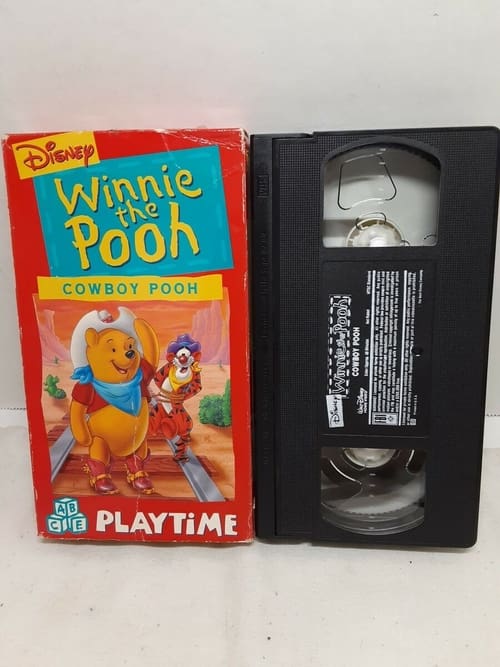
"Winnie the Pooh Playtime: Cowboy Pooh" is not a single feature-length story but a 1994 collection of three separate New Adventures of Winnie the Pooh episodes, so its "plot" unfolds as three distinct adventures in sequence rather than one continuous narrative. The release has no shared opening date, no single overarching climax, and no unified ending; instead, the complete story is the order of the three segments: "The Good, the Bad and the Tigger," "Rabbit Marks the Spot," and "The Masked Offender."
The first tale, "The Good, the Bad and the Tigger," begins in Christopher Robin's room, where he proudly shows his electric train set to Winnie the Pooh, Piglet, Tigger, Rabbit, Eeyore, and the others. Christopher Robin warns them not to touch the train while he is away, but Tigger is immediately tempted by it, and the playful warning hangs in the air like the start of trouble. When Tigger cannot resist any longer, he climbs aboard, and Pooh, half-admiring and half-worried, goes along with him. The train starts out smoothly, but once it reaches unfinished track, the situation turns into a catastrophe-in-waiting. Tigger scrambles to keep the locomotive from derailing, improvising a new path that sends the runaway train out of Christopher Robin's room and into an imagined Wild West world, where the friends re-envision themselves as cowboys, outlaws, and lawmen chasing the runaway engine.
That fantasy section gives the episode its western flavor. Piglet becomes the anxious would-be hero trying to stop what looks like a train theft, while Pooh and Tigger are seen as the reckless bandits responsible for the chaos. The mood grows more tense as Piglet, Rabbit, Eeyore, and eventually Gopher pursue the train in a pump trolley, determined to catch up before the situation becomes worse. Their chase goes badly, and the trolley collides with the train, leaving everyone rattled and the locomotive still beyond easy control. Tigger finally takes the only action he can think of: he drops a banana peel in the train's path, causing the runaway engine to smash and finally stop, which saves Piglet from further danger.
The ending of that segment is not tragic, but it is tense and moralizing. Tigger, despite having helped stop the disaster, is still treated as the one who caused the whole mess because he stole the train in the first place. He apologizes and begs for another chance, and the others eventually decide to forgive him with a warning rather than exile him. The confrontation ends in uneasy peace: the train is safe, Christopher Robin's trust is strained but not broken, and the friends return from the cowboy fantasy to the ordinary room where the trouble began.
The second tale, "Rabbit Marks the Spot," shifts to a pirate adventure with the same group of friends. Pooh, Piglet, Tigger, and Gopher become the "Pooh Pirates," and in their excitement they tear up Rabbit's garden while digging for buried treasure. Rabbit is furious at first, but instead of openly lashing out, he decides to punish them with a clever trick. He fills a treasure chest with rocks, buries it, marks it with an X, and draws a fake treasure map that he claims once belonged to his ancestor, the legendary pirate Long John Cottontail. The lie works: the Pooh Pirates follow the map and, with Captain Piglet leading, discover the chest exactly where Rabbit intended.
At first the pirates are ecstatic, but the mood changes when they cannot open the chest. Fearing that the treasure may be stolen or destroyed if it is opened outdoors, they bring it inside Piglet's house and keep struggling with it. Meanwhile, Rabbit spends the night worrying that his joke may have gone too far. He falls asleep and has a nightmare in which his friends rise from the ground as stone-like monsters, each one confronting him with the emotional damage he has caused: Gopher doubts Rabbit's supposed genius, Piglet says it was not a very nice thing to do, Pooh says Rabbit built up their hopes, and Tigger says he made them all excited for nothing. The nightmare is the emotional turning point of the story, because it makes Rabbit realize that his prank is no longer funny to him.
Terrified that his friends will turn against him once they discover the chest is worthless, Rabbit tries to get it back before it can be opened. He first disguises himself as the ghost of Long John Cottontail, trying to scare the pirates into surrendering the chest, but the plan fails. The others are not fooled, and Rabbit's panic only deepens. He becomes so convinced that he has ruined everything that he prepares to leave the Hundred Acre Wood entirely. But before he can disappear, the Pooh Pirates decide to blast the chest open. They even bring Rabbit along to watch the explosion, which becomes the climax of the segment. When the chest is opened, the "treasure" is exposed as rocks and dirt, proving Rabbit's scheme was a complete fake. There is no death, no real treasure, and no lasting punishment beyond embarrassment, but the emotional consequence is clear: Rabbit's trick is exposed, and he must face his friends after trying to teach them a lesson through deception.
The final tale, "The Masked Offender," turns the energy toward superheroics and another kind of mistaken identity. Tigger becomes the masked hero of the story, with Piglet serving as his sidekick, and the episode plays with the excitement and vanity of being a costumed crime-fighter. The title points to a figure whose identity is hidden behind a mask, and the story builds around the suspense of who is truly behind the trouble and whether the "offender" is a real villain or simply someone caught in a misunderstanding. The release-level material identifies the segment only by title, so the broader details are less fully documented than the first two stories, but it is still clearly one of the three self-contained adventures included in the cassette.
What matters structurally is that this final segment does not resolve any larger movie-wide plot, because there is no larger single plot to resolve. Instead, the compilation simply finishes after the third episode ends, with no grand crossover ending tying all three stories together. There are no confirmed deaths in the release, and none of the available information indicates any permanent losses or fatal consequences in any of the three stories. The "end" of "Winnie the Pooh Playtime: Cowboy Pooh" is therefore the end of the last episode, after which the anthology concludes as a home-video presentation rather than a singular dramatic arc.
Taken together, the compilation's mood is playful and western-themed: the first story centers on a runaway train and the dangers of Tigger's impulse, the second on Rabbit's revenge scheme and its collapse under guilt, and the third on masked heroics and the fun of roleplay. The emotional throughline is not death or destruction but friendship strained by mistakes and restored through apology, forgiveness, and shared adventure.
What is the ending?
In the ending of "Winnie the Pooh Playtime: Cowboy Pooh," Pooh and his friends successfully rescue Piglet from the clutches of the "big bad wolf." They work together, showcasing their friendship and teamwork. The story concludes with a celebration of their adventure, emphasizing the importance of camaraderie and bravery.
As the final scenes unfold, the atmosphere is filled with a sense of relief and joy. The friends gather around a campfire, their faces illuminated by the warm glow. Pooh, dressed in his cowboy attire, reflects on their adventure, expressing gratitude for his friends. Tigger bounces around excitedly, recounting their daring rescue of Piglet, who is still a bit shaken but grateful to be safe. Eeyore, with his usual somber demeanor, adds a touch of humor by commenting on how he thought they would never find Piglet, but he is glad they did.
The camera pans to Rabbit, who is busy preparing a feast to celebrate their victory. He grumbles about the mess they made during their adventure but can't hide his smile as he sees his friends enjoying themselves. Owl, perched nearby, shares a story about bravery, reinforcing the theme of friendship and teamwork.
As the sun sets, casting a golden hue over the Hundred Acre Wood, the friends sit together, sharing stories and laughter. Pooh takes a moment to appreciate the bond they share, realizing that their friendship is the greatest treasure of all. The film closes with a heartwarming song about friendship, as the characters join in, their voices harmonizing in a joyful celebration of their adventure and the love they have for one another.
In the final moments, the screen fades to black, leaving the audience with a sense of warmth and happiness, knowing that no matter the challenges they face, Pooh and his friends will always be there for each other.
Is there a post-credit scene?
"Winnie the Pooh Playtime: Cowboy Pooh," produced in 1994, does not contain a post-credit scene. The film is a compilation of segments featuring Winnie the Pooh and his friends in various playful scenarios, primarily centered around the theme of cowboy adventures. The narrative concludes without any additional scenes or content after the credits roll, focusing instead on the charming and whimsical interactions of the characters throughout the main feature.
What role does Pooh play in the cowboy adventure?
In 'Winnie the Pooh Playtime: Cowboy Pooh,' Pooh takes on the role of Cowboy Pooh, embodying the spirit of a classic cowboy. He wears a cowboy hat and a bandana, showcasing his playful and adventurous side. His motivation is to have fun and explore the Wild West with his friends, demonstrating his cheerful and carefree nature.
How do the other characters participate in the cowboy theme?
The other characters join in on the cowboy theme by adopting their own cowboy personas. Tigger becomes a lively cowboy with his bouncy energy, while Piglet takes on a more timid role as a cowboy who is nervous about the adventures ahead. Eeyore, as usual, brings a touch of melancholy, but he still participates, showcasing the camaraderie among the friends.
What challenges do the characters face during their cowboy adventure?
During their cowboy adventure, the characters face various challenges, including navigating through the 'wild' terrain of the Hundred Acre Wood, dealing with their fears, and working together to solve problems. For instance, they might encounter obstacles like a pretend stampede or a missing item that they need to find, which tests their teamwork and bravery.
How does the character of Tigger contribute to the story?
Tigger contributes to the story with his boundless energy and enthusiasm for the cowboy adventure. His playful antics often lead to humorous situations, such as bouncing into trouble or trying to lasso things in a comical way. Tigger's character adds a lively dynamic to the group, encouraging his friends to embrace the fun of their cowboy roles.
What is Piglet's emotional journey throughout the cowboy adventure?
Piglet's emotional journey throughout the cowboy adventure involves overcoming his fears and insecurities. Initially hesitant about the cowboy theme, he learns to find courage through the support of his friends. As the adventure progresses, Piglet gradually gains confidence, showcasing his growth and the importance of friendship in facing challenges.
Is this family friendly?
"Winnie the Pooh Playtime: Cowboy Pooh," produced in 1994, is generally considered family-friendly, designed to entertain young audiences with its charming characters and lighthearted themes. However, there are a few aspects that might be considered potentially objectionable or upsetting for very sensitive children:
-
Mild Frightening Moments: There may be scenes where characters face minor challenges or misunderstandings that could be slightly alarming, such as getting lost or encountering a situation that causes temporary distress.
-
Conflict Among Friends: The characters occasionally experience misunderstandings or disagreements, which could lead to feelings of sadness or concern for younger viewers who are sensitive to conflict.
-
Silly Predicaments: Some scenes involve characters getting into silly or precarious situations that might cause a moment of worry, though these are typically resolved quickly and with humor.
Overall, the film maintains a light tone and resolves any tension in a reassuring manner, making it suitable for children while still being mindful of their emotional responses.







