




Popular
What is the significance of the time travel element in the story?
How does Mickey's character evolve throughout the film?
What role does the character of the old man play in Mickey's journey?
What are some key historical events that Mickey witnesses during his time travel?
How does the film visually represent the contrast between the past and the present?
Should I watch it?
Ask Your Own Question

What is the plot?
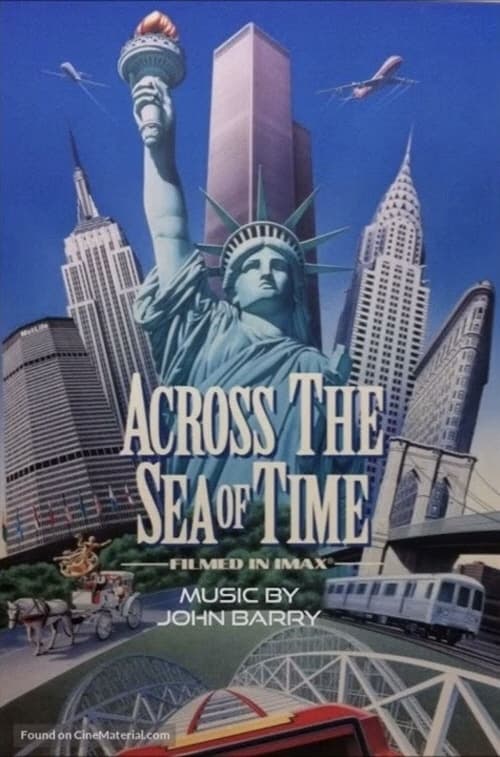
Thomas Minton's story begins on the dark water of the Atlantic, where an eleven-year-old Russian boy rides into New York aboard a Russian freighter in 1995, carrying almost nothing except a stereopticon, a handful of old 3D photographs, and family letters that have crossed the sea before him. He is not simply arriving in America; he is trying to recover the branch of his family that Leopold Minton left behind decades earlier, and the film immediately frames his journey as both an immigrant's crossing and a search through memory itself. Near Ellis Island, the symbolic threshold of American arrival, Thomas jumps ship or gets off the vessel and begins his search on foot, reproducing, in a modern key, the route of the earlier immigrants in his family line.
The first feeling of the film is one of suspension between centuries. Thomas stands at the edge of the harbor with the city ahead of him, the old photographs in his hands and the present-day skyline in his eyes, and the narrative's central device becomes clear: he compares New York as it is in 1995 with New York as Leopold Minton photographed it in 1916. The viewer and slides are not decorative props but the map he uses to navigate the city, and the film repeatedly returns to the idea that the past is still visible if one knows how to look. As he walks, a voice reads from Leopold's letters, so the dead ancestor becomes a constant companion, speaking across time while Thomas moves through the living city.
Thomas's search is lonely at first. He is a child in a huge city, and the film uses that loneliness to make every landmark feel larger than life and every street corner feel like a test. He scans buildings, storefronts, piers, and avenues, holding the 1916 images up against the 1995 streets, searching for anything recognizable in the modern skyline. The film's visual pleasure comes from this constant doubling: old New York and new New York, black-and-white stillness and color motion, memory and present tense sliding over one another.
As Thomas moves through Manhattan, the letters and photographs slowly reveal who Leopold Minton is. Leopold is not just a distant relative; he is the ancestor who emigrates to America almost a century earlier and finds work as a 3D photographer, sending home a viewer and a set of stereo slides that preserve his new life in New York. Those images show the city in 1916, and they function as proof that Thomas's family once had roots here, that the city he is crossing is already part of his inheritance. The emotional force of the story lies in the fact that Thomas is chasing a family he has never met by following fragments of a life that Leopold deliberately left behind for those still in Russia.
The journey is structured as a sequence of encounters with the city. Thomas wanders through Manhattan with the photographs, comparing each old image to whatever he can find in the present, and the film turns his search into a moving collage of New York landmarks. The sources explicitly note that he explores the city for two days and nights, which gives the story a compressed but vivid rhythm: arrival, wandering, uncertainty, discovery. He is not simply sightseeing. He is actively reading the city, hunting for the places where family history might still be accessible.
At one point, he passes Pete's Bar and peers in through the window, a quiet but memorable pause in the journey. Inside, a calico cat walks along the top of a piano and then hops onto a table, a small domestic image that briefly softens the city's scale and gives the scene a feeling of accidental guidance, as if even the cat belongs to the web of signs leading Thomas toward home. The moment is not an action beat in the usual sense, but it matters because it reminds the viewer that Thomas is constantly reading signs, looking for meaning in ordinary places, hoping the city will answer him if he looks long enough.
The search grows more precarious when Thomas is robbed in Central Park. The film's tone darkens here, because the park is one of the places where the city's beauty and danger sit side by side. Thomas has been moving through New York with almost no protection besides his documents and photographs, and the robbery shows how exposed he is as a child alone in a vast place. The sources do not identify the thief or describe any fatal injury, but the encounter is still one of the clearest conflicts in the film because it places Thomas's vulnerability directly against the city's anonymity. He loses the comfort of innocence there, yet the story does not stop moving; instead, the robbery sharpens his determination to keep going.
The narrative also sends Thomas through the waterfront and ferry routes, reinforcing the link between movement across water and movement through family history. He is repeatedly made to confront the city as an immigrant space, a place defined by arrivals, departures, and the burden of inheritance. Ellis Island remains the film's emotional anchor, because Thomas's modern crossing mirrors the old immigrant passage that Leopold once made, and the harbor scenes give the story its strongest sense of historical continuity. Even when he is far from the water, the film keeps returning to that first arrival, as if the sea itself is the invisible thread connecting past and present.
Another notable episode sends Thomas toward the Broadway theater district, where he sneaks backstage to glimpse the production "Crazy About You." The sources do not describe a major confrontation there, but the act of slipping into a backstage area suggests both curiosity and fear, a child's willingness to trespass in order to keep the search moving. The theater sequence adds a different kind of spectacle to the film: not the spectacle of the city as history, but the spectacle of live performance, another form of manufactured reality layered over the streets Thomas is crossing. In this sense, the scene fits the film's larger structure, which constantly alternates between what is publicly visible and what lies just behind the surface.
As Thomas keeps walking, the letters continue to speak, and Leopold's presence becomes more intimate. The family archive reveals not only that Leopold settled in America but that he built a life there, including a marriage to Julia. This is a major revelation because it transforms Leopold from a historical name into a flesh-and-blood person with a domestic future, a man who does not merely send souvenirs home but becomes part of American life in a lasting way. The fact that the letters mention Julia also confirms that the family line Thomas is chasing is not lost at all; it has continued, even if Thomas does not yet know where. The film does not frame this as a twist in the melodramatic sense, but it is a turning point in Thomas's emotional understanding: the ancestor he seeks is not a myth, and the American branch of the family is not an abstraction.
The crucial step toward resolution comes when Thomas's wandering finally leads him into contact with living kin. In the sources, a bartender directs Thomas to a house two blocks away, where he meets his relative's wife and is introduced to other family members. This is the moment when the search changes from archival reconstruction to actual reunion. The letters and photographs have been pointing him toward a living family all along, and now the abstract promise of belonging becomes real. The bartender's guidance functions almost like the city itself deciding to help him after testing his resolve, and the two-block distance gives the revelation a sudden, almost everyday intimacy: home has been nearby all along.
The sources do not describe a single dramatic standoff at the house, but the emotional outcome is unmistakable. Thomas finally enters the space where Leopold's descendants still live, and the family search that began on the freighter ends in human recognition rather than disappointment. He is no longer only a boy with a viewer and some old photographs; he is a relative being welcomed into a continuing family story. The film's entire structure has been working toward this contact, using the city as a maze of memory so that the final meeting feels earned.
There are no deaths reported in the available plot sources, and no source identifies any fatal confrontation or death caused by any character. The major conflict events are Thomas's exposure, the Central Park robbery, and the tension of navigating an unfamiliar city alone, but the narrative remains fundamentally restorative rather than tragic. That absence of death is itself meaningful: the film is about continuity, survival, and the transmission of memory, so its most important resolution is the rejoining of separated family lines.
By the end, the film has moved Thomas from the edge of Ellis Island to the threshold of family belonging. He arrives in New York as a child with a small archive of his past, follows the ghostly instructions of Leopold's letters and 1916 photographs through two days and nights of wandering, survives the city's hazards, and reaches the home of relatives who connect him to the American branch of the Minton family. The final emotional note is one of arrival after displacement: the old pictures have served their purpose, the ancestor's voice has led him here, and the city that first looked like a puzzle becomes a place of reunion.





What is the ending?
In the ending of "Across the Sea of Time," the protagonist, a young boy named Tommy, learns to appreciate the importance of family and the connections that transcend time. He ultimately finds a way to reconcile his feelings of loss and longing for his deceased father, leading to a sense of closure and understanding.
As the film approaches its conclusion, Tommy is transported back to the present day after his journey through time. He stands at the edge of the water, reflecting on his experiences and the lessons he has learned. The film closes with a sense of hope and renewal, emphasizing the enduring bonds of love and memory.
As the final scenes of "Across the Sea of Time" unfold, the atmosphere is charged with emotion. Tommy, having traveled through time to the early 20th century, stands on the shores of New York City, gazing out at the vast expanse of water. The sun begins to set, casting a golden hue over the skyline, symbolizing the transition from his past experiences back to his present life.
In this moment, Tommy reflects on his journey. He recalls the vivid encounters he had with his father, who passed away when he was very young. The memories of their time together, filled with laughter and love, flood his mind. He remembers the stories his father told him, the lessons he imparted, and the warmth of their bond. Each recollection brings a bittersweet smile to his face, as he realizes how deeply his father's spirit lives on within him.
As he stands there, the sound of the waves crashing against the shore echoes in the background, mirroring the tumult of emotions within him. Tommy feels a sense of peace wash over him, understanding that while his father is no longer physically present, their connection transcends time and space. He acknowledges the pain of loss but also embraces the joy of the memories they shared.
In the final moments, Tommy turns away from the water, a newfound determination in his heart. He walks back towards the city, ready to embrace his life with a renewed sense of purpose. The camera captures his silhouette against the vibrant sunset, symbolizing hope and the promise of new beginnings.
The film concludes with a poignant message about the enduring nature of love and the importance of cherishing the memories of those we have lost. Tommy's journey has taught him that while time may separate us from our loved ones, the bonds we share remain unbroken, guiding us through life's challenges.
As the credits roll, viewers are left with a sense of closure for Tommy, who has not only reconciled with his past but has also found a way to carry his father's legacy forward. The film leaves an impression of warmth and nostalgia, celebrating the connections that define our lives.
Is there a post-credit scene?
Across the Sea of Time, produced in 1995, does not have a post-credit scene. The film concludes its narrative without any additional scenes or content after the credits roll. The story wraps up with the emotional journey of the main character, a young boy named "Danny," who experiences a time-traveling adventure that connects him to his family's past and the historical significance of New York City. The film focuses on themes of nostalgia, family, and the passage of time, leaving the audience with a sense of closure as the credits begin to roll.
What is the significance of the time travel element in the story?
The time travel element in 'Across the Sea of Time' serves as a crucial narrative device that allows the protagonist, a young boy named 'Mickey', to explore his family's past and connect with his heritage. Through the use of a magical device, Mickey is transported back to 1895, where he witnesses the lives of his ancestors and the historical events that shaped their experiences. This journey not only provides a visual spectacle but also deepens Mickey's understanding of his identity and the importance of family history.
How does Mickey's character evolve throughout the film?
Mickey begins as a curious and somewhat naive boy, eager to learn about his family's past. As he travels back in time, he encounters various challenges and learns about the struggles and triumphs of his ancestors. This journey forces him to confront his own fears and insecurities, ultimately leading to a more mature understanding of responsibility and the value of his heritage. By the end of the film, Mickey emerges as a more confident and self-aware individual, having gained a profound appreciation for his family's legacy.
What role does the character of the old man play in Mickey's journey?
The old man serves as a mentor figure for Mickey, guiding him through his time-traveling experiences. He provides wisdom and insight into the historical context of the events Mickey witnesses, helping him to understand the significance of his family's past. The old man's presence is both comforting and challenging, as he encourages Mickey to confront difficult truths about his ancestors while also instilling a sense of hope and resilience. This relationship is pivotal in Mickey's growth and understanding of his own identity.
What are some key historical events that Mickey witnesses during his time travel?
During his time travel, Mickey witnesses several key historical events that are significant to his family's history. He sees the struggles of immigrants arriving in America, the challenges they face in adapting to a new life, and the cultural richness they bring with them. Specific scenes depict the hardships of the past, such as labor struggles and the pursuit of the American Dream, which resonate deeply with Mickey as he learns about the sacrifices made by his ancestors for a better future.
How does the film visually represent the contrast between the past and the present?
The film employs vivid cinematography and special effects to create a stark contrast between the vibrant, bustling life of 1895 and the modern world Mickey comes from. The use of color, lighting, and set design highlights the differences in technology, fashion, and social dynamics. Scenes depicting the past are often rich in detail, showcasing the beauty of historical architecture and the simplicity of life, while the present is portrayed with a more sterile, fast-paced environment. This visual dichotomy enhances the emotional weight of Mickey's journey as he navigates between two worlds.
Is this family friendly?
"Across the Sea of Time," produced in 1995, is generally considered family-friendly, but there are a few elements that might be potentially objectionable or upsetting for children or sensitive viewers.
-
Themes of Loss and Longing: The film explores deep emotional themes, including the longing for connection and the pain of separation, which may resonate strongly with some viewers, particularly children who may not fully understand these concepts.
-
Historical Context: The film includes scenes that depict historical events and the impact of time on relationships, which might be confusing or distressing for younger audiences.
-
Emotional Turmoil: Characters experience moments of sadness and introspection, which could evoke feelings of empathy or discomfort in sensitive viewers.
-
Visual Imagery: The film features scenes that may be visually intense or evoke a sense of nostalgia and melancholy, which could be overwhelming for some children.
Overall, while the film is suitable for family viewing, parents may want to prepare younger viewers for its emotional depth and historical themes.





