

























Popular
What is the significance of the character Luigi Mackeroni in the story?
How does the killer condom come to life in the film?
What role does the character of the mad scientist play in the plot?
How does the film portray the relationship between Luigi and his love interest?
What are some of the key comedic elements used in the film?
Should I watch it?
Ask Your Own Question

What is the plot?
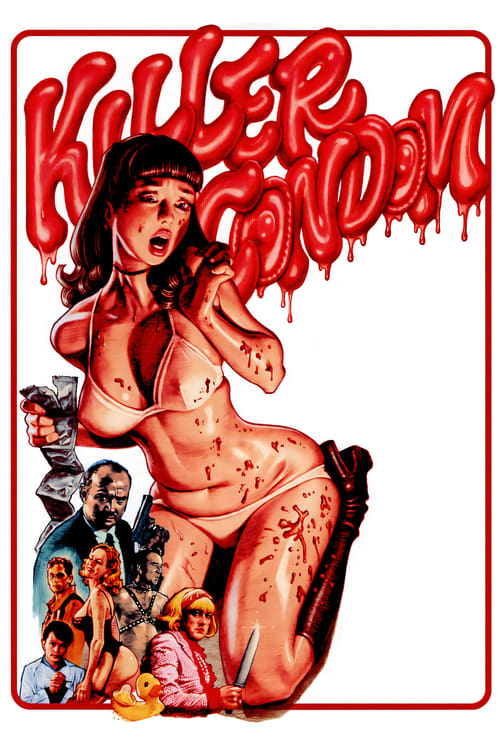
In present-day New York City, the story opens at the seedy Hotel Quickie, where something grotesque and absurd is already underway: a series of men have been found with their genitals mutilated in ways no one can quite explain. At first, the police treat the incidents as sordid but ordinary sex-crime fallout, something they can pin on angry women, blackmail, or the victims' own shameful behavior. But the first case is more specific and more damning. A sleazy professor blackmails a reluctant student into sex in one of the hotel rooms, and when he reaches for a free condom, the thing comes alive and bites off his penis before vanishing into the room's walls.
The case falls to Luigi Mackeroni, a hard-boiled gay NYPD detective who moves through the city's seedy underworld with a cigarette in hand and an eye always on the next clue. Luigi is introduced as a world-weary, Italian-descended cop with a noir attitude and a personal familiarity with the Hotel Quickie and the surrounding gay club and bar scene. He initially approaches the mutilations with professional skepticism, but his instinct tells him something is wrong with the official story. When he goes to the Hotel Quickie himself, he begins piecing together the pattern of the attacks, and in the lobby he meets Billy, a young gigolo or rent boy who is working the hotel. Billy is bright, flirtatious, and immediately draws Luigi's attention. The encounter is both investigative and erotic: Luigi asks Billy to come with him to the room where the first attack occurred, and the chemistry between them is unmistakable.
Inside the crime scene, the movie tips from sleazy police procedural into full-body grotesque comedy. Luigi and Billy start to hook up, but before the tryst can really begin, a killer condom springs to life and attacks them. The creature is not simply rubber gone rogue; it is a living, toothy predator with a hunger for male flesh. In the first close encounter, the condom bites off Luigi's right testicle, or in some descriptions his left, but the clear point is that Luigi is castrated in the attack and left furious, humiliated, and personally invested in stopping the thing. The police do not believe his version of events. His superiors think Billy attacked him or that Luigi is spiraling into obsession. That disbelief matters, because from this point on Luigi is no longer just investigating a crime; he is chasing the thing that maimed him, and his search becomes a vendetta.
The film then broadens its scope as more and more men are attacked across New York City. The victims include sex workers, clients, and other men moving through the city's nightlife, especially around sleazy hotels, flophouses, and bars. The attacks are described as a wave of bizarre castrations, with cheap condoms turning into bloodthirsty traps and disappearing after each assault. One of the first victims is the professor at the Hotel Quickie, but the violence quickly spreads well beyond that room. The police keep trying to fit the cases into a conventional frame, but the body count and the missing penises make that impossible. Luigi, increasingly isolated, keeps working the case while also dealing with his own physical and emotional injury. His pursuit of the monster is inseparable from his attraction to Billy, and the film keeps folding the investigation back into Luigi's desire and shame.
As Luigi stalks the city's gay club and bar scene looking for clues, he continues to encounter Billy, and their bond deepens even as the danger escalates. Their relationship is not simply a side plot; it becomes one of the film's emotional anchors. Luigi is a grizzled cop, Billy a young hustler, and the mismatch between them makes their connection feel reckless and charged. The film also introduces other oddball allies and recurring figures, including Bob, later Babette, an ex-cop who now performs in hotel drag shows and helps Luigi navigate parts of the investigation. Around him, New York becomes a carnival of vice and panic, with every shadowed hallway and grimy room potentially hiding another creature. The killer condoms are not limited to the hotel, and the violence starts cropping up in other parts of the city.
One especially revealing sequence involves a street hustler who returns home after a failed encounter, only to be attacked in his own apartment when something emerges from the toilet. That scene widens the story's sense of invasion: the horror is no longer confined to the hotel or to sex work; it can come through any household plumbing, any hidden opening, any private space that has been contaminated by the conspiracy. The film also includes an attack on Republican presidential candidate Dick McGouvern during a romantic bath with his mistress, which becomes one of the events that finally convinces others that Luigi's absurd-sounding claims may actually be true. The tonal joke lands hard because the creature is shown to be indiscriminate in its targets, even as the larger conspiracy is aimed at punishing people deemed sexually "impure."
Luigi's investigation keeps circling back to the hotel and the hotel's free condoms, which are initially treated like a joke and then like evidence. He realizes the attacks are not random and are too coordinated to be the work of an angry lover or a single human killer. The condoms are identical in their method: they spring, bite, tear, and flee. Behind the comedy, the film steadily builds a conspiracy shape. Luigi learns that the victims are not chosen by accident but are being targeted because of their sexuality, their work, or their connection to New York's "deviant" nightlife. The film's deeper antagonist is revealed as an intensely religious, conservative female doctor or mastermind who believes she is doing God's work by eliminating gay men, sex workers, transvestites, and other people she sees as sinful. The plot is not just about monsters; it is about ideological violence made literal through biotech horror.
The trail eventually leads Luigi beneath the city, into the sewer system, where the movie reveals its hidden laboratory. This is the central twist of the story: the killer condoms are not supernatural at all, but manufactured creatures, engineered and bred in secret. The lab is grimy, claustrophobic, and filled with the machinery of perverse science, a place where the city's filth and the conspiracy's hatred merge into one obscene underground workspace. There Luigi discovers that Prof. Smirnoff has been kidnapped, drugged, and held captive there so he can be forced to help create the monsters. The revelation transforms the professor from one of the earliest perpetrators of a sex-crime into another victim of the wider plot, showing that the conspiracy is bigger than any one corrupt man's hypocrisy. He is now a coerced tool in a system designed to militarize moral disgust.
The hidden lab makes the whole case click into place. The attacks are part of a coordinated program, and the condoms are functioning as biological weapons in a punishment campaign. The film makes clear that the conspiracy uses fear, secrecy, and engineered creatures instead of public declarations. The whole operation has been hidden inside the city's underbelly, out of sight until Luigi follows the violence far enough down. By this point, his pursuit is no longer only about revenge for his mutilation. It becomes a defense of the people the conspiracy wants to erase, even if Luigi himself starts out more motivated by personal humiliation than by solidarity. That shift matters because it turns his storyline into a rescue mission as much as a hunt.
The final stretch of the film pushes toward open confrontation. Luigi now knows the condoms can be destroyed by ordinary means, including gunfire, and the creatures are not invincible despite their shock value. He uses practical force against them rather than any elaborate scientific antidote, which keeps the climax in line with the film's pulpy, low-budget energy. In one of the decisive moments of the ending, Luigi destroys a killer condom by using the gas line from his stove, causing an explosion that blows the creature apart. The sequence is absurd and tense at once: the apartment space becomes a trap, the gas hisses, and then the blast turns the monster's body into the final proof that brute, improvised resistance can beat engineered horror.
As Luigi closes in on the people behind the outbreak, the movie keeps the emotional thread alive through Billy. What began as a lustful, almost throwaway encounter becomes the relationship that humanizes Luigi and gives his investigation a heart. He has been chasing the killer condoms, but he has also been confronting his own feelings for Billy the entire time. The narrative never treats that as a separate issue. Luigi's wounded masculinity, his attraction, his anger, and his protectiveness all converge. By the end, he is no longer just a detective solving an outlandish case; he is a man forced to accept what and whom he wants.
The conspiracy's collapse comes with the exposure of the lab, the defeat of the creatures, and the undoing of the people who tried to weaponize morality against the city's outsiders. The major revelation is not only that the condoms are manufactured, but that the whole outbreak is part of a deliberate program of anti-sex, anti-gay punishment disguised as urban horror. Luigi's discoveries destroy the illusion that this is a case of random urban degeneracy. It is organized hatred, and the film makes that plain by the time the lab is breached and the source of the monsters is found. Prof. Smirnoff's captivity underlines the conspiracy's cruelty, showing how scientific expertise is twisted into complicit labor through drugs and coercion.
By the ending, Luigi has stopped the immediate threat, the city is spared further attacks, and the monster program is broken. The final emotional resolution is that Luigi and Billy are no longer just a detective and a hustler who briefly hook up in a crime scene. Luigi comes to love Billy, and the film closes on that romantic note after the horror has been contained. The story ends with both the conspiracy and Luigi's emotional denial being defeated at roughly the same time: the city is safe, the condoms are no longer free to roam, and Luigi's private desire is finally brought into the open.


What is the ending?
In the ending of "The Killer Condom," the main character, a detective named Luigi Mackeroni, confronts the source of the killer condoms. After a series of chaotic events, he manages to defeat the monstrous condom and save his love interest, the transsexual sex worker, who had been targeted. The film concludes with Luigi and his love interest embracing, having survived the bizarre ordeal.
Now, let's delve into the ending in a more detailed narrative fashion:
As the climax of the film unfolds, Luigi Mackeroni, the weary yet determined detective, finds himself in a dimly lit, abandoned warehouse. The atmosphere is thick with tension, the air heavy with the scent of fear and desperation. The walls are lined with remnants of the chaos that has ensued throughout the city, where killer condoms have wreaked havoc on unsuspecting victims. Luigi's heart races as he recalls the gruesome tales of those who have fallen prey to these monstrous contraceptives.
In a moment of clarity, Luigi realizes that the source of the killer condoms lies within the lair of the villain, a deranged scientist named Dr. Schmidlapp. The detective steels himself, gripping his gun tightly, as he pushes through the creaking door. Inside, he is met with a grotesque sight: the walls are adorned with various sizes of condoms, each pulsating ominously, a testament to the madness that has unfolded.
Dr. Schmidlapp, with a manic glint in his eye, reveals his twisted plan to create the ultimate contraceptive that has turned deadly. He taunts Luigi, boasting about the power he wields over life and death. Luigi, fueled by a mix of anger and determination, confronts the scientist, demanding an end to the terror that has plagued the city.
As the confrontation escalates, the killer condom, a monstrous entity with a life of its own, emerges from the shadows. It lunges at Luigi, who narrowly dodges its attack. The scene is chaotic, filled with frantic movements and the sound of the condom's sinister squelching. Luigi's resolve strengthens as he recalls the victims, the pain they endured, and the love he has for his partner, the transsexual sex worker, who has been caught in the crossfire of this bizarre conflict.
In a climactic struggle, Luigi manages to outsmart the killer condom, using his wits and resourcefulness. He finds a way to trap it, utilizing the very tools that Dr. Schmidlapp had created. With a final push, he defeats the creature, watching as it deflates and crumples to the ground, lifeless. The warehouse falls silent, the tension dissipating as Luigi catches his breath, the weight of the ordeal lifting from his shoulders.
In the aftermath, Luigi rushes to find his love interest, who had been captured during the chaos. He finds her in a nearby room, shaken but unharmed. Their reunion is filled with relief and gratitude, as they embrace tightly, the bond between them stronger than ever. The horrors they faced have only deepened their connection, and they share a moment of vulnerability, acknowledging the fear they both felt.
As the film draws to a close, Luigi and his partner step out into the light of day, the sun shining brightly, symbolizing hope and a new beginning. They walk hand in hand, ready to face whatever challenges may come their way, having triumphed over the absurdity and terror of the killer condoms. The final scene captures their silhouettes against the backdrop of the city, a testament to their resilience and love amidst the chaos.
In this ending, Luigi Mackeroni emerges as a hero, having confronted not only the external threat of the killer condoms but also the internal struggles of love and acceptance. His partner, having faced danger and discrimination, stands by his side, embodying strength and courage. Together, they symbolize the triumph of love over fear, a poignant message that resonates throughout the film.
Is there a post-credit scene?
The movie "The Killer Condom," produced in 1996, does not have a post-credit scene. The film concludes its narrative without any additional scenes or content after the credits roll. The story wraps up with the resolution of the main plot, focusing on the bizarre and darkly comedic events surrounding the killer condom and the characters involved. The absence of a post-credit scene aligns with the film's overall tone and style, leaving the audience with the finality of the story as it stands.
What is the significance of the character Luigi Mackeroni in the story?
Luigi Mackeroni is a private detective who becomes the central figure in the investigation of the killer condom. His character is portrayed as a tough yet vulnerable man, grappling with his own insecurities and desires. As he delves deeper into the mystery, his motivations shift from mere curiosity to a personal quest for justice, especially as he becomes emotionally involved with his love interest, the transvestite sex worker, who is also affected by the condom's deadly nature.
How does the killer condom come to life in the film?
The killer condom is a result of a bizarre and comedic twist involving a mad scientist who has been experimenting with a new type of condom that is supposed to enhance pleasure. However, the experiment goes horribly wrong, leading to the creation of a sentient condom that attacks and kills its users. This absurd premise sets the stage for the film's dark humor and satirical take on sexual health.
What role does the character of the mad scientist play in the plot?
The mad scientist, Dr. W. H. O. (a play on words for 'who'), is a pivotal character who embodies the film's satirical critique of scientific experimentation gone awry. His obsession with creating the ultimate condom leads to the chaos that ensues. As the detective investigates, Dr. W. H. O. becomes a target of suspicion, and his motivations are revealed to be both comical and sinister, adding layers to the narrative.
How does the film portray the relationship between Luigi and his love interest?
Luigi's relationship with his love interest, a transvestite named 'Bimbo,' is complex and evolves throughout the film. Initially, Luigi is hesitant and struggles with societal norms and his own prejudices. However, as they face the threat of the killer condom together, their bond deepens. The film explores themes of acceptance and love beyond conventional boundaries, showcasing Luigi's emotional growth as he learns to embrace his feelings for Bimbo.
What are some of the key comedic elements used in the film?
The Killer Condom employs a variety of comedic elements, including absurd situations, dark humor, and visual gags. The very concept of a killer condom is inherently ridiculous, leading to over-the-top reactions from characters. The film also uses witty dialogue and satirical commentary on sexual health and relationships, often juxtaposing serious themes with ludicrous scenarios, such as the exaggerated fear and paranoia surrounding the condom's attacks.
Is this family friendly?
"The Killer Condom," produced in 1996, is not considered family-friendly. The film contains several potentially objectionable or upsetting aspects, including:
-
Graphic Violence: There are scenes depicting violent encounters, including the condom attacking individuals, which can be unsettling.
-
Sexual Content: The film features explicit sexual themes and innuendos, which may not be suitable for children.
-
Dark Humor: The film employs a blend of horror and comedy that may be inappropriate for younger audiences, as it often tackles taboo subjects in a provocative manner.
-
Adult Language: There is frequent use of strong language throughout the film, which may be offensive to some viewers.
-
Themes of Fear and Paranoia: The overarching theme of a killer condom creates a sense of fear and anxiety that may be distressing for sensitive viewers.
Overall, the film's combination of horror, sexual themes, and dark humor makes it more appropriate for an adult audience.







